LinkedIn

One offer, one page, two weeks, no extra ad spend. I’ll pick the PPC-and-SEO stack that can trace a converting search to a gap on my site, publish one approved answer, and leave me enough evidence to judge it later. I don’t care how many integrations or built-in skills the other stack has.
I used to run this sort of test the slow way: export search terms at midnight, argue about which ones showed real demand, write the page, then discover nobody had recorded the baseline. Two weeks feels short until I list what I’m not doing. I’m not rebuilding the ad account, rebranding the offer, or proving SEO works. I’m testing whether paid search can point me to one buyer question my site should answer better. If the chain breaks, I stop and write down where.
1. Day 1: Set the scope and name who can approve the page
Before I open a connector, I put the test on one line: “For [one offer], does [specific buyer] ask [one question] before buying, and what paid-search evidence do I have?” The question is provisional. The offer and the page limit aren’t.
In the same document, I name the person who can approve the page change and the person who owns the baseline. Neither is “the team” when the deadline arrives. Then I list what I already have: up to 12 months of search terms with spend, clicks and conversions, the landing pages those terms hit, and the definition of a conversion. If the account counts form fills and I have no sales feedback, I write that down now. Form fills can help me find a question worth answering. They can’t prove pipeline.
I also write down what day 14 means. It’s the deadline to publish and verify the approved answer, not a deadline for Google to index it, rank it and send qualified traffic. The record should let me make a decision in 30 or 60 days without having to reconstruct what happened from a screenshot and somebody’s memory.
Cost: The first part of day 1. No new ad spend, account or content strategy. What it buys: One test with named owners and a finish line I can actually reach. I cut the keyword cluster now: 40 terms are a content calendar in disguise.
2. Day 1: Make Claude map the chain before I pick the connectors
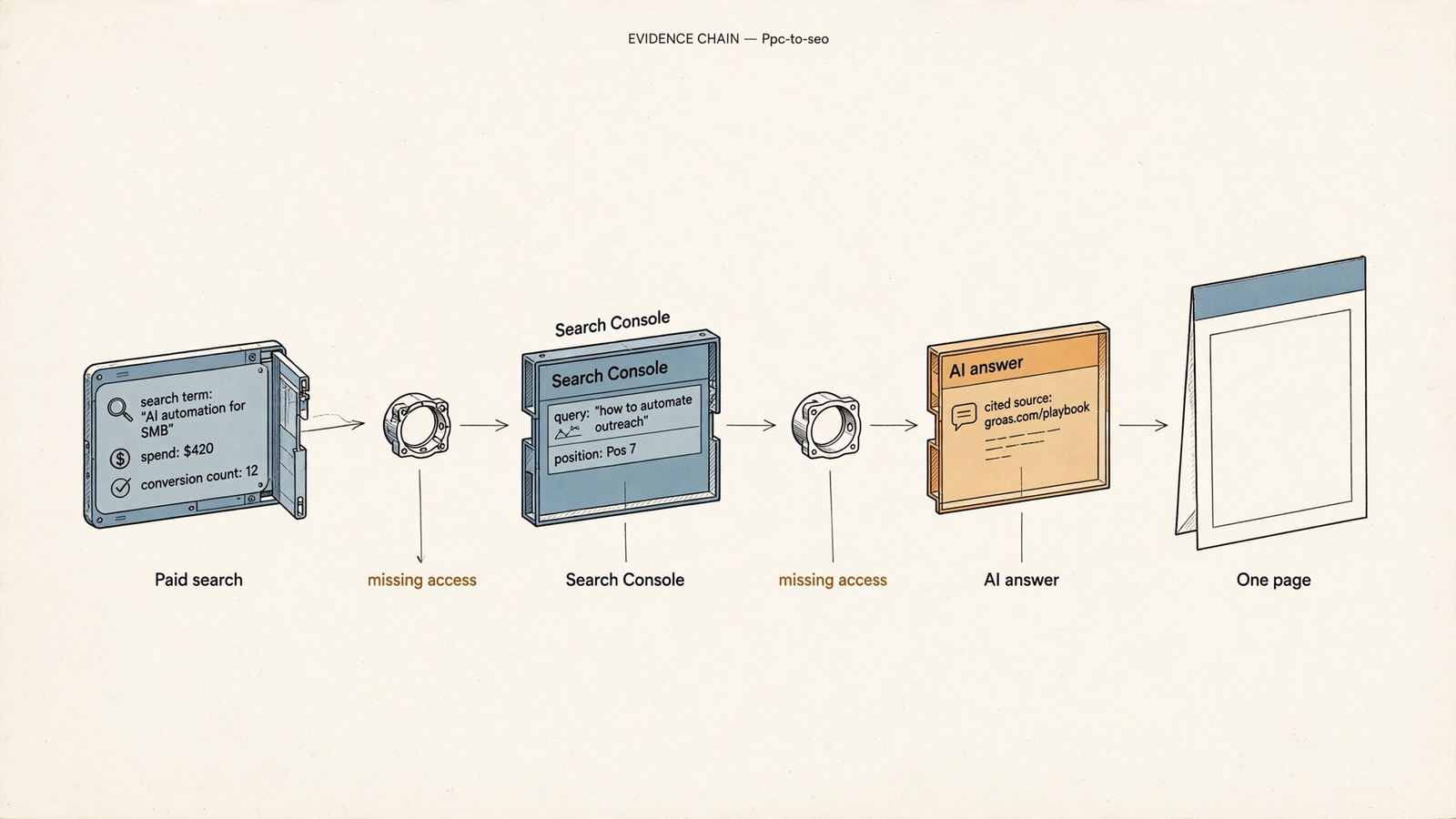
I open Claude and ask it to plan, not act: “List the data and actions this test needs. Name the source for each, distinguish available access from missing access, and don’t change anything.” I want six things listed separately: paid-search reads, Search Console reads, AI-answer samples, a draft, a publication action and a baseline record. If Claude puts half of them under “SEO data,” I ask it to split them out. A tidy plan is not proof of access.
Surfer’s MCP release makes the distinction useful. It brings live Surfer and Search Console data into assistants such as Claude, adds AI-visibility data, and includes six skills for content work. That covers a good part of the middle of this test. Its product notes don’t list paid-search reads, which is where I need to start. Counting the skills doesn’t fix the missing link.
I check paid-account reads and publication separately. The Google Ads MCP docs distinguish between reading data with GAQL and changing campaigns, budgets or bids. For this test I need the former, not the latter, and neither tells me whether Claude can publish to the site. I use groas to connect the accounts, site and evidence so I can run the chain in one place and keep a log of the live change instead of stitching together connectors and hoping I haven’t missed a handoff.
Cost: The rest of day 1 to map and check access, with no live changes. What it buys: A workflow I can run, or a named reason to stop. I cut connector shopping by tool count. The only tools that count are the ones that close a link in this chain.
3. Days 2–3: Find one buyer question the paid evidence supports
My next request to Claude is narrower: “For this offer, group the available search terms by buyer question. Show the terms, spend, clicks, reported conversions, date range, landing page and evidence limits.” I want the table, not a paragraph telling me what to think. “How much does it cost?”, “How long does it take?” and “Is it safe for X?” are different questions even when they share most of their words.
The table is where the attractive rows start to look less attractive. A term with $900 of spend and two conversions is a lead worth checking, not a verdict. A row with $60 of spend and nine conversions looks better until I notice the 30-day conversion lag and check which dates I’m comparing. And the table isn’t the whole search market: Google Ads withholds some low-activity terms and Search Console anonymises rare queries, so neither gives me a complete view of the long tail.
If I have pipeline or revenue tied to the terms, I use it to rank candidates and treat raw conversions as a secondary check. If all I have is form fills, I label the column reported conversions only. Then I reject a candidate for any of three reasons:
- The conversion window is incomplete. The recent rows haven’t had time to tell me what older rows can.
- The ad carried a promise the page won’t carry. A promotion, price or guarantee can be the reason someone acted. I don’t get to attribute that response to a question alone.
- The landing page answered a different question. The term may have converted, but the conversion doesn’t tell me the buyer wanted the answer I’m about to write.
The HVAC example makes the gap concrete: “Why is my AC running but not cooling?” can convert in Ads while the site still offers no concrete answer. If an accurate claim that belongs on the page currently lives only in the ad, I need to put it in plain text on the page. If I can’t substantiate it there, I drop the candidate.
Cost: Days 2–3 and a read of existing paid data. No campaign changes. What it buys: One buyer question I can defend without claiming every form fill became a sale. If none survives, I stop on day 3 instead of manufacturing a brief for day 6.
4. Days 4–5: Confirm the organic gap and capture the baseline
I ask Claude: “Show the relevant Search Console queries, the existing pages that could answer this question, and tracked AI answers for related prompts. Keep query, page and prompt separate, with dates.” Search Console gives me impressions and clicks in Google Search. It doesn’t tell me whether an assistant recommended the site. For that I keep a separate sample with the prompt, model, date and raw response.
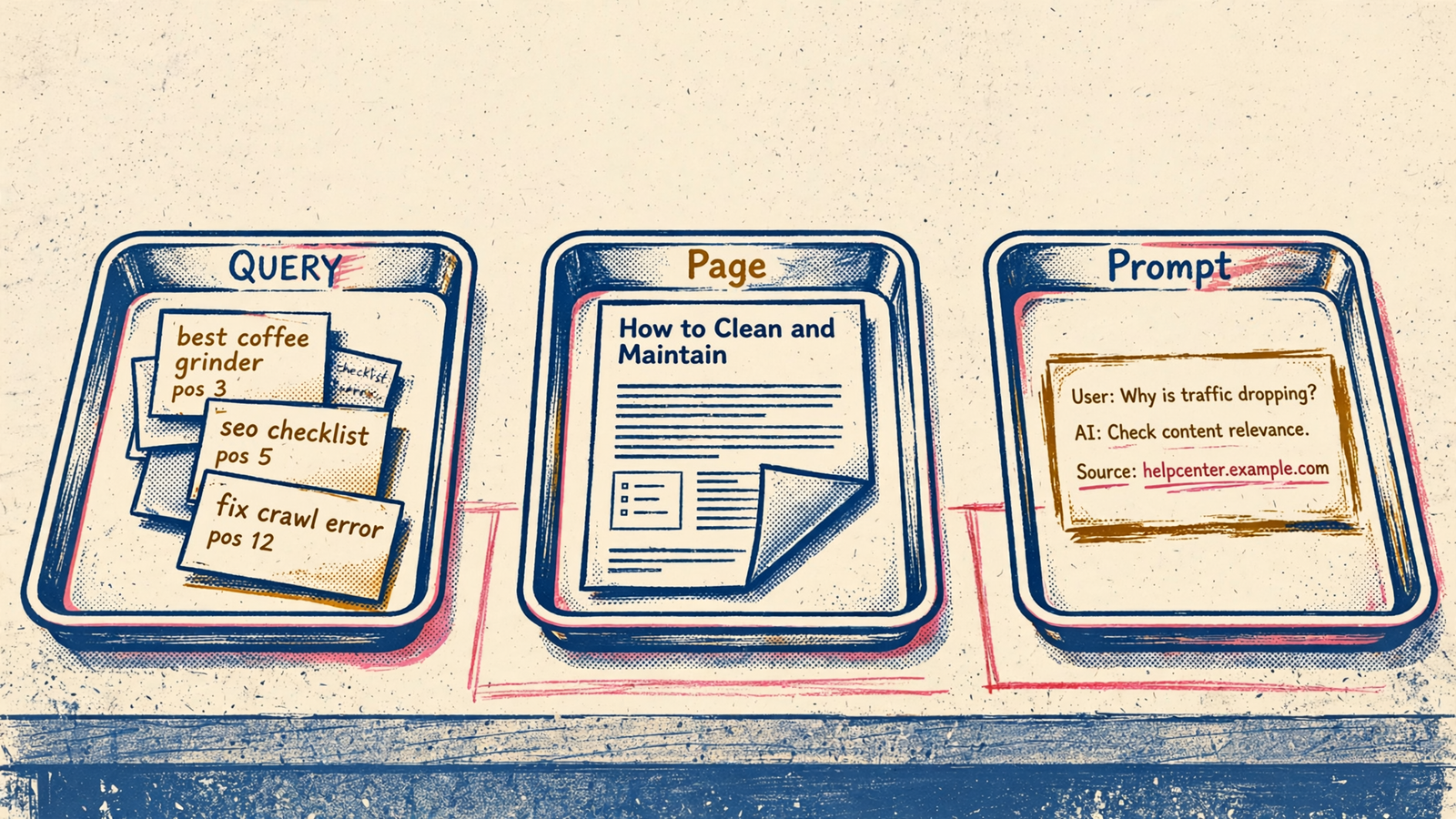
A query is a string someone searched. A page is a URL I can change. A prompt is what I asked a model on a particular date. I can compare the three without pretending they make one funnel. If clicks fell the week an AI Overview appeared, I line up the dates and check the units before I even call it a lead. I don’t call it a cause.
I look for one objection with paid evidence behind it that the site doesn’t answer well and that the tracked AI answers leave open. Then I check my own site and look in Search Console for URLs already ranking, including pages in positions two to six. I use a three-way decision before drafting: create, improve existing or reject. If a URL already owns the intent but answers the question badly, that’s the page I improve. If two URLs split the intent, I note it and don’t add a third. A coverage gap is a missing answer, not necessarily a missing URL.
Before anything goes live, I save three baseline lines:
- Search Console clicks and impressions for the target query and, where there’s an existing page, the URL, with the date range.
- Position for the target query, kept separate from clicks. If I don’t have a reading, I mark it missing rather than treating it as zero.
- The dated AI-answer sample, with the prompt, model and raw response preserved.
Cost: Days 4–5 to check what the site already covers and save the pre-change record. What it buys: One defensible gap, one page decision and a baseline I won’t have to recreate. I cut the combined dashboard. Three readable lines do the job.
5. Days 6–10: Draft, approve and publish one answer
I give Claude the evidence and fence in the claims: “Draft an answer using only these verified offer facts. Mark unsupported claims and proposed site changes for review.” Then I read it like a sceptical client. Every price, guarantee, timeframe and safety claim needs support I can point to. If it doesn’t have any, I cut it. “Typically” is not a source.
The ad can make a promise in one line. The page has to spell out the answer in language a reader can use and an assistant can quote. I used to tell clients a good ad could paper over a thin page. I was wrong. A line that earns a click doesn’t do the work of the answer someone came to read.
My rule is simple: Approve the exact draft, then publish only what was approved. The approval owner signs off on the wording, not the idea. With groas connected to the site, the change is logged with its reason and can be undone in one step. I keep the approval with the change record: “Published approved answer to [question], based on paid evidence dated [range].” A screenshot shows what the page looked like. The receipt tells me why I changed it.
That’s also the practical difference between a Claude Skill and the groas MCP here. A skill can encode drafting and review instructions. I use groas for the account and site access and the logged change. I keep the human approval between the draft and publication either way. A change log isn’t a sign-off.
Cost: Days 6–10, one approval and one page. What it buys: A live answer I can tie back to the paid evidence and identify at review. I cut the site-wide rewrite, template overhaul, schema package and internal-linking sweep. Each gives the result another possible explanation. If the chosen page needs a technical fix just to be readable, I record that fix separately from the answer.
6. Days 11–14: Verify the change and set the review rule
I open the live URL as a stranger would. I check that it loads and is indexable, compare the published answer with the approved draft, and confirm the internal links and canonical point where they should. Then I put the URL and change record next to the baseline from days 4–5. I don’t overwrite the before numbers with whatever the tools show on day 14.
I keep clicks and impressions separate for a reason. In one practitioner example, a page went from zero to 8,800 impressions in 20 days, with 16 clicks and an average position of 13.4. The impression count says the page started showing up. The click count says few people clicked. Neither says what those people did after they landed.
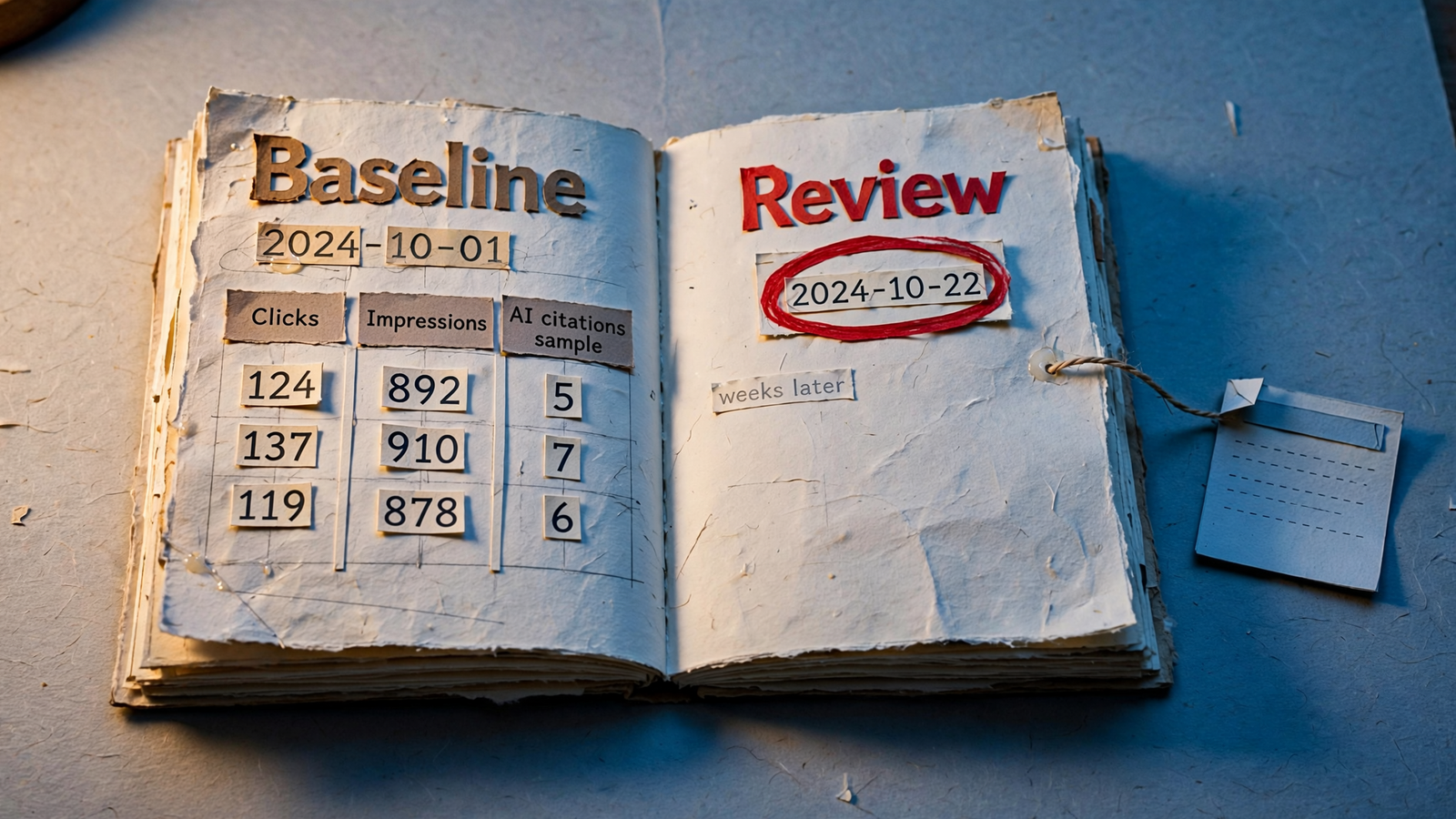
I schedule the review for 30 or 60 days and write the decision rule while I’m still unimpressed by my own page:
- Continue if the target query reaches the position and click range I named in advance.
- Revise if impressions arrive without clicks, or if repeat AI samples still leave the objection unanswered. I use each observation to revisit its own part of the test.
- Stop if another page already owns the query or the paid evidence turns out to be weaker than it looked.
One new citation in one answer doesn’t trigger any of those on its own. It’s one run of a model whose answers vary. Connecting an MCP doesn’t create missing history or start a fresh scan for me, either.
Cost: Days 11–14 to verify and file the change, not to make another one. What it buys: A review I can run without guessing what was live, what I measured or what I meant by progress.
When the constraint lifts, I widen the test in order: a second buyer question from the same paid evidence, then a second page, then a reviewed cluster. Each gets its own baseline before the next change goes live. That’s the pattern behind six Claude requests that end in an approved change. I run it through groas so the next change has a reason and a record, just like the first. What I’m scaling isn’t the connector stack. It’s the chain I can show: what buyers asked before converting, what the site failed to answer, what I published and what the record tells me to do next.