
YouTube Ads Won’t Get Fewer: Six Calls to Check by 2027
October 1, 2026
•
11
min read


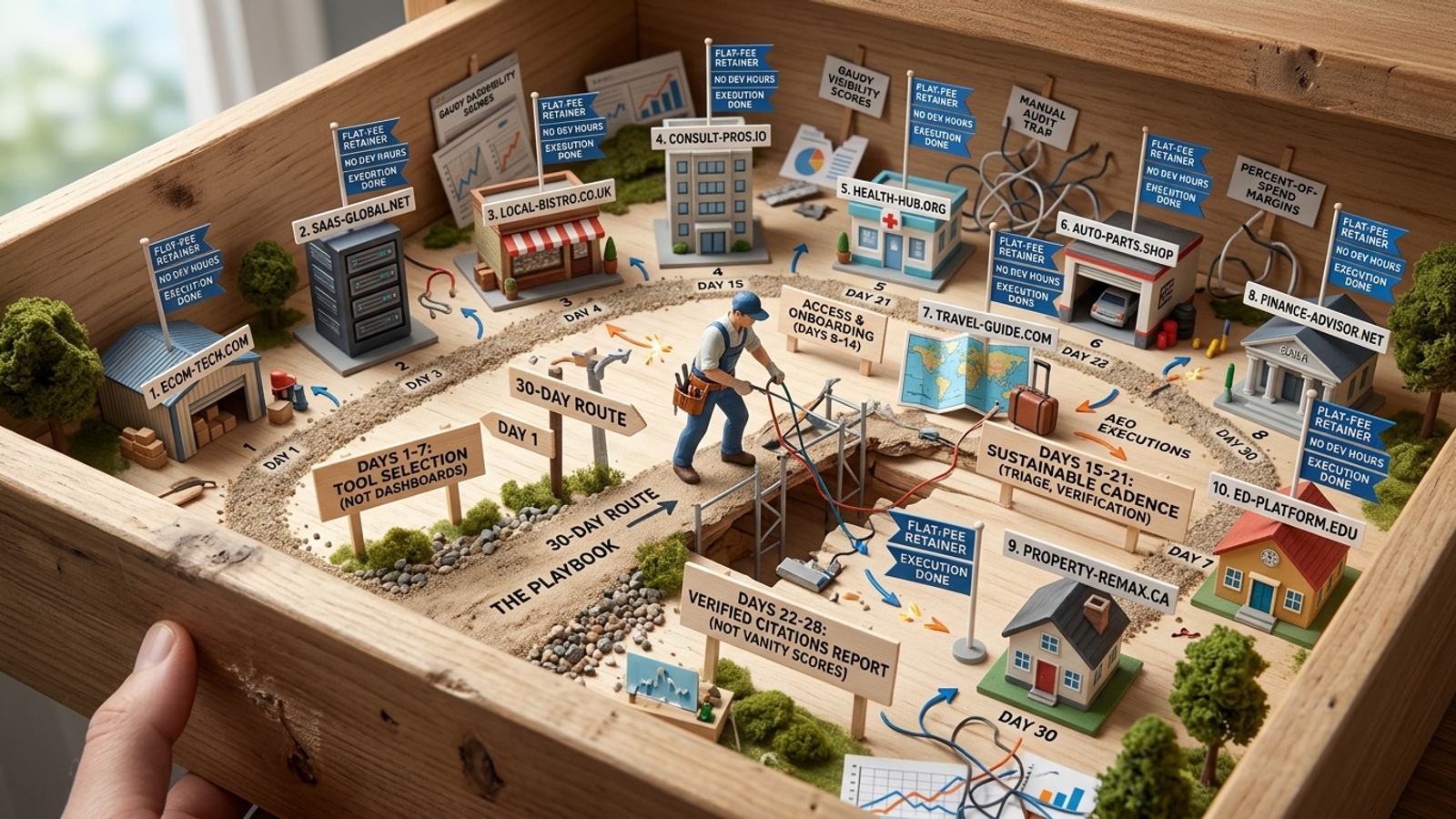
One operator, ten client domains, 30 days, and zero developer hours: that is the constraint. If the AEO retainer needs a second hire, a client developer, or someone spending Friday afternoon copying AI answers into slides, it fails.
I can see agencies pricing Answer Engine Optimization the way they priced PPC in 2015: hours for manual audits or a percentage of something nobody can define cleanly. Meanwhile, the client wants to know why a competitor appears in ChatGPT, Perplexity, or Google AI Overviews and they do not. Interest in AI search tracking is rising, but a tracking chart is not the service. Execution is.
Sell a flat fee per domain for work that gets done. Cut the custom decks, manual response screenshots, and developer tickets that wait in a backlog. Keep client strategy, approvals, and accountability with the operator. The software choice comes down to three requirements: it executes, it does not cap the prompts you need, and it charges predictably per domain.
In Week 1, use the operator’s 40-hour ceiling to select and test that delivery system before promising ten clients a cadence. Agency AEO tools ranked by the work they deliver expose the trap: many are good at showing a missing mention and bad at fixing the reason for it. A notification that creates a research ticket is not automation.
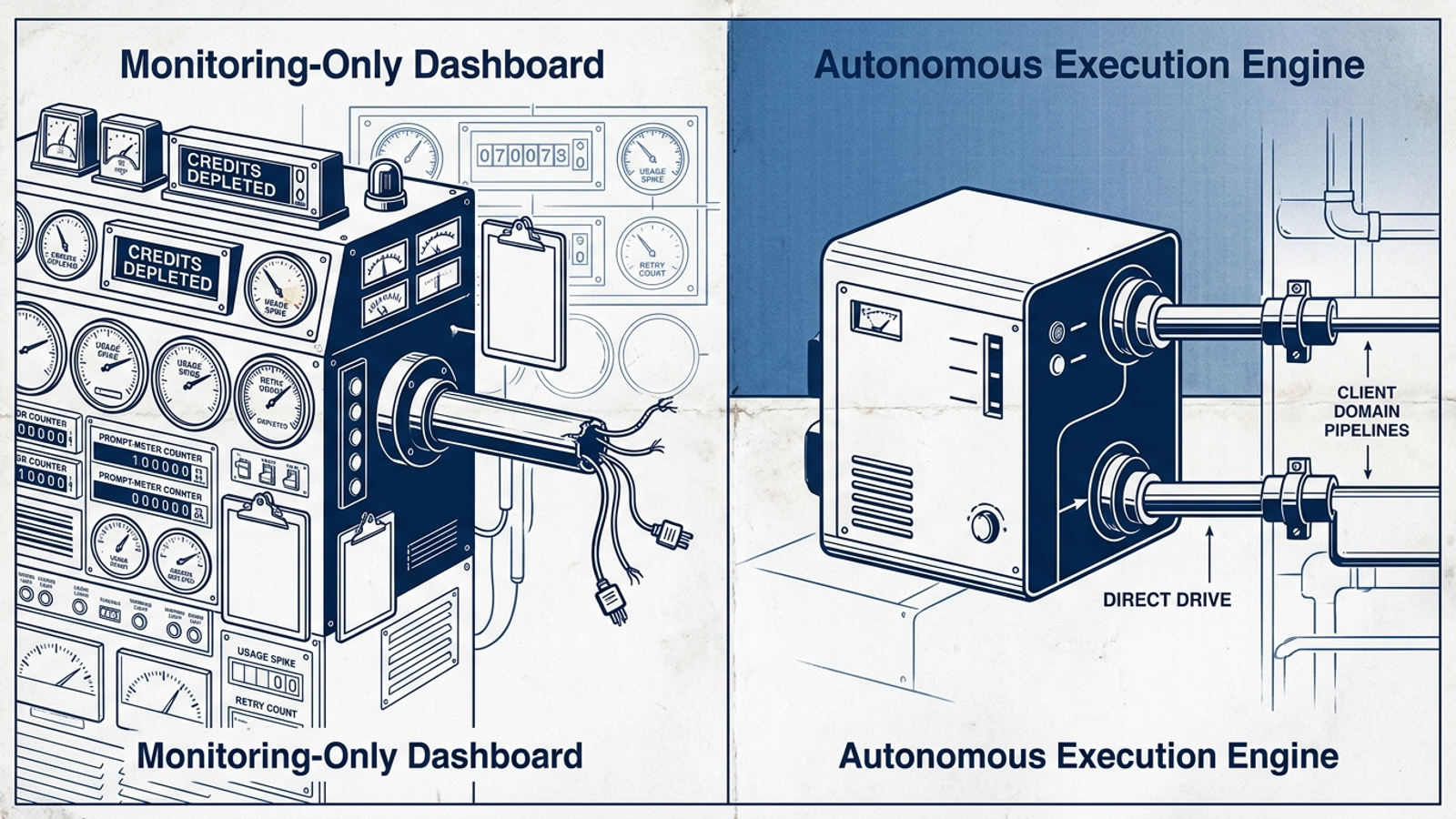
Reject a vendor if it fails any of these tests:
The flat-rate AEO pricing breakdown goes deeper on prompt caps and domain costs. For this playbook, the decision is simpler: groas offers continuous paid and organic search execution for a flat monthly fee, without percentage-of-spend markups or setup fees. Get the applicable domain price in writing before you set your retainer. Flat-fee architecture makes the model possible; it does not make an unpublished software bill disappear.
Week 2 costs the operator up to 20 hours of one-off setup at the draft’s two-hour-per-client allowance. It buys a repeatable intake instead of ten separate email sagas about CMS permissions. Keep the other 20 hours of the week available for access problems, client decisions, and any onboarding work that does not fit neatly into a form.
Ask for CMS and analytics access together. Confirm who can approve publishing and whether a security rule blocks the crawlers you need. These five questions to ask before buying another agency AEO dashboard are useful here, especially on client access and connections. With groas for agencies, the ad accounts and website connect through the platform; the point is to establish those connections once, not recreate a bespoke implementation for every client.
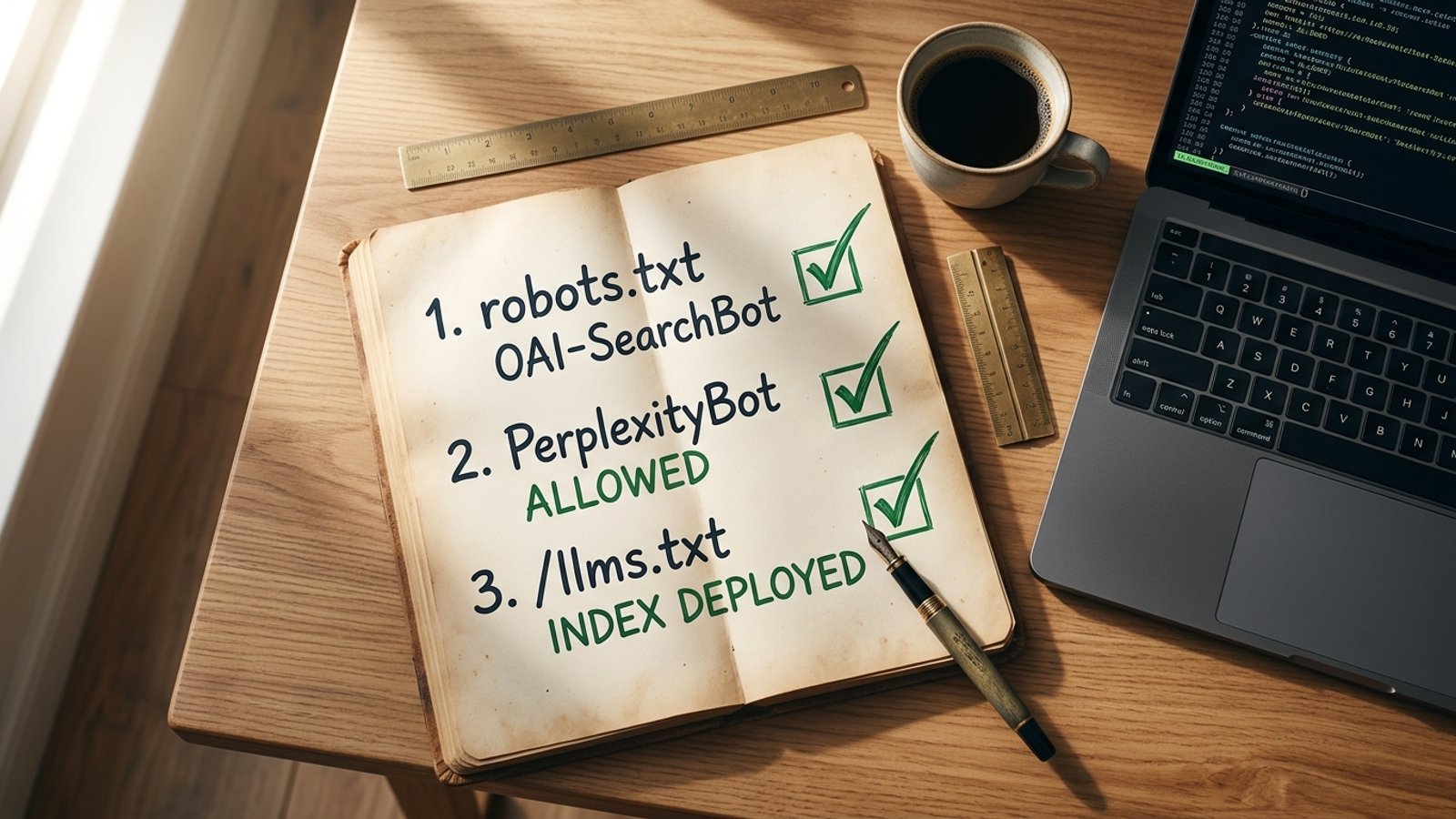
I would not commission a comparison page until I knew relevant crawlers could reach it. Otherwise, you can publish diligently and spend the next month discussing why nothing appears. Start with robots.txt, server access, and the planned /llms.txt index. Cognizo’s AI SEO overview covers those checks alongside server-response issues. Treat /llms.txt as part of the setup, not a magic citation switch.
The bots also have different jobs. As Checkvibe’s reachability guide explains, GPTBot relates to model training, while OAI-SearchBot and PerplexityBot matter for live search access; ChatGPT-User handles on-demand browsing. Check the relevant bot before calling a domain ‘accessible.’ If a client requires a developer to clear a firewall rule and will not provide one, that domain cannot satisfy the zero-developer constraint yet. Do not disguise the blocker as a content task.
Once access is clear, give each domain 20 commercial prompts, divided into four five-prompt clusters. That is 200 prompts across the roster, not 2,000 variations the operator cannot sensibly review:
A missing client on a direct comparison where a competitor appears gives you a concrete content gap to investigate. It does not give you permission to invent a favorable comparison. By Day 14, the target is straightforward: ten domains with access checked, the planned index deployed where appropriate, and 20 prompts active per client. If access is still blocked, record the exception rather than pretending onboarding is complete.
Week 3 establishes the cadence. The scheduled delivery work is about nine hours and ten minutes across ten domains, based on the review times below. That buys the operator room inside a 40-hour week for client strategy, approvals, communication, and problems that do not arrive on schedule. It is a working budget, not a promise that ten clients will never cause surprises.
The cut is the traditional production chain: separate briefs, manual copywriting for every comparison, screenshot collection, and a standing developer ticket for each technical change. The draft’s manual model budgets 16 operator hours per client per month before freelance content. That does not fit comfortably beside ten client relationships in one person’s calendar. Automation only saves the time if the operator can inspect the work and the client can approve it promptly.
Do not turn the saved hours into more dashboards. Use them to decide which commercial gaps deserve work, resolve client questions, and stop inaccurate content before it goes live. One operator owns the judgment; the engine carries the repetition.
The first report costs operator review time and should not require a fresh screenshot project. It buys an honest conversation about what changed. By Day 28, show three things: verified clickable citations in commercial answers, referral traffic from AI search where measurable, and performance on the client’s 20 core prompts. Add the execution log so the client can see which technical fixes and content updates happened.
Do not present a bare mention as a click. Do not present a cited URL that never names the brand as proof of direct brand discovery. Search Engine Journal’s discussion of AI visibility measurement is a useful warning against collapsing those different outcomes into one flattering score. If there is no attributable traffic yet, say so. A report is not improved by renaming absence ‘momentum.’
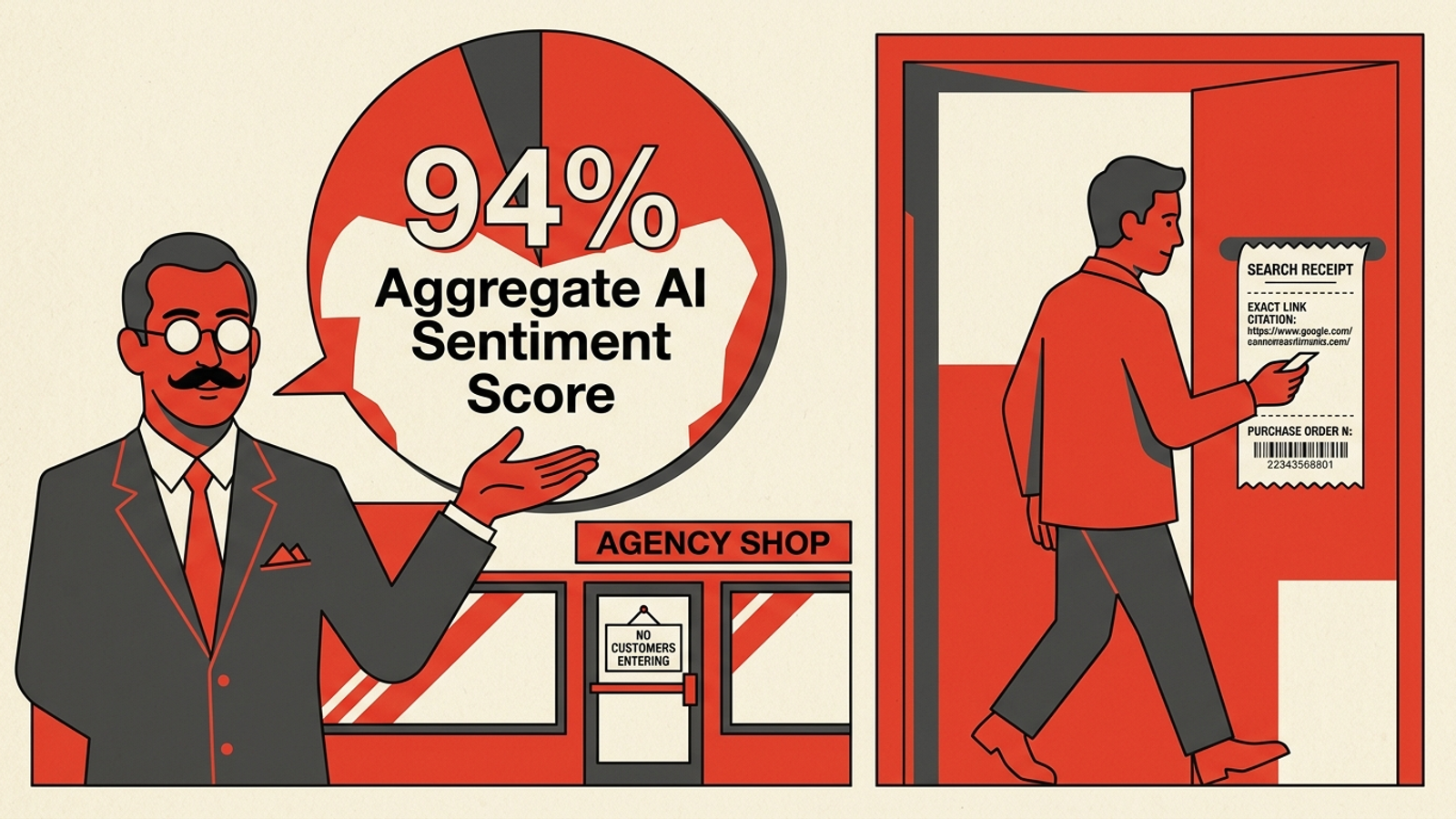
Manual reporting is its own cost. The agency reporting benchmark cited here puts screenshot and deck work at 30%–40% of account managers’ non-billable time. groas for agencies provides branded weekly reports and an action log. Use that record to explain the work, not to avoid discussing the result.
For ten domains, the illustrative execution-model labor is $1,750 per month, plus a groas software fee that needs a quote. At the draft’s $50 hourly labor assumption, the one-off onboarding allowance is another $1,000 in Month 1. There is no defensible all-in range until you have the software price and know which clients can grant access. The alternative costs below show why a cheap-looking monitoring tier can become expensive; they are not charges to add to the execution model.
| Line item | Type | Ten-domain cost or pricing basis | Figure source or driver |
|---|---|---|---|
| groas delivery software | Listed, recurring; execution model | Flat monthly fee; confirm the quote per domain | groas for agencies describes the service, not a public per-domain price |
| Operator delivery labor | Recurring; execution model | About 35 hours/month × $50 = $1,750 | Draft’s 3.5 hours per client and illustrative $50 hourly rate; actual hours depend on approvals and exceptions |
| Technical onboarding and access | One-off; Month 1 | 20 hours × $50 = $1,000 | Draft’s two-hour-per-client setup allowance |
| Metered monitoring suite | Alternative, recurring; not an execution-engine add-on | Draft’s $99 base + $399 per client workspace = $4,089/month | Profound pricing discussion; check the plan before purchase |
| Manual audit labor | Alternative, recurring | 16 hours/client × $50 = $8,000/month | Draft’s manual prompt, writing, and reporting workload |
| Prompt overages and engine add-ons | Hidden, recurring where metered | Draft’s $400–$1,200/month allowance; depends on prompts and engines | Pepper.inc cost analysis |
| Freelance comparison writing | Hidden, recurring in a manual model | Two pages/domain × $150 = $3,000/month | Draft’s illustrative writing assumption |
| Manual client reporting | Hidden labor in a manual model | Draft’s $1,200–$1,600/month allowance; avoid double-counting it with labor totals | Agency reporting benchmark and draft allowance |

A vendor’s single-brand headline price is not your ten-domain price. This discussion of Profound’s agency plans illustrates the workspace question to ask before signing. Check prompt limits, engine access, seats, and every client workspace on the actual quote. The cheapest mistake is tracking too many prompts at launch; the most expensive is buying monitoring, then paying people to do all the execution it cannot do.
I would offer this at $3,500 per domain per month, with no client setup fee and no percentage-of-spend markup. Ten signed domains would mean $35,000 in monthly retainer revenue. That is a proposed selling price, not a demonstrated margin. Before quoting it as a profitable service, put the real software quote beside the labor allowance and the clients’ approval requirements. A flat fee protects the model only when delivery costs stay predictable.

I would also decline clients who cannot meet the cadence. A business that needs six weeks of legal review for every comparison table cannot run this publishing schedule. A client that cannot grant CMS access or resolve a crawler block without developer work cannot fit a zero-developer launch. An early-stage offer with no market validation will not become compelling because an AI answer mentions it. And an agency determined to sell hourly audit decks should not pretend it is selling autonomous execution.
When Day 30 passes and the ten-domain cadence holds, do not hire another account manager by reflex. First, check the actual hours, exceptions, software bill, and client outcomes. If the operator still has room, add domains within the same guardrails or expand the work for existing clients into paid search management across Google Ads and ChatGPT Ads. The constraint lifts by proving what one operator can carry, not by quietly rebuilding the agency workload this retainer was meant to replace.
A flat fee per domain pays for work that gets done, such as audits, published answers, and technical fixes, rather than hours of manual monitoring and screenshots. The software you use should execute changes, not cap the prompts you need, and should charge predictably per domain so delivery costs stay predictable.
Reject a vendor if it only monitors and cannot audit, publish answers, or fix technical issues; if it meters prompts or gates engines behind higher tiers and add-ons; or if it charges by seats or workspaces that make the eleventh domain's cost unpredictable. Read the plan limits before building a service around a headline price.
Start with robots.txt, server access, and the planned /llms.txt index before commissioning any content. Check the specific bot you need, because GPTBot relates to model training, OAI-SearchBot and PerplexityBot matter for live search access, and ChatGPT-User handles on-demand browsing. If a firewall rule requires a developer the client will not provide, record the exception instead of pretending onboarding is complete.
Give each domain 20 commercial prompts, divided into four clusters of five: brand alternatives, category shortlists, problem and solution, and direct comparisons. That is 200 prompts across a ten-domain roster, a number one operator can sensibly review, rather than thousands of variations.
Monday is triage: 15 minutes per domain on baseline prompts, crawler errors, and newly cited competitors, about two and a half hours. Tuesday through Thursday, let the engine produce content and spend 30 minutes per domain reviewing it, five hours total. Friday is verification at ten minutes per domain, about one hour and 40 minutes, leaving room in a 40-hour week for strategy and client communication.
Show verified clickable citations in commercial answers, referral traffic from AI search where measurable, and performance on the client's 20 core prompts, plus an execution log of technical fixes and content updates. Do not present a bare mention as a click or a cited URL that never names the brand as direct discovery, and say so if there is no attributable traffic yet.
The illustrative execution model is about 35 hours of operator labor per month at $50 per hour, or $1,750, plus a groas software fee that needs a quote, and $1,000 in one-off Month 1 onboarding. There is no defensible all-in range until you have the software price and know which clients can grant access.
The proposed selling price is $3,500 per domain per month with no client setup fee and no percentage-of-spend markup, so ten signed domains would mean $35,000 in monthly retainer revenue. Before quoting it as profitable, put the real software quote beside the labor allowance and the clients' approval requirements. Decline clients who cannot meet the publishing cadence or grant CMS access.