

 LinkedIn

One product category, $3,000 in media, 30 days: that is the entire ChatGPT Ads test. I will not open the rest of the catalog halfway through because early clicks look promising.
Most ecommerce teams asking about the best ChatGPT ads agency for an online store want everything live on day one and a ROAS verdict on day seven. That makes a small test harder to read, not more ambitious. Put 40 SKUs with different margins and return rates under one budget, and even a sale leaves you asking whether you bought useful demand or an expensive order.
Start with one economically coherent category. Work out what its customers can cost, then release spend only when inventory, reconciled orders, and contribution justify it. Headline ROAS does not get a vote on its own.
1. Lock the ceiling before spending a dollar
Media cost: $0. What it buys: a boundary nobody can quietly move.
The ceiling is $3,000 for 30 days, one category, no exceptions. Management sits outside that number. With groas, that means $1,499 for management plus $3,000 in media: $4,499 all-in for the first month. The media allowance does not stretch to cover fees, apps, or creative.
Self-serve ChatGPT Ads carry a $25/day minimum in the US with no account minimum. Across 30 days, that is $750 before any increase. If media and management share one pot, it becomes easy to protect the retainer by silently shrinking the test, then wonder why 12 clicks cannot produce a read.
Write down what gets cut:
- The rest of the catalog: different economics muddy the result.
- Country expansion: feed campaigns currently use country-level geography, and another country is another test.
- A second offer or clearance experiment: leftover budget is not permission to change the question.
Broader coverage gives a small budget more ways to lose. Keep the question narrow enough to answer.
2. Set allowable CAC from contribution, not target ROAS
Media cost: $0. What it buys: a price ceiling for acquiring a customer.
Before launch, calculate contribution before ad spend: revenue less product cost, payment fees, fulfilment, shipping, and an allowance for returns. I use CM2 for that pool here. It is not gross margin, and it is not revenue divided by a preferred ROAS.
On an $80 order, the example economics leave about $34 before ad spend and $8 after a $26 CAC. On a $45 order at 55% gross margin, the pool is closer to $15.79 after $5.40 in shipping and fulfilment, $2.25 in expected returns, and $1.31 in fees. Buy that second customer for $26 and you lose money on the order. Calling it scaling does not improve the arithmetic.
Write one page with:
- Average order value.
- Product costs, fees, shipping, and fulfilment.
- Expected return rate and returns allowance.
- Contribution per order before acquisition.
- Allowable CAC for a one-time buyer, including the contribution you intend to retain.
Then exclude SKUs with incompatible economics, thin stock, or returns that eat the pool. A product at 2.04x blended ROAS can still lose money when breakeven on a 35% contribution pool sits near 2.9x. I use the same filter described in how ROAS hides your best products to cut products before launch.
The draft economics for this channel put US buying at roughly $25–$45 CPM or $3–$5 suggested CPC. Those are buying costs, not permission to acquire customers at a loss. Allowable CAC is the gate; ROAS is supporting information.
3. Verify access, eligibility, and the controls you actually have
Media cost: $0. What it buys: permission to proceed, not an obligation to launch.
Confirm access to Ads Manager at ads.openai.com, category eligibility, and the controls available in the account. ChatGPT Ads match conversational context rather than bought keywords, using context hints at ad-group level. Units render for logged-in adults on Free and Go plans. That is a narrower slice of demand than “everyone asking ChatGPT about our products.”
For a feed launch, check all nine required fields: item_id, title, description, url, brand, seller_name, image_url, availability, and price. Also check is_ads_eligible=true. Items expire after two weeks unless maintained through a hosted URL, SFTP, or the Shopify app.
Use Upload History to confirm load success. The Products tab shows products with delivery, not a complete feed-error report. Debugging delivery is pointless if the feed never loaded.
Check Creative Enhancements too. The documented default from October 29, 2026 allows headline and description rewrites, translation, image resizing, and clicks sent to another page on the same site without preview. Where that setting applies, opt out at account level if regulated claims or a strict landing-page promise make those changes unacceptable.
Do not build a plan around assumed keyword, placement, or audience controls. And do not count paid feed delivery as organic visibility: beta feed units are ads-only and do not appear in organic ChatGPT answers.
Plan with the controls visible in the account, not the ones implied by a sales deck.
4. Days 1–3: finish the brief and reconcile tracking
Media cost: $0. What it buys: a launch you can measure and hold accountable.
The brief fits on one page. It names the buyer question, three to five qualifying SKUs, exclusions with reasons, and the exact landing-page promise.
Not “women 25 to 44 interested in running.” An illustrative brief is more useful: a buyer asks for waterproof trail shoes for wide feet under $150; the ad shows three in-stock models with delivery dates; the feed excludes models with a 22% return rate; the landing page promises a 30-day trail trial. Those details must reflect the actual offer, not the copywriter’s optimism.
If the manager cannot repeat back who the buyer is and what the test refuses to sell them, the brief is unfinished.
Reconcile tracking during the same three days. ChatGPT attribution will lie to you politely if you let it:
- Check the event setup. The tracking stack includes the oaiq JavaScript pixel, server-side Conversions API, and an image-tag fallback. Pixel and API events need a shared
event_idfor deduplication, with money passed in minor units. - Check click identification. The pixel stores the click ID in a
__opprefcookie for 30 days; CAPI needs thatopprefpassed manually. - Check checkout coverage. On Shopify, use OpenAI’s free ChatGPT Ads app or a custom pixel under Settings > Customer events, not
theme.liquid, which misses checkout. Mapcheckout_completedtoorder_createdwith value, and keep one sender per Pixel ID. - Check the reconciliation outside Ads Manager. The default attribution window is 30-day click plus 1-day view. There is no refund or cancellation event, so cancelled orders stay in reported revenue unless removed from the business-side read.
Only about 40% of influenced conversions happen inside the click session. That makes conversion maturity part of the test, not an excuse discovered after it.
Assign one named owner to inventory and offer changes. No reconciled order IDs, no spend release.
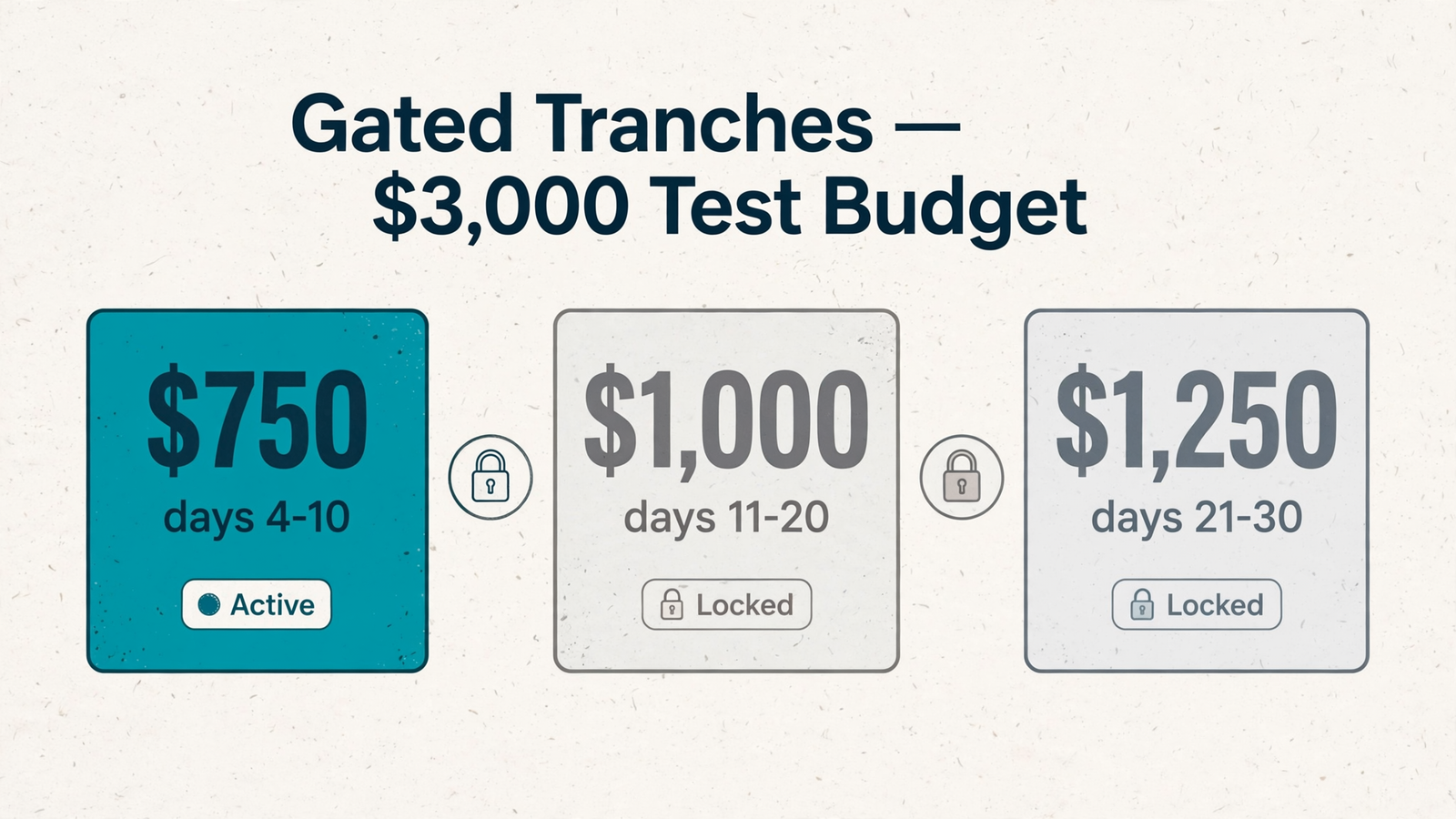
5. Days 4–10: release the first $750 to test integrity
Media cost: up to $750, about $107 per day. What it buys: proof that delivery, destinations, and purchase data work.
This tranche is a ceiling, not a spending obligation. Launch one feed-filtered ad group within the category, with context hints written like buyer questions rather than isolated words.
If delivery is slow, wait. If a product URL resolves to the wrong variant or an out-of-stock page, fix the feed and page. Do not “make up spend” later to keep a spreadsheet looking tidy. Unspent money stays unspent unless explicitly released within the existing tranche schedule and $3,000 ceiling.
Run a 15-minute daily check:
- Spend against the $750 limit.
- Impressions and clicks by product.
- Landing-page match for clicked products.
- Ads Manager purchase events against Shopify orders for the corresponding period.
Allow for reporting lag: conversions report daily, product-level rows can lag up to seven hours, and the Insights API retains about 30 days of history. A same-day mismatch needs investigation, not an instant verdict.
Week one establishes integrity. It does not settle profitability. If the first tranche cannot connect purchase events to order IDs, click IDs, and reconciled values, the next tranche stays locked.
6. Days 11–20: make the next $1,000 earn its release
Media cost: up to $1,000; cumulative ceiling: $1,750. What it buys: a better read on customer economics.
Pull the purchases attributed to days 4–10. Reconcile them against actual orders, remove cancellations and refunds, identify new customers, and apply the returns allowance without counting known returns twice.
Then calculate actual CAC: media spend divided by reconciled new customers acquired. Compare it with the allowable CAC set before launch. Do not divide purchase revenue by customer count and call the result an acquisition cost.
I also use the contribution-to-CAC check from this DTC unit-economics framework:
| Contribution before ad spend ÷ new-customer CAC | Decision inside this test |
|---|---|
| Above 1.0 | Consider releasing spend only if allowable CAC, inventory, and measurement also pass. |
| 0.7–1.0 | Hold and repair. Do not assume repeat purchases will rescue the order. |
| Below 0.7 | Stop releasing spend on those economics. |
A ratio above 1.0 is not permission to ignore the contribution you intended to retain. Nor does day 11 magically mature every conversion. If the evidence is still incomplete, hold the money rather than converting uncertainty into a pass.
If delivery concentrates on one unsuitable product, tighten the feed subset and context hints using the controls available. Do not invent keyword exclusions or audience levers to rescue the forecast. The country stays fixed.
With groas, changes and their reasoning belong in the weekly action report. The report should explain a decision, not decorate it. The second tranche is earned by reconciled economics, never by early CTR.
7. Days 21–30: keep the last $1,250 conditional
Media cost: up to $1,250; cumulative ceiling: $3,000. What it buys: depth inside the same category.
Release this money only if the earlier tranches justify it. Work on the buyer questions that already convert, in-stock variants with viable contribution, and fresh creative that keeps the same landing-page promise.
No second category. No second country. No clearance test funded by whatever remains.
Scope creep sounds reasonable in the meeting. Its mechanism is less charming: each addition splits the final $1,250 into smaller samples, then day 30 arrives with four inconclusive reads instead of one useful one.
Log every change and its reasoning so the final decision traces back to actions rather than vibes. Check inventory and returns alongside acquisition costs. A category that qualified before launch can stop qualifying mid-flight.
If stock slips or returns spike, pause. Protect the ceiling instead of spending to it.
8. Day 30: decide what happens when the constraint lifts
Additional media cost: $0. What it buys: an explicit expand, revise, stop, or observe decision.
The test aims to buy a clean read on one category, not a verdict on ChatGPT Ads as a channel. Spending all $3,000 does not guarantee even that. Measurement and conversion maturity still decide what the evidence can support.
Make one of four calls:
- Expand: matured, reconciled CAC sits below allowable CAC, contribution holds, and stock supports more volume.
- Revise: the evidence identifies a repairable break, such as the wrong landing variant, expired feed items, or checkout events that never match orders. Document the fix and propose a separate 14-day retest. Do not smuggle it into this test’s budget or calendar.
- Stop: reconciled economics fail the gate, including contribution-to-CAC below 0.7. More clicks do not repair an order that cannot carry its acquisition cost.
- Observe without more spend: attribution has not matured enough to distinguish a weak result from an incomplete one. Leave the budget closed while the existing orders reconcile.
This is where management earns its fee: watching delivery, recording changes, and refusing to release a tranche merely because the calendar says it is time. groas does that without taking a percentage of the $3,000 media budget.
When the constraint lifts, add a second category with its own allowable CAC and its own $3,000 gate. Do not pour the catalog into the first winner. Carry forward the contribution threshold, reconciled tracking, and written record of what worked. Expand the test, not the ambiguity.


