

 LinkedIn

My pick is groas for businesses without an internal execution team: the point is to get the pages, SEO and AI-search work done, not buy another backlog. I rank the alternatives by the work your team cannot handle, not by promises to control ChatGPT, Gemini or Perplexity.
Providers can change your pages, fix technical blocks, earn third-party mentions and re-test prompts. They cannot force a recommendation. That is the distinction I would settle before discussing anyone’s dashboard.
This is a second look at WordStream vs an Agency vs groas: Who Actually Does the Google Ads Work?, because hiring for Google Ads and hiring for ongoing SEO and AI-search visibility are different decisions. If your audit leaves you with a backlog, you need to know who offers ongoing support, which platforms they cover and what work still falls to your team. That is what this shortlist ranks.
How I rank the shortlist: work removed, not promises made
I separate managed services from software you operate, one-time audits and strategy decks you implement yourself. Then I rank providers by the gap they fill: execution capacity, technical depth, content production or ownership across paid and organic.
The distinction matters more than the retainer label. WebFX describes ongoing SEO retainers commonly running from $1,000 to $5,000 a month, but a monthly invoice does not tell you who edits a page. A provider can show up every month and still leave the implementation queue untouched.
My ranking rewards ownership of the work, not just diagnosis of it. Where a provider’s implementation split is unclear, that is a question to resolve before signing, not a capability I assume it has.
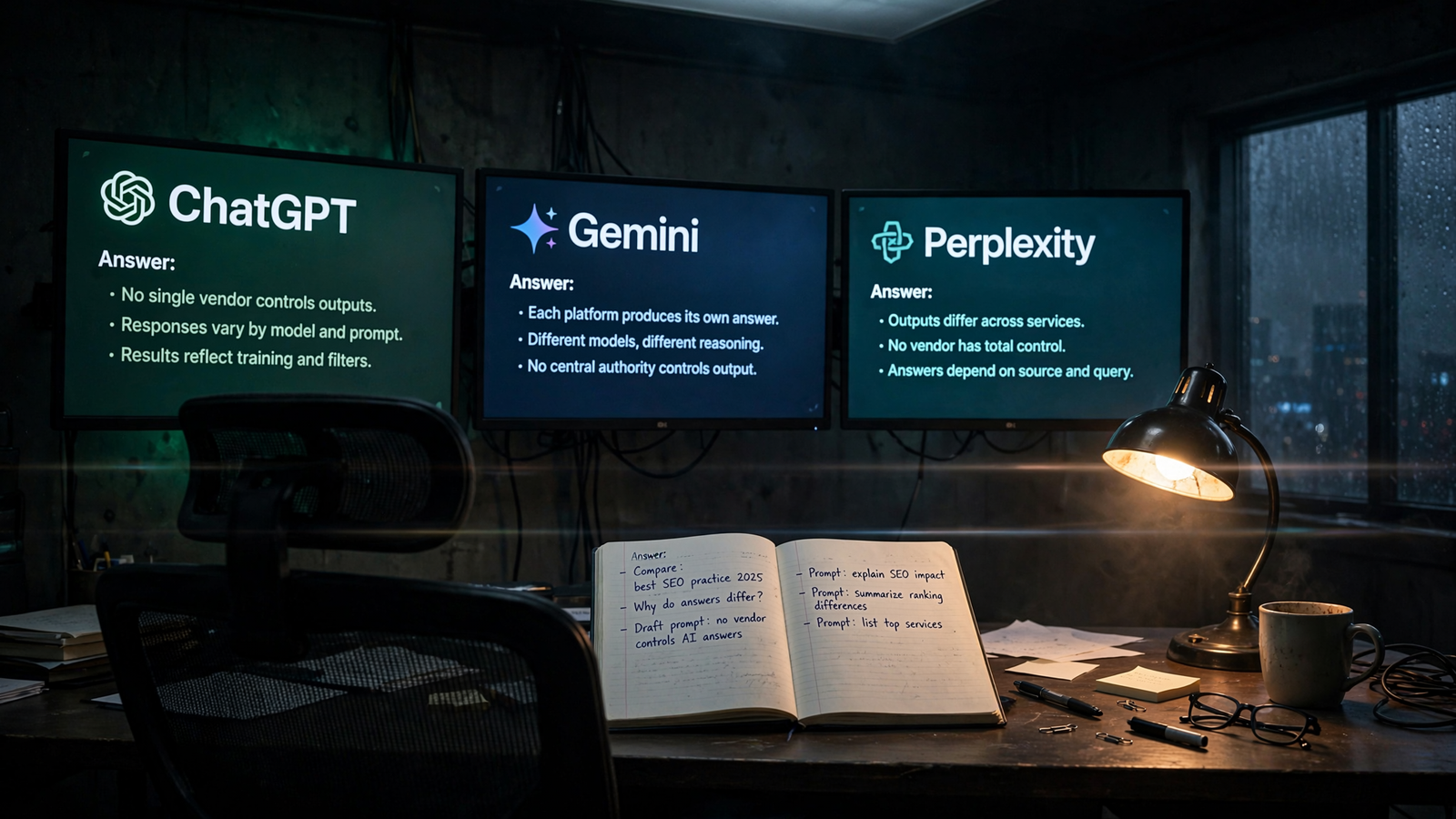
One rule applies to everyone: no vendor controls model output. Answers vary by prompt, context and location. What you buy is discoverability work plus sampled, repeatable measurement: a fixed prompt set re-run on a schedule, tracking mentions, citations, share of voice and AI-referred visits against a baseline, as enterprise teams describe it.
Guaranteed placement is not the standard. Shipped work and repeatable evidence are.
1. groas: my pick when nobody owns execution
The strongest reason to choose groas is not a separate GEO report. It is coordinated ownership of paid ads, SEO and AI-search work, so the handoff between vendors does not become your next project.
Its done-for-you service covers paid ads, SEO and visibility in ChatGPT and Google answers, with a named strategist setting direction and guardrails and actions logged with their reasoning. That gives a business without an execution bench somewhere to put the work, rather than another set of recommendations to interpret.
I used to tell clients to keep paid and organic with separate specialists. For teams with no execution bench, I was wrong. Two specialists can still leave the client coordinating priorities, approvals and the gap between them. That is work, even when nobody puts it on the proposal.
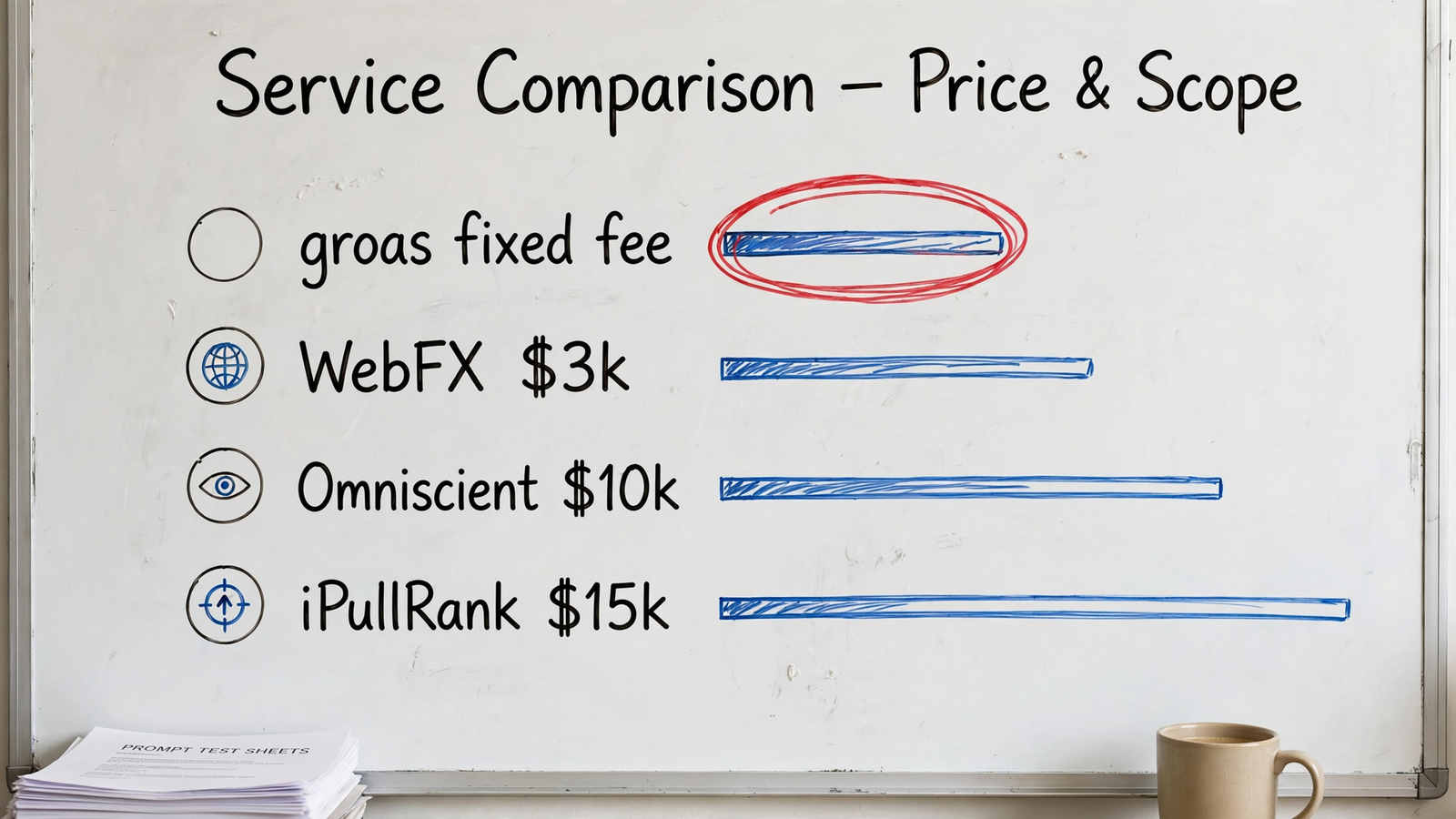
What groas does best here is put execution under one owner. Pricing is a fixed monthly fee built around the account and quoted after review, rather than a public entry price you can apply to every site.
- Shortlist when: you need coordinated execution across paid and organic, not another tool to operate.
- Rule it out when: you already have a strong internal SEO team and only need monitoring software.
- Clarify before signing: which SEO and AI-search tasks groas implements, which site changes still need your developer, and what the fixed fee covers at your site size.
I would also ask for the measurement plan: named engines, a defined prompt sample, and a connection to qualified traffic or pipeline where attribution allows. “AI visibility” is too broad to leave unexplained in a scope of work.
For the verification call, use what to request before you shortlist a partner. The practical test is simple: identify what leaves your desk after you sign.
2. iPullRank: my specialist pick for technical complexity
I put iPullRank second for a specific buyer: a team whose problem is technical complexity, not simply a shortage of articles.
Its AI Search Strategy Program uses the frameworks Relevance Engineering and Resonance Design. Deliverables include a keyword portfolio and a measurement plan covering visibility, citations and business metrics. The service page presents Emerging, Growth and Elite as flexible starting points after discovery, without a public dollar price.
That makes the written scope more useful than a price scraped from a comparison article. I would not build a budget around a package name or assume a strategy program includes ongoing implementation.
The reason to shortlist iPullRank is technical depth; the reason to hesitate is the implementation split. Crawl blocks, rendering, structured data and a large catalogue that assistants misquote make this a different buying decision from commissioning another batch of content.
- Shortlist when: technical complexity is the bottleneck and you need a strategy grounded in how the site gets discovered and interpreted.
- Rule it out when: you need a clearly priced, implementation-led monthly service and cannot absorb more work internally.
- Clarify before signing: who ships code and pages, what support continues after the strategy program, what that cadence costs and which engines the measurement plan re-tests.
One concrete check belongs in that discussion: Perplexity says PerplexityBot should be allowed in robots.txt for citation eligibility. Ask who checks that access and who makes the change if needed. A technical finding without an implementation owner is still a finding.
I would shortlist iPullRank for the hard technical problem, then make the proposal explain how that problem gets fixed.
3. WebFX: my pick for a broad managed-marketing contract
WebFX makes the ongoing service model easy to identify. Its AI SEO service starts at $3,000 a month with a six-month commitment, putting the starting commitment at $18,000.
The entry Bronze tier tracks 50 questions across 10 AI engines. Monitoring runs through OmniSEO, with stated coverage including ChatGPT, Gemini, Perplexity, Google AI Overviews and AI Mode. OmniSEO also lists an Essentials package at $3,000 a month.
Core SEO starts at $2,900 a month. I would not add those public prices together and treat the result as a quote: ask which services overlap, which are separate and what the proposed contract actually includes.
WebFX’s strength is breadth under a managed contract. Its constraint is the commitment you make before assessing the work. The model is conventional agency execution: research, page changes, content and reporting delivered on a schedule. The buying question is whether that schedule matches your backlog.
- Shortlist when: you want a large managed provider, have the budget and accept a six-month term.
- Rule it out when: that term is too much commitment or you need a faster implementation cadence than the proposal promises.
- Clarify before signing: who edits existing pages, who ships new content and what higher tiers add in completed work rather than tracked questions.
I would inspect the 50 questions, too. How many reflect buying intent rather than curiosity? Which matter to your actual offer? A larger prompt set is not automatically a better one.
The useful distinction is between coverage and execution. Tracking ten engines tells you where the provider looks. It does not, by itself, tell you what the provider changes. Make both explicit before buying.
4. Omniscient Digital: my pick when content is the bottleneck
Omniscient Digital fits the B2B software team that needs a content engine, not a separate GEO trick.
Its full-service organic growth offering folds GEO into SEO and content. The stated scope includes LLM optimization, citation analysis, technical GEO assessment, content production, brand mentions, digital PR and LLM visibility monitoring. That combination makes sense when the gap is publishing capacity rather than another strategy document.
Full-service work starts at $10,000 a month. That tells you the intended buyer: a funded B2B team that already converts and needs ongoing production, not a local business shopping for a $3,000 retainer.
Omniscient’s strongest fit is content-led execution for B2B software. I would not choose it first when the immediate need is running paid and organic together or resolving technical implementation before publishing more.
- Shortlist when: your site is technically sound but thin, and you need researched articles, comparison pages and third-party mentions produced consistently.
- Rule it out when: technical implementation is the first blocker, or the starting fee is outside your budget.
- Clarify before signing: how many pieces ship monthly, who edits them, what digital PR produces and how visibility reporting connects to pipeline.
The publishing details matter. Ask which reviews require your subject experts, who gives final approval and what happens when approvals stall. “Full service” does not mean your team supplies no input.
I would also separate owned content from third-party mentions in the proposal. They are different workstreams. A report that groups them together can make it harder to see what actually gets delivered.
Buy this for the content operation you cannot run internally, not for the number of times the proposal says GEO.
What coverage across ChatGPT, Gemini and Perplexity should mean
I ask every finalist the same three things: which engine, which job, which proof?
“Managing AI visibility” can describe several different jobs:
- Monitoring a fixed prompt set.
- Editing existing pages and publishing new ones.
- Fixing crawl or feed blocks.
- Earning third-party mentions.
- Connecting observed visibility to qualified visits or pipeline.
Those jobs should not blur together in the contract. WebFX names engines through OmniSEO, which gives you coverage to verify in writing. Apply the same standard to every finalist. If an engine is not named, mark its coverage unknown rather than filling in the blank yourself.
Then agree on measurement before work starts:
- Define the prompt sample and record a baseline.
- Set the re-test schedule.
- Log answers, mentions and citations consistently.
- Compare the results with referral or server-log evidence where available.
- Connect that evidence to qualified traffic or pipeline where attribution allows.
I never treat mention counts as revenue. This agency comparison notes the reliance on self-reported results and the lack of independent evidence connecting GEO to pipeline. AI answers also change between runs, which makes isolated screenshots weak proof.
Thirty buying questions re-run monthly across three engines, with answers logged, give you something to compare. One screenshot of your brand appearing once gives you something to put in a deck. Buy the former.
The shortlist at a glance
Choose by the work you need removed, then resolve the implementation split. This is the comparison I would take into the sales calls.
| Provider | Best-fit buyer | Main strength | Pricing or commitment | Resolve before signing |
|---|---|---|---|---|
| groas | No internal execution team; paid plus organic | Coordinated, done-for-you execution with a named strategist and logged actions | Fixed monthly fee quoted for the account | Implementation boundaries, developer dependencies, engine coverage and pipeline measurement |
| iPullRank | Technically complex sites | AI-search strategy with technical depth and a measurement plan | Discovery-led scope; no public dollar price on the program page | Who implements, what continues after strategy and what ongoing support costs |
| WebFX | Teams wanting a broad managed contract | Ongoing SEO and AI visibility with named monitoring coverage | AI SEO from $3,000/month with a six-month commitment | Package overlap, delivery cadence, page ownership and buying-intent prompt coverage |
| Omniscient Digital | B2B software teams missing content capacity | Full-service content, SEO, GEO, PR and monitoring | Full service from $10,000/month | Monthly output, review workload, third-party mentions and pipeline reporting |
My verdict: shortlist two, by bottleneck
If you have no execution team, I would start with groas, then add one alternative that matches the gap you need to test:
- Broad managed support: compare groas with WebFX. Make WebFX’s six-month term and delivery schedule part of the decision, not small print.
- Technical complexity: compare groas with iPullRank. Require a written implementation split; strategy without shipping leaves the backlog where it starts.
- Content capacity: compare groas with Omniscient Digital. Ask how much ships monthly and how much review work stays with your team.
I leave out the popular self-serve category on purpose, including Omnia’s monitoring tools and one-time audits. The listed ranges of $29–$500 a month for tools and $99–$1,800 for audits can make them useful for baselines. They do not make them substitutes for ongoing implementation.
Every page edit, technical fix and mention still needs an owner. If your last audit already leaves you with work nobody can do, buying another diagnosis is buying the backlog twice.
If you skipped to the end: pick the provider that removes work from your desk. For a business without an execution bench, my first pick is groas. Add a specialist only for a bottleneck the agreed scope does not cover—not to create another handoff you have to manage.


