
YouTube Ads Won’t Get Fewer: Six Calls to Check by 2027
October 1, 2026
•
11
min read



Your Google Ads budget goes up. Should your agency’s fee go up with it? Smart people disagree because a bigger account can demand more work, but a bigger budget does not automatically create more work. That gap is the whole pricing debate.
Percentage-of-spend advocates have a serious case: if an agency helps grow your account from $10,000 to $100,000 a month in profitable spend, its fee should share in the expansion it helped produce. Flat-fee advocates have an equally serious reply: once campaign structure, conversion tracking, and margin guardrails are in place, modern auction algorithms can handle more spend without requiring a proportional increase in human hours.
The 2026 Agency Pricing Survey reflects the split: 42% of performance marketing shops use flat monthly retainers, 31% bill a percentage of ad spend, and 27% combine a base fee with a percentage. If you are comparing Google Ads agency pricing models, you need more than a price list. You need to know what each model pays an agency to do when your account grows—or when it needs to shrink.
Set aside the hot takes calling percentage fees a scam. An expanding account is not always the same account with a larger number in the budget field. As practitioners discussing PPC management fee structures point out, percentage pricing can serve as a proxy for value. If an agency scales spend from $5,000 to $50,000 a month while holding cost per acquisition steady, the client gains revenue without renegotiating the management contract every ninety days. The agency shares in the upside it helped create.
Budget expansion can bring genuine account complexity. A brand spending $5,000 a month might run two focused search campaigns with twenty tightly scoped ad groups. At $50,000 or $100,000, it may add regional targets, non-brand discovery, product feeds, Performance Max asset groups, and far more search term data to review. That calls for negative keyword work, creative testing, and bid-target calibration. The budget alone does not create those tasks. The broader account does.
Now put that account on a $1,500 flat retainer with no change in scope. If its campaigns multiply while the fee stays fixed, the manager has an incentive to ration attention just as the business gains traction. Percentage pricing gives the agency room to support growth without turning every new campaign into a contract negotiation. For an advertiser whose scale brings new markets and products, that is a real advantage.
The strongest defense is not that agencies deserve more money whenever a client spends more. It is that profitable expansion is hard to produce and worth paying for. A fee that rises with spend rewards the agency for finding room to grow rather than maintaining a comfortable account at its original size.
Percentage fees do not automatically make an agency reckless, either. On a $10,000 monthly budget, persuading a client to waste another $2,000 earns a 15% agency just $300 while putting the whole contract at risk. Client retention can be a stronger incentive than that marginal fee. The argument is imperfect, but it deserves better than pretending every agency wants to set your budget on fire for $300.
Even some ad tech uses a similar model. Advertisers asking whether Google Ads automation platforms can charge a percentage rather than a flat subscription can look at Google’s Search Ads 360, which charges usage fees tied to media spend alongside minimum commitments. Auction-time bid calculations, API synchronization, and data ingestion give percentage-based software pricing its own rationale. The practical question for an agency is whether its fee buys expanding work and value, not merely access to an expanding budget.
The percentage model made intuitive sense when growing an account meant writing ad variations by hand, building match-type structures in spreadsheets, and adjusting keyword bids at midnight. I have done enough of that work to respect it. I also know how much of it was repetitive.
A $60,000 account does not necessarily take four times the human hours of a $15,000 account. Once structure, tracking, and margin guardrails are working, Smart Bidding and automated scripts absorb some of the additional execution volume, as discussions of modern Google Ads agency pricing note. Bigger accounts can still be harder. But if the campaigns and strategic scope stay much the same, increasing the fee by $6,750 a month under a 15% contract is difficult to defend as payment for additional human work.

That is the flat-fee argument in plain English: pay for the work and accountability the account needs, not for the amount of media you can afford to buy. A budget increase should be good news for your business, not an automatic price increase for unchanged management.
The conflict becomes sharper when performance deteriorates. If acquisition costs rise and marginal returns fall, the right move may be to prune costly broad-match terms, stop weak Performance Max assets, and cut media spend by $10,000. Under a 15% spend contract, that recommendation cuts the agency’s next invoice by $1,500.
As advocates of the flat-fee model argue, a retainer separates the management fee from the size of the media budget. Even an ethical account manager can feel the pull when protecting a client’s cash flow means reducing agency revenue. The structural conflict in percentage-of-spend pricing matters most at precisely the moment you need an unambiguous recommendation to spend less.
A flat fee also gives advertisers a predictable management bill and agencies a clearer picture of delivery costs. Strategist time and software tooling do not spike just because a client turns on another campaign. Agencies evaluating tools face the same choice: some legacy platforms use seat tiers or add a 1% to 3% fee on media spend, while fixed-cost setups make per-account costs easier to forecast. Our breakdown of AI Google Ads software costs per client account goes deeper on that distinction.
Predictability is not glamorous. Neither is discovering that your management fee rose while your agency’s output stayed exactly where it was.
Principles are useful; invoices are harder to ignore. Percentage-based agency contracts commonly charge 10% to 20% of media spend, often with a $1,500 to $2,500 monthly minimum. Flat-fee agencies commonly quote $2,000 to $5,000 a month for standard commercial accounts, with new deliverables such as landing pages or international translation changing the scope.
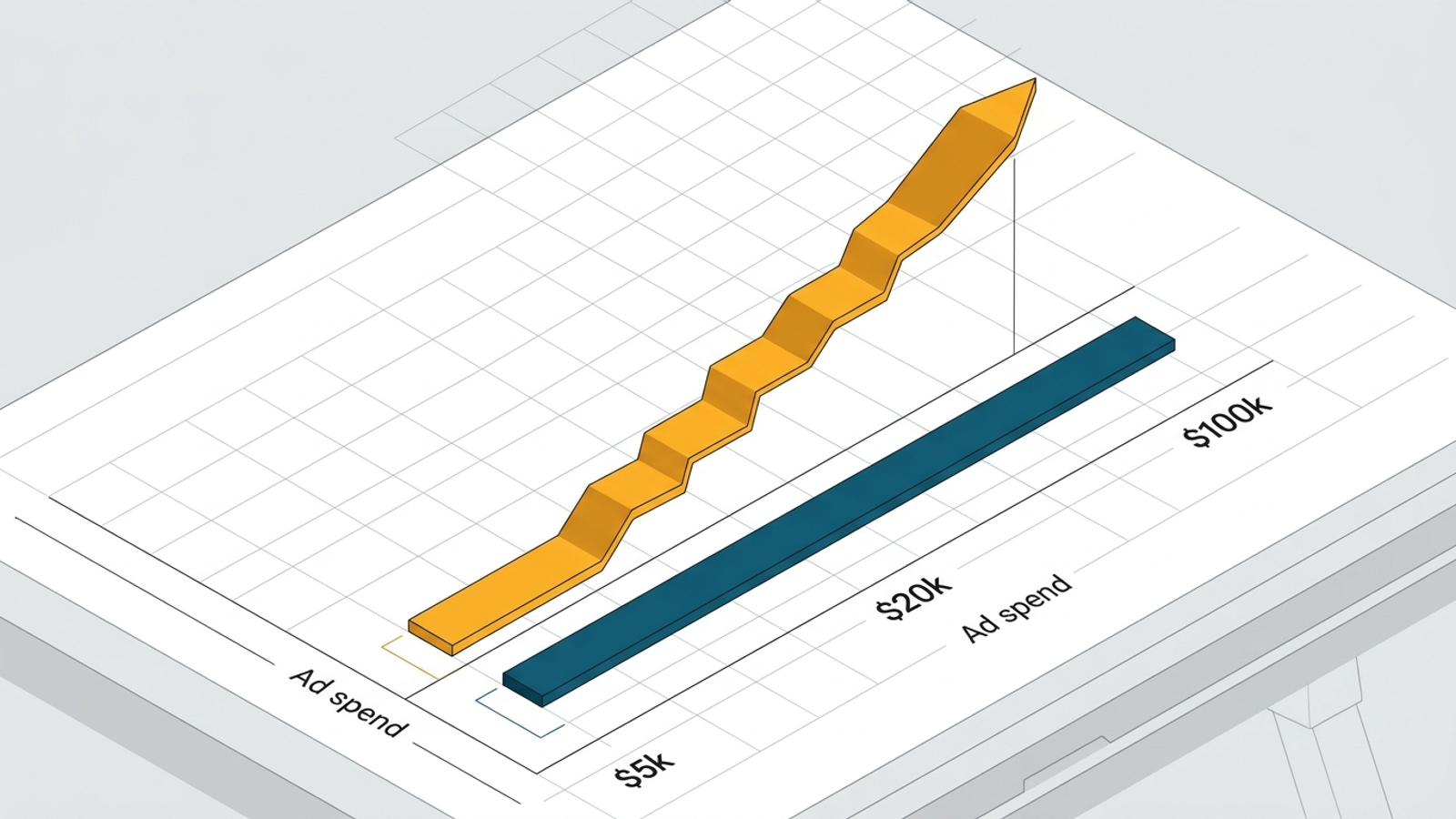
Here is how those models can look at three budgets:
The difference at $100,000 is large. It can be warranted if the account has also grown into a substantially bigger strategic and operational job. If the campaigns and deliverables have barely changed, it is a surcharge on your media budget. That is the distinction the invoice alone cannot show.
Percentage pricing is weakest on a mature, stable account. Early on, an agency may be auditing tracking, rebuilding campaigns, and writing responsive search ad variations. Months later, it may still charge the same percentage while Smart Bidding handles auction-time bids and the structural work is largely done. A growing budget raises the fee even if the agency’s work does not grow with it.
The conflict extends to conversion improvements. Say better post-click conversion lets you reduce monthly media spend from $30,000 to $20,000 while maintaining revenue. Under a 15% contract, recommending that move costs the agency $1,500 a month. The client’s better outcome becomes the agency’s smaller invoice. That is a poor incentive to bake into an ongoing relationship.
A flat fee has its own breaking point: scope can outrun the agreement. Hire an agency for $2,500 a month while spending $10,000, then scale to $75,000 across five new product lines, regional feeds, and international markets. The original fee no longer reflects the job. If the agency cannot renegotiate scope, the risk is silent under-servicing: fewer tests, less senior attention, and an automated PDF where a substantive conversation used to be.
That is not a case for charging a percentage forever. It is a case for writing a flat-fee agreement that can change when the actual work changes. Separate new deliverables from a budget increase. Your agency should be able to explain which one it is charging you for.
Before you sign or renew, put the pricing model under pressure. Do not ask only what the fee is today. Ask what the contract rewards tomorrow.
Those answers tell you whether you are paying for a bigger job or simply paying more because you can. Then make the decision.
For a simple account below $10,000 a month, I would accept a percentage agreement with a clear, reasonable minimum. It can offer a lower-cost entry point than a flat retainer and give an agency a stake in finding early traction. Treat it as a launch arrangement, not a permanent entitlement to a slice of your media budget.
Between $10,000 and $20,000, run the numbers and inspect the work. This is the crossover zone: neither model wins on price alone. An account adding products, regions, and substantial new management work has a better case for a percentage fee than a stable account whose budget is simply rising.
Above $20,000 a month, I would walk away from an open-ended percentage-of-spend contract. At that level, the fee rises quickly while the work may not. If scope genuinely expands, pay for that scope explicitly. Do not let a larger media budget stand in for a description of what your agency will do.
That is also why I prefer the operating model behind groas: specialized AI models handle bidding, search term work, negative additions, and creative rotation continuously, while a named human strategist owns guardrails, budget allocation, and revenue targets under a flat monthly fee. When spend rises from $25,000 to $50,000, the management bill does not automatically rise by $3,750. The strategist still has a job; the repetitive execution does not need a percentage commission.
Agency pricing is not an accounting technicality. It determines what happens when your account manager needs to say, on an uncomfortable Friday afternoon, “Spend less.” Below $10,000 with a simple account, a percentage can be a useful launchpad. Once you are spending more than $20,000, pay for strategic work and revenue accountability—not a tax on the budget you worked to build.
Percentage pricing can make sense when a growing budget brings real new work, such as regional targets, product feeds, Performance Max asset groups and more search term review. It also gives the agency a stake in profitable expansion instead of renegotiating the contract every time the account grows.
Not necessarily. Once campaign structure, conversion tracking and margin guardrails are in place, Smart Bidding and automated scripts absorb much of the extra execution volume. The article argues that raising a fee by $6,750 a month under a 15% contract on a $60,000 account is hard to defend as payment for additional human work.
Yes, it can. If performance drops and the right move is to cut media spend by $10,000, a 15% contract lowers the agency's invoice by $1,500. Even an ethical account manager can feel that pull when protecting the client's cash flow means reducing agency revenue.
At $5,000 a month, a 15% contract with a $1,500 minimum bills $1,500, while a flat retainer might cost $2,000 to $2,500. At $20,000, a 15% fee is $3,000 and flat retainers run roughly $2,500 to $3,500. At $100,000, a 10% to 12% rate means $10,000 to $12,000 per month versus a $3,500 to $5,000 flat retainer.
Scope can outgrow the agreement. An account that scales from $10,000 to $75,000 across new product lines, regional feeds and international markets may need far more work than a $2,500 fee covers. If the fee cannot be renegotiated, the risk is silent under-servicing, meaning fewer tests and less senior attention.
Ask three things: what happens to the fee if you cut media spend by 30% next month, which line items buy human work versus automated bidding, and what strategic output comes with higher spend. If higher spend brings no new landing pages, creative testing or deeper attribution, the larger fee buys nothing extra.
Below $10,000 a month with a simple account, the article recommends accepting a percentage agreement with a clear minimum as a launch arrangement. Between $10,000 and $20,000 it is a crossover zone where you should run the numbers and inspect the work. Above $20,000 a month, an open-ended percentage contract is best avoided.