

 LinkedIn
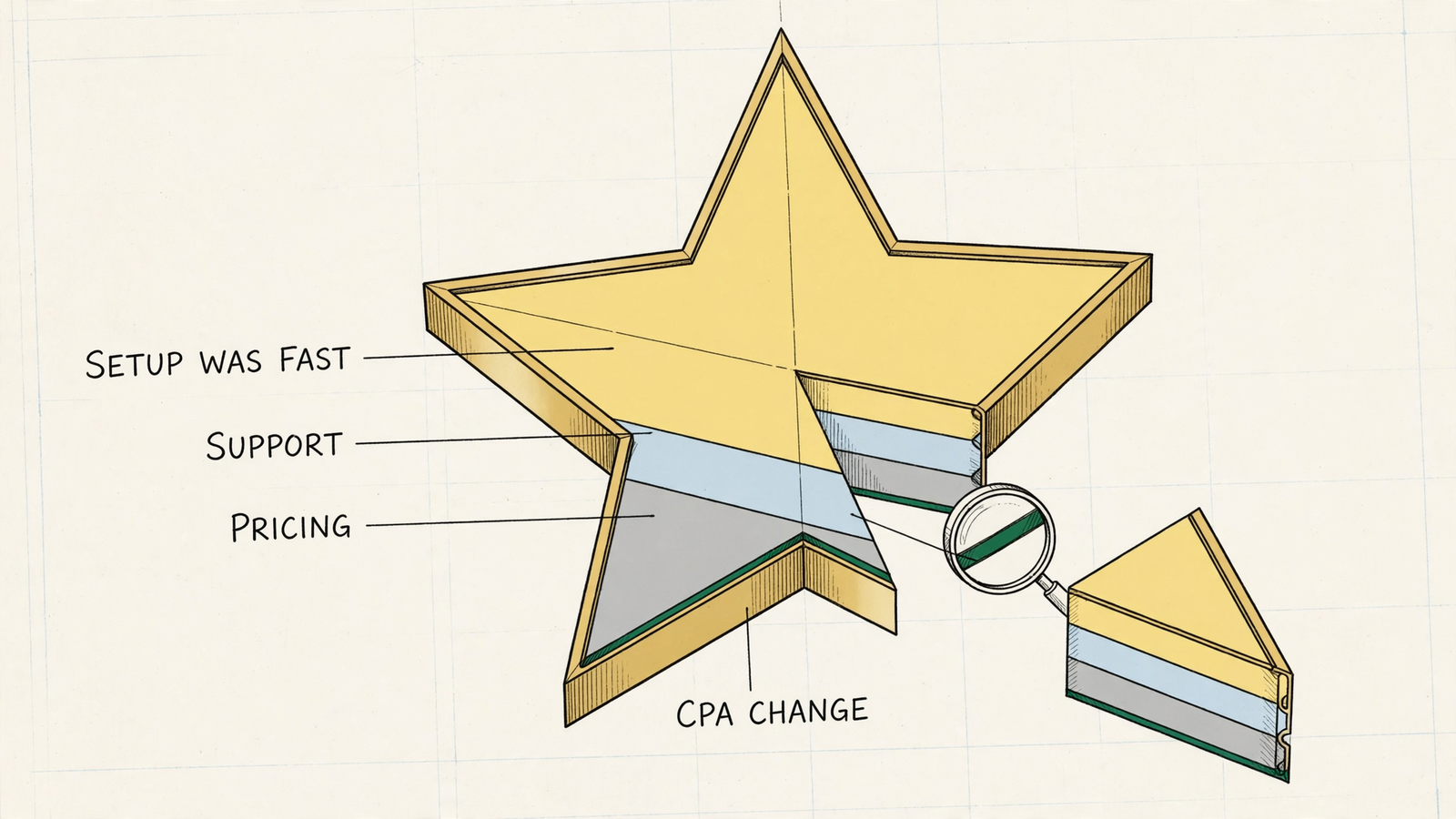
A 4.9-star rating will not tell you whether your CPA fell. I chose Ryze AI’s public review footprint for this teardown—the Trustpilot profile and the claims on get-ryze.ai—because those are the artefacts a buyer encounters when searching for “ryze ai reviews.” Ryze claims 4.9 out of 5 across 2,000+ reviews on Trustpilot, G2 and Capterra, alongside $500M+ in managed spend. That is a reason to look closer, not a performance result.
I spent years mining search terms at 1am for small ecommerce brands and watching CPA move for reasons no dashboard explained. That work left me with one question for every review: what would count as evidence? A reviewer who names a metric, a timeframe and a baseline gives me something to examine. A reviewer who says onboarding was smooth gives me evidence about onboarding. Read that way, Ryze’s footprint is useful. You just have to stop asking its stars to do a change log’s job.
First, read the rating without borrowing its conclusion
Open Trustpilot first, then get-ryze.ai in another tab. Trustpilot is where I look at volume, timing and distribution: how many reviews there are, when they arrived, and how many sit outside the five-star pile. The site is where I read the vendor’s account of what the product does. A review and a product claim answer different questions. Neither should quietly stand in for the other.
The labels matter before the prose does. Trustpilot says its Verified label requires an automated invitation tied to a transaction; reviews from manual link invitations appear as Invited or Unprompted. Businesses can invite customers, but automated invitations are what receive the Verified label. That label tells me something about how a review arrived. It does not certify that the reviewer measured a business outcome.
This is where a rating starts to lose its magic. If a batch of reviews arrives just after setup and talks mainly about setup, the average may reflect a good first impression. It cannot, by itself, establish what happened to CPA weeks later. I would read the distribution and the dates before I let the headline number into a buying decision.
Onboarding praise earns an onboarding verdict
The familiar five-star tool review has a short list of compliments: setup was fast, support answered quickly, the dashboard made sense. Those details are worth reading. For a shop spending, say, $20k/month without someone to babysit tags and feeds, a painless start has value. But easy setup is not evidence of lower CPA. I used to treat fast onboarding as an early sign that a tool was good. I was wrong. It meant onboarding was fast.
I pay more attention when a reviewer gets specific about what happened and when. Generic praise and single-profile reviewers leaving only five-star reviews give me less to work with than a dated account of a problem solved. That is a limit on the evidence, not an accusation about the reviewer. People are allowed to be happy with responsive support. I just cannot turn their happiness into a ROAS claim.
Verdict: take the service praise seriously as service praise. Do not promote it to proof that Ryze cut wasted spend, raised revenue or changed an account for the better.
Performance praise needs three things the stars cannot supply
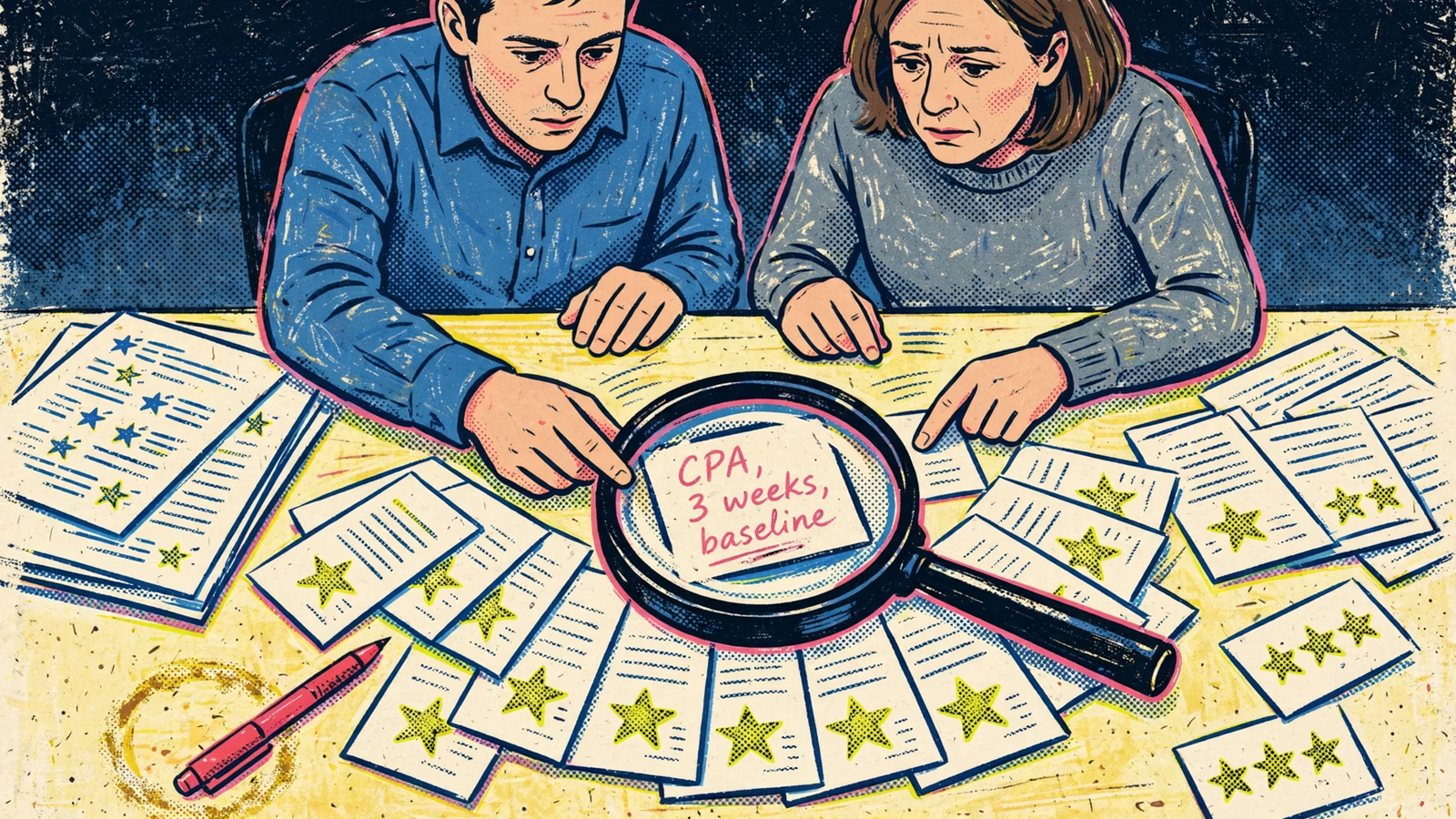
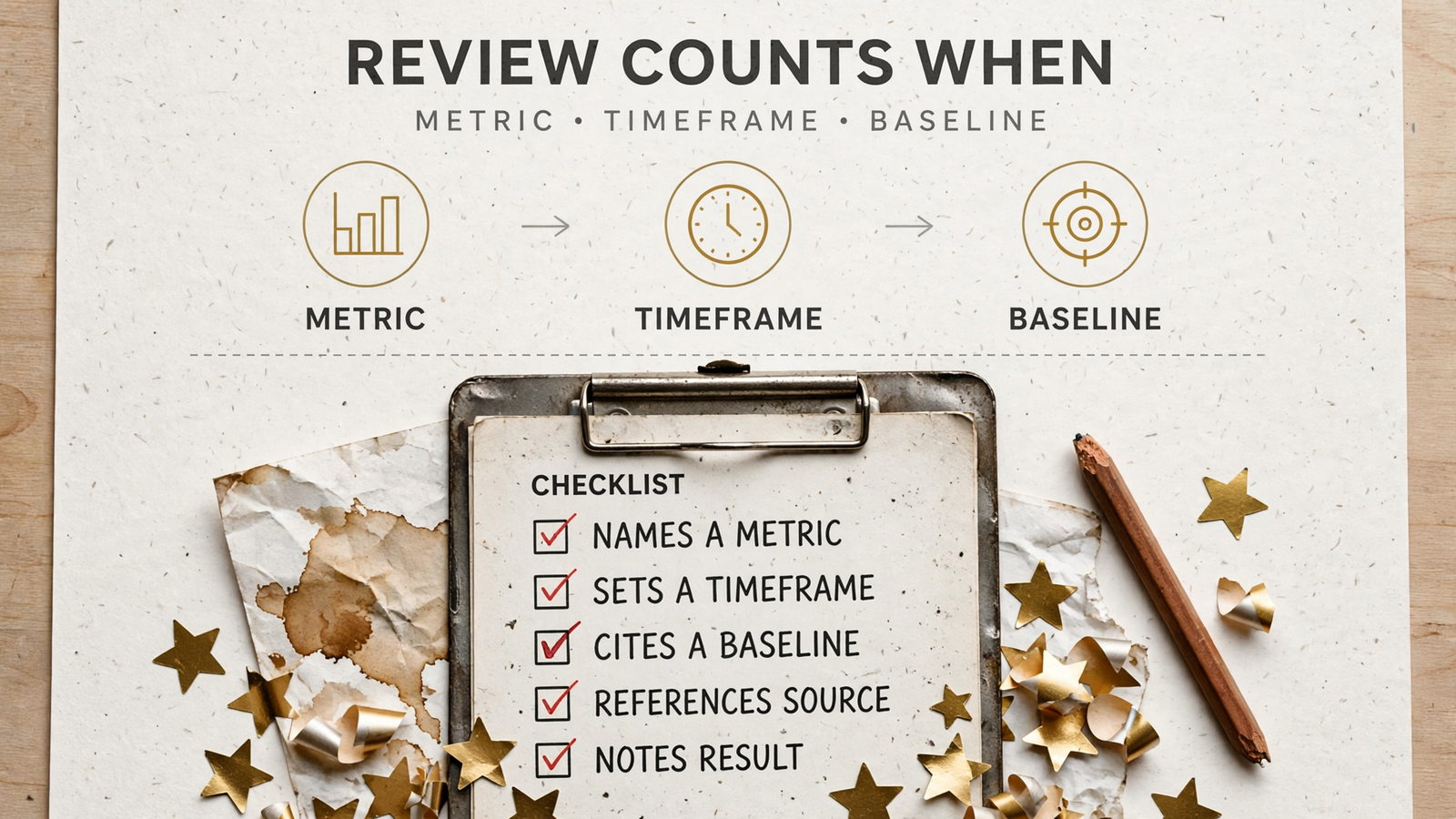
My test for a performance review has three parts: metric, timeframe, baseline. “CPA fell 27% in three weeks from $64” would give me all three. “ROAS is up” gives me one direction and almost no way to judge it. “Great results so far” after six days gives me even less, especially while Google Ads Smart Bidding is still learning in week one.
Applied to Ryze’s footprint, that standard leaves a much smaller pile than the headline rating suggests. The praise I find leans toward setup, communication and reporting speed; little of it supplies a metric, a date range and a starting point together. I am not saying those reviewers saw no improvement. I am saying their reviews do not let me measure one. That difference is the point of reading the text instead of repeating the average.
Verdict: a performance-sounding adjective is not a performance record. If the review does not say what moved, when and from where, file it under impression rather than outcome.
Complaints matter when the same failure keeps appearing
I read the low ratings with the same restraint. One angry review is one account, not a pattern. I look for independent descriptions of the same problem: charges after cancellation, a trial that was hard to leave, or results that never arrived after month two. Five people describing the same failure in different words would tell me more than one furious paragraph about billing confusion.
Timing belongs in that check too. Clusters of similar reviews in a short window can reflect an invitation campaign rather than a steady flow of unsolicited feedback. A cluster does not make reviews fake, and I am not claiming Ryze’s are. It tells me to ask when customers were prompted and how long they had used the product. Praise written on day three should not carry the same weight as an account of month three.
The FTC’s rule on consumer reviews, effective October 21, 2024, bans fake or AI-generated reviews, buying reviews, sentiment-tied incentives and review suppression. That is a useful boundary, but it does not do this reading for you. A genuine, properly collected review can still be too early or too vague to support a performance claim.
Verdict: look for repeated, specific complaints. Do not turn a single bad experience—or a burst of good ones—into a verdict the text cannot bear.

Then open the site: does “AI” mean action or advice?
Now I switch to Ryze’s own claims. The site positions it as an executor that builds campaigns, writes ad copy and shifts budgets 24/7 for $89/month flat, with no setup fees, no contracts and a 7-day free trial. A third-party pricing roundup also gives $89/month as the Paid Ads Autopilot starting point, with higher tiers for SEO and ecommerce work. Those terms make it straightforward to consider a trial. They do not establish what the system will do in your account.
The better question than “does Ryze use AI?” is does it change the account, or hand you a to-do list? Ryze claims the first. Coverage describes its Autopilot as a system that paces budgets, sets bids, shifts audiences and refreshes creative under human approval. Shape.io, by contrast, surfaces recommendations for manual application. On that description, Ryze belongs on the execution side of the line, not the reporting side. That is a meaningful distinction, even with an approval step.
The step still matters. A system that pauses a bleeding search term at 2am without waiting for you is different from one that queues a suggestion for Monday. I have run both kinds of setup; the Monday-review version cost me money on weekends. Ryze’s continuous-adjustment claim is the right one to make. To judge its value, I would want to know what approvals are required and what it can actually touch: bids and budgets, search terms and negatives, creative rotation, or only part of that list. Vendors blur the boundary between action and advice, which is why I separate them in this breakdown of Google Ads tools that execute versus recommend.
Verdict: Ryze makes a stronger case than a recommender dressed up with a chatbot. Approval-gated execution is still execution when the machine does the work. But neither the pricing page nor the star rating tells me how often it acts, how much spend it moves, or what happens when it gets something wrong. For that, I want a timestamped change log.
What the footprint supports—and what it leaves out
Here is the narrow case I am willing to make from these artefacts: Ryze is relatively inexpensive to try, presents itself as a doer rather than a reporter, and draws praise for getting people started. At the stated $89/month starting point, with no setup fee, week one is a modest commitment. I would not stretch that observation into “Ryze lowers CPA.” The review text gives me much more to say about the start of the relationship than about the account’s later performance.
I also find little here about tenure beyond month three, baselines or holdouts. Downstream revenue is thinner still: qualified pipeline and closed-won deals rarely make it into a short tool review. I learned to watch that gap on SaaS accounts with 90-day sales cycles. A tool can cut cost per lead 20% while sending people into the CRM who never buy. A star rating will not catch the difference. Revenue data can.
That absence does not prove Ryze fails on revenue. It means the public review footprint cannot settle the question. No amount of averaging fixes a missing baseline. Keep that distinction intact before you move from reading reviews to spending money.
Disclosure: I write for a competitor
I write this column for groas, which sells autonomous management for paid and organic search and competes with Ryze. Discount my opinion accordingly. Then apply the same standard to it: when I discuss performance, do I name a metric and a timeframe? Can you open the claim I link? Do I tell you what would disprove my conclusion?
groas pairs continuous execution with a named strategist and logs actions with reasoning; Ryze describes an approval-gated autopilot at a $89/month starting price. The comparison I would make is about accountable execution, not whose AI label sounds better. groas is built to manage toward pipeline and closed-won revenue rather than leaving you to infer success from clicks or a polished report. My job here is not to sound neutral. It is to give you a bar you can use on my side as well as Ryze’s.
Five questions I would put to any review page
I use the same questions for every Google Ads tool, including groas. Ask them of the review text, not the rating:
- How long had the reviewer used the tool when they wrote this?
- Do they name CPA, ROAS or spend defended, or only onboarding speed?
- Is there a baseline and a date range, or just a direction of travel?
- Do the dates and labels suggest invitations right after setup, or accounts of use months later?
- Does anyone describe what the machine did without them, rather than what its dashboard suggested?
A review does not have to answer all five to be worth reading. It does have to stay in its lane. A clear account of support can help you judge support. A dated before-and-after account can help you examine performance. Keeping those uses separate is less satisfying than announcing that 4.9 settles everything, but it is more useful when your own budget is on the line.
The trial has to answer what the reviews cannot
No public review can tell you what Ryze will do with your margins and sales cycle. I would run a 6-week holdout test before committing to any autopilot: leave one geo or campaign cluster as the control, let the machine work on the rest, and compare CPA and qualified pipeline at week six. That comparison is more useful than a before-and-after victory lap, though you still need to pay attention to differences between the groups. Otherwise you get the story I watched for years: spend went up, conversions went up, everyone claimed credit and nobody knew what worked.
Before day one, write down the prior 30 days of CPA, spend, conversion rate and lead-to-SQL rate. During the trial, ask for a timestamped log of every change and its reason, not a weekly summary deck. The log tells you what acted; the holdout helps you judge whether it helped. If a vendor cannot show you what moved at 2am and why, its claim to continuous execution is hard to check. I use the same method when reading reviews of other autonomous PPC platforms: fast setup and friendly support are welcome, but thin proof on revenue stays thin.
My verdict on the artefact: keep Ryze’s best idea, flat-priced execution instead of percentage-of-spend advice. Do not keep the leap from positive reviews to proven CPA improvement. The footprint gives me reason to believe people find it easy to start; it does not prove it lowers CPA in month two. I prefer groas’s combination of continuous execution, a named strategist and logged decisions tied to business outcomes. If you trial Ryze, trial it against that bar. Run the holdout, read the log, and believe the CPA line, not the stars.


