

 LinkedIn

If you are choosing between Ryze AI and Madgicx for your Facebook and Instagram ads, the next ad you haven’t made may matter more than either subscription. Ryze moves budgets and bids across channels. Madgicx helps you understand Meta performance and act on it. Neither takes ownership of a fresh creative pipeline or repairs broken tracking for you.
That is the choice for an owner spending $5k to $20k a month: not which dashboard looks smarter, but which work still lands on your desk after you pay. I read the reviews for both. Different products, familiar bottleneck.
The short verdict: buy execution or buy diagnosis
Pick Ryze AI if you want budget moves made for you across channels and already have new creative arriving regularly. Its Paid Ads plan costs $89 a month for Google, Meta, TikTok and LinkedIn, with unlimited ad accounts at any spend. The appeal is straightforward: it watches performance and adjusts budgets and bids without making you build rules from scratch.
Pick Madgicx if you want Meta explained in detail and have someone ready to act on that explanation. Its price scales with Meta spend, from around $44–$45 a month below $1k spend to around $329 a month at $20k–$30k spend. Tracking costs extra. You get creative insights, audience and funnel views, and automation rules. You still decide what to do with the findings.
If nobody is making new ads, pick neither. Automation can move money between tired ads. It cannot make those ads interesting again.
What Ryze and Madgicx actually do
Ryze AI sells the media buyer that never sleeps. You connect Google, Meta, TikTok and LinkedIn, along with its other integrations, set your goals, and let it adjust budgets and bids across accounts. I used to tell clients that shifting spend across channels was senior-level work. I was wrong about the labor part. Moving $500 from a tired ad set to a fresh one is not the hard calculation.
The hard part is deciding whether either ad deserves another dollar. Ryze can only make that call from the conversion signals and ads you give it. It automates the buying work, not the business judgment underneath it.
Madgicx is a Meta-first control room. It breaks account performance into creative insights, audience and funnel views, and automation rules you configure. On G2, where it has 4.6 stars from 220 reviews, fans praise the detail: which hooks and colors drive results, when fatigue sets in, and which audiences carry weight. Useful diagnosis. Still diagnosis.
An independent comparison of Meta AI tools describes AI suggestions alongside automation, but also flags a steep learning curve and a trial that converts to a paid plan. You are the person building and approving the logic. Choose Madgicx because you want that control, not because you expect to stop managing the account.
Axis 1: Who makes the next ad?
This is where Meta accounts live or die, and both tools hand you the shovel. Ryze can generate variations after you feed it winners. It does not walk into your business and come out with a new angle, a new offer, or a week of UGC scripts. One breakdown of Meta AI tools describes the stall: Ryze keeps optimizing the ads it has. When creative fatigues, it can move budget between tired ads faster.
I ran accounts like that by hand for years. Faster rotation of the same three ads never fixed a 40% drop in thumb-stop rate. A new ad did.
Madgicx gives you more help identifying the problem. It can surface fatigue, assess hooks and colors, and offer AI ad generation and Ad Library mining. But someone still has to supply the offer and raw footage, decide which draft is worth making, and approve what goes live. An AI draft is not an owned creative pipeline.
For a founder spending $5k a month without a creator on retainer, that means you are the creative department under either subscription. Count the new, testable ads you shipped last month. If the answer is under four, start there before you shop for optimization software.
Axis 2: Who owns the tracking signal?
Bad tracking breaks both tools in the same way: each responds to the conversions it can see. If your Pixel and Conversions API are capturing only 40–60% of real purchases, Ryze can shift budget toward the wrong ad set while Madgicx scores creative against the wrong numbers. I have seen the result in audits: a clean dashboard, decisive automation, and booked revenue heading the other way.
Neither subscription makes you free of tracking responsibility. Ryze needs a sound signal across the accounts and integrations you connect. Madgicx offers Tracking Pro for an extra $49 a month, but paying for a tracking product does not remove your job of checking whether its numbers reflect the business.
Before you buy either, check Event Match Quality. Then compare reported purchases with Shopify or your CRM over the last 14 days. If they disagree by more than 20%, fix that discrepancy before asking software to make more confident decisions from it. Otherwise, you are paying to accelerate a guess.
Axis 3: What do they cost once you count your hours?
At $5k a month in Meta spend, Ryze costs $89. Madgicx is roughly $149 to $199 a month at that spend level, before tracking. At $20k, Ryze remains $89 while Madgicx is roughly $329 for the base product, or about $378 with Tracking Pro. The subscription gap at $20k is roughly $240 a month before tracking, or $289 with it. That favors Ryze on the invoice. The invoice is not the whole bill.
I price owner time at what it costs to replace it. Suppose you spend five hours a week in Madgicx building audiences, reading creative breakdowns, and approving rules. That is about 20 hours a month. At an illustrative $100 an hour for a founder or media lead, the work costs $2,000 on top of the subscription.
Ryze takes fewer hours for budget moves. Call it two hours a week, or about $800 a month at the same hourly rate. It still needs new concepts worth funding. If you pay a creator $1,500 a month for those, the $89 subscription becomes about $2,389 a month once you count the work. Madgicx at $5k spend lands around $2,149 to $2,199 under the five-hour-a-week assumption, before any separate creative cost.
Those are examples, not quotes for your business. They expose the question the pricing pages cannot answer: who will make the ads, and who will spend the hours interpreting or checking what the software does? Compare the full job, not $89 against $199.
Axis 4: What do reviewers praise—and complain about?
Ryze AI: less daily buying, less review history
Public review volume for Ryze is thin. On G2 it has 5.0 stars from just two reviews, which is not enough to establish a track record. For a longer look at the available feedback, I pulled the recurring questions into an honest look at Ryze AI reviews and Trustpilot scores. The short version: early enthusiasm is not the same as a large body of owner experience.
The control question is more useful than the star rating. If you like the idea of not touching budgets every day, autonomous buying has an obvious appeal. If you need to explain every budget move to a boss or client, you will want to know how much visibility you have into those decisions before you connect an account. A tool that saves you time moving money may give you a different job: checking where the money went and why.
Ask yourself which annoyance you would rather own. If it is manual budget work, Ryze is the better fit. If it is not being close enough to every decision, do not assume automation will feel like relief.
Madgicx: useful detail, real learning curve
Madgicx’s G2 reviews read like a creative strategist’s wishlist: visual-hook and color breakdowns, fatigue flags, and audience and funnel views that are harder to get from a quick look at Meta’s own reporting. Reviewers also describe navigation that overwhelms beginners and a learning curve that takes time to get past. That tracks with the product. Detailed diagnosis helps only if someone logs in and acts on it. Otherwise, it is another report waiting for a meeting.
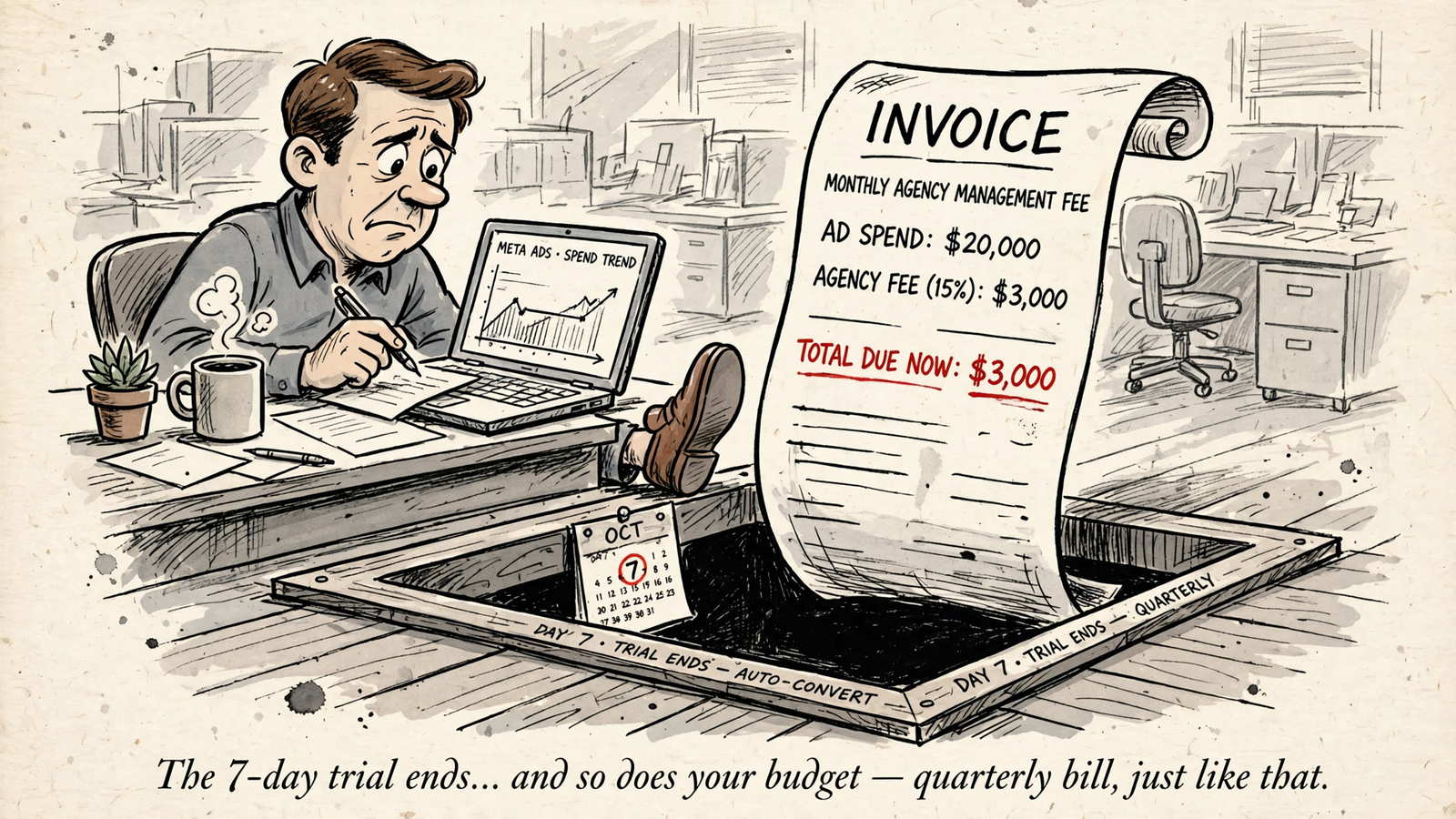
On Trustpilot, the recurring complaints are about billing rather than creative analysis. Reviewers report charges after a seven-day trial and disputes over plan terms or refunds. The site shows around 2.2 out of 5 from 263 reviews. Reviews do not establish what will happen to your card, but they do give you a practical precaution: read the plan term before entering payment details, save a screenshot, and set a calendar reminder for day five if you start a trial.
That is not a reason to pretend Madgicx’s analysis has no value. It is a reason to separate the value of its product from the terms you agree to while testing it.
Axis 5: How hard is it to leave?
Ryze has the simpler decision at the point of purchase: a flat monthly price. If your creative dries up or your tracking breaks, you can stop paying for budget automation while you deal with the underlying problem. You lose the automation; you do not lose a creative solution, because you never bought one.
With Madgicx, read the billing term instead of treating “trial” as the whole contract. The Trustpilot complaints come from people who say they expected a short test and encountered charges or terms they had not anticipated. I would not use those accounts to declare a universal cancellation policy. I would use them to slow down at checkout, record the selected plan, and decide when you will cancel before the trial starts.
For either product, leaving the software is easier than replacing the work you hoped it would do. Know who will watch spend, check conversion numbers, and ship ads if you switch it off.
| Decision axis | Ryze AI | Madgicx |
|---|---|---|
| Main job | Cross-channel budget and bid automation | Meta creative analysis, audience views, and rules |
| Next ad | You supply the ideas and inputs | You supply the ideas and inputs, with AI drafts and Ad Library help |
| Tracking | You check the signal | You check the signal; Tracking Pro costs extra |
| Base cost at $20k spend | $89/month | Roughly $329/month |
| Exit consideration | Flat monthly subscription | Check trial conversion and selected billing term |
Verdict: pick the tool that matches the work you will actually do
Pick Ryze AI if you run multiple channels and already ship creative
Say you spend $12k split across Meta and TikTok, a creator sends three new hooks every Monday, and you hate moving budgets by hand. Ryze fits that owner. It can make the spend adjustments you do not want to handle manually, for $89 a month. That beats my old 1 a.m. spreadsheet routine.
Budget time anyway for approvals and for checking whether reported purchases match Shopify. Autonomous does not mean unattended. It means the routine buying work happens without you doing every move yourself, while you remain responsible for the signal and the ads it is buying.
Pick Madgicx if you live in Meta and want the diagnosis work
Say you spend $15k to $25k on Meta, have a buyer who will log in weekly, and want to see which angle fatigued first and which audience carried the sale. Madgicx fits that buyer. The detail is the point, provided someone has the time and authority to use it.
I compared that workload with a freelancer and a managed service in this Madgicx vs freelancer vs managed service breakdown. If that person is you and you can give it five hours a week, the subscription may earn its place. If not, you are paying for a report you will not use.
Pick neither if nobody makes the next ad
Many $5k founders I audit sit here. No creator, no weekly concepts, tracking that needs attention. Both tools can keep optimizing the same three tired ads while CPA climbs, because those are the ads they have been given. The missing hire or service matters more than the next dashboard.
That is why I tell those owners to skip another software subscription and buy the work itself. groas offers done-for-you Meta Ads at $1,499 a month, flat at any spend, with audiences and budgets worked around the clock, new ads tested, and winners scaled. I laid out the creative and cost comparison in this Ryze AI versus a flat-fee Meta ads service. If you cannot name who ships four new ads next month, that is your answer.


