

 LinkedIn
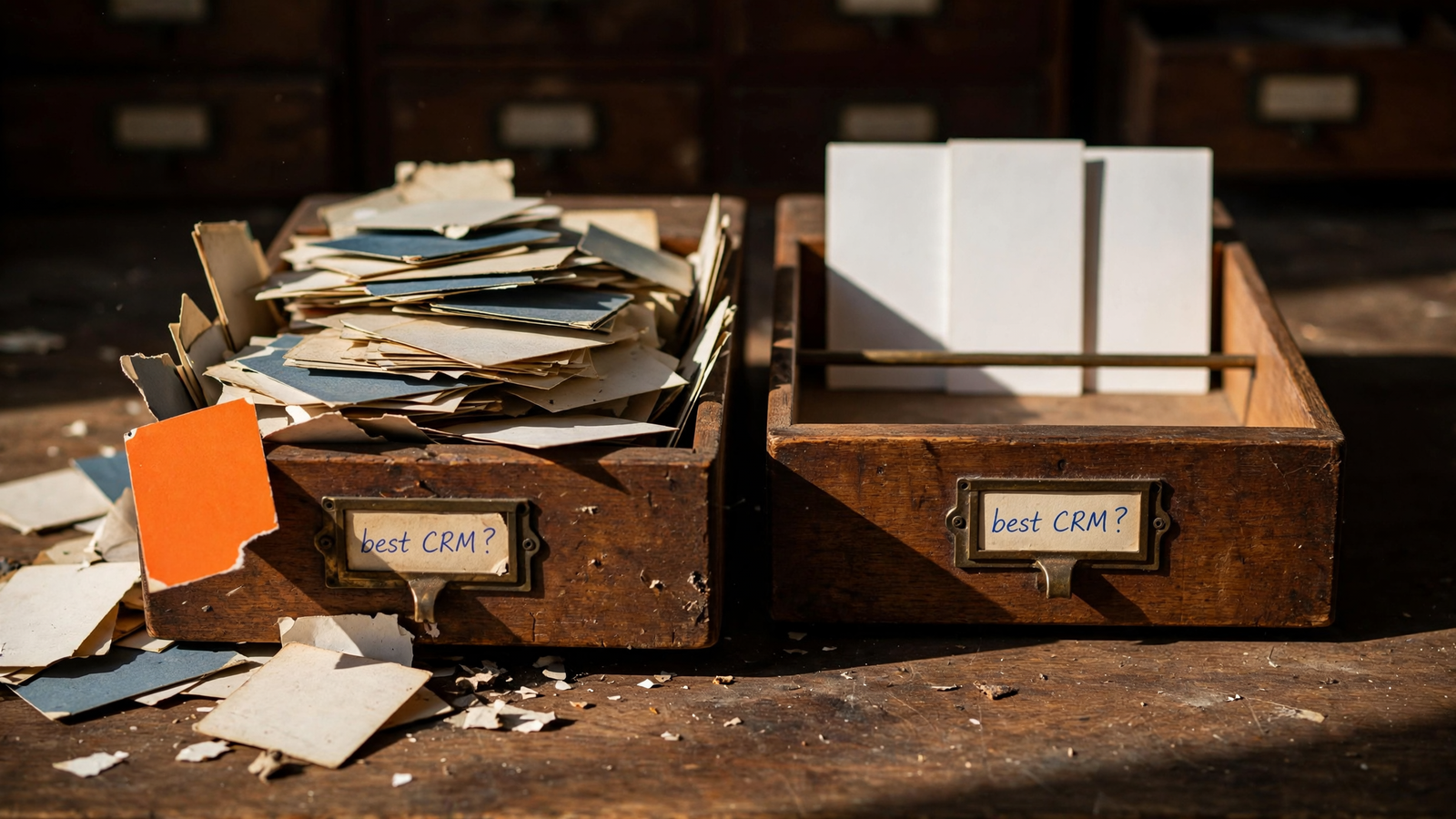
Paste best CRM for a 10-person SaaS team under $100 per user into Perplexity and ChatGPT on the same morning, and you can get two different reading lists. Same words in. Different sources out. Treating “AI search” as one engine hides the reason your page appears in one answer and disappears from the other.
Start with one mechanical difference: Perplexity retrieves live web results for every query, while ChatGPT decides per prompt whether to search or answer from memory. Before either engine can choose a page to cite, it has to retrieve it. ChatGPT has an earlier decision to make: whether to look at the live web at all.
I used to talk about winning “AI search” as if it were one placement. That framing hides three separate questions: did the engine search, did it retrieve your page, and did it cite it? I’ll use that CRM prompt to work through each layer. The fix depends on where the chain breaks.
First, establish whether the engine searched
For the CRM prompt, Perplexity might return a long source list spanning comparisons, pricing pages and discussions. ChatGPT might return a shorter list, different domains or an answer without live sources. Those outcomes do not necessarily say anything about the quality of your page yet.
In one September 2026 test of 80 questions run three times each, Perplexity searched on all 240 answers and cited 19.48 sources per answer, while ChatGPT searched on 216 of 240 and cited 3.05 per answer. Across that test, Perplexity cited 748 distinct sites. ChatGPT cited 218.
That is a finding from one question set, not a forecast for every CRM search. But it exposes the first distinction: Perplexity retrieves first; ChatGPT first decides whether retrieval is necessary. Broader Semrush clickstream data from February 2026 put web search enabled on 34.5% of ChatGPT queries.
I would not use that percentage to predict a specific buyer prompt. I would use it to avoid diagnosing every missing citation as a content problem.
Before arguing about rankings, check whether the engine looked. If ChatGPT answered from memory, rewriting your comparison table does not explain that particular miss.
Retrieval builds two different candidate lists
Once an engine searches, it needs a set of pages to work from. Think of retrieval as the candidate list: a page cannot earn a live citation if it never makes that list.
For Perplexity, the pipeline breakdown describes a process that breaks a question into sub-queries, retrieves full candidate pages and reranks them for topical authority and semantic depth before composing the answer.
Our CRM question contains several needs: a SaaS use case, a 10-person team and a price ceiling. Retrieval can pursue those separately rather than look for one page containing the entire sentence. A pricing page might answer the budget question; a comparison might explain team fit; a discussion might expose a limitation.
That helps explain why a page sitting at rank 12 in Google can still earn a citation. The useful passage matters, not just its position in another engine’s results.
ChatGPT adds another source of variation. One test of 1,000 prompts identified four retrieval pipelines, with 11.6% of prompts switching pipelines across runs. When the pipeline changed, URL overlap fell from 0.273 to 0.149.
I do not need to turn those pipeline names into a new optimization religion. The practical point is simpler: identical prompts can produce different candidate lists before citation selection even begins.
A missing page can be a retrieval problem, not a writing problem. Keep that distinction open until repeated runs show a pattern.
A retrieved page still has to earn its citation
Retrieval decides what an engine can use. Citation selection decides what it actually names in the answer. These are not the same event.
Perplexity tends to attach sources throughout its response. The pipeline notes describe typical answers carrying 15 to 20 citations, compared with 3 to 4 for ChatGPT on the same class of query. For our CRM prompt, that leaves room to cite a comparison grid, a pricing page and a discussion supporting different parts of the answer.
ChatGPT can retrieve considerably more than it cites. The retrieval-versus-citation research summarized here reports different ratios across studies: Ahrefs found roughly 33 pages retrieved with about half cited; AirOps measured about six times as many retrieved pages as cited pages. Different measurements, same operational lesson: making the candidate list is not enough.
Prompt-to-page relevance appears important at this stage. In the reported analysis, cited titles averaged 0.602 semantic similarity to the prompt, compared with 0.484 for non-cited pages. Similarity rose to 0.656 against the strongest rewritten sub-query.
For the CRM page, “Sales Platform Overview” and “CRM for a 10-Person SaaS Team” communicate different levels of fit. The point is not to stuff the buyer’s sentence everywhere. It is to make the page’s actual answer obvious.
Fetched is not cited. A page can be accessible, relevant enough to retrieve and still lose the final selection.
Source preferences help explain the gap, not predict every answer
The next layer is source selection. The engines do not distribute citations evenly across every kind of page.
In the 80-question test, ChatGPT’s most-cited site was Google Search Central documentation, appearing in 58 of 240 answers, followed by arXiv in 44. Perplexity’s top source was Reddit, appearing in 98. On 69 of the 80 questions, no single site appeared in all four tested engines’ citations.
Those are not CRM-specific results. I would use them as a reason to inspect which page types win, not as proof that ChatGPT will always choose documentation and Perplexity will always choose a forum.
ChatGPT also concentrates citations. One citation study found that the top 30 domains within a topic took 67% of citations; for product comparisons, the top 10 took 46%. It also found citations clustering in the top 10 to 20% of a page, while the bottom 10% drew only 2.4 to 4.4%.
For our CRM comparison, that gives me two things to inspect: the authority of the pages being selected and where those pages place their useful answers. It does not give me permission to declare that adding words creates authority.
Use source patterns to choose what to investigate. Do not mistake them for a guaranteed recipe.

Build a citation map before changing the page
One run cannot separate a persistent gap from a different retrieval decision.
In the repeat-run test, two answers to the same question shared 96% of cited sites on Perplexity but only 37% on ChatGPT. Perplexity returned identical site sets in 199 of 240 run pairs; ChatGPT did so in 27 of 206.
Again, those are test results, not promises about your next session. They are enough to make a single screenshot a poor basis for a rewrite.
For the CRM prompt, I use this sequence:
- Run the exact prompt three times in each engine, in separate sessions.
- Record whether each answer used live search.
- Log the cited URLs and domains, plus whether my page or brand appears.
- Label the pages that beat mine: vendor documentation, pricing, comparison or discussion.
- Look for differences that repeat across runs, rather than explain every stray citation.
Now the question becomes useful: which pages repeatedly appear in Perplexity and never in ChatGPT, and what do they answer that mine does not?
I bring that work into the chat where I can act on it. I plug groas into ChatGPT to pull together AI search answers and competitor data. groas also collects the surrounding market continuously: rival ads and funnels, Reddit research, AI answers, and SEO data from Semrush and Ahrefs. That context helps me compare the citation gap with what the competing pages actually say.
For the wider routine, I use the prompt breakdown in 9 Buyer Prompts That Make ChatGPT and Perplexity Cite Different Pages and the ongoing checks in Track AI Brand Mentions Where You Can Act on Them.
Map per engine, per prompt, across runs. An average hides the fix.
If Perplexity cites you but ChatGPT does not
Start with the earliest unresolved step. Did ChatGPT search? If it did, is your page being retrieved? If that is unknown, keep it unknown rather than confidently blaming the copy.
For a repeated citation gap on our CRM prompt, I would check three things:
- Match: Does the title and opening clearly address a 10-person SaaS team with a budget under $100 per user, or merely describe a broad CRM category?
- Placement: Is the direct answer near the top, or buried beneath a company introduction and a tour of features?
- Substance: Does the comparison give testable details, pricing boundaries and limitations, rather than call every option “powerful”?
I would rewrite the title and first 150 words around the buyer’s actual need, provided the page genuinely answers it. Then I would move the fit, price and limitations into that opening section. Specificity has to come from the content, not just the headline.
I would also check access. Blocking GPTBot for training does not automatically block OAI-SearchBot retrieval or ChatGPT-User live fetches. Treat those as separate controls rather than assume one bot rule settles the question.
Make the match explicit, put the answer where it can be found, and check retrieval access. Then rerun the same prompt instead of grading the revision by how much better it sounds.
If ChatGPT cites you but Perplexity does not
Here I would inspect passage-level answerability first. A page can have a convincing title and still make the reader assemble the answer from six sections.
For the CRM example, I would give each buyer sub-question a self-contained passage of roughly 80 to 120 words:
- Who does this CRM fit, specifically for a 10-person SaaS team?
- What does it cost within the stated per-user budget?
- Where does it fall short for that buyer?
These are editing targets, not magic word counts. Each passage needs to answer its own question without borrowing essential context from somewhere else on the page.
That fits the retrieval model: if the engine is evaluating passages against sub-queries, the useful answer should survive being read as a passage. A rank-12 page can compete when its answer is more direct. A rank-1 page does not get a free pass for making the engine hunt.
Fix the passage before expanding the page. More text is not the same thing as a clearer answer.
Do not turn a citation into a verdict
A single ChatGPT miss does not establish that you are blocked, penalized or deindexed. It may mean the engine did not search, retrieved a different candidate list or selected other pages from that list.
My first questions stay mechanical:
- Did it search?
- What did it cite?
- Does the miss repeat across three separate sessions?
Perplexity creates a different temptation. A citation that repeats can feel like the job is finished. But presence is not the same as visibility: a link deep in a long source list is not equivalent to a prominent recommendation.
That limitation applies to both engines. Repeated citations establish repeated inclusion, not buyer attention or a sale. Keep citation coverage separate from business results. Otherwise the report gets prettier while the question you meant to answer goes untouched.
Apply the model to a new buyer prompt
Now take best dispatch software for a 5-truck HVAC company. I do not need a new theory. I need to work through the same chain.
First, I check whether each engine searches. Next, I inspect the sources it selects. Perplexity may pursue pricing, scheduling and mobile-app questions through separate pages. ChatGPT may search and choose an established comparison or vendor documentation. Those are hypotheses to test, not results I can announce before running the prompt.
Suppose the HVAC vendor repeatedly appears in Perplexity and disappears from ChatGPT’s searched answers. I would not rewrite the whole site. I would compare the winning pages with mine, tighten the title to the buyer wording, move the roughly 100-word fit-and-price answer into the top fifth of the page, and add the testable specifics the comparison lacks. Then I would repeat the runs.
If the pattern runs the other way, I would inspect whether the page gives Perplexity clear, self-contained answers about price, scheduling and mobile use. Same model. Different point of failure.
Stop buying one AI search report and calling it coverage. Run the CRM prompt three times in each engine, write down which pages each actually cites, and fix the engine you are missing for its own reason. I keep that loop inside groas because the citation map and the work can live in the same chat. The next runs tell me whether the gap is closing, not merely whether a score moved.


