

 LinkedIn

A mention in an AI answer is a sampled event, not a permanent position. I want to track it inside the assistant I already use, beside my SEO and ads data, so a persistent drop becomes a fix rather than another dashboard notification.
Say I sell project management software to agencies and track 25 buyer prompts across ChatGPT, Claude and Perplexity. My brand appears for 12 prompts, then only eight. A standalone score tells me something changed. It does not tell me whether I lost recommendations, citations or merely appearances in a list.
The useful version arrives with the answers, the competitors named instead and the pages those answers cite. Tracking earns its keep when it shortens the distance between finding a gap and testing a fix. Everything else in this piece follows from that.
Separate the three events hiding inside a “mention”
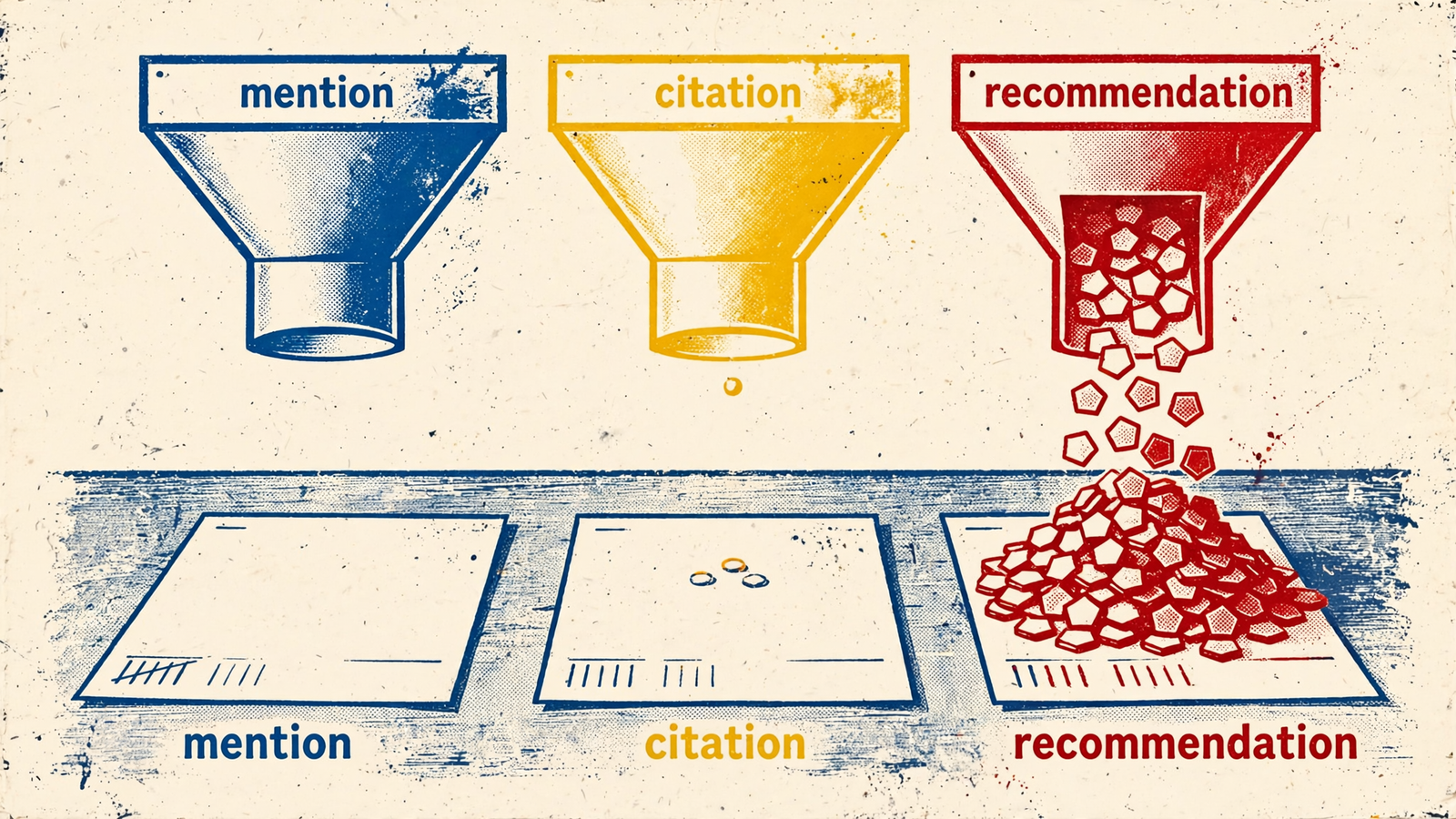
A dashboard can make three different events look like one win:
- Mention: the answer names my brand.
- Citation: the answer links to or credits my site as a source.
- Recommendation: the assistant suggests my product for a specific need.
Practitioners separate these events because one can happen without the others. An answer can name my product without citing it, cite my research without recommending my software, or recommend me through a third-party review.
Take a prompt my example brand cares about: “best project management software for a 20-person agency.” Suppose ChatGPT names my product third, links to a competitor’s comparison page and recommends that competitor.
I earned a mention. I did not earn an owned-site citation or the recommendation. The answer alone does not establish why: a missing link does not prove my page was never retrieved, and a brand name does not reveal whether it came from training or search.
Logging only “mentioned: yes” records a win while hiding two useful gaps. Those gaps call for different work.
Citation ownership matters, too. My pricing page, a G2 review and a Reddit thread praising my product are not interchangeable assets. I can improve the first today. I cannot rewrite the second. The third sits outside my control.
I keep brand-owned citations separate from third-party citations so I do not credit a page edit for visibility supplied by someone else’s review. Mentioned but Not Cited? The Two Pipelines Behind AI Answers explains that distinction in more detail. Make it before interpreting any score.
Track three assistants, not one imaginary ranking
The next layer is the answer’s mechanism. An answer built with live retrieval presents a different opportunity from one produced without a search.
Perplexity generally searches and displays sources, while ChatGPT and Claude can answer with or without searching. That difference changes what a page edit can reasonably accomplish. An improved page can become a better retrieval candidate. It cannot change an answer generated without retrieving it just because I published it this morning.
For my agency-software example, a competitor’s comparison page appearing repeatedly in Perplexity gives me something concrete to inspect. The same competitor appearing in a ChatGPT answer without citations does not give me the same evidence. Same brand, different diagnostic value.
Source patterns also differ. Citation samples show limited overlap between the URLs surfaced by different assistants. A page earning citations in one is not automatically earning them in another. I treat those patterns as context, not permanent rules about which websites an assistant will use.
That means I record whether an answer searched and which sources it displayed, where that information is available. I do not infer the entire retrieval process from the final paragraph.
Keep a separate trend for each assistant. A blended score can hide a useful improvement in Perplexity beneath an unrelated decline in Claude. Averaging them does not make the diagnosis simpler. It makes the evidence harder to use.
Build a repeatable sample before trusting the trend
Answers move. In one January 2026 test, the same recommendation question produced the same list in fewer than one in 100 runs and the same order in fewer than one in 1,000. One answer is a sample, not a settled position.
For my example brand, I start with 20 to 30 real buyer prompts: category questions, problems, comparisons and one or two questions naming the brand directly. Then I use a repeatable protocol:
- Keep the prompt set fixed. Changing the questions changes what the trend measures.
- Run each prompt several times, keeping location, language, device and login state consistent.
- Use the same one or two follow-up turns when they belong in the test.
- Save the full answer and every cited URL.
- Record mentions, citations and recommendations separately, alongside competing brands.
- Compare repeated observations over time, assistant by assistant.
Repeated-run research documents substantial answer and citation drift. The practical response is not a more elaborate-looking score. It is a more consistent sample.
I also state the denominator every time. “Seven of 25 prompts” and “seven of 10 runs for one prompt” describe different things. Both can be useful. Neither should appear as an unexplained percentage.
When a prompt gets repeated runs, I keep those response-level counts beside the prompt-level summary. Otherwise, “appeared for eight prompts” can conceal the difference between appearing once and appearing reliably.
A trend is only useful when I know what was counted and can compare like with like.
Make the report show the work, not just the score
My report needs five things for each assistant:
- The prompt set: what buyers were asking.
- The rates and raw counts: mentions, citations and recommendations, kept distinct.
- The competing brands: who appeared alongside or instead of mine.
- The cited URLs: separated into owned and third-party sources.
- The trend: what changed across comparable runs.
The underlying formulas are straightforward: mention rate counts answers naming the brand; citation rate counts answers linking it; recommendation rate counts commercial answers recommending it. Share of voice compares my appearances with all tracked-brand appearances. Each needs its stated denominator.
For the agency-software brand, “mention rate fell” is the headline. The working brief is more specific: which prompts changed, which competitors appeared and which pages repeatedly earned citations.
That last list is where measurement becomes useful. If a competitor’s agency comparison page keeps appearing while my generic pricing page does not, I have a page to inspect and a question to answer. I do not yet have proof of the cause.
A dropped mention without the answers and sources is a weather report. With them, it becomes a brief. This is the reporting standard I use: enough evidence to choose the next investigation, not just decorate a chart.
Put that evidence beside the data needed to act
This is where the location of the report matters. A tracker can show me a decline. I still need my site, the competitor’s page and the surrounding SEO and ads data to decide what to do about it.
groas collects AI search answers around the clock alongside competitor ads, landing pages and funnels, Reddit discussion, and SEO data from Semrush and Ahrefs. I can query that information from the assistant I already use, connected over MCP or with an API key.
My AI is the brain; groas is the hands and the data. The advantage is not another visibility score. It is keeping the evidence and the ability to act in the same workflow.
I start with two requests:
Show our mention rate in ChatGPT, Claude and Perplexity for the last 30 days, by prompt, with raw counts and the competitors named instead of us.
Then:
Which pages of ours get cited, and which competitor or third-party pages get cited instead?
The first keeps the assistants separate. The second separates a page I control from a review I need to earn. Together, they give me a better starting point than a blended percentage.
groas Unlimited costs a flat $19 a month for unlimited teammates, ad accounts and websites. I would rather put that infrastructure beside my existing work than pay for a separate tracker that still leaves the fix elsewhere.
Autopilot stays off until I switch it on. Every change made through groas is logged with its reason and can be undone in one step. That matters because the next move is a test, not an excuse to let a visibility score rewrite the site unattended.
Turn a repeated citation gap into a page test
Back to the agency-software example. Suppose Perplexity cites a competitor’s comparison page in nine of 10 runs for a valuable prompt, while my pricing page receives no citation.
I now have a repeated gap and a concrete comparison. Because groas holds the answers beside my site and the competitor funnel, I can ask my assistant to inspect the differences: headings, pricing clarity, proof and page speed.
The proposed edit might be specific:
- Add an agency pricing table with seat ranges.
- Add a 60-word section addressing the 20-person agency use case.
- Tighten the title so it matches the question more clearly.
Those are possible responses to the evidence, not a universal citation recipe. I choose the edit that addresses a real gap on the page, ask my AI to make it through groas, and retain the change log and one-step undo.
Then I rerun the same prompts under the same conditions. The loop is observation, diagnosis, edit, repeated measurement. Skipping the last step turns a plausible explanation into a story I have decided to believe.
That is the point of working in one chat. The dropped mention becomes a page test without a second dashboard, a copied spreadsheet and a ticket for next quarter.
Start manually if the method is still unproven
I do not need software to establish whether this is useful for my business. A manual starting protocol uses 10 to 20 buyer prompts, a clean logged-out session and two runs per prompt in ChatGPT and Perplexity. A sheet records the mention, cited URL, recommended brand and competitors.
That is a small starting sample, not a verdict on all three assistants. It lets me learn the distinctions before paying to collect them. This weekly monitoring approach follows the same logic.
When the sheet shows a persistent gap, such as my site cited in two of 10 runs while a rival review page appears in eight, I can bring the prompt set into groas and preserve the counts.
The method stays the same; the handoff disappears. Manual tracking establishes the question. The connected workflow makes it easier to investigate and act without rebuilding the evidence elsewhere.
Know what the sample cannot tell you
No tracker sees inside every buyer’s conversation. AI firms do not publish comprehensive real-user prompt logs, and estimated prompt demand is not a Search Console ranking.
Before trusting a tool’s score, I check which assistants the plan covers, whether collection uses the front end or an API, the refresh cadence and whether the prompt set can stay fixed. Those details define what the sample represents.
I also keep traffic signals separate from answer visibility. A utm_source=chatgpt.com filter can catch ChatGPT clicks, but it misses every mention that produces no click. Bing Webmaster Tools’ AI Performance view covers Copilot and Bing summaries; Google includes AI Overviews clicks under Web traffic. None replaces the answer record.
Repeated answers show a pattern within my test, not the whole market. If I need exact rankings to report upward, this will frustrate me. If I need to see where competitors repeatedly appear and identify something worth improving, it is useful.
Connect the workflow, then apply the model to a new case
I connect the ad accounts and website once, then add groas to my assistant over MCP. The ChatGPT connection uses a custom connector and sign-in; the same conversation becomes a place to ask about ads, SEO and AI answers.
I run the two requests above, inspect the underlying answers and leave autopilot off unless I deliberately enable it. Connecting the tools does not replace judgment. It puts the evidence beside the controls.
Now suppose I run an HVAC company in Austin rather than a software business. I track 15 prompts, including “best furnace installer for a two-story home.” In week three, Perplexity cites a competitor’s checklist in eight of 10 runs. ChatGPT names my company in six of 10 without a link. Claude rarely searches and names neither company.
The model gives me three different responses.
- Perplexity: inspect the cited checklist against my service page. Look for useful gaps in headings, pricing ranges and proof, then test an edit.
- ChatGPT: record the mentions separately from citations. Keep a citation target in the work queue without pretending the missing link proves why my page was absent.
- Claude: do not prescribe an immediate page fix for answers that did not search. Keep measuring that surface separately.
One gets a page test in the same chat. One gets a citation gap to investigate. One gets left alone for now.
That is what one place buys me. Not a higher score. A shorter path from a dropped mention to the next justified action.


