

 LinkedIn

At $1.8 million in annual search spend, Search Ads 360’s reported 2–5% fee means $36,000–$90,000 a year for software alone. If the job is managing Google and Microsoft from one place, groas Unlimited costs $19 a month, or $228 a year, through the AI you already use.
That gap needs an explanation, not a sales deck. SA360 buys more than another set of campaign tabs: shared measurement, portfolio bidding and enterprise governance can justify its cost. But a small team does not need to buy that whole structure just to compare two engines and move a budget. Here is the bill, the work outside it, and where I would draw the line.
The listed costs: percentage versus flat subscription
Google’s help describes the SA360 fee as a percentage of eligible media spend, with the specific percentage set in the contract. Invoices arrive monthly for prior-month usage and show % Media Spend as a line item.
There is no public rate card and no universal minimum threshold published. Independently reported deals fall around 2–5% of managed search spend. Treat that as a planning range, not a quote: the percentage you pay is negotiated through Google sales or a partner.
| Line item | Listed cost or pricing basis | One-off or recurring | Source |
|---|---|---|---|
| SA360 platform fee | Reported range of 2–5% of managed search spend; actual rate negotiated | Recurring, billed monthly on prior-month usage | Reported range and worked example |
| SA360 invoice basis | Percentage of eligible media spend, defined in the contract | Recurring monthly | Google help |
| SA360 public rate card / minimum | No universal public rate card or minimum published | Quote through sales or a partner | Practitioner comparison |
| SA360 worked example | $45,000 a year at 2.5% of $1.8 million in annual spend | Recurring platform fee | Reported example |
| groas Unlimited | $19 a month flat; unlimited teammates, ad accounts and websites, every feature and all the data | Recurring subscription | groas pricing |
The scope matters when you request a quote: spend commitments, engines, regions, measurement requirements and the seller all belong in that conversation. Ask whether Floodlight and Campaign Manager 360 work sit inside the quoted scope or outside it. There is no checkout page because the price is the contract.

What SA360’s percentage actually buys
For that percentage, you do not automatically get better ad copy. You get cross-engine campaign management, portfolio bid strategies that apply a target across campaigns and engines, and budget strategies and plans that help allocate spend.
The more consequential part is shared measurement through Floodlight, including its connection with Campaign Manager 360 and DV360. That gives teams a common conversion basis rather than leaving each engine’s own reporting to settle the argument about which campaign earned a sale.
That distinction matters. A dashboard that puts two CPA columns beside each other is useful. A measurement setup that changes the conversion signals used for bidding does a different job. I would not pay an enterprise fee for the first and assume I had bought the second.
The profile where SA360 makes sense is specific: high six figures to eight figures in annual search spend, thousands of keywords, and multiple business units, regions or brands needing consistent governance. For a smaller Google-only account, the same structure can be an unnecessary fee.
Pay for the measurement and operating structure you need, not the number of tabs you can consolidate.
What the $19 groas connection covers
With groas Unlimited at $19 a month, you connect your ad accounts and website once, then add groas to ChatGPT, Claude, Cursor, Gemini or another AI agent over MCP. Your AI is the brain; groas supplies the hands and the data.
Through that connection, your AI can read and change Google Ads, Microsoft and Bing Ads, Meta Ads and ChatGPT Ads, alongside SEO and AI search visibility. The subscription includes unlimited teammates, ad accounts and websites. No seats. No per-account meter running in the background.
For the narrower job of cross-engine management, that changes the buying decision. You can ask your AI to inspect the accounts, compare performance and make changes without buying a separate enterprise interface priced against media spend.
A useful starting prompt is:
Through groas, compare Google and Microsoft Ads CPA by campaign this quarter and propose budget shifts.
The mechanism matters more than the phrasing. groas gives your AI live account access for reads and writes, plus data collection it cannot do on its own. That includes competitor ads on Google and Meta, the landing pages and funnels behind them, customer conversations on Reddit, AI answer mentions, and SEO data from Semrush and Ahrefs.
Connect your AI to that workspace, and it can work from your account numbers rather than ask you to paste another spreadsheet. The price stays flat when you add another account.
The annual bill as spend grows
A percentage looks small until you apply it to the whole year. At $20,000 a month in search spend, the reported SA360 range adds $4,800–$12,000 a year in software costs. At $100,000 a month, it becomes $24,000–$60,000.
The table below applies the same reported range to each spend level. It is arithmetic, not a set of SA360 quotes.
| Annual search spend | SA360 at 2% | SA360 at 5% | groas Unlimited at $19/month |
|---|---|---|---|
| $240,000 ($20,000/month) | $4,800/year | $12,000/year | $228/year |
| $600,000 ($50,000/month) | $12,000/year | $30,000/year | $228/year |
| $1.2 million ($100,000/month) | $24,000/year | $60,000/year | $228/year |
| $1.8 million ($150,000/month) | $36,000/year | $90,000/year | $228/year |
At $1.8 million in annual spend, the reported 2.5% example comes to $45,000 a year. That is the tool bill, not the media bill.
I cover the same budgeting trap in my Google Ads agency pricing comparison: a percentage feels modest until it becomes a recurring annual total.
For one to five accounts on Google and Microsoft, groas wins decisively on price. The remaining question is whether you need something beyond that cross-engine operating job. Make the enterprise requirement explicit before accepting the enterprise bill.
What your AI reads, proposes and changes
Through groas, your AI can inspect campaigns, ad groups, keywords, bids, budgets, search terms, conversion actions and campaign performance. It can then use the market data around those accounts: competitor ads and offers, landing pages, funnels, Reddit conversations, AI answer mentions and SEO data.
That supports practical account work:
- Compare Google and Microsoft campaign performance.
- Propose budget shifts between engines.
- Pause underperforming ads or campaigns.
- Add negative keywords and test new copy.
- Build campaigns using the connected account data.
The point is not another report to export. It is the connection between reading the account and acting on it. That is also the distinction behind my comparison of Skai, Marin, SA360, Optmyzr and groas by who makes the decision.
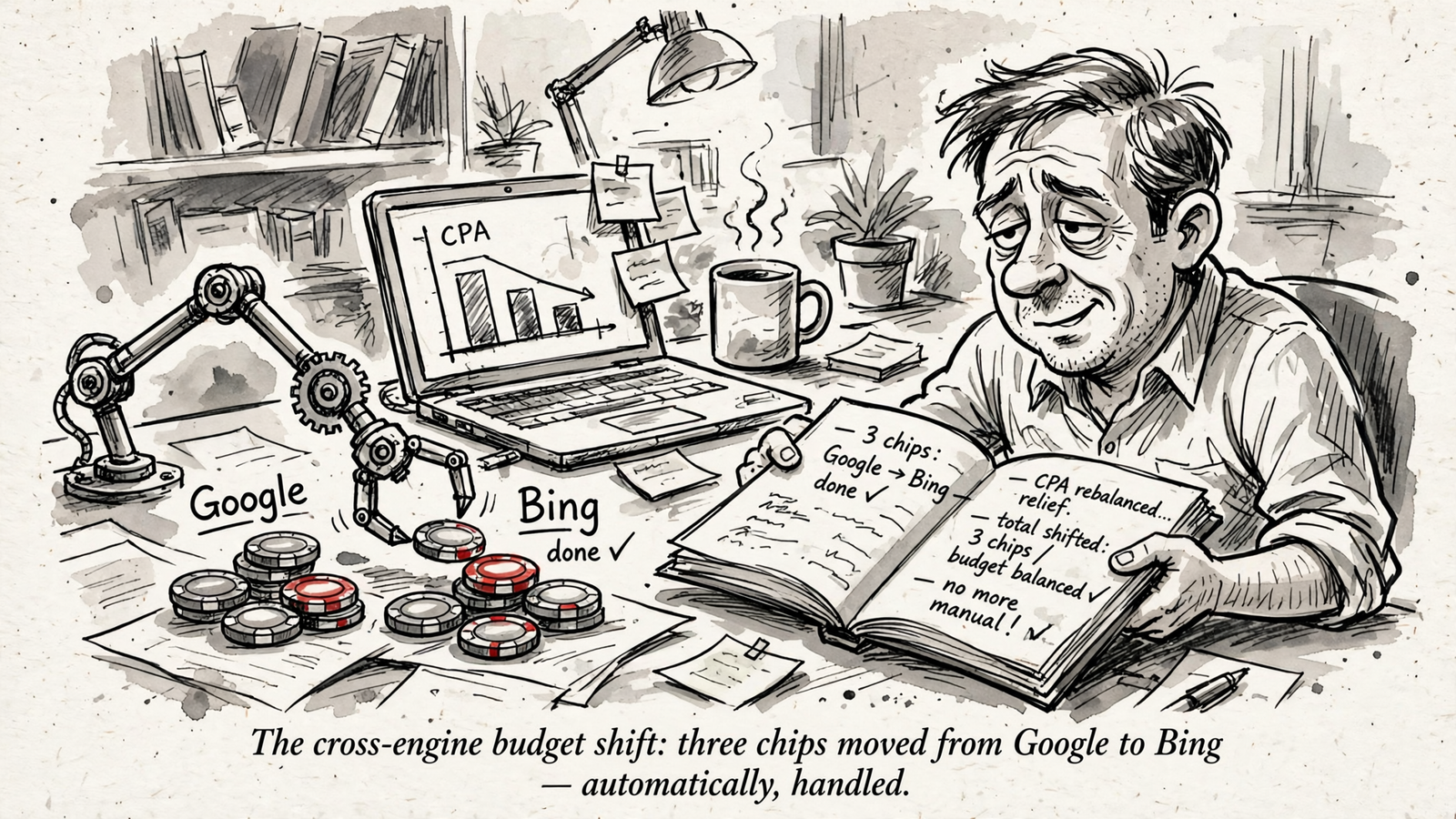
Autopilot stays off until you switch it on. Every change is logged with its reason, and any change can be undone in one step.
My starting approach is read first, write later: have the AI inspect and propose for two weeks, then allow changes on one account and check the log each morning. That is a way to evaluate the workflow, not a promise that two weeks proves performance. The log makes the work inspectable; the conversion data still has to be right.
The hidden costs: setup once, oversight repeatedly
The software invoice is only the listed cost. Both approaches require work outside it, but the shape of that work differs.
Separate implementation from ongoing ownership. Otherwise, a low subscription can look effortless and an enterprise contract can look all-inclusive. Neither assumption helps you budget.
| Work outside the subscription | Initial setup | Ongoing responsibility | What drives the cost |
|---|---|---|---|
| SA360 measurement and integration | Floodlight tagging, Campaign Manager linkage, feed and audience connections where needed | Maintaining the setup and its conversion inputs | Sites, measurement scope and existing integrations |
| SA360 operating structure | Learning portfolio logic and configuring budget plans | Owning plans, governance and invoice reconciliation | Engines, regions, business units and approval requirements |
| groas connection | Connecting accounts and websites; setting goals and limits | Reviewing proposals and logged changes | Account scope and how much control you delegate |
| Conversion data in either setup | Checking tags and conversion actions | Keeping inputs complete and avoiding duplication | The condition of your tracking |
SA360 governance gives large teams roles, approvals, labels, templates and change history. Someone still owns the tagging. Someone owns the budget plans. Someone reconciles eligible spend against the invoice each month. What the deck calls governance, the calendar calls meetings.
With groas, the initial work is connecting the accounts and setting your goals, budget limits and operating rules. After that, you review proposals or monitor the changes you have authorized. A flat fee does not remove that responsibility.
Implementation is front-loaded; oversight recurs. So does the platform fee. With percentage pricing, the software bill grows with eligible media spend even when the basic management job stays much the same.
When the enterprise structure earns its fee
I would take SA360 seriously when shared measurement changes how the business bids, not merely how it presents a monthly report.
A team already working across Google, Microsoft, display and social with Campaign Manager 360 has a different problem from a brand running Google plus a small Microsoft test. Floodlight’s shared measurement, portfolio strategies and budget plans belong in that enterprise conversation.
So do the people involved. Multiple business units and regions may need a consistent operating structure. Legal or procurement may require platform-native roles and approval processes. An agency managing 30 client accounts under one governance standard may treat the percentage as an explicit tooling line.
That is a real setup. It is not most setups.
For one brand, two engines and a small team, paying a percentage just to answer “which engine made money?” is an expensive route to a straightforward task. Through groas, that question becomes a prompt against live Google and Microsoft account data. Adding client number 31 does not change the subscription price.
Buy the percentage only when the enterprise structure changes the decisions you can make. If Google represents 80% of spend and Microsoft is a test budget, start with the flat-fee connection rather than an enterprise contract.
What the $19 comparison does not mean
groas is not a replacement for Floodlight shared with Campaign Manager 360 and DV360. This is a comparison of the cross-engine operating job, not a claim that the two products have identical measurement architecture.
If your media plan depends on that full Google Marketing Platform setup and procurement requires its native governance, those requirements belong in the decision. They are more meaningful than a feature checklist with “AI” repeated down the page.
Neither tool fixes broken conversion data. Smart bidding learns from the conversions you send it. Incomplete feeds or duplicate tags give either an enterprise bidder or an AI operator bad inputs to act on.
With groas, keep autopilot off while you establish the rules. Set the CPA target, budget limit and approval expectations before delegating changes. Logged actions and one-step undo make oversight easier; they do not make measurement optional.
Four questions before signing either contract
I would ask these in order. Start with the job, then the operating requirements, then the purchase.
- Which engines and stack do you need? Google and Microsoft account management points toward groas. A wider media operation built around Campaign Manager 360 creates a different measurement requirement.
- How complicated is the business structure? One brand and a handful of accounts is not the same job as multiple business units and regions sharing targets and budget plans.
- Does shared measurement change budget decisions? If competing conversion claims affect how you bid, investigate that measurement requirement directly. Do not confuse a cleaner dashboard with a shared conversion basis.
- Who must approve changes? One person reviewing a log each morning needs a different workflow from a team requiring three sign-offs for every budget move. Buy the governance you will use.

If those answers describe Google and Microsoft, a small team and no CM360 requirement, start with groas Unlimited. Connect the accounts, add groas to the AI you already use, and run the cross-engine comparison against a full quarter of account data. Check the proposed budget shifts before enabling any autopilot.
That test costs $19 a month and tells you whether shared account access answers the question you were considering SA360 to solve. Agencies get the same flat subscription across clients, with unlimited teammates and ad accounts. If you want a senior team to run the work end to end instead, Done For You starts from $5,000 a month.
The cheapest mistake to correct is paying 2–5% of spend for a cross-engine interface when Google takes almost all the budget and Microsoft is a side test. The most expensive is letting that percentage bill grow while duplicated or incomplete conversion data teaches the bidder the wrong lesson.
SA360 is priced for enterprise media spend and earns it in setups that need its shared measurement and operating structure. For many teams, the job they actually need, cross-engine management from one place, now costs a flat $19 through an AI connection. Buy the percentage only when shared measurement changes your bids. Otherwise, connect the accounts and let your AI do the work.


