

 LinkedIn

By day three, the Google Ads campaign you rebuilt on Monday has spent $1,800 for four conversions: a $450 CPA against a $180 goal. The status says Learning, and two smart operators disagree on whether ChatGPT should have write access: one wants to protect the campaign from a panic edit; the other doesn’t want to keep paying for a setup that might be broken. I want the option to act, not permission to tinker. A learning campaign needs protection from speculative optimization, not immunity from intervention.
What write access actually changes
Keep that one campaign on the table. Say you spend $20,000 a month on search. On Monday, you rebuild a core exact-match campaign with fresh ad groups and switch to Maximize Conversions without setting a bidding target. The $180 is what you want to pay for a conversion, not a target you’ve entered into Google Ads. The campaign is pacing at $600 a day, and your manager wants to pause it.
There are two kinds of decisions here. Google’s bidding system makes auction-level decisions on its own. ChatGPT connected through groas can propose account-level edits: a budget change, a negative keyword, a correction to a destination URL. Read-only lets ChatGPT investigate; write access lets it carry out a correction I approve. Neither option stops Google from bidding. The debate is about who can change the setup while the bidder is still calibrating, not who sets the bid in the next auction.
The case for read-only: four conversions don’t justify a rewrite
I used to tell clients to wait two weeks after any relaunch. I was wrong about the exact number, but right about the instinct. Four conversions in three days give me a CPA I can calculate, not one I’m ready to act on. If sales take days to close, some of the clicks I’ve already paid for haven’t had time to convert. In reporting that credits conversions to the click date, the latest days are still incomplete. The spend is already there. Some of the conversions aren’t.
The Learning badge doesn’t settle that question. Google’s explanation of the status describes when the bid strategy is learning; the badge isn’t a verdict on profitability. If the account records few conversions, the evidence can stay thin even after the label disappears. I’ve seen low-volume Target ROAS accounts look permanently stuck because the target restricts auctions so hard there’s little left to learn from. The badge can go away before I have enough evidence to judge the campaign.
There’s another reason to keep my hands off: each new edit makes the last one harder to evaluate. Launch Maximize Conversions on Monday. Panic at Tuesday’s CPA. Set a Target CPA 40% below historical CPA on Wednesday, watch volume dry up, then switch to manual bidding on Thursday. By Friday, I don’t know what Monday’s setup would have done. I’ve managed to spend the week testing my tolerance for a bad dashboard.
Read-only gives me a way to say yes to the investigation without saying yes to another round of changes. I ask ChatGPT for the campaign status, the change history, and the conversion delay. I look at days to conversion in a date range that ended 30 days ago. If a large share of conversions arrived after day seven, I don’t judge the latest week as though it were complete. I check the bid strategy report for the average delay and any estimate of conversions yet to be reported. That gives me an account-specific reason to wait instead of a fixed number of days to recite.
If the manager asks what I’m waiting for, I can point to the delay in this account and explain why I’m not treating four conversions as the final count for those clicks. That’s a better answer than “it’s learning,” and it doesn’t require a budget move to prove I’m paying attention. If all I can point to is early CPA, I read the account and leave the setup alone.
The case for write access: patience won’t fix a dead destination
Learning can explain an ugly stretch of CPA. It can’t explain a final URL that returns a 404. If the client swaps templates and the ad now points to a dead page, waiting doesn’t give that page a chance to improve. The same goes for a quote form that throws an error on mobile or a campaign set to reach the whole United States when the plumber serves Austin. None of those faults needs a bigger conversion sample.
The strongest case for write access is that I can go from a verified diagnosis to one approved correction without treating the whole campaign as a rebuild. The evidence has to match the change. A dead final URL justifies correcting the destination. A change history entry showing the budget doubled gives me a setting to check with the account owner. It doesn’t give me a reason to change the bid strategy while I’m in there.
I start with what the account can show: the configured final URL, disapproved ads, which conversion action is marked primary, when the budget changed, and which search terms triggered ads. Then I check what those records can’t establish on their own. Does the URL load on mobile? Can I submit the form? Does the phone number connect? Did the CRM upload actually run? An account setting can tell me which action is supposed to count. It can’t tell me whether a customer got through the form.
That distinction matters when ChatGPT hands back a finding. “The form might be broken” belongs on the list of hypotheses. A form that throws an error when I try to submit it belongs on the fault list. I don’t have to settle how much that error contributed to the $450 CPA before I address it. I do have to establish that the error exists.
I ask ChatGPT for two lists: observed faults with evidence, and hypotheses about performance. I keep bid and budget recommendations out of that first pass. If it flags jobs and DIY queries, I look at the actual terms before approving negatives. If it flags a budget change, I confirm it was unintended before reverting it. If it flags the form, I reproduce the failure before calling it broken. Then I authorize the smallest change that addresses what I can verify.
Cross-examination: three cases, two corrections
- CPA is high, but I can’t verify a fault. We’re back to $1,800 spent, four conversions, and a $450 CPA against a $180 goal. The read-only side says to let the conversion delay play out before judging. The write-access side has no evidence to justify a pause or a switch to target bidding. A bad screenshot is enough to start diagnosing the campaign while it’s still learning. It isn’t enough to change it. I leave the campaign alone.
- The final URL returns a 404 on mobile. Same CPA, but now the destination fails a direct check, and the change history shows a template swap on Tuesday night. I don’t need the swap to explain the whole CPA gap. I need to confirm that the destination is broken and that the proposed correction sends people somewhere that works. I approve the URL correction, check the destination again, and leave the bid strategy alone.
- The daily budget doubled overnight. The history shows it went from $600 to $1,200, and the account owner confirms the increase wasn’t intended. The change history tells me what happened; the owner tells me whether it was a mistake. Once I have both, the case for reverting it doesn’t depend on whether CPA went up or down. I’m restoring the intended budget, not picking a new one based on three days of results. I approve the revert and decline the switch to target bidding the manager wants to make at the same time.
The difference is what I can verify before I act. In the first case, I can verify the reported CPA, not why it’s high. In the other two, I can point to something specific that’s wrong and check whether the correction put it right. That’s my test, not whether an edit brings back the Learning badge.
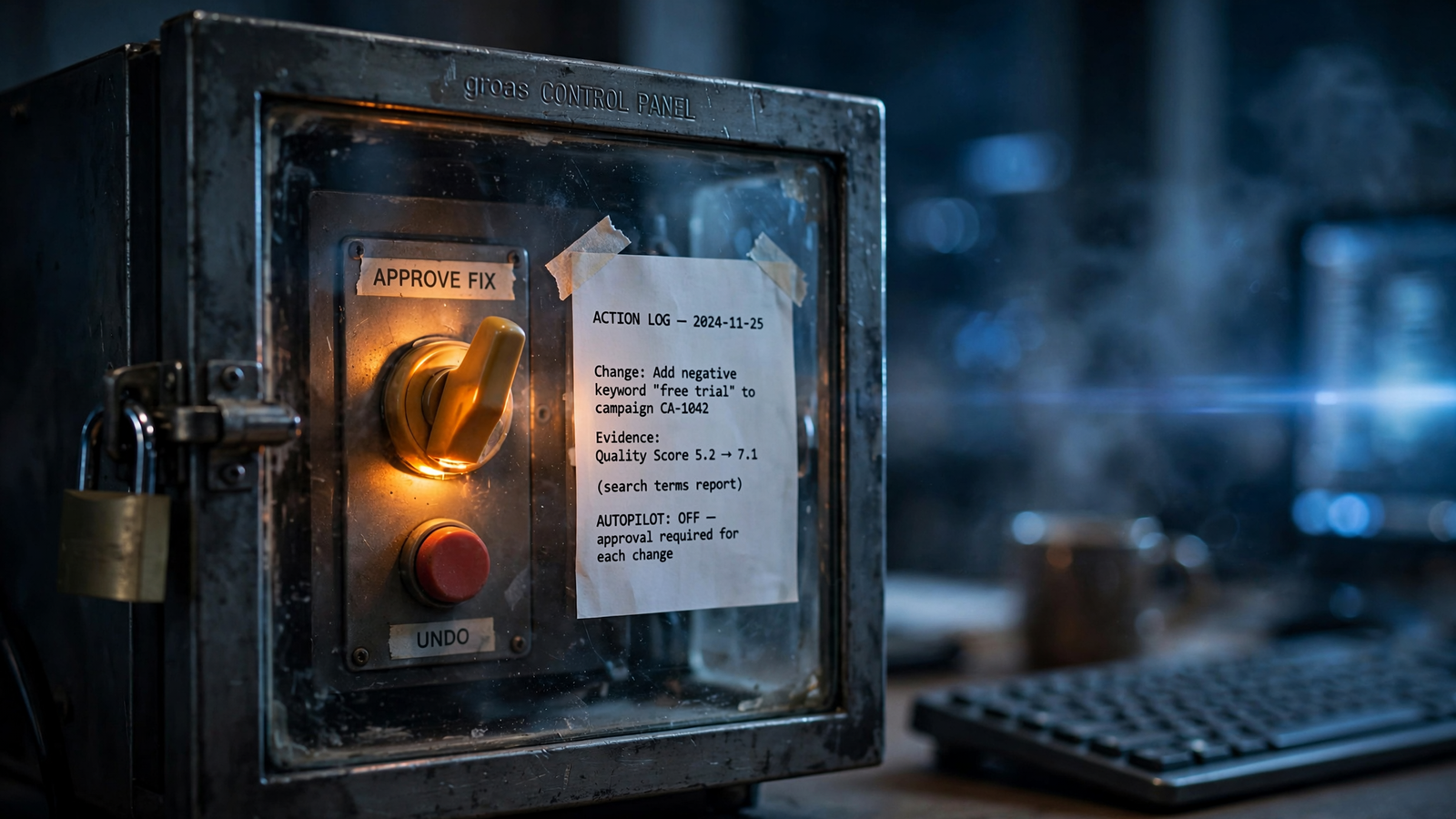
The verdict: give ChatGPT write access, keep approval on
If you run the account and can verify a fault before approving its correction, I’d choose ChatGPT with groas write access over read-only. One consideration decides it for me: the same connection that surfaces the evidence can carry out the narrow fix I approve. A read-only connection can describe the 404 or flag the budget accident, but I have to make the correction separately. I want the option to fix a verified fault while the campaign is still spending. I don’t want to give ChatGPT discretion to decide that an ugly CPA counts as one.
I set the rules before granting access, not in the middle of a bad morning:
- Read first. I require a named campaign, an observed fault, and the evidence behind it before I consider an edit. A CPA above my goal belongs in the diagnosis, not in the fault column by default.
- Approve each write. I keep confirmation for write actions in the workflow, including budget moves, pauses, and new campaigns. Approval for the URL correction isn’t approval to change the budget while the campaign is open.
- Limit budget changes. I set a monthly cap and a maximum step for discretionary changes. At 20%, a proposed increase from $200 a day stops at $240, not $2,000. That cap isn’t permission to raise a budget during Learning. It’s a ceiling, not a recommendation.
- Scope by client. “Pause everything over target CPA” is vague enough in one account. I don’t give that instruction a chance to reach every client I manage.
- Check the log and keep undo available. I check what changed and why. After the approved edit, I verify that the intended setting changed and nothing else did.
I’d leave autopilot off until the intervention rules are explicit. For this campaign, I don’t need it running in the background. I need ChatGPT through groas to read the live account, show me the evidence for one fix, and stop for approval. Afterward, I check the log and verify the result. If the fix was a destination URL, I load the destination. If it was a budget revert, I check the budget. I don’t wait for tomorrow’s CPA to tell me whether today’s edit went through.
I’d put this into the chat before touching the campaign:
Read the campaign status, changes in the last 14 days, and conversion delay. Separate verified faults from hypotheses about CPA. For each fault, show the evidence and propose one narrow correction. If you find no verified fault, propose no change. Wait for my approval before making any edit.
The last sentence is what makes write access worth buying. It keeps a diagnosis from becoming a budget decision just because the agent has the means to make one. Early CPA with delayed conversions gets observation. A dead destination, broken tracking, or an unintended budget change gets a narrow, approved correction once I’ve verified the fault.
So buy the connection that can act, and run it on approval only. The Learning badge deserves patience. A broken setup never did.





