LinkedIn

Tell Claude to maximise AI search revenue and it can give AI credit for a sale it didn’t make. Tell it to maximise share of voice and it can run up citations without changing a single buyer’s mind. So which metric should guide what Claude helps publish? Smart marketers disagree because they’ve seen different versions of the same bad meeting: one where a citation chart passes for a business result, and one where a revenue chart passes for proof. My answer is to optimise for revenue without letting a prediction publish a page. I use share of voice to pick the experiment and observed business outcomes to decide whether it deserves more budget.
Semrush’s AI-influenced traffic metric makes that distinction worth settling now. In a Semrush survey of 481 marketers, 49% named measuring AI’s impact on pipeline or revenue as their top challenge. I used to tell clients to wait for cleaner attribution. I was wrong. I need a rule for Claude before I give it a target and permission to publish, not after it comes back with a plan.
Here’s what Semrush puts on the table: a predictive estimate, not a count of observed referrals. The model learns from aggregated activity linking brand mentions to site visits within 24 hours. It covers direct visits from people typing in the address, branded organic search and citation clicks. Semrush puts the estimate next to organic traffic, mentions and citations in Organic Rankings 2.0 so I can compare domains and topics. It’s an attempt to fill in the middle of the story: what happens between showing up in an answer and seeing something in the revenue report.

The case for revenue: a citation isn’t a commercial result
Citations are cheap. A page gets cited, the dashboard turns green, and nobody asks whether a buyer made a different decision because of it. I’ve watched that slide too many times. The best argument for revenue is that it forces me to ask what happened after the mention. If all I can show is that the brand appeared in more answers, I’ve got an impressions deck with a new haircut.
The revenue advocate doesn’t need to pretend attribution is clean. Ahrefs lays out why it isn’t: stripped referrers can make visits look direct, a complete answer doesn’t need a click, and buyers don’t always say they used AI. The IAB attribution debate runs into a related problem. An answer that helps someone work out what they want doesn’t play the same role as an answer that helps them choose whom to buy from. The available data doesn’t always let me tell the two apart.
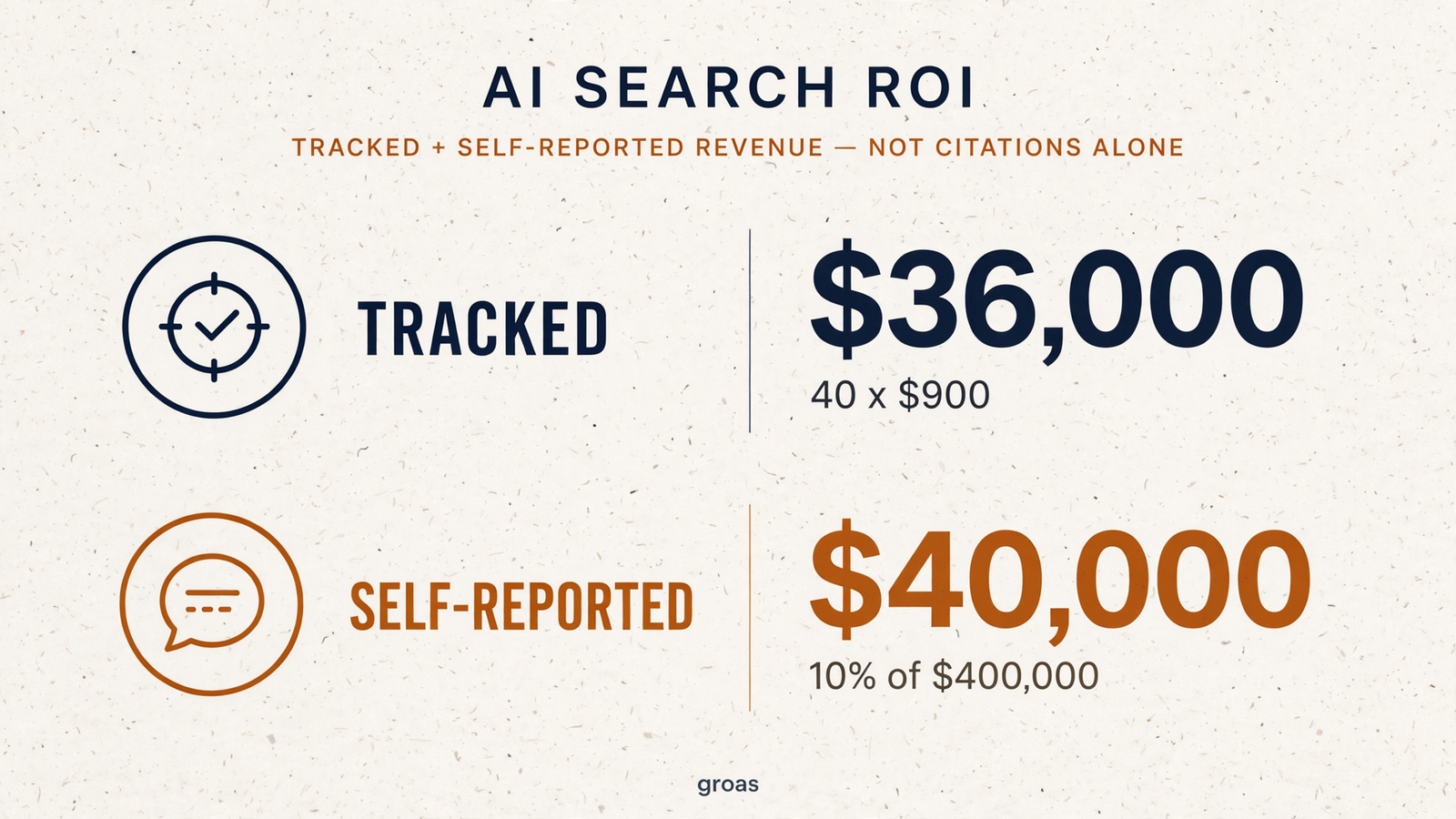
I’d still rather work with an estimate I can challenge next quarter than a visibility score nobody has to defend. Keep tracked outcomes and buyer-reported influence separate. If there’s revenue attached to each, I report it side by side. The first tells me what I can see in the journey. The second tells me what the buyer says mattered. If the same sale shows up in both, that doesn’t make it two sales. Neither needs to be rolled into one heroic number for the board deck.
With Claude connected to groas over MCP, I’d have Claude read the GA4 outcomes I bring to the review alongside the AI answers and citations groas tracks. My reporting order is tracked conversions first, revenue associated with buyer-reported AI influence second, and Semrush’s modelled traffic estimate third, if I have it. That gives the estimate a place without asking it to do the job of the other two. groas Unlimited is $19 a month flat for unlimited teammates, ad accounts and websites, with every feature and all the data included and no cut of ad spend. I don’t want a second SEO stack just to put visibility and outcomes in the same review.
The case for share of voice: I have to pick a topic before revenue comes in
A B2B page I publish today might not produce a qualified opportunity for 90 days. By the time finance agrees AI had anything to do with it, I’ve missed ten publishing decisions. That’s the strongest argument for share of voice. It’s not that mentions matter more than money. It’s that the signal I need to pick a test has to arrive before the result.
The old case for excess share of voice is that brands whose visibility runs ahead of their market share tend to gain share. The rough rule is half a point of annual market-share gain for every ten points of excess share of voice. I wouldn’t put that rule into a forecast for AI search. What carries over is the reason to look at the answer itself: 83% of AI Overviews and 93% of AI Mode results are zero-click. If a buyer gets what they need without clicking, the answer is where I can see whether my brand was even in the running. Waiting for a closed deal to tell me which of those answers to look at is waiting too long.
I use prompt-level share of voice the way I use a negative keyword report: I look at the individual entries, not just the number at the top. With Claude and groas, I can build a share-of-voice report I can actually defend. Show me a buyer prompt where a competitor gets cited and I don’t. Quote the answer. Tell me what the competing page gives the buyer that mine doesn’t. Now I have something I can argue with. A score that says I’m behind doesn’t give me an editorial brief. One missing answer, for one recognisable buyer intent, might.

My verdict: optimise for revenue, but don’t let a model approve publishing
For a team using Claude to decide what to publish and where to put the next round of content budget, I rule for revenue as the objective. The deciding consideration is what evidence I’m willing to spend more money on. A citation gap is enough to make me look. It isn’t enough to make me commission a cluster. A modelled visit doesn’t clear that bar either.
Take the 24-hour window. A buyer who already picked me can type the brand name the morning after reading a Reddit thread. A homepage citation can coincide with a branded search I paid for in Google Ads. The estimate can tell me something may have shifted around the brand. It can’t tell me that a particular answer sent that buyer to a particular page, much less that writing five more pages will produce five more sales. That isn’t something I can fix by writing Claude a better prompt. It’s a limit of the input.
The answer itself can change just as quickly. SISTRIX measured a 47% citation shift in 48 hours after ChatGPT switched to GPT-5.5. Citations to major publishers fell by as much as 90% while Google rankings held steady, according to the analysis reported by WSIDM. That tells me the citation map can move when the model changes. It doesn’t tell me buyers suddenly want something different. If Claude responds to every bump with another batch of briefs, I’m funding churn.
So I give Claude three separate gates:
- Research: Use the tracked answers groas collects to find one prompt-level citation gap worth testing. Share of voice gets the idea onto the list.
- Publishing: Approve one page for one buyer intent. A human signs off. No autopilot.
- Expansion: Review tracked conversions and qualified pipeline alongside what buyers report about AI’s role. Those outcomes decide whether the test earns more budget. A visibility gain on its own doesn’t.
One distinction matters in that setup: groas gives Claude access to my connected accounts and site, tracked AI answers, competitor ads and funnels, Reddit research, and SEO data from Semrush and Ahrefs. It does not supply Semrush’s modelled AI-influenced traffic number. I paste that in if it helps explain what I’m seeing. I don’t make it the scoreboard.
Give Claude one brief and review it on two clocks
“Grow AI revenue” leaves Claude to guess what counts as success and what it’s allowed to do about it. I give it a smaller job with a hard stop. Once groas is connected, this is the brief I’d use:
Using groas data for my site and competitors, find one buyer prompt where a competitor is cited in AI answers and I’m not. Propose one page that could fill the gap. State the buyer intent in one sentence, quote the competing citation, and list the facts the page needs to cover. Stop there. Ask for approval before drafting. Do not publish.
That gives me the prompt, the rival and the missing answer before anyone writes a page. I can reject the brief if the gap is real but the buyer intent isn’t worth chasing. And if I approve it, Claude still doesn’t get to turn one approved brief into a publishing queue. Approval to draft isn’t approval to publish, and approval to publish one page isn’t approval to write the next one.
I review the test on two clocks because earning a mention and earning more budget are different jobs:
- At 30 days, check the answers. I use the share-of-voice report to see whether the page earned tracked citations or appeared in answers for the target prompts. This is the research read. It tells me whether I moved the visibility signal I set out to move. It doesn’t make the page a commercial winner.
- At 90 days, check the business outcomes. I look in GA4 and the CRM for assisted conversions and qualified pipeline where the page appeared in the journey. I also check what buyers say about AI in post-purchase surveys and keep those reports separate from what tracking shows. I’m deciding whether the topic family deserves more budget, not claiming the page caused every sale it touched.
Say the page earns a citation by day 30, but at day 90 I can’t find it in a conversion or qualified opportunity, and buyers haven’t reported AI influence. I can record a visibility win without calling it a business win. That doesn’t prove the page did nothing. It means I don’t have the evidence I asked for before spending more.
I write the expansion rule down before Claude starts: one winning page earns one follow-up brief; three winners earn a cluster; zero winners after two tests means I pause AI search publishing for that topic. Say I’m spending $20k a month on content and dev time. I want to agree what earns the next brief before a nice-looking 24-hour lift turns into a 12-page commitment.
I keep autopilot off for publishing at the start. groas supports autopilot under rules I set, with changes logged and undoable. That’s exactly why I set the approval boundaries, voice rules and undo path first. Claude proposes the work, I approve it in plain English, and groas carries out the change I authorised. The fact that it can do more isn’t a reason to let it.
My verdict for the next planning call: let share of voice choose the experiment, let observed business outcomes decide the budget, and never let a prediction publish a page.