

 LinkedIn

Stop asking Claude for one CPA across Google and Bing. Google can pull the average down in the same month Bing gives you a reason to open the account.
Take a hypothetical $20,000 monthly budget. Google spends $17,000 and gets 340 conversions at $50 CPA. Microsoft spends $3,000 and gets 30 conversions at $100 CPA. The blended CPA rounds to $54. Next month, on the same budgets, Google improves to $48 while Microsoft slips to $130 because two search terms start matching junk. The blended CPA still drops, to about $53. If Claude leads with that number, I can thank it, close the chat, and miss the only thing in the report that needs my attention.
I used to hand clients the blended number and call it reporting. I was wrong. The Microsoft account has a problem here, but it’s my report that lets the problem sit. Google drives enough volume to pull the average down while Bing gets more expensive. The report calls that improvement. I want Claude to show me what got worse, even when the headline got better.
Connect both accounts. Keep the reports separate.
This is where groas earns its keep. I plug Claude into groas over MCP so it can read both accounts in the same chat. I don’t have to build a refresh pipeline or re-export a CSV every time I want fresh numbers, two of the Google Ads workarounds Coupler.io documents for ChatGPT. I want one place to ask the question, not one number that answers it for both accounts.
I start with this:
Claude, use groas to read Google account [ID] and Microsoft Advertising account [ID]. Do not make changes. Show each account separately before comparing them.
MCP gives Claude access. It does not make the accounts equivalent. I put “show each account separately” in the opening request because a single summary can make two different conversion setups look like a single measurement system. I put “do not make changes” there for the same reason I don’t act on the first number in a report: I haven’t seen the evidence yet. The first pass is for reading, not touching the account.
Make Claude show what it counted before it divides
Google lets me set a conversion action to count Every conversion or One conversion. Counting every sale after a click can make sense for purchases. Counting one lead per click can make sense for lead generation. Both numbers can sit under a column called “Conversions,” and neither label tells me what went into the number. That’s before I get to which actions each account includes or which dates it reports them on.
I ask for the denominator before I ask for CPA:
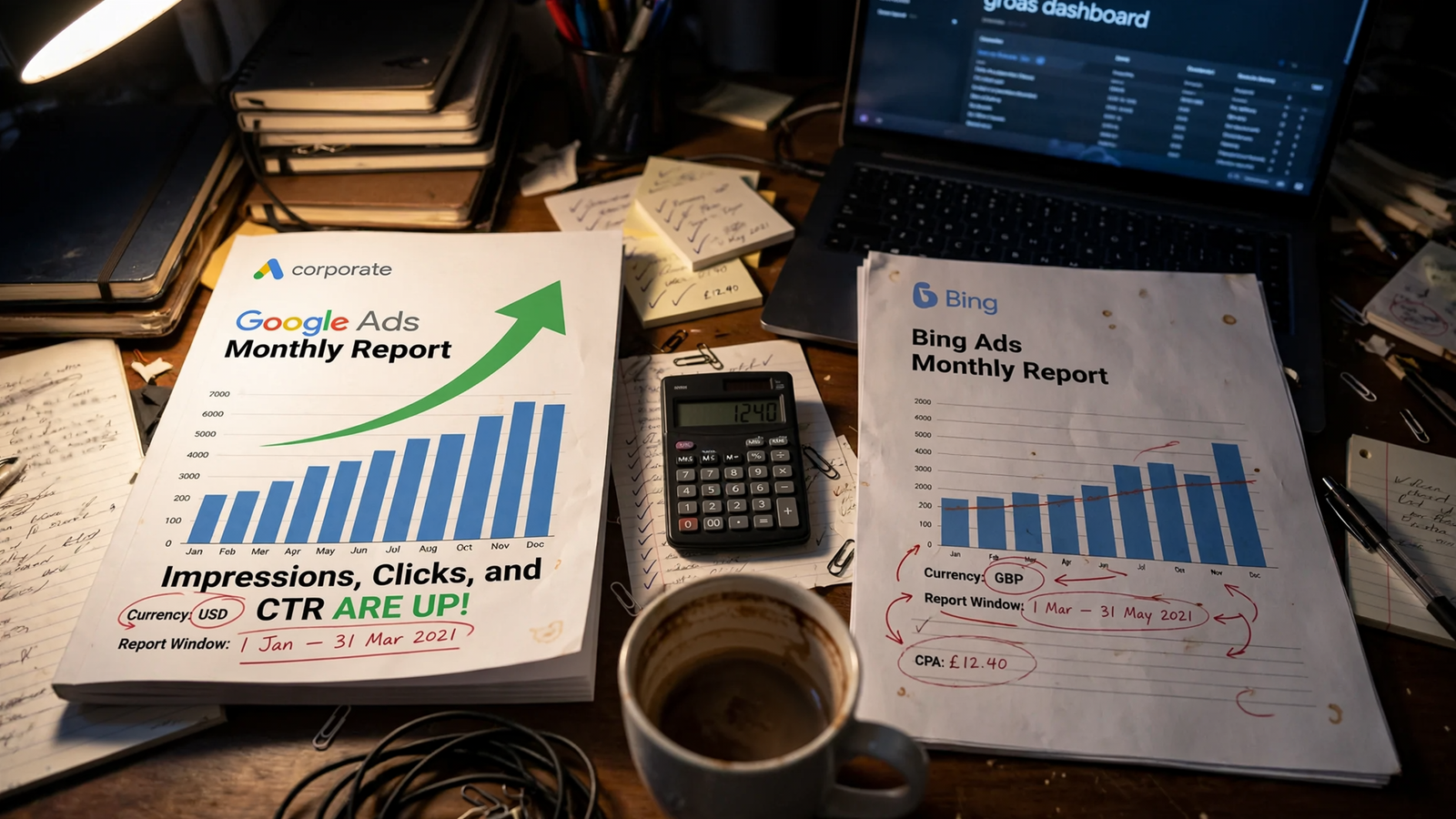
List each platform’s included conversion actions, reporting window, currency and attribution settings where available. Mark missing information explicitly.
If Claude can’t tell me what it counted, I don’t want it telling me what a conversion cost across both accounts. “Not available” is a useful answer. At least I know where the report stops and the guesswork starts.
A purchase and a phone call aren’t the same outcome
Google counts purchases. Microsoft counts phone calls and form fills on imported goals someone set up two years ago and forgot. Claude adds 340 purchases to 30 calls, divides spend by 370, and hands me a cost per acquisition. It has 370 recorded events, not 370 of the same outcome. A call isn’t a closed sale, and the arithmetic doesn’t tell me how many calls turn into one.
I know this trick from brand versus non-brand reporting: efficient brand traffic can mask weak prospecting. In two 90-day audits, non-brand CPA ran 2.1x and 1.5x the blended number. The cross-platform version can hide the same performance gap and give me a second problem: the cheaper and more expensive rows might not even measure the same outcome. I keep them split before deciding which spend deserves more budget.
Even two purchases can be one sale
Say someone clicks my Google ad on Monday, clicks my Bing ad on Tuesday, and buys on Wednesday. Both platforms can claim the purchase. If I sum the columns, I give myself two sales from one transaction. Even without that overlap, a report that uses click date instead of conversion date can put credit in a different reporting period.
Matching action names isn’t enough to combine the counts. I need the same action, the same window, the same currency, and no double counting. If I can’t establish that, Claude should withhold the combined CPA. That refusal is the report working. It’s the same reason one shared connection can leave an $80 CPL meaning two different things.
Ask for a reconciliation table, not an executive summary
I ban the executive summary for the first pass. I want the table underneath it:
Show spend, conversions and CPA separately by platform and campaign. Label each comparison valid, conditional or unsupported. Explain why.
- Valid: The rows count the same action over the same window, in the same currency, on a consistent reporting and attribution basis.
- Conditional: The action matches, but a difference in attribution or reporting date limits what I can infer from the comparison. Name the difference next to the row, not in a footnote three screens down.
- Unsupported: The rows measure different outcomes, such as purchases versus calls and form fills. A combined CPA is also unsupported if I can’t tell whether both platforms claimed the same sale.
The labels apply to the comparison, not to the campaign. An unsupported head-to-head CPA doesn’t mean I throw out the Microsoft row. I can still look at what Microsoft spent to get the calls it counted, and which campaigns accounted for that spend. I just don’t rank that row against Google’s purchases as though the numbers answer the same question.
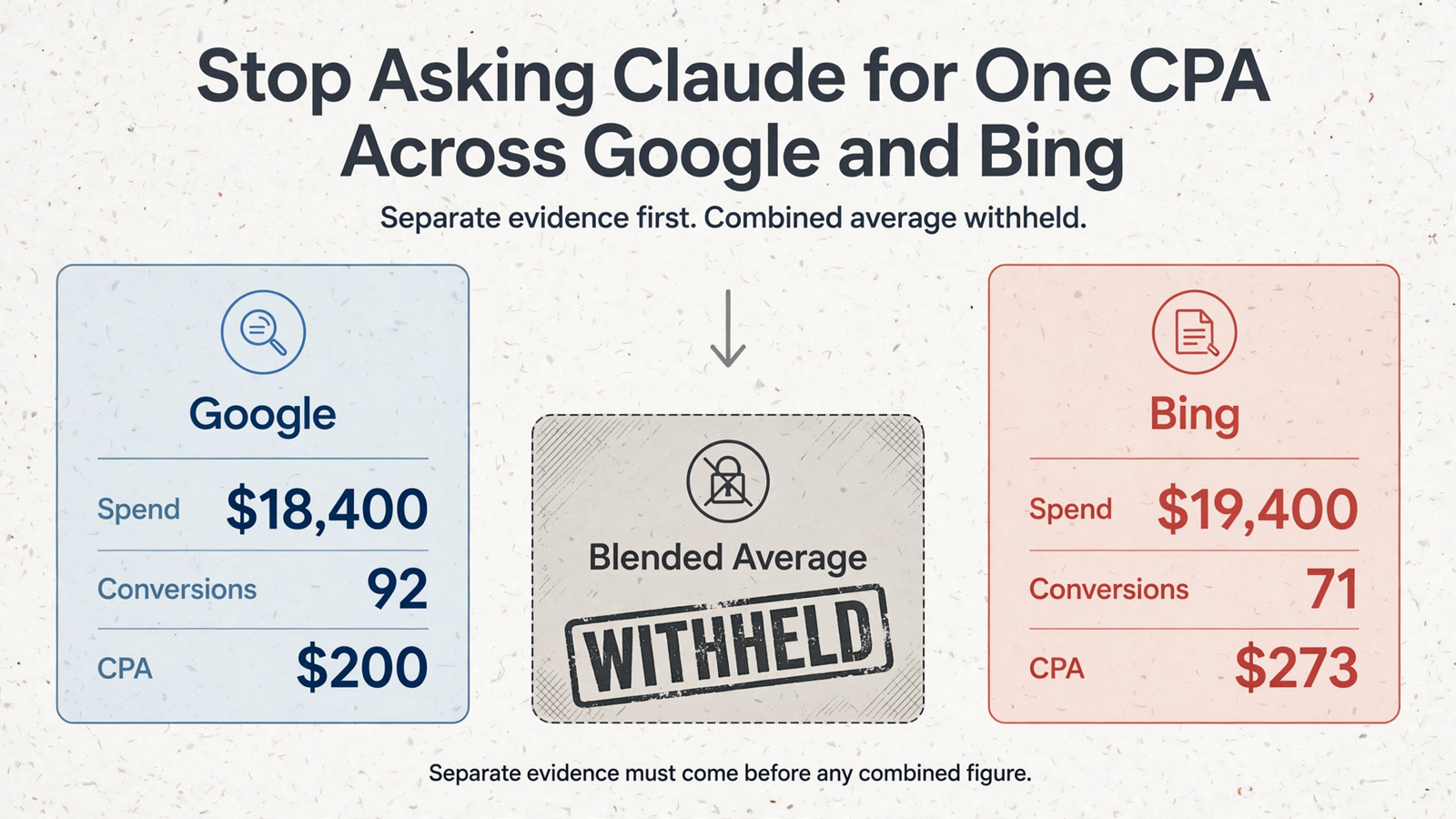
A combined CPA has one job: give the owner a portfolio figure after the separate rows are on the page and the counts can legitimately be pooled. Divide total spend by the total number of comparable, non-overlapping conversions. That tells me what I paid on average across the budget. It does not tell me where to cut. That decision lives in the rows the average compresses.
I’m not writing off Bing because it hits $130 in a hypothetical. Microsoft search can have lower click costs than Google. But a cheap click doesn’t rescue a bad search term, and an efficient Google campaign doesn’t fix one. I want the Microsoft rows because that’s where the fix is.
Make the report earn its place in the next decision
A report that ends in a number is a souvenir. In my hypothetical, the $130 CPA gets me into the Microsoft account. It doesn’t tell me what to do once I’m there. The useful finding is underneath it: two search terms spent $640 for one call between them while the branded campaign held steady. Now I have a reason to look at those terms, not a reason to cut the entire channel.
I ask Claude for a proposed change I can check against the account: name the exact negative keyword, name the campaign it belongs in, show the rows that justify it, and stop before execution. The scope matters. A proposal for the prospecting campaign isn’t permission to block the term across the account. If Claude can’t show me the rows, I have a suggestion, not a decision.
I leave autopilot off unless I deliberately turn it on. When I approve a change, groas logs it with the reason and lets me undo it in one step. I can read why the change was made and go back to the same rows on the next pull. I want Google and Bing in separate sections then, too. Otherwise I’m back to $53 with no clean view of what happened in the account I changed. It’s the same point I make in the ChatGPT version of this argument: shared access should sharpen the comparison, not erase it.
Keep the shared connection. Reject the blended fiction.
I still want Claude connected to both platforms through groas. I don’t miss the weekly CSV shuffle, and I don’t want a second dashboard just to keep a second account visible. I want to ask one question in one chat and get two answers when the accounts have two different stories. That’s what saves Friday afternoon: less time getting the numbers into the same place, not less time looking at what they mean.
Keep the access shared and the reporting separate. I make that a standing instruction: retain separate Google and Microsoft sections in future reports, and don’t show a combined CPA unless the actions, windows and currencies match, the attribution and date differences are resolved, and the counts don’t overlap. The extra work is reading two rows and checking what they measure. The alternative is admiring a $53 average while the $3,000-a-month account runs at $130 per conversion.

The three lines I paste into Claude
I keep these together because Friday afternoon is exactly when I’m tempted to type “How did paid search do?” and accept whatever comes back. The first line keeps the accounts separate and the request read-only. The second makes Claude show what it counted. The third makes it say what the comparison supports before it recommends a change.
- Claude, use groas to read Google account [ID] and Microsoft Advertising account [ID]. Do not make changes. Show each account separately before comparing them.
- List each platform’s included conversion actions, reporting window, currency and attribution settings where available. Mark missing information explicitly.
- Show spend, conversions and CPA separately by platform and campaign. Label each comparison valid, conditional or unsupported. Propose the next change with supporting rows and stop before execution.
Back in the hypothetical, if the supporting rows point to a close variant in Bing prospecting, I want Claude to propose it as an exact negative for that campaign only, not account-wide. If I approve it, I pull the rows again in seven days. I read the logged reason alongside the new report and undo the change if the next pull proves me wrong. None of that requires Google to get worse before I notice that Bing has a problem.
Clients will still ask for one number. I give them one sentence instead: “Google is doing the work at $48, Bing is at $130 with two search terms I can name, and here’s the fix I approved.” It takes ten seconds longer to read than “$53.” It also tells the client what I did and where I’ll look next. If my AI can’t tell me that, I didn’t buy reporting. I bought formatting.
Keep the blended fiction and Claude becomes my most polite junior: fast, confident, and wrong in exactly the way that costs money quietly. I can forward that $53 for another quarter while Bing keeps running at $130, right up until someone splits the columns and asks why I didn’t catch it sooner. I stopped asking for one CPA because I got tired of finding that waste late. Ask for two.





