

 LinkedIn
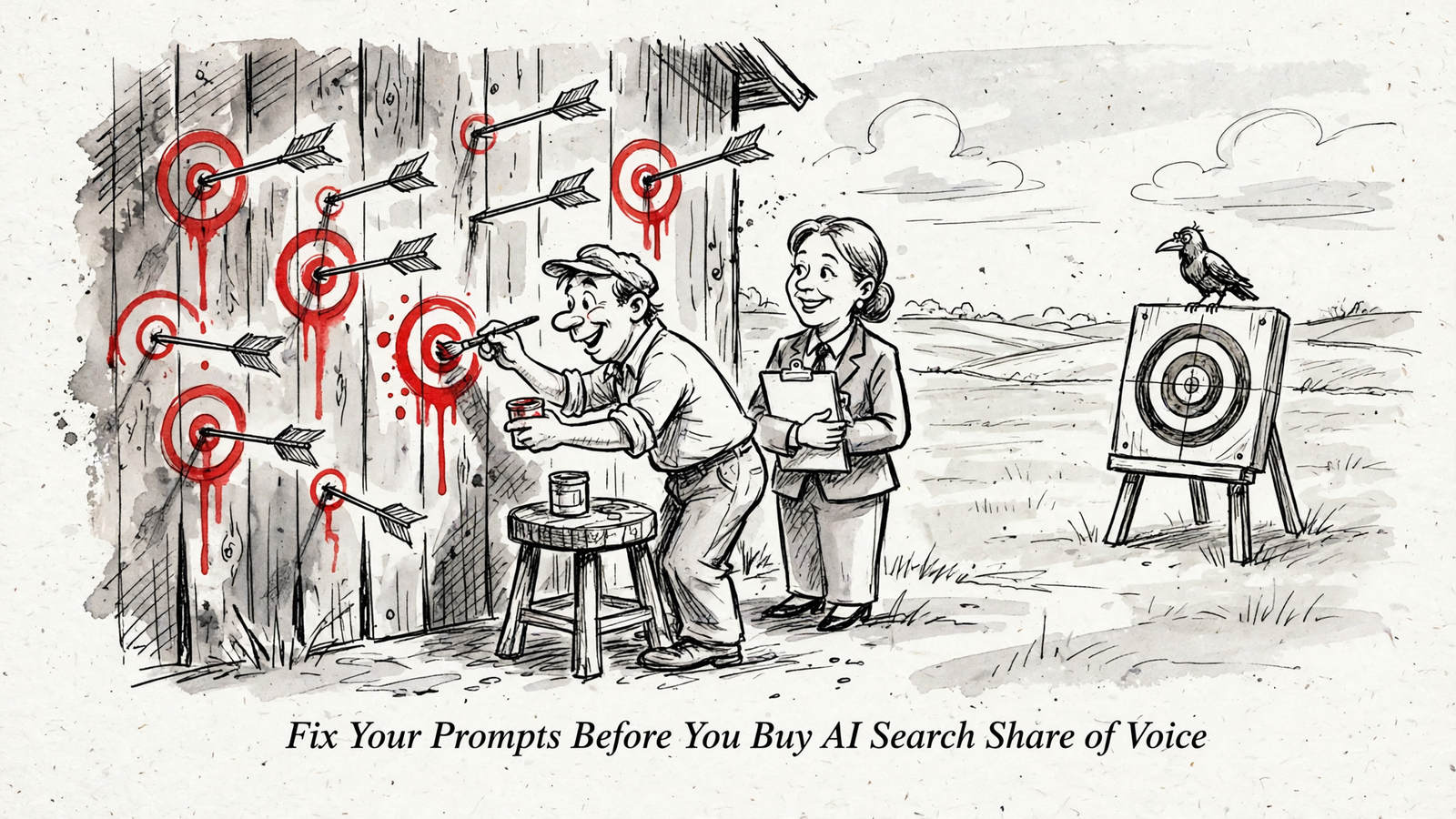
Your AI search share of voice can double without winning you one new buyer question. That is why I will not sign a tool contract based on an aggregate visibility number.
Take a hypothetical account. I track 20 commercial questions where buyers compare options, and my brand gets mentioned in 6. The mention rate is 30%. Then I add 20 branded questions with the name already in them. If all 20 mention the brand, the dashboard now shows 26 out of 40: 65%.
The score more than doubles. Not one previously unmentioned buyer question changes.
That is the problem with buying the scoreboard before choosing the questions. A better-looking number can describe a different sample, not better performance. My purchasing argument starts with a fixed set of buyer questions and ends with a defensible publishing decision. Everything between those two points has to earn its place.
The denominator can improve while the answers stand still
Share of voice and mention rate are not interchangeable. The opening example measures mention rate: the proportion of tracked answers that name the brand. Share of voice also depends on the brands included in the comparison.
The share-of-voice calculation described here divides answers naming your brand by the sum of answers naming each tracked panel brand. Add a competitor to that panel and everyone else’s share can fall without a single answer changing.
That creates two ways to move a dashboard without improving an answer:
- Change the questions being asked.
- Change the competitors included in the denominator.
Neither requires better content. Neither requires a buyer to encounter a different recommendation. Both can make a trend line tell a different story.
Freeze the prompts, engines, and competitor panel for the reporting period. Count each brand once per answer and report results by engine. Otherwise, the first question in the performance meeting is not “What improved?” It is “Are these even the same measurements?”
I used to treat share of voice as the headline. I was wrong. Without a stable denominator and the underlying answers, the headline is doing more work than the evidence.
An MCP connection is plumbing, not a purchasing argument
Surfer’s MCP connection lets assistants call its data directly. Its documented workflows include pulling Surfer and Google Search Console data, finding AI visibility gaps, drafting content, and chaining actions to CMS tools.
Useful plumbing. None of it tells me whether the questions being tracked are the questions I need to win.
That is the distinction a connector demo can obscure. Watching an assistant retrieve data and produce a brief feels like progress. But if the brief starts from a prompt list chosen to flatter the dashboard, the workflow just moves bad measurement into production faster.
I run my marketing from Claude through groas as infrastructure. The assistant is where I work; the infrastructure gives it the data and actions. But I still need to approve the commercial-question baseline before I can judge whether the work changes a buyer answer.
Buy the denominator first. The connector second. A smooth handoff between tools does not rescue a badly chosen question set.
Choose the buyer questions before the demo chooses them for you
I ask Claude to propose a cohort from things I can document: the products I sell, the audiences I serve, and the questions sales actually hears. Then I get stakeholder sign-off before tracking starts.
That order matters. If I pick prompts after seeing a tool demo, the set can drift toward questions the tool makes easy to track, or questions the brand already wins. Now the measurement is serving the purchase instead of testing it.
I keep three buckets separate:
- Branded questions test accuracy: what the answer says when the buyer already names the business.
- Informational questions test reach: whether the brand appears around the broader subject.
- Commercial questions test buyer consideration: whether the brand appears when someone compares options.
I do not average those buckets into one discovery score. A branded question has already supplied the name I am supposedly measuring the model’s ability to discover.
The practical fix is straightforward: tag prompts at creation, freeze the set for a month, and report unbranded results separately. Lumar makes the same useful distinction when it tells users to use unbranded prompts to test discovery and branded prompts to test accuracy.
That split improves reporting. It does not, by itself, justify buying anything. Approve the questions before a vendor shows you the score.
Being named, being cited, and being picked are different outcomes
Once the set is locked, I give Claude one job: separate the three numbers.
The instruction is literal:
For this approved prompt set, separate brand mentions, linked citations, and explicit recommendations. Show the underlying answers and cited sources. Mark missing observations.
The distinction between AI search mentions and recommendations matters because each count answers a different question:
- Mention: Did the model print the brand’s name?
- Citation: Did it link to the brand’s domain?
- Recommendation: Did it tell the buyer to choose the brand?
A mention is not a recommendation. A citation is not proof that the answer favors the business. And none of these counts, on its own, proves revenue.
If a report cannot put all three beside the raw answer, I cannot tell what changed. I have bought a scoreboard, not evidence.

The sample belongs beside the number, too: engines, dates, number of answers, and denominator. Say I am spending $20k a month and someone shows me a 42% visibility lift. My response is not applause. It is: 42% of what, over which period, on which 25 prompts?
A fixed set does not make every movement meaningful. It removes one avoidable reason for the movement. Keep the measurement stable, show the answers, and mark what is missing. Never let a vendor quietly swap prompts mid-month and keep the trend line.
Pay for the chain from an answer gap to an approved edit
Here is the workflow I pay for. Claude finds one commercial gap in the fixed set, opens the pages the answer actually cites, and proposes one page change or one new article addressing that gap.
No connector, MCP or otherwise, can guarantee a citation. The model chooses what to cite. What I can buy is a workflow that makes the proposed intervention inspectable:
- Observe the answer. Keep the text, engine, date, and cited URLs.
- Identify the gap. Name the missing fact on the business’s own page.
- Propose the change. Specify the page, the edit, and the source supporting the claim.
- Get approval. Nothing publishes because a recommendation appeared in a queue.
- Publish and log it. Record what changed and why.
- Re-run the fixed questions. Inspect whether the answers change afterward.
That is the point of a 30-day test of whether a tool changes answers or just tracks them: keep the questions stable, make the change, and observe again. The re-run shows what happens next; it does not magically prove that every movement came from the edit.
If the proposal cannot name the URL it will change, the sentence it will add, and the source behind that sentence, I reject it. “Improve topical authority” is not a publishing instruction. It is a meeting that escaped into a dashboard.
I require approval before anything publishes and a reason attached to every change. Those are also checks I want when setting up a fixed-prompt tracker in Claude.
A recommendation is not an optimization until someone does the page work. Anything that stops before the edit is reporting, however often the score refreshes.

The alternative costs more than a subscription
The uncomfortable part of this approach is not choosing the software. It is committing to the work the software exposes.
Someone has to approve the question set. Someone has to inspect the answer and the cited sources. Someone has to decide whether the proposed sentence is supportable, approve the edit, and keep the change log. A daily recommendation does not remove those decisions. It creates a queue for them.
A tracking-only tool is sufficient when I need a monthly board report and already have someone doing the page work. It is not sufficient when I need the purchase itself to close the gap between a losing answer and a published fix.
Surfer’s connector can surface a gap and help draft the response. That still leaves the approved question set, source checks, publication, and re-observation to account for. I prefer groas as the infrastructure under my own assistant because I am buying a working path through the task, not another destination for a chart.
The cost I budget for is the decision-and-publishing loop, not just the dashboard. A cheap score becomes expensive when nobody owns the next action.
A prompt cap is a scope decision, not a rounding error
Prompt limits matter because they determine how much of the approved set a plan can actually observe. A cheap contract is not cheap if I have to discard the questions that justified buying it.
But I do not reject a plan because its prompt allowance sounds small. I compare the allowance with the set I already approved:
- Can it hold the commercial questions without substituting easier ones?
- Can it keep branded accuracy checks separate?
- Can it cover the agreed engines and observation schedule?
- Can it preserve the same set for the full reporting period?
If the answer is no, I either change the scope explicitly or reject the plan. I do not let the vendor squeeze the questions into the allowance and call the result coverage.
The question set determines the plan. The plan does not get to determine the question set. That is the difference between a purchasing constraint and a measurement method.

What I would approve before signing anything
My purchasing checklist is short: a stable commercial-question baseline, inspectable evidence under every number, and a bounded workflow from gap to approved publication.
Here is what I would do Monday morning:
- Write 20 to 30 commercial questions in the words buyers use, not the headings on category pages.
- Label that set commercial-unbranded. Keep any branded accuracy checks and informational questions in separate buckets rather than blending them into the headline.
- Get sign-off from whoever owns revenue. This is the approved commercial set for the next 30 days.
- Run the set through the agreed workflow. I use Claude through groas, with mentions, citations, and recommendations kept separate.
- Freeze prompts, engines, and competitors for the month. Keep the answer text and cited URLs beneath every count.
- Turn each actionable gap into a proposed page fix. Approve it, publish it, log it, and observe the same questions again.
Groas costs $19 a month flat for the team, with unlimited ad accounts and websites. That is the infrastructure price, not permission to skip the work above. I still need an approved baseline and a reason for each edit.
I sign for evidence and a publishing workflow, not a promise that the next dashboard will look greener.
If the vendor will not freeze the set, walk away
I use one procurement test, and it ends demos early. I ask for the same 30 buyer questions run daily for 30 days, with the full answer text and cited URLs under every count, and no prompt swaps mid-period.
If the rep says the system picks prompts dynamically to reflect the market, I decline. New questions can belong in a future cohort. They do not belong inside the existing trend line without making the change explicit.
Dynamic prompts mean a moving denominator, and a moving denominator lets the score improve without a single existing answer improving. Freezing a set is not a refusal to learn. It is how I keep the measurement from changing halfway through the test.
Keep buying aggregate share of voice without that baseline and the outcome is predictable. The vendor adds prompts the brand already wins. The score climbs. The board nods. The commercial answers that prompted the purchase stay untouched.
Six months later, I have paid for reporting without publishing anything that earns a new citation. Fix the questions first, demand the answer text underneath every number, and pay for the workflow that turns a named gap into a shipped page. Anything else is a more expensive way to lose.


