

 LinkedIn
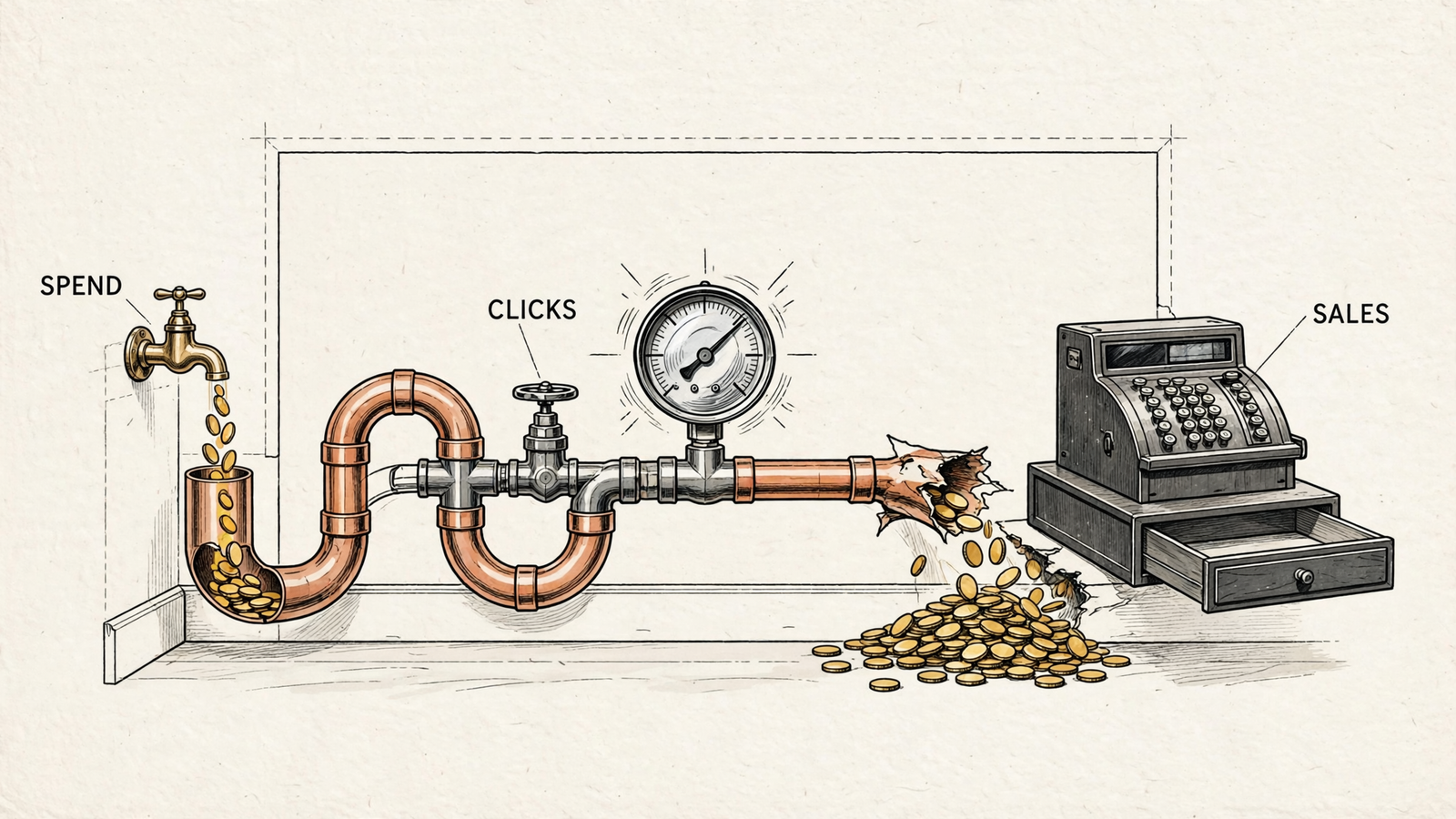
An agency shows you 19,000 ChatGPT ad impressions and calls the campaign proven. I call that a delivery report, not a revenue result. The artefact I’m tearing down is a composite agency pitch: a case-study slide, a reach story, a proposed minimum budget, a percentage-of-spend fee and a reporting promise. I chose it because that is the order an advertiser usually encounters the claims, and each deserves a verdict before anyone hands over a test budget.
This is a second look at 1,346 ChatGPT Fetches, and the Question Your Ad Report Cannot Answer. Since that piece, more agencies have started saying they have run ChatGPT ad campaigns and have results to show. If you are about to fund a small test, the useful question is not whether their slides look plausible. It is which claims tie spend to verifiable conversions.
The artefact: five slides, one recurring mistake
This is not one agency’s deck. It stitches together lines I have encountered in different pitches so I can examine the argument, not take a swing at a logo. The sequence is familiar:
- Case study: 19,000 impressions and a click-through rate.
- Reach: ChatGPT’s hundreds of millions of users.
- Budget: a $4,000 to $6,000 monthly minimum.
- Fee: 15% to 20% of spend.
- Reporting: a live dashboard and weekly AI visibility updates.
My verdict up front: most of this establishes that an agency can buy or monitor ads. It does not establish that those ads produced revenue. I used to tell clients a good CTR meant a test was working. I was wrong. Keep that mistake in view as we go through the slides.
Slide 1: The case study proves delivery, not demand
The first slide leads with impressions, clicks and a CTR. Sometimes it adds brand mentions or an AI visibility lift. Published agency tests report CTRs from 0.65% at $7.16 CPC in one Canadian test, to 1.3% across 97,000 impressions in another, to 0.91% against 6.4% in Google in a third. That spread does not give you a single ChatGPT CTR benchmark. More importantly, a CTR cannot tell you whether the visitors wanted to buy.
Look below the click. In one published test, $477 bought 19,154 impressions and 370 clicks with zero conversions. Organic ChatGPT sessions in the same window averaged 443 seconds and produced five sales. Set that beside a pitch claiming 150+ qualified leads at under half Google CPL across three B2B SaaS clients and another agency’s $1,500-a-month self-test reporting $20 to $40 clicks, about $700 per lead and one qualified lead so far. Same channel, very different accounts of what happened after someone clicked.
I would not dismiss a campaign because its CTR looks modest, or buy one because its CTR looks heroic. I would ask how many paid visitors became sales conversations, how the agency separated those visitors from organic ChatGPT traffic, and what happened to the conversations. A case study earns its place when the click has a traceable path to pipeline.
Slide 2: The reach number is not the inventory you can buy
The second slide points to ChatGPT’s huge audience. The implied argument is that a huge audience gives your ad huge exposure. But eligibility and actual delivery sit between those two statements. ChatGPT ads began as a US test on Feb. 9, 2026 for logged-in adults on Free and Go plans; as of Oct. 14, 2026, they run in 60+ countries, with self-serve buying in 63. Plus, Pro, Business, Enterprise and Edu users see no ads; neither do Temporary Chats, under-18 accounts, or health and politics-adjacent chats. The audience on the slide is not the audience your campaign can reach.
Delivery narrows it further. Adthena indexed nearly one million queries from March to May 2026 and found ads on 4.5% of US queries, zero in about 170,000 UK indexes and an average of 1.06 ad items per ad-bearing answer. Think roughly one ad per answer that carries ads, not a crowded carousel. Category matters too: Legal, Pharma, Banking and Nonprofit returned zero ads; Healthcare ran at 0.45%, while Retail and Fashion represented 24% of queries but 39% of US ad items.
That is why I want evidence from the category, not a total-user figure. Ask which relevant prompts actually showed ads, and ask to see the answers above those ads. If the agency cannot establish that there is inventory for your use case, its reach slide is decoration. Available impressions in your category beat platform-wide audience size.
Slide 3: The proposed minimum needs a test rationale
The third slide turns the sales pitch into a budget request: $4,000 to $6,000 a month as the supposed minimum to learn anything. OpenAI’s self-serve floor is $25 a day per campaign, about $750 for 30 days or $175 for seven days. That floor is not a promise that $750 will answer every business question. It does mean the proposed $4,000 to $6,000 is an agency recommendation, not the platform’s minimum.
For a small-budget anchor, law-firm pilots run $1,000 to $1,500 a month for 60 to 90 days, above the floor to get more clicks to judge lead quality. I would ask an agency proposing more to show its working: expected impressions and clicks at its assumed CPC, the conversion evidence it hopes to collect, and the decision the extra spend will make possible. A bigger number on a proposal is not a learning plan.
Then ask what happens if the campaign cannot deliver. One early pilot spent only $2,500 of a $250,000 commitment in four weeks because impressions would not deliver. A budget you cannot spend will not produce the sample the agency promised. Set the spend cap around the question you need answered, with a stop rule for thin delivery.
Slide 4: A percentage fee rewards a bigger recommendation
Next comes the management fee. PPC agencies commonly charge 10% to 20% of spend with roughly $500 minimums, or $1,000 to $3,000 flat. On a $4,000 test at 15%, the fee is $600. Raise the proposed spend to $6,000 and it becomes $900. That extra $300 does not depend on better leads; it depends on a bigger recommended budget.
This matters in a channel where inventory may not support the budget in the first place. I have written about why percentage-of-spend pricing misaligns incentives. Here the conflict is plain: the advertiser needs to learn whether relevant ads can deliver and convert, while the fee model rewards the agency for proposing more volume. Ask whether the fee falls if spend stalls and get the answer in writing. Pay for accountable execution, not enthusiasm for a higher cap.
Slide 5: A live dashboard cannot close the attribution gap
The fifth slide promises a live dashboard and weekly visibility updates. Good: I want to know whether an ad ran. But a delivery screenshot cannot tell me whether it generated revenue. Platform and business records can also disagree. Conversions may take 24 to 48 hours to appear while spend lags seven to eight hours; in one UK test, Accuracast saw form fills that Ads Manager still showed as zero conversions two weeks later, and about 100 platform clicks against 20 in its own tracking.
There is a second limit the deck should not hide. Ads Manager shows your own spend, impressions, clicks, CPC and CTR, but no Auction Insights, impression share, competitor copy or prompt-level data. If an agency claims share of voice or says it beat competitors, ask where that evidence came from. Its own Ads Manager dashboard does not supply it. Likewise, screenshots of particular answers are separate evidence; they are not a prompt-level export hiding inside that dashboard.
For the test itself, I want UTMs on every ad, ChatGPT paid recorded as its own CRM source, and a reconciliation between platform numbers and CRM records. Show paid sessions, engaged sessions over 60 seconds, form starts, bookings and pipeline without mixing in organic ChatGPT traffic. If the report stops at clicks, it reports delivery.
After the deck: “We’ve done this before” needs a paper trail
Experience is the line after the five slides: beta access, three B2B clients, a law-firm pilot. Maybe true. I would ask for read-only Ads Manager access to a past campaign or a redacted export showing dates, spend and delivery. Then I would ask separately for any records of the prompts and answers beside which the ads appeared, plus the CRM source splits for the same period. One source cannot stand in for all three.
A logo slide answers none of this. An account view without conversion records establishes that the agency ran ads, not that the ads won business. A conversion total without a clean paid source leaves the same question open. The proof is the chain from spend to source to sales conversation.
What survives the teardown
I would keep three parts of a proposal, provided the agency can make them concrete:
- A scoped category with evidence of inventory. Start with one high-intent use case, not a claim about everyone who uses ChatGPT.
- Conversion tracking agreed before spend. Put UTMs on every ad, separate paid from organic ChatGPT in the CRM, and use engaged sessions over 60 seconds as an early quality gate rather than a final outcome.
- Spend governed by delivery and sales evidence. Use a daily cap near the $25 floor, write down when to pause for poor delivery, and do not scale before at least 20 sales conversations from that source.
That last threshold is my rule. It prevents a click report from becoming a victory lap before the sales team has anything to discuss. It may also mean a small test ends without permission to scale. That is a useful answer, not a failed presentation.
The small-budget proposal I would sign
Say you spend $20k a month on search and carve out $1,000 to $1,500 for ChatGPT paid over a 60- to 90-day test. The proposal should identify the high-intent use case, the prompts and answers the agency intends to investigate, and the landing page for each group. Those are hypotheses to check against observed delivery, not a promise that Ads Manager will hand over prompt-level reporting. If the document offers only a broad reach claim and a repackaged audience list, I would send it back.
The pacing belongs in writing. My working rule is no pipeline read before 30 days and no scale before at least 20 sales conversations from ChatGPT paid. Add a delivery check: if the campaign cannot spend half its daily cap after two weeks because impressions will not clear, pause and re-scope rather than raise the budget to hit a spend target.
At day 30, I want an evidence package, not a prettier dashboard: platform spend and impressions; any separately documented prompts and answers; raw paid sessions and those engaged for over 60 seconds; form starts and bookings by source; cost per started conversation; then qualified pipeline and closed-won dollars as those outcomes become available. Be explicit about gaps between the platform, site tracking and CRM. I can work with an incomplete answer. I cannot work with three incompatible totals presented as one result.
Seven questions to send before signing
- Which prompts and answers can you document from a past ChatGPT ad test, and what separate account records show the spend and impressions for that period?
- How will you separate ChatGPT paid from organic ChatGPT in my CRM? Show me the UTMs before spend starts.
- What share of paid sessions lasted over 60 seconds, started a form or booked a call in your last test?
- How many sales conversations and how much qualified pipeline came from ChatGPT paid?
- What are the daily cap, the stop rule if impressions do not deliver and the scale rule in conversations?
- How does your fee change if the budget cannot spend? Put the flat or percentage terms in writing.
- Can I see read-only Ads Manager access or a redacted export alongside the conversion records, rather than a logo slide?
Overall verdict: keep the small, tightly gated test. Discard the pitch that calls reach and CTR proven results. Thin, uneven inventory makes those numbers especially easy to oversell. I run this work inside Search Ads at one flat $1,499 a month for Google, Bing and ChatGPT together, with no cut of spend, because a percentage fee rewards an agency for recommending $6,000 when $1,200 might answer the question. It is the same structural problem behind why big agencies underdeliver for mid-market advertisers: pay for execution tied to pipeline, not slides about delivery. Send the seven questions. Hire the shop that answers with records. Skip the one that answers with reach.


