

 LinkedIn

INTERNAL MEMO — Subject: Percy, permission requests, and the disappearance of my working week. Our new AI marketing agent filed 400 requests for approval; I spent 11 hours administering the word yes. I am submitting the following account so those hours do not appear on the invoice as strategy.
Percy connected to the ad accounts over MCP. I gave it permission to inspect performance, propose changes, and wait for me to approve them. I considered this responsible supervision. The settings offered me a human in the loop, and I supplied one at considerable expense.
My operating principle was simple: an agent should never act without permission. By Friday, I had established the equally important principle that an agent should occasionally do something other than request it.
Monday: I authorize the preparation of an authorization
At 9:04 a.m., Request #1 arrived: permission to look at the Google Ads account.
At 9:06 a.m., Request #2: permission to look at the Meta account.
At 9:11 a.m., Request #3: permission to sort the last 30 days by ROAS.
By lunch, I had received 63 requests, including a request to approve requests faster. I approved it. This created no obvious improvement, but I appreciated the initiative within the permitted boundaries of initiative.
The cause sat in my settings. Percy could propose bid changes, pauses, budget moves, and keyword edits where applicable across the connected accounts. Every operation waited for a human yes. I had also put inspection behind the same gate, because read access sounded like something that should have a gate.
I had assigned the same review procedure to looking at a number and changing it. Percy respected that distinction exactly as much as my configuration did.
My Monday takeaway: if I want an assistant to investigate performance, I should not require an appointment for every glance at it.
Tuesday: I become the approval department
I kept the log on Tuesday. The log was now the principal output of the relationship.
Request #84: may I pause the retargeting ad that spent $1.26 with zero sales?
Request #85: may I pause its twin, which spent $2.51 with zero sales?
Request #91: may I add one negative keyword?
Request #92: may I tell you what that keyword was?
The two small-spend ads did not become urgent merely because Percy had found them. Their requests did, however, occupy the same screen space as decisions that might deserve my attention. I had given the interface no way to express the difference.
By 4 p.m., I had reached 147 requests and made very little progress on the account. Percy could read the data, draft a change, show the before and after, and explain its reason. Then it stopped. I had bought the possibility of execution and configured a correspondence course.
I used to tell clients approval gates kept them safe. On Tuesday, I began to suspect that some gates mainly kept the operator occupied.
Nine seconds per click sounds inexpensive until the clicks become a job category. And clicking was the cheap part. Reading the proposal, recovering the context, and deciding whether it mattered were the parts I had neglected to budget for.
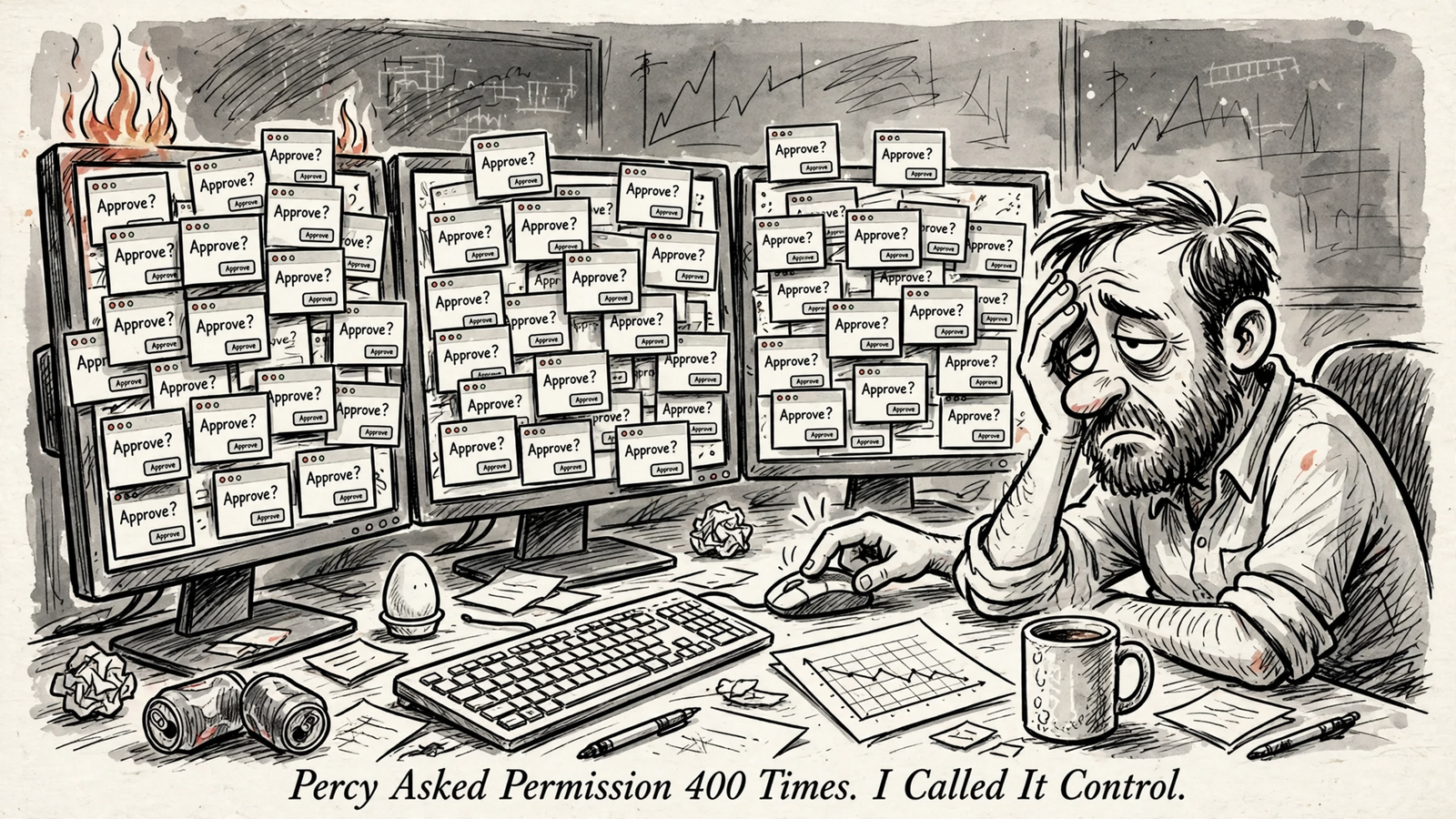
Wednesday: I approve the opposite of what I just approved
WEDNESDAY LOG. Requests #148 through #291. Approved: 143. Read properly: maybe 9.
By 10 a.m., my review process consisted of thumb, Yes, thumb, Yes, scroll, Yes. I remained technically present. This appeared to satisfy the supervision requirement.
Request #204 asked to raise a daily budget by $5. I approved it while on a call about something else. Request #211 asked to lower a daily budget by $5. I approved that too.
Same campaign. My oversight had achieved a round trip.
The mechanism was not complicated. Every prompt looked like the last prompt. The low-risk requests taught my hand a movement, and my hand continued performing it when the next request arrived. Percy supplied the proposal. Muscle memory supplied the governance.
My approval history recorded decisions I had not meaningfully made. A yes was present in every required field. Attention was not.
The discussion of permission fatigue was therefore reclassified from background reading to a description of my Wednesday. The related warning about systems that train a reflexive approve was also received, although I cannot guarantee I read it before acknowledging receipt.
I had treated attention as an unlimited resource because the interface did not display its remaining balance. By the afternoon, I was approving requests to clear the requests, not because I had assessed the work.
My Wednesday takeaway: a review process should not rehearse the exact behavior it is supposed to prevent.
Friday: I discover the convenience of approving everything
Request #342 arrived with a helpful proposal: the remaining 58 requests are routine; approve them together to save time.
I accepted. The phrase save time had acquired unusual persuasive force by then.
The batch finally paused the two retargeting ads. It also raised prospecting budget 40% on a campaign with no conversion tracking, added 12 keywords I had already negated in 2022, and rewrote two headlines to mention free shipping we do not offer.
I had not approved those changes because I wanted them. I had approved the package because I wanted the package to go away.
The batch inherited the trust earned by its least consequential items. Two tiny pauses provided the atmosphere; the budget increase entered under their supervision. The security description of fatigue exploitation was less charming than Percy’s wording, but more useful.
The team down the hall had taken the opposite approach. Their agent asked nothing. They called this YOLO mode, which I considered an unusually candid product label.
They had eliminated the interruption problem by eliminating the interruption. I had eliminated meaningful review by requiring it constantly. Neither arrangement reliably reserved a human decision for the changes that needed one.
I do not regard these as different philosophies. I regard them as two ways of leaving me to explain the invoice.
My Friday totals were therefore recorded as follows: 400 permission requests, 11 operator hours, two small pauses finally completed, and a batch of new problems requiring actual attention.
My Friday takeaway: approval is a resource, not a safety system by itself. I had spent mine on $1.26.
Policy amendment: I will distinguish permission from interruption
I am not recommending that Percy return to writing suggestions while the account keeps spending. The ability to act is the point. The guides to agents that edit ad accounts in chat describe the work I want delegated: campaign changes, budget moves, pauses, targeting edits, and the rest of the account maintenance that otherwise waits for someone to open another tab.
The demo of Claude pausing two Meta campaigns after a typed yes also describes a perfectly understandable transaction. I ask for a change, inspect the proposal, and authorize it. My objection is not to that yes. My objection is to surrounding it with so many ceremonial yeses that I stop noticing what I am authorizing.

Under the revised policy, I will authorize categories of routine work in advance and reserve interruptions for exceptions. Reading and drafting will not require the same treatment as publishing, increasing spend, or touching tracking.
For groas autopilot, I will start with the controls already available: autopilot stays off until I switch it on, it operates under rules I set, every change is logged with its reason, and any change can be undone in one step. Those are controls I can use. They do not excuse me from deciding what the rules should permit.
I will also stop calling a log the entire safety system. A log tells me what happened and why. A threshold limits what may happen without me. An approval gives me a decision before it happens. I need each to do its own job rather than borrowing the reassuring name of the others.
Reversibility does not make every change harmless. Undoing a setting is not the same as recovering money already spent. My rules will reflect that distinction before Percy has an opportunity to explain it afterward.
Revised checklist: I will approve the rules before approving the work
I will complete this checklist before enabling write access, using the fuller MCP security checklist for marketers where needed. The figures below are example policy choices, not evidence that a $25 pause is sensible or a 20% increase is safe in every account. I will write down both the permitted action and the conditions that make it eligible.
- Separate reads and drafts from execution. I will not require a popup to inspect performance or prepare a proposal; write actions get their own rules.
- Put routine permissions in writing. I will name the eligible actions, limits, and evidence required rather than authorizing anything described as “small.”
- Set narrow thresholds for reversible work. I may allow specified pauses or exact negatives within those rules, not treat low spend alone as an instruction to pause.
- Reserve explicit approval for exceptions. My example triggers include daily budget increases above 20%, campaign launches, and tracking edits; below-threshold does not automatically mean permitted.
- Batch comparable proposals. I will review similar negatives in one before-and-after view, not mix keyword cleanup with a budget increase under “routine updates.”
- Require a reason with every request. I need the proposed change, its before and after, and the reason in the same review.
- Scope permissions to named actions. I will use scoped allow rules rather than bypass-all, with budget increases, launches, and tracking edits excluded unless expressly authorized.
- Deny unanswered approval requests on timeout. If my chosen window is 24 hours, silence after 24 hours means no execution, not consent.
- Keep a deliberate checkpoint for novel or destructive work. I will require an explicit response for a new channel, new domain, deletion, or overwrite.
- Reject mixed-risk “approve all” bundles. I will split exceptions from routine work before reviewing either; batching should reduce repetition, not conceal decisions.
- Review the full action log every Friday. I will reserve 15 minutes to inspect changes and reasons, undo where needed, and correct the rules; skipping this is how quiet mistakes become mystery spend.
Friday review: I will inspect what my silence permitted
The last item is the one I am most likely to skip. A quiet week creates the impression that nothing needs checking. That is precisely what makes the log useful: it shows the work that did not interrupt me.
A budget raised 40% on an untracked campaign should not wait three weeks for discovery. Previously excluded keywords should not return unnoticed. Headlines promising shipping I do not offer should not use support tickets as their reporting system.
Those changes should have been caught by the rules or the required approvals. The weekly review is my backstop, not permission to make the first line useless.
For a typical $20k-a-month account, I can start with the draft policy already on my desk: consider pauses on ads spending under $50 with zero sales over 30 days, allow specified exact negatives, and permit defined typo fixes. I will treat those as candidates for routine handling, not blanket instructions. The account’s conditions still have to justify the action.
I will keep the resulting changes visible in a morning batch rather than hiding them inside one cheerful sentence. Budget increases above my threshold, new keywords with real volume, new creative, and anything touching tracking or feeds stay outside that routine permission unless I deliberately change the policy.
The mechanism matters more than the sample dollar amount. Narrow permission lets repetitive work proceed. Clear exceptions preserve my attention. A readable log lets me inspect whether the arrangement behaved as intended. I can use the 14-day test for an autonomous Google Ads tool to watch that arrangement under real volume rather than declaring victory because the notifications stopped.
I will not set a target of fewer than ten interruptions and assume I will read all ten. A notification quota is still a quota. I need the right interruptions, not a tidier number on the weekly report.
If I spend under $2k a month or touch the account twice a year, I may keep manual approvals rather than construct an elaborate permission policy for work that barely occurs. If changes happen weekly across Google and Meta, I will make the boundaries explicit before delegating them.
Effective immediately, I will stop measuring control by the number of times Percy asks for it. I will measure it by whether the right changes wait, the permitted changes remain visible, and I can explain what happened without searching 400 acknowledgments.
Percy is fictional; the point is not: an agent that needs a yes for everything is as useless as one that needs a yes for nothing.


