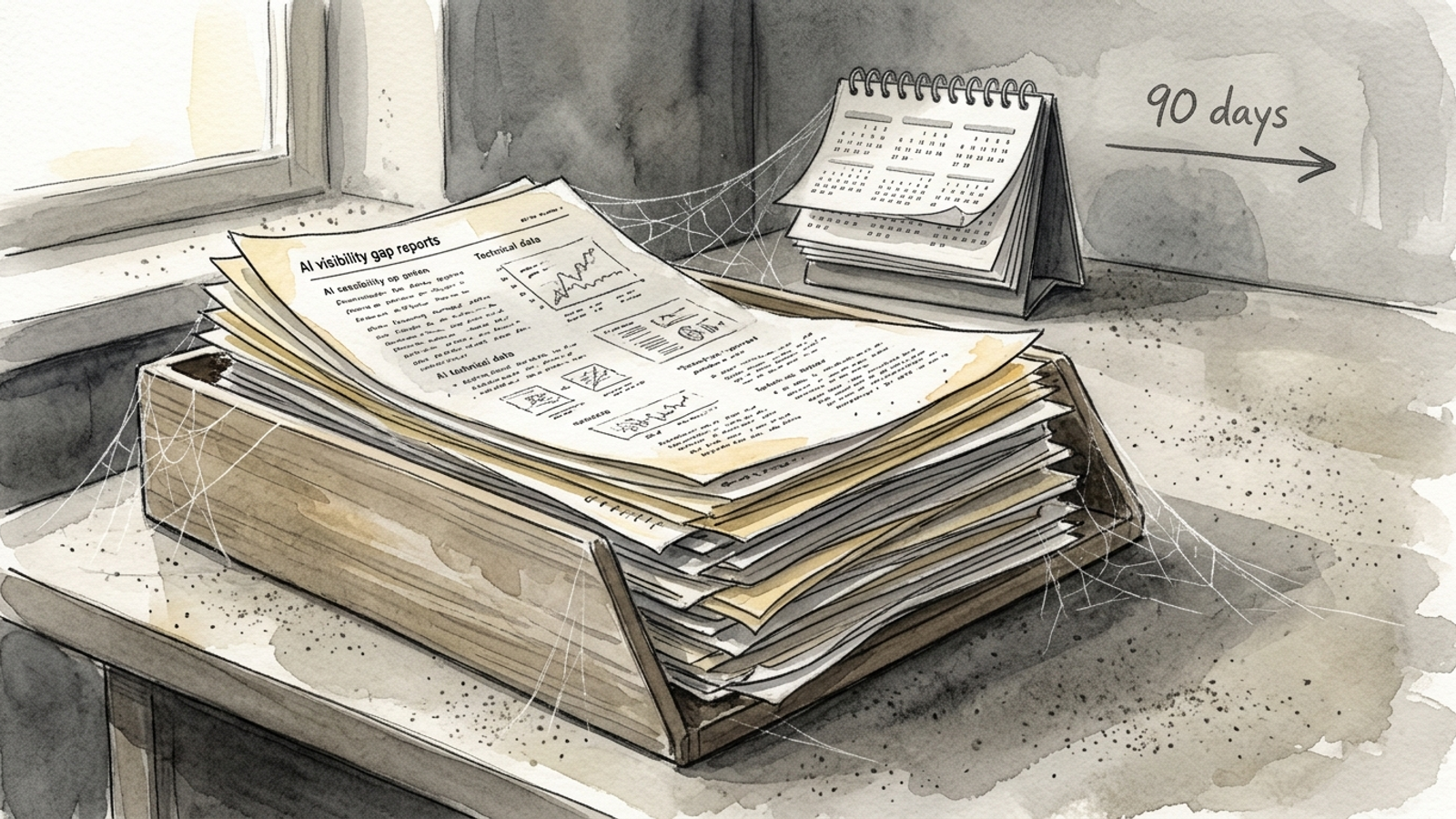

Most agencies won’t tell you this: the tool that flags your missing AI citation is the smallest line on the bill. Closing one gap can run $1,025 to $2,980 in one-off freelance labor, plus a share of the monthly monitoring seat; let it sit for 90 days, and the missed value may cost more than the fix.
I used to tell clients tracking was the hard part. I was wrong. Tracking is rent. The fix is the purchase, and the backlog is the charge nobody puts on the invoice.
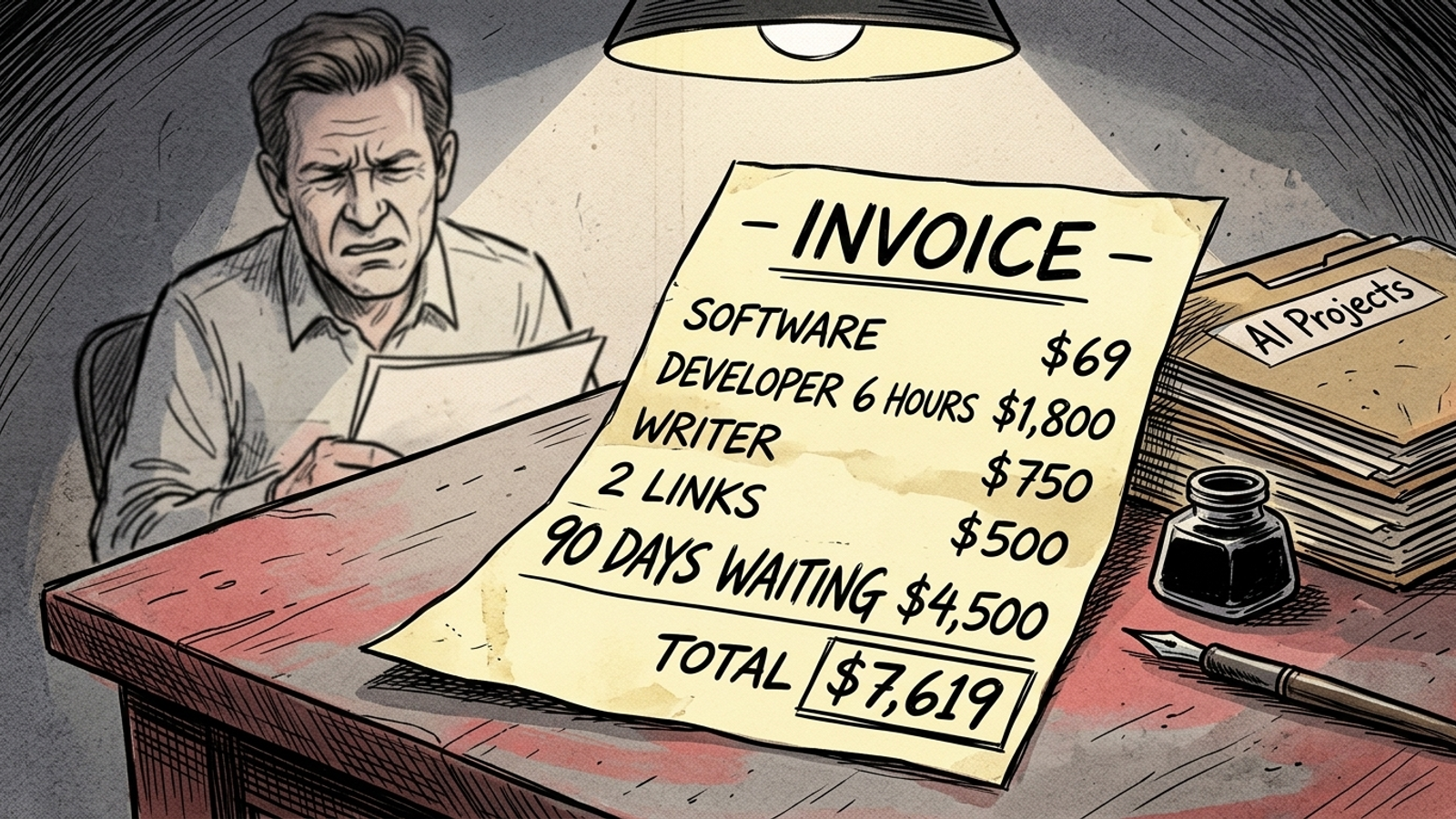
Here is the bill for one illustrative gap. Assume a small business on a standard CMS, no in-house developer, and an AI-visibility seat shared across 40 flagged gaps. The labor ranges below describe work bought separately, not a promise that every gap needs every line. The backlog figure is a model, not a vendor quote.
| Line item | Timing | Illustrative cost per gap | Basis |
|---|---|---|---|
| Detection share, with 40 gaps | Recurring | $2 to $10/month | Listed seat prices, divided by 40 and rounded |
| Technical fix, 3 to 8 hours | One-off | $300 to $1,280 freelance; $600 to $2,400 agency | Illustrative hours at published developer rates |
| Answer page, roughly 1,500 words | One-off | $450 to $900 freelance; $1,200-plus specialist | Illustrative writing and editing budget against published content rates |
| Authority work, one placement | One-off | $200 to $600 | Draft budget for a single placement; digital PR pricing shows how much higher campaign costs can run |
| Re-measurement, 1 to 2 hours | One-off | $75 to $200 | Illustrative labor at the cited freelance rate range |
| Ninety days in the backlog | Hidden, not invoiced | About $900 in modeled missed value | The traffic and job-value assumptions below |
| Total, lines 2 to 5 | One-off labor | $1,025 to $2,980 freelance | Sum of the illustrative line items |
Do not add the $900 backlog model to a vendor quote and call it a price. It is a way to ask what waiting costs your business. Likewise, do not multiply the monitoring fee by every gap: one seat watches more than one question. With those distinctions in place, the lines become useful.
Line 1: detection is rent, not repair
A monitoring seat can show which prompts you lose and which competitor gets cited instead. It does not rewrite a page, change robots.txt, or earn a mention elsewhere. That distinction matters more than another column in a dashboard.
The listed entry prices span $29 a month for 15 prompts, $69 for 500 checks, roughly $95 to $99 for 50-prompt starter plans, and $250 for Scrunch Core. The draft’s higher-volume example reaches $399 a month. Prompts and checks are not identical units, so read the allowance before comparing the sticker prices. At $69 for 500 checks, the arithmetic is about $0.14 per check. If 40 gaps share a $95 to $250 seat, the seat costs roughly $2 to $6 per gap per month; the wider table range includes cheaper and pricier tiers.
That is a reasonable recurring bill for finding losses and watching what changes. It becomes waste when the report is treated as the work. If the same gap appears in next month’s export, you have not bought progress. You have bought a reminder.
Line 2: bot access can turn a small ticket into a dev project
Before you write an answer page, check whether the relevant crawlers can read the answer. GPTBot, ClaudeBot, and PerplexityBot rely on the initial HTML rather than rendering client-side JavaScript. If the useful text arrives only after a React or Vue app runs, a crawler may miss the part you need it to see. A polished page that looks empty to a fetcher is still empty to that fetcher.
Then check access at the edge. A permissive robots.txt is not proof that a bot can get through a CDN rule. The AI crawler audit checklist names the fetchers and access controls worth checking. I would price the work in this order:
- Test the fetch, including CDN rules and any relevant crawler exclusions.
- Make the answer block available in initial HTML if client-side rendering hides it.
- Add or correct relevant structured data after the content is accessible.
- Fetch again to confirm the change actually reached the crawler.
That order keeps you from polishing schema on a page the bot cannot open. It also explains why the bill varies. Schema work can take a few hours, while replacing JavaScript-only content can take days or weeks and may require a platform change. The table’s 3-to-8-hour fix is a bounded example, not a quote for a rendering overhaul.
For that bounded job, the draft’s working budget is $300 to $1,280 with a freelancer or $600 to $2,400 through an agency. The published rate ranges are $70 to $100 an hour for a mid-level North American developer, $100 to $160 for a senior developer, and $150 to $300 for an agency; geography changes the rate too. Scope determines whether you are buying a short access fix or a much larger rebuild. For the implementation detail behind this line, see how to fix unreadable-page and schema issues.
Price the fetch test before you price the article. Otherwise you can pay a writer to improve content the intended crawler still cannot read.
Line 3: an answer page is a separate invoice
Once the page is accessible, it still has to answer the question. A new introduction on an old blog post may not do it. The useful work is research, a direct answer near the top, a dated fact table where facts need dates, clear steps or criteria, and a review by someone who knows the subject. Those are writer and reviewer hours, not monitoring features.
The content-rate anchors put work-for-hire posts at 25 to 45 cents per word, or $375 to $675 for 1,500 words before editing. The same source gives typical freelance work at $300 to $700, specialist work at $800 to $2,500, and copyediting at $45 to $75. For this bill, $450 to $900 is the working freelance budget for a researched page and review; use $1,200-plus when the subject calls for a specialist.
Length is not the deliverable. If the draft has no usable facts, no dates where they matter, and no structure that lets a reader find the answer, you paid for a blog post that happens to be 1,500 words long. Send it back before paying to promote it.
Line 4: authority work does not come with the page
A new answer page does not arrive with off-site credibility attached. If the gap calls for authority work, budget for outreach and a relevant mention, not a directory blast or a pile of vendor links bought because the spreadsheet needed a green cell.
This is where vendors can make the price hard to read. Digital PR link building is priced at $1,250 to $1,500 per unique link, with cited campaign budgets of $5,000 to $10,000 for six or seven linking domains. That is a campaign bill. The $200 to $600 per-gap line in the table is an illustrative budget for one placement and outreach, not a claim that it buys a credible citation on demand. If you already have the relationships or standing to earn a mention, the cash cost may be zero. If you need a full campaign, this small line will not cover it.
That is the decision to make before buying anything: does this gap actually need off-site work, and what work can you credibly get done? Do not disguise a campaign as a cheap per-page add-on.
Line 5: pay someone to check the result
Publishing is not verification. To check whether the work changed the outcome, rerun the same prompts on different days, inspect the cited link, and confirm the intended bots can fetch the page without a block. The existing seat covers the checks; the table allows one to two hours, or roughly $75 to $200, for someone to look at what happened.
A citation might not appear. That does not make the check optional. It tells you whether the page is accessible, whether the answer is showing up, and whether more work is needed. Without that pass, an open gap can be marked closed because a page went live, or a working page can be rebuilt because nobody checked. I have seen the second mistake made with ordinary search pages. It is an expensive way to avoid an hour of inspection.
Close the ticket on evidence, not on publication. Keep the exact prompt and page URL with the result so next month’s report means something.
Line 6: the backlog has no invoice and can still cost the most
Here is where monitored fails to become featured. A report flags 40 gaps in January. The access ticket sits, then the brief sits, then the draft waits for review. Ninety days later, the team owns a very detailed record of not being cited.
You cannot put one universal price on that delay. You can put your own assumptions into it. Say one gap concerns a question asked 1,000 times a month. Suppose AI answers it half the time, the cited source gets 8% of those opportunities as clicks, 3% of those visits become jobs, and each job is worth $250. The model runs like this:
- 1,000 questions × 50% AI-answer rate × 8% click share = 40 visits a month.
- 40 visits × 3% conversion rate × $250 job value = $300 a month.
- Three idle months × $300 = $900 in modeled missed value for one gap.
Those are rounded assumptions, not observed traffic or a promised return from a citation. Change the inputs if your questions, conversions, or job value differ. The point is that delay has a driver you can price, while the monitoring invoice does not mention it. In this example, three idle months cost more than several of the individual labor lines.
Date the oldest unfixed gap. Its age is a more useful number than the count of prompts your tool checked yesterday.
Ten gaps is a project; forty gaps need sequencing
At the table’s freelance rates, ten fully worked gaps imply $10,250 to $29,800 in one-off labor, plus $9,000 in modeled missed value if all ten fit the example and sit for 90 days. Forty imply $41,000 to $119,200 in labor before the seat. Those are straight-line totals, not a purchase order. They assume every gap needs the same four labor lines and gets priced separately.
Real work should be sequenced. If one rendering or bot-access fix affects a shared template, do it once rather than billing it against every page. Then choose which answer pages need writing and which gaps actually need authority work. The seat can keep watch while those fixes ship. It cannot make a queue disappear. For the aggregate comparison across DIY, agency, and done-for-you models, see the bill beyond tracking.
Read the scope line, not the feature list
When I compare tools that promise to get you featured, not just monitored, I start with one question: who does lines 2 and 3? If the scope ends with detection, the developer, writer, and outreach bills remain yours. A longer prompt-history chart does not pay them.
groas is built around the work on the other side of a monitoring report: autonomous search execution with a named human strategist setting direction and owning accountability. That is the distinction to test against the scope, not a reason to assume every client CMS fix, outside placement, or citation is guaranteed. Ask who can make a change, who approves it, and who checks the result. If the answer is “your team,” put those hours back into your comparison.
Worksheet: price your own gap list
Fill this in before renewing another seat. Use your counts, not the number of rows in a vendor report. One shared technical fix may cover several gaps; one gap may need no placement at all.
- Gaps flagged last month: ; monthly seat cost ÷ flagged gaps = $ per gap.
- Gaps needing render or bot-access work: ___ × estimated hours × your developer rate = $___ one-off.
- Gaps needing a new or rebuilt answer page: ___ × your writing and review quote = $___ one-off.
- Gaps needing authority work: ___ × your credible placement or outreach budget = $___ one-off.
- Gaps ready for re-measurement: ___ × your review hours and rate = $___ one-off.
- Gaps sitting over 60 days: ___ × your estimated monthly missed value × months idle = $___ modeled delay.
If the last line is blank because you have not estimated it, do that before you buy more monitoring. If it is blank because the team ships every fix promptly, good. The invoice should reflect that.
The cheapest mistake is paying for a second monitor when the first already told you what loses. I made that mistake with rank trackers in 2019: three seats showed the same drop while no one rewrote the page. The most expensive mistake is letting 40 flagged gaps sit because each looks small on its own. Price one gap honestly, fund the work to close five, and make the tool watch while you ship.