YouTube Ads Won’t Get Fewer: Six Calls to Check by 2027
October 1, 2026
•
11
min read



At 9:47 on a Wednesday night, two ad groups started sending people to the wrong landing page. This is an illustrative composite, with rounded figures, of the kind of home services account I used to manage: about $20k a month in spend, a dedicated booking page that worked, and a site change nobody thought to mention to the person running the ads.
On Monday morning, the account had looked boring in the best way. Cost per acquisition sat at $41 for the trailing seven days. Conversion volume was steady. No disapproved ads, no budget caps, no angry email waiting in the inbox. I checked Change History, saw nothing from Friday, and moved on. By 9:14, the tab was closed. I told myself the account could run untouched for a few days.
I used to tell clients that stability meant an account was healthy. What I meant, though I did not know it then, was that the last set of numbers I had seen looked healthy. Those are not the same thing.
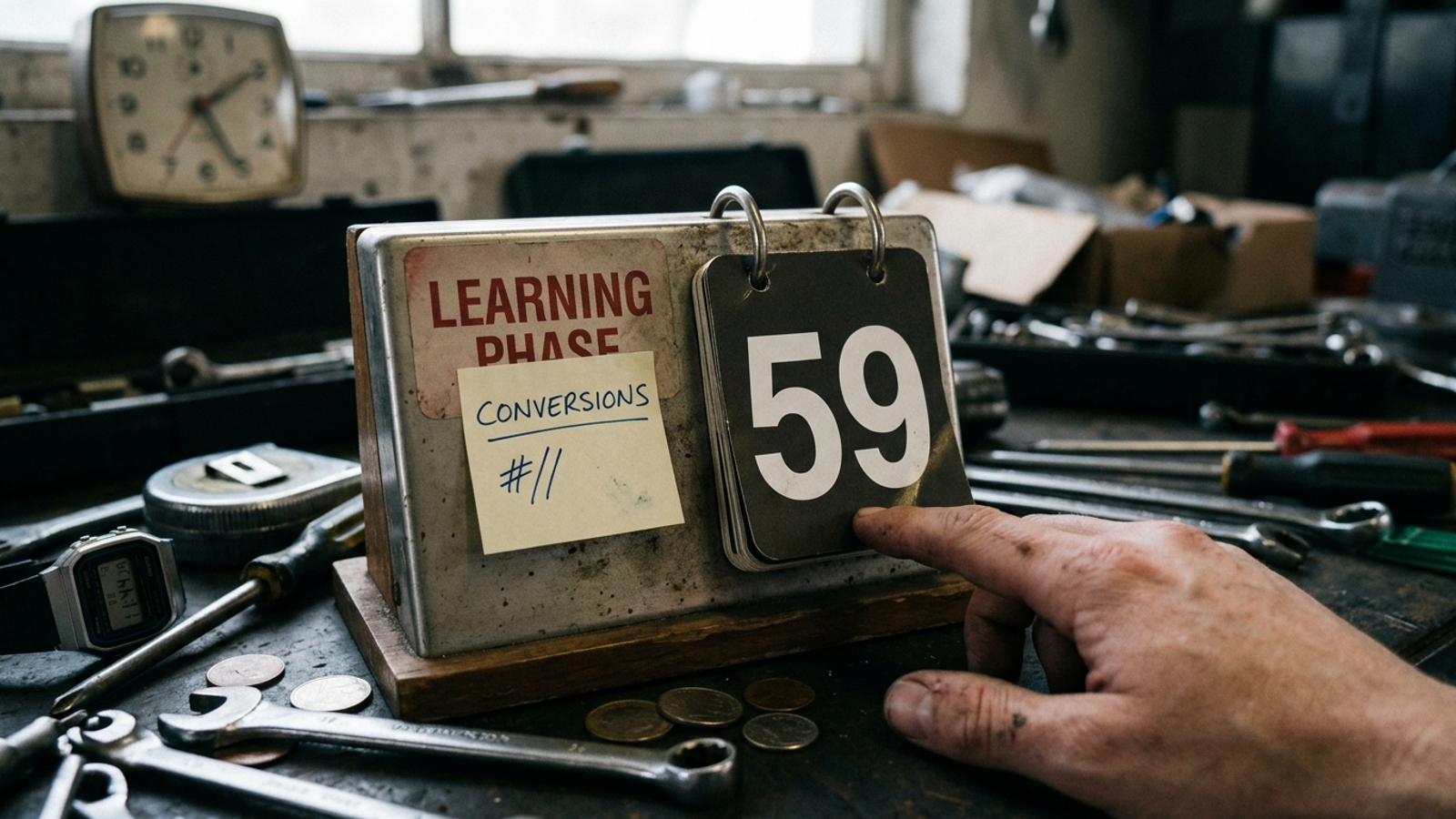
By Thursday, the account looked as if someone had swapped it overnight. Spend was pacing $50 higher per day with four fewer calls. CPA had climbed from $41 to $68 in three days. Search impression share had slipped three points. The bid strategy column showed the small gray tag I had trained myself to ignore when things were going well: Learning.
I went through the familiar suspects. Bids, budgets, search terms, auction. Nothing there looked broken enough to explain the jump. Maybe it was variance. Maybe a competitor had raised bids. Maybe a soft Tuesday was pulling down the weekly average. Those are comforting explanations when you check an account on a schedule and the schedule says the next real look can wait.
Then I opened the campaign status and read it properly. Two campaigns on Target CPA were in learning. They had been stable for six weeks. Google’s explanation of the status points to changes in a strategy’s setup or composition, among other conditions. I had not made a bidding change. That did not tell me what had happened, but it gave me a better question than “Why is CPA up?”
What changed while I was not looking?
The answer sat on the second scroll through Change History. Wednesday, 9:47 p.m.: a user who was not me had edited the Final URLs on the two ad groups driving 70% of conversions. The old destination was a dedicated booking page. Its headline matched the ad word for word. The phone number and form sat above the fold, and call tracking fired. The new destination was the client’s redesigned services overview: a pretty hero image, three paragraphs about the company story, and a phone number in the footer.
The ad was still making its specific promise. The page was now answering a much broader question. An audit of small-business accounts describes that same mismatch: a specific ad sending people to a generic page. In this account, click-through rate held while conversion rate fell from 11.2% to 4.8% in 48 hours. People were still interested enough to click. Fewer found an easy way to book.
I could see the URL edit, the conversion-rate break, and the Learning status. I could not prove from that sequence alone that changing the Final URL had triggered the status. I did not need that certainty to know the ads were sending paid traffic to a page that was doing a worse job. The destination needed fixing first.
Nobody had told me about the swap. The client’s marketing manager had pushed the new site live and pointed the ads at it to keep things consistent. I understand the instinct: if the website changes, surely the ads should point to the new website. No malice in it. That is exactly why this sort of change is easy to miss. It does not arrive labelled as an account emergency. It arrives as a tidy little task someone has already finished.
I caught it on Thursday because I happened to look. If I had waited for the next Monday check-in, the account would have kept buying clicks to that services page through the weekend. A weekly review can find a problem. It cannot give you back the days before the review.
I switched the Final URLs back that night. Eleven minutes of work. The booking page was live again, and tracking fired on the first test click. I sat there expecting the account to exhale. It did not. The Learning tag stayed on Friday.
The page fix removed the problem I could see. It did not make the intervening clicks and conversions disappear, and it did not instantly settle the bidding strategy. I wanted to adjust the Target CPA down, pause the worst-looking ad group, do something that felt proportionate to the damage. That impulse is useful when a destination is wrong. It is less useful after the destination is right and every new edit gives you one more variable to untangle.
Friday morning, I called the client. I asked the question I should have asked as soon as the account went strange: had anything changed on the site? A pause. Then yes, the new services page had gone live, and someone on the team had pointed the ads at it so the message would stay consistent.
I explained what I had found: two high-volume ad groups had sent traffic to the overview page, conversion rate had dropped, the URLs were back, and the campaigns were showing Learning. CPA might run hot for a while. To his credit, he did not argue about whose change it was. He asked how long recovery would take. I said I would give it two to three weeks before calling the account stable again, provided we did not keep changing it.
He said that sounded like a long time for an eleven-minute mistake. He was right.
That afternoon, we put a guardrail around the mistake rather than around the person who made it. Nobody edits a Final URL without a conversion check the same night. One person owns the website, one person owns the ads, and a shared Slack alert fires on a URL or tracking change. I also put a two-minute open at the start of each check-in: Change History first, performance second. A neat CPA chart is not much comfort if you have not checked what the ads are pointing at.
None of that required a heroic audit. The fix had taken eleven minutes. The expensive part was the stretch between the edit and anyone noticing it.
The Learning tag stayed through the weekend and into the next Friday. Week one after the revert was the worst: CPA averaged $74. Week two settled to $59. Week three printed $43, close to the old $41. I watched the number come down without treating each bad morning as an instruction to change the account again.
That was harder than the URL fix. I had grown up with the shorthand that learning lasted seven days, as though a calendar could tell a bidding strategy when it had seen enough. Google now describes the period in terms of conversion cycles, not a fixed number of weeks. More recent coverage discusses conversion events and cycles as ways to think about calibration after a change. The timing depends on what the account is actually recording. For the longer version of that question, I wrote about how long the learning phase can take.
That guidance was useful, but it was not a countdown for this account. I could see CPA improving week by week. I could also see the temptation to manufacture progress by moving a target, then moving it again when the next day looked bad. The performance-drop checklist I kept bookmarked gave me a better order: check tracking, then policy and auction, then the landing page and site, then bidding. Once the broken destination was fixed, I had a reason to wait before judging the strategy, not a reason to keep pressing buttons.
I know that sounds suspiciously like charging someone to do nothing. It was not nothing. It was checking that the booking page stayed live, that calls were still recorded, that traffic was going where the ads said it would go, and that the account was not developing a second problem while the first one faded. I was not going to make the chart look busier to prove I was working.
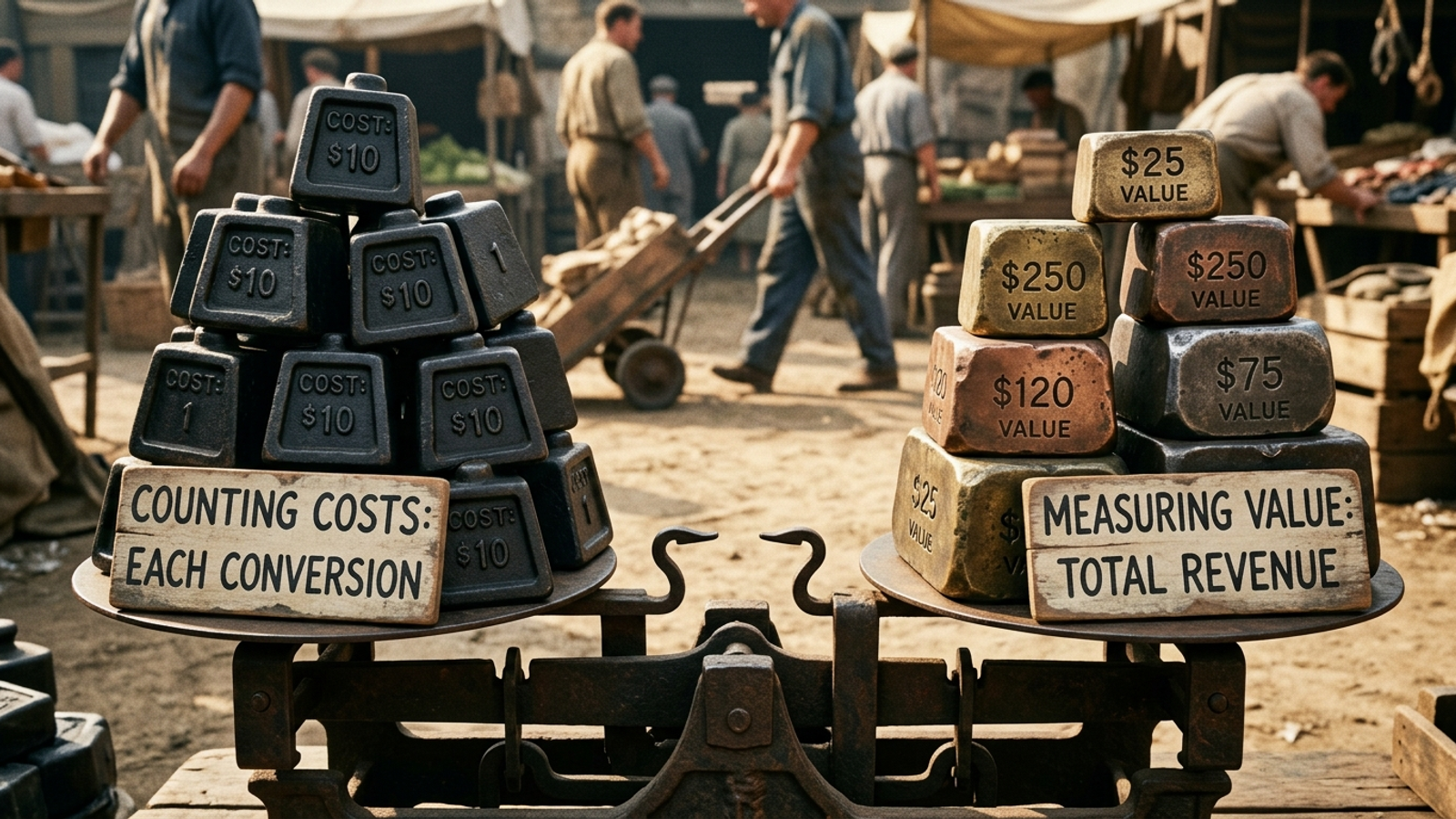
There was still a bill. At roughly $20k a month, the account would spend around $15k over three weeks even at its usual pace. That was not $15k lost to the page swap. It was spend running through a stretch when CPA was above the $41 baseline: $74 in the first week, $59 in the second, then $43 in the third. I had to explain that distinction plainly. Calling all three weeks of spend “the cost of the mistake” would have made for a sharper line and a worse account of what happened.
My management fee did not shrink because the account was having a bad month. It was the same percentage-of-spend invoice as always. I knew how that looked from the client’s side. The page had been fixed in minutes; the account took weeks to settle; the person paid to watch it had found the change the following day. A polished report would not make that arrangement feel clever.
The time on the change log bothered me more than the Learning tag. By 2 a.m., the account had bought 40 clicks to the wrong page. Conversion rate for that window was zero. Someone checking the account the next morning could catch the damage then. Someone checking it on Monday would see several more days folded into the totals. The gap was between the change and the next person looking.
A system watching through the night could flag a Final URL edit, a conversion-rate break, and a status change while they were happening. It would still need a sensible rule for what to do next. Reverting a URL is not the same decision as rewriting a bidding target, and a quiet hour with no conversions is not proof that a campaign has collapsed. The advantage is not that a machine can panic faster. It is that the change need not wait for a human’s next open tab to become visible.
That is why I use groas differently from the old scheduled-check-in model. It watches the account around the clock, logs actions, and keeps a human strategist responsible for the call on what to hold and what to revert. I still want that person asking whether the page serves the promise in the ad. I do not want to pay for the privilege of discovering on Thursday that someone changed the destination on Wednesday night.
I have written about an account that spent six weeks stuck while sensible-looking edits kept interrupting recovery. This account had a different first mistake. The shared problem was an account being changed more readily than it was watched. Back in the home services account, the client’s line kept cutting through every explanation I had about cycles and status labels: a long time for an eleven-minute mistake.
Last Monday, I opened a different account. CPA was $38, volume was steady, and the numbers were boring in the best way. I opened Change History before I looked at performance. Nothing from Friday. I left the tab open a little longer anyway.
What caused the CPA to jump in this Google Ads account?
A client's marketing manager edited the Final URLs on the two ad groups driving 70% of conversions, sending traffic from a dedicated booking page to a redesigned services overview. Conversion rate fell from 11.2% to 4.8% within 48 hours, and CPA climbed from $41 to $68 in three days.
How long did it take for the account to recover after the landing page was fixed?
Fixing the page took eleven minutes, but the Target CPA campaigns stayed in learning and CPA ran hot for weeks. Week one after the revert averaged $74, week two settled to $59, and week three printed $43, close to the old $41 baseline. The manager estimated two to three weeks to stability, which is what happened.
Should you change your Target CPA while a smart bidding campaign is in learning after a fix?
The account manager resisted that impulse because every new edit adds another variable to untangle. Once the broken destination was fixed, the useful work was verifying the booking page stayed live, calls were still recorded, and traffic went where the ads promised, while waiting for the bidding strategy to recalibrate.
Does changing a landing page URL reset Google Ads learning?
The two Target CPA campaigns entered learning after the Final URL edit, and Google attributes the learning status to changes in a strategy's setup or composition. Google describes the learning period in terms of conversion cycles rather than a fixed number of days or weeks, so the recovery time depends on what the account records.
What is the real cost of an unnoticed landing page change in a Google Ads account?
The URL fix itself took eleven minutes, but by 2 a.m. the account had already bought 40 clicks to the wrong page with zero conversions. The expensive part was the stretch between the edit and the next person looking at the account, which is why monitoring matters more than faster fixes.
How can you prevent unauthorized Final URL changes from hurting an ad account?
The rule agreed with the client was that nobody edits a Final URL without a conversion check the same night. One person owns the website, one person owns the ads, a shared Slack alert fires on a URL or tracking change, and every check-in starts with Change History before performance.