

 LinkedIn

At $60,000 a month in Meta spend, a 15% management fee is $9,000 every month. That is roughly six times the $1,499 flat fee groas charges for Meta Ads. The question is whether the work, or the profit left after scaling, grows anything like the invoice.
I built the model because proposals rarely show that curve. Agencies quote 10% to 20% of ad spend, sometimes with a minimum retainer. At $5k, the percentage can look sensible. As spend rises, the fee rises with it, even if each additional dollar of budget brings back less revenue. Here is the math at $5k, $20k and $60k, with the tiers between them left in so you can see the bend.
The inputs: five budgets, three rates, one flat fee
I model five monthly spend tiers: $5k, $10k, $20k, $40k and $60k. The percentage cases use the 10% to 20% range quoted for Meta management. The comparison uses groas’s $1,499 monthly Meta Ads fee, which does not rise with spend. I use 15% as the baseline: a published WebFX example charges $975 or 15%, whichever is higher, for $5k to $30k in spend. Other arrangements can include a minimum-or-percentage structure. This model does not add a minimum to its percentage columns.
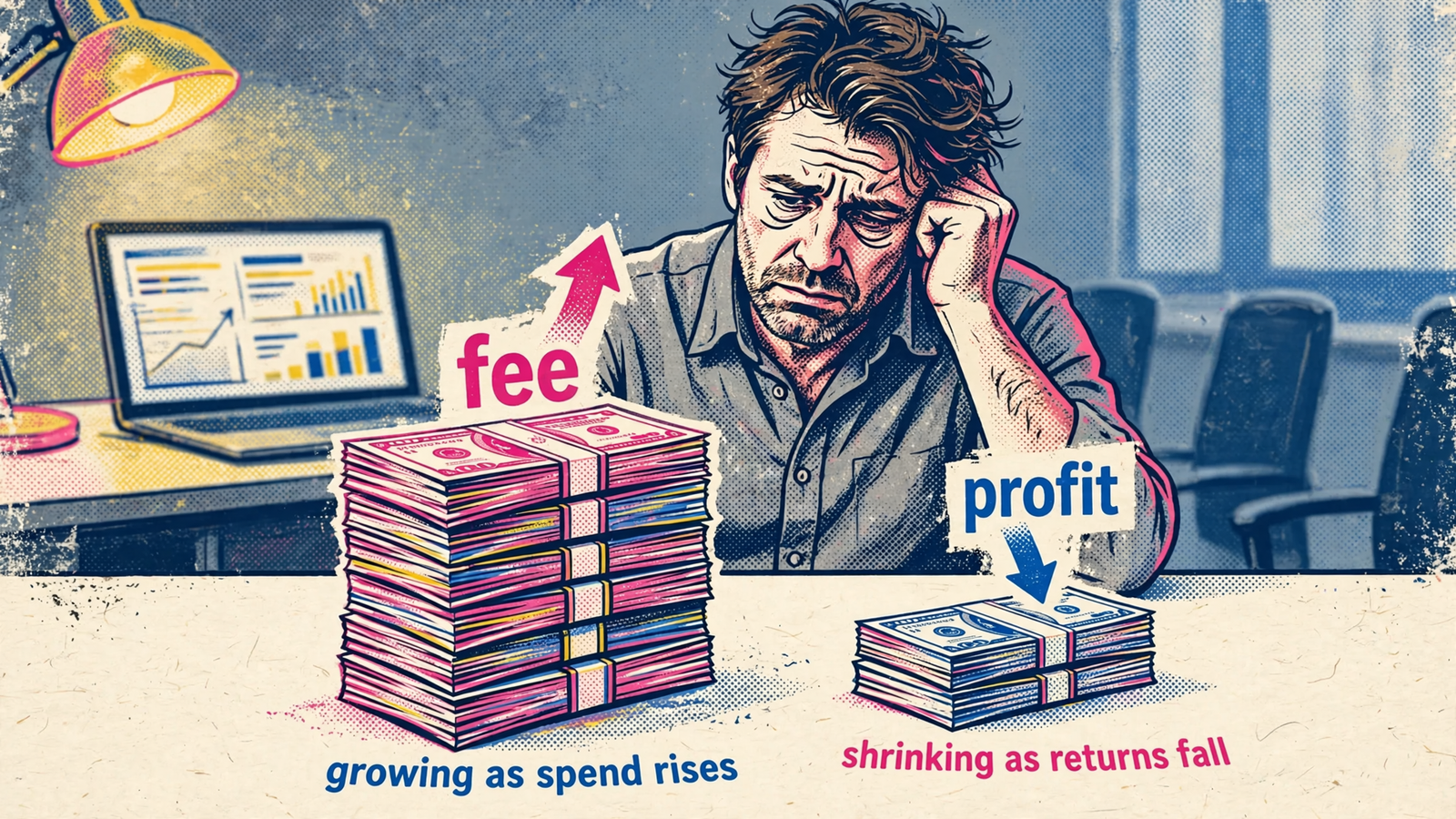
The revenue side is an illustration, not an account forecast. I set blended ROAS at 4.5x for $5k and step it down to 3.8x, 3.2x, 2.7x and 2.4x as spend rises. A report found average Meta campaign spend up 47% while Sales ROAS fell from 5.48x to 4.57x. That observation makes a declining-return scenario worth testing; it does not establish this slope for your account. The fee calculations, by contrast, require no ROAS assumption. They are spend multiplied by rate.
Free tool: the ROAS Calculator works out your return on ad spend, your break-even ROAS and the budget a revenue goal takes.
First, the invoice curve
At each tier, the percentage columns are monthly spend multiplied by the stated rate range. The final column holds the groas fee constant. These are management fees, not total advertising costs or a claim that the services are identical.
| Monthly Meta spend | 10% fee | 15% fee | 20% fee | Flat fee |
|---|---|---|---|---|
| $5,000 | $500 | $750 | $1,000 | $1,499 |
| $10,000 | $1,000 | $1,500 | $2,000 | $1,499 |
| $20,000 | $2,000 | $3,000 | $4,000 | $1,499 |
| $40,000 | $4,000 | $6,000 | $8,000 | $1,499 |
| $60,000 | $6,000 | $9,000 | $12,000 | $1,499 |
On management fees alone, the crossover comes just below $15k of monthly spend at 10%, $10k at 15% and $7.5k at 20%. Divide $1,499 by the applicable percentage rate to find your exact threshold. Below it, the percentage invoice is cheaper. Above it, the flat invoice is cheaper.
I used to tell clients under $5k that a percentage could save them money. It can. What I should have asked next was whether they intended to stay there. A rate that looks cheap at $5k follows you to $40k unless the agreement changes. Before you sign, price the budget you hope to reach, not just the budget you have today.
Next, separate average ROAS from the next dollar’s return
Blended ROAS answers what the whole budget returned. It does not answer whether the next increase paid for itself. In a simple illustration of marginal ROAS, $100 a day produces $400 in revenue, or 4.0x. Raise the budget to $200 and revenue reaches $600: blended ROAS is 3.0x, but the added $100 returned only $200, or 2.0x marginal ROAS. An average can hide a weak addition.
For the table below, ad revenue equals spend multiplied by the stated illustrative blended ROAS. Each jump’s marginal ROAS equals the change in revenue divided by the change in spend. The declining curve is an assumption for examining the fee structure, not a projection derived from the aggregate report.
| Monthly spend | Blended ROAS* | Ad revenue | Extra spend vs prior tier | Extra revenue vs prior tier | Marginal ROAS on jump |
|---|---|---|---|---|---|
| $5,000 | 4.5x | $22,500 | — | — | — |
| $10,000 | 3.8x | $38,000 | $5,000 | $15,500 | 3.1x |
| $20,000 | 3.2x | $64,000 | $10,000 | $26,000 | 2.6x |
| $40,000 | 2.7x | $108,000 | $20,000 | $44,000 | 2.2x |
| $60,000 | 2.4x | $144,000 | $20,000 | $36,000 | 1.8x |
*Assumed ROAS values. The reported pattern of higher spend alongside lower Sales ROAS is context, not a source for these exact values or a guarantee that every account declines.
In this scenario, blended ROAS still reads 2.4x at $60k. The last $20k of budget, though, returns only 1.8x. Use the marginal figure to evaluate the increase. Use the blended figure to describe the account you already have.
The correction that matters: margin is not profit
A fee as a share of spend is easy to quote. What I want to know is what the business keeps after paying for the additional ads. To show that, I use an illustrative 50% gross margin. At that margin, break-even ROAS before management fees is 2.0x: half the revenue has to cover the ad spend.
The calculation for each jump has two stages. First, multiply the extra revenue in the previous table by 50% to get extra gross margin. Then subtract the extra ad spend to get the incremental contribution before the management fee. Only after that do I subtract the increase in the fee. Calling gross margin ‘profit’ without subtracting ad spend would make the last jump look healthy when it loses money.
| Scale jump | Extra gross margin at 50%* | Extra ad spend | Contribution before fee | Extra fee at 15% | Contribution after that fee | Extra flat fee |
|---|---|---|---|---|---|---|
| $5k to $10k | $7,750 | $5,000 | $2,750 | $750 | $2,000 | $0 |
| $10k to $20k | $13,000 | $10,000 | $3,000 | $1,500 | $1,500 | $0 |
| $20k to $40k | $22,000 | $20,000 | $2,000 | $3,000 | −$1,000 | $0 |
| $40k to $60k | $18,000 | $20,000 | −$2,000 | $3,000 | −$5,000 | $0 |
*Extra revenue from the illustrative ROAS table multiplied by an assumed 50% gross margin. ‘Contribution’ here accounts for the additional ads and the indicated fee increase, not other business costs. The 2.0x break-even rule at 50% margin explains why a jump at 1.8x loses money before either fee model changes.
The fee consumes about 27% of contribution before fees on the first jump and 50% on the second. On the $20k-to-$40k jump, it exceeds that contribution. There is no useful positive ‘share of profit’ to calculate for the final jump: the increase is already loss-making before the fee. A flat fee avoids the additional $3,000 management charge there. It does not make the $20,000 budget increase a good decision.
Your margin changes the answer. At 30%, these jumps have less room to pay for ads; at 70%, they have more. Put your own margin into the calculation before approving the next tier. That is the practical test, not whether the current blended ROAS looks respectable.
Does the work follow the invoice?
From $20k to $60k in monthly spend, the modeled 15% fee rises from $3,000 to $9,000. Does the account require $6,000 more management work each month? Do not assume either answer; ask what changes. Setup and pixel, Conversions API, catalog and attribution checks do not repeat in direct proportion to spend. Budget changes are not, by themselves, a plausible explanation for a proportional fee increase.
Creative is the harder part of that conversation. As frequency rises and a winning angle fatigues, an account may need more testing. That is work worth paying for. But a percentage invoice does not tell you how many concepts, formats or iterations you will receive. Ask the agency to show the added output between $20k and $60k, rather than treating ‘more optimization’ as a deliverable.
Cheap flat plans have a limit too. LYFE Marketing lists $500 a month for image ads and $1,400 for image and video, with the cited video plan including two vertical videos per quarter. If that output is too thin for your testing needs, the low invoice is not the whole comparison. Likewise, if a percentage agency shoots and edits a substantial volume of creative, account for that production before comparing its price with media management alone.
My working question is specific: what new concepts will be tested, when will losers be cut, and what changes as spend grows? A cadence of two to four concepts a week is something you can discuss and check. A larger bill with no clearer work attached is just a larger bill.
The incentive shows up in the next $10k
At 15%, every additional $10,000 of spend adds $1,500 to the agency’s monthly fee. The calculation holds whether that budget returns 3.1x or 1.8x at the margin. Pricing guidance describes the same conflict: a percentage-based agency earns more as spend rises, whether or not results improve. That does not mean every agency recommends bad increases. It means the contract rewards the recommendation before the result is known.
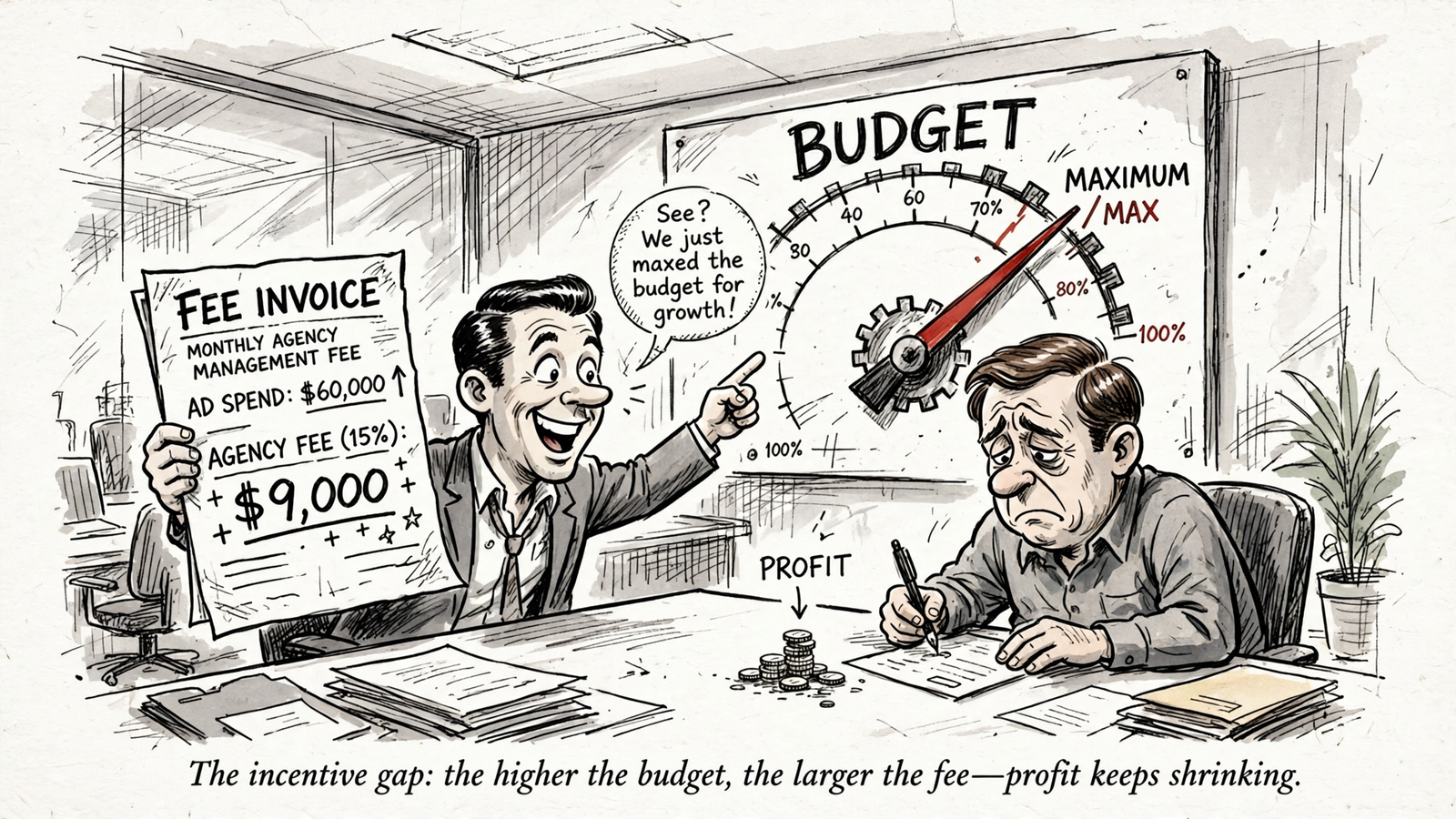
My rule from managing accounts is to separate the budget decision from the fee decision. In this model, the $40k-to-$60k jump adds $36,000 of revenue and $18,000 of gross margin at the assumed 50% margin. It also costs $20,000 in ads. The business is down $2,000 before the added agency fee; the percentage fee takes that to a $5,000 loss. The flat fee adds no management charge, but the jump still fails.
That is why the question is not simply ‘Can I afford the agency?’ It is: Would I buy this extra traffic if nobody’s fee increased when I did? If the answer is no after you account for margin and ad spend, hold the budget.
When a percentage can still be the cheaper buy
I am not saying every percentage agreement is a bad deal. At $5,000 in spend, 15% is $750, against the $1,499 flat fee. If you expect to remain at that level, the lower management invoice matters. If you only need a short test, it may matter more than a crossover you never reach.
Three cases deserve a closer look before you choose a flat fee:
- You plan to stay below the relevant crossover. At 10%, 15% or 20%, that means comparing your budget with roughly $15k, $10k or $7.5k a month, respectively. At a much smaller budget, question whether you need paid management at all.
- The percentage includes substantial creative production. If the shop shoots, edits and delivers work you would otherwise buy separately, price that work separately before declaring either invoice cheaper.
- You are running a short test. A minimum-or-percentage arrangement may cost less over a brief period. Put the review date and the fee at your intended next budget in writing, so a temporary bargain does not become the permanent curve.
These are reasons to examine the agreement, not reasons to ignore marginal profit. The agency can be fairly priced and the next budget increase can still be a mistake.
Three questions to ask before the next increase
If you run Meta at $10k or more on a percentage, you do not need a new philosophy on Monday. You need three answers from your current agency. I asked versions of these when I managed accounts. The useful answers came in numbers; the less useful ones came in adjectives.
- At what spend does our rate step down? Get the fee at your current budget and your next planned tier. If you have a minimum-or-percentage agreement, include the minimum in the calculation. Then use your own gross margin to work out contribution after the additional ads and fee.
- What weekly work changes between $20k and $60k? Ask for concepts, formats, dates and decisions on losing tests. ‘More optimization’ is not a schedule. If creative production is included, make its volume visible too.
- Who can call a hold on scale? Ask what evidence that person uses and what happens to the fee if spend stays put. A recommendation should stand up to a marginal-ROAS calculation, not rest on blended ROAS alone.
For a flat-fee comparison, groas runs Meta Ads for $1,499 a month, with audiences, budgets and creative testing worked continuously. I also modeled one Meta account under five fee structures across 24 months of growth. If your decision is whether to hire anyone yet, start with who should run your Facebook and Instagram ads by budget.
At $20k in this model, the 15% shop charges $3,000 against a $1,499 flat fee: a $1,501 monthly gap. At $60k, the gap reaches $7,501 a month, or $90,012 a year. Neither number proves which team will produce better results. It does show what the contract rewards. Stop negotiating only the starting percentage. Negotiate the curve, then approve the next budget increase only if its contribution survives the math.


