

 LinkedIn

Turn off ChatGPT Ads’ creative enhancements until your autopilot rules are set. Faster variation is not a strategy when the system can change the offer’s wording and send the click somewhere else without asking you.
OpenAI’s creative enhancements documentation says variations can be prepared in advance or in real time and run without individual review or approval. The changes include new or updated headlines and descriptions, translations, image resizing, and destination URL optimization to another page on your site.
That last permission is why I opt out first and grant permission second. A headline rewrite can change what an ad promises. A destination change can change whether the page delivers it. Before I let either happen, I want campaign rules for claims, tone, destinations and approval. Then I decide whether the native enhancement setting belongs on at all.
One toggle grants four kinds of permission
The popular advice is to leave everything automated and let the machine learn. That skips the question I care about: what, exactly, am I authorizing it to change?
Creative enhancements are not one small adjustment. A single toggle controls all four change types. I cannot allow headline rewrites while blocking destination swaps. Text, translation, resizing and landing-page changes come bundled together.
There is no middle setting. Calling it creative testing at scale does not make those permissions narrower.
The settings hierarchy matters, too. OpenAI says existing account and campaign opt-outs are preserved, and campaign settings take priority over the account default. The account switch establishes the starting point. A campaign can override it.
That creates an easy mistake: someone turns off the account default, assumes the job is done, and leaves live campaigns with enhancements enabled. The dashboard looks reassuring until someone opens the campaign settings.
I start with the account default, then check every live campaign individually. If I duplicate a campaign, I check the duplicate rather than assuming it inherited the setting I wanted. One account-level screenshot is not an audit.
A $49 holiday bundle exposes the problem
Say I am spending $20k a month on a holiday push for a $49 bundle that ends December 24. The campaign sends traffic to a gift guide page built around that offer.
That setup makes automatic variation a business decision, not just a copywriting decision. OpenAI itself tells advertisers to keep ads and landing pages current on prices, promotions, details and availability. The system gets room to vary the ad. I carry the cost when the price, date or destination no longer matches the offer.
The damage can show up as refunds, support tickets and a CPA that looks acceptable while contribution margin bleeds. A conversion is not proof that the promise was profitable to keep.
The destination change is the part I would inspect first. A technically valid page can still be the wrong place for paid traffic:
- A blog post can discuss the product without presenting the bundle.
- A locator page can be relevant without offering a purchase path.
- Another product page can omit the promotion entirely.
- A page outside the intended tracking setup can make the result harder to measure.
One breakdown of the enhancement setting also flags uncertainty over whether UTMs survive a destination swap. That is a question to resolve before spending, not an explanation to assemble afterward.
The ad can keep running. The click can keep appearing in the report. Neither tells me that the visitor reached a page capable of delivering the advertised offer.
For a fixed-price, time-limited promotion, the offer and its destination are part of the same promise. I do not give permission to vary one while pretending the other is protected.
More versions do not automatically produce better evidence
The usual defense is that more variations create more learning. Only if the reporting lets me connect the variation to the outcome.
Ads Manager reports impressions, clicks, spend, CTR, CPC, CPM and attributed conversions at campaign, ad group and ad level. The reporting described there does not include a separate breakdown for every enhanced variation. OpenAI also warns that changes over time do not, by themselves, establish the effect of enhancements.
That leaves a gap between generating versions and understanding them. If several things change together, a better campaign result does not tell me which rewrite, translation or destination helped. A worse result does not identify the offender either.
I judge enhancements on qualified leads or sales against a clean baseline, not on creative volume. A pile of new headlines is an output. It is not a business result.
This matters most when the offer is fragile. An evergreen product page gives a test more room than a holiday bundle with a fixed price and an expiry date. If the offer depends on exact wording or a specific page, variation without individual approval is not the tidy experiment the sales deck suggests.
Before I accept less visibility into individual versions, I need a purchase path and measurement setup that can tolerate it. Otherwise, I am buying more uncertainty and calling it learning.
Set groas rules without pretending they replace OpenAI’s switch
My sequence starts with enhancements off at the account level and a check of every campaign override. Then I write the rules for what the account may change through groas.
Those per-campaign rules cover claims, tone, destinations and approval. I want them written plainly enough that nobody needs to translate them out of strategy-deck English:
- Claims: use the approved offer, price and expiry date.
- Tone: stay within the approved voice rather than improvising a different promise.
- Destinations: use approved landing pages, preserve UTMs and stay on the purchase path.
- Approval: require review for changes outside those boundaries, including native-language review of translated regulated claims.
In groas, autopilot stays off until I switch it on. Its changes are logged with their reasons and can be undone in one step. That gives me accountability for the work groas performs.
Those rules do not split OpenAI’s all-in-one enhancement toggle into separate permissions. Nor should a groas change log be mistaken for a complete record of every variation OpenAI generates inside its own system. The two controls do different jobs: groas governs its managed actions; the native toggle grants OpenAI permission to make the bundled enhancements.
That distinction decides whether I switch enhancements back on. If my campaign requires individual approval of every translation or prohibits every destination swap, the native setting stays off. Writing a rule elsewhere does not make that conflict disappear.
For more on what an approved ad can become, I break down the same issue in six ChatGPT Ads setup myths. Approval of the original is not approval of every possible variation. I set the boundaries first, then decide whether the available control actually respects them.
A hands-on manager must show the settings, not explain them
Slides, audits and prompt packs are not account management. I draw the line at working inside the account the advertiser owns, checking conversion and tracking before spend, and taking responsibility for the settings.
That is also the distinction in this guide to hiring a ChatGPT Ads consultant, which separates hands-on work from advice and rejects guarantees of rankings or mentions. I use a simpler test: show me the account default, every live campaign override and who approved the last managed change.
If a manager cannot do that, they are commenting on the account, not managing it.
A cross-platform opt-out checklist calls ChatGPT simple to control but easy to miss because the campaign setting overrides the account default. That is exactly the kind of small operational detail that disappears between an impressive kickoff and a rushed launch.
My launch record needs four things:
- The enhancement setting for each live campaign.
- The permissions approved for managed changes.
- The person responsible for approving exceptions.
- The person responsible for fixing broken tracking or a wrong destination.
A change log is useful only if everyone understands what it records. For groas-managed changes, I expect the reason and a one-step undo. For native enhancements, I expect an honest explanation of the visibility available, not a promise that every generated version appears in the same log.
I hold a Done For You team to that standard too. Paying someone to operate the account does not remove the need to define what they can authorize.
The cost of this approach is real: a campaign-by-campaign check, written permissions and an approval decision before automation starts. That is work. It is also the work a hands-on manager is being paid to do.
Enhancements earn permission when the offer can survive variation
I leave enhancements enabled when the whole bundle of permissions fits the campaign. That means an evergreen catalog, no fixed price in the copy, no expiry date, durable landing pages and conversion tracking I have verified before spend.
Accurate product information and a purchase path that tolerates destination changes give the system room to test combinations. Translation and resizing can then be useful rather than extra ways to misstate a seasonal offer.
The campaign has to tolerate all four change types, not just the one I happen to want. If I want resizing but cannot accept destination changes, the bundled toggle is still the wrong permission.

Even with a flexible offer, I treat enabling enhancements as a test. I keep the groas rules in place for groas-managed work, record the native enhancement setting and judge the result against the clean baseline. I do not treat the rules as a substitute for inspecting the native setting.
My decision criteria stay blunt:
- If CPA measured against closed revenue falls for two full buying cycles with tracking intact, the extra freedom has earned its keep.
- If clicks rise while sales-qualified leads stay flat, I switch enhancements off.
- If exact wording, regulated claims or unsuitable destination pages make the bundled permissions unacceptable, I leave them off.
That is consistent with Major Tom’s holiday testing advice: automatic rewrites and landing-page changes deserve a deliberate decision, not acceptance by missed checkbox.
More variations are not performance. Cheaper pipeline is. I grant room to test only after the offer and measurement can support the test.
Before the seasonal push, ask for a screen share
Before I hand a manager the seasonal budget, I want a screen share showing three things: the account default, the override on every live campaign and the approval record for the last managed change.
If they open Slides instead of Ads Manager, I have my answer.
I also want the awkward questions settled before launch. Who owns the account? Who approves changes? What happens when a variation breaks tracking or sends paid traffic to the wrong page? Those are the questions behind a controlled launch, not a management promise. They belong in writing while everyone still has time to answer them calmly.
This is where I put groas: guardrails and accountable execution before permission to automate. I start with the native enhancement default off, check the campaigns and set per-campaign autopilot rules for claims, tone, destinations and approval. Autopilot stays off until I enable it. Changes it makes are logged with their reasons and undoable in one step.
Then comes a separate decision: can this campaign tolerate OpenAI’s bundled creative enhancements? If yes, I enable them deliberately and measure the result. If not, they stay off. No rule document turns an unacceptable destination swap into an acceptable one.
That order costs a settings audit and some decisions before launch. Ignoring it can cost the seasonal budget while everyone argues about why paid clicks landed on a gift guide from two years ago.
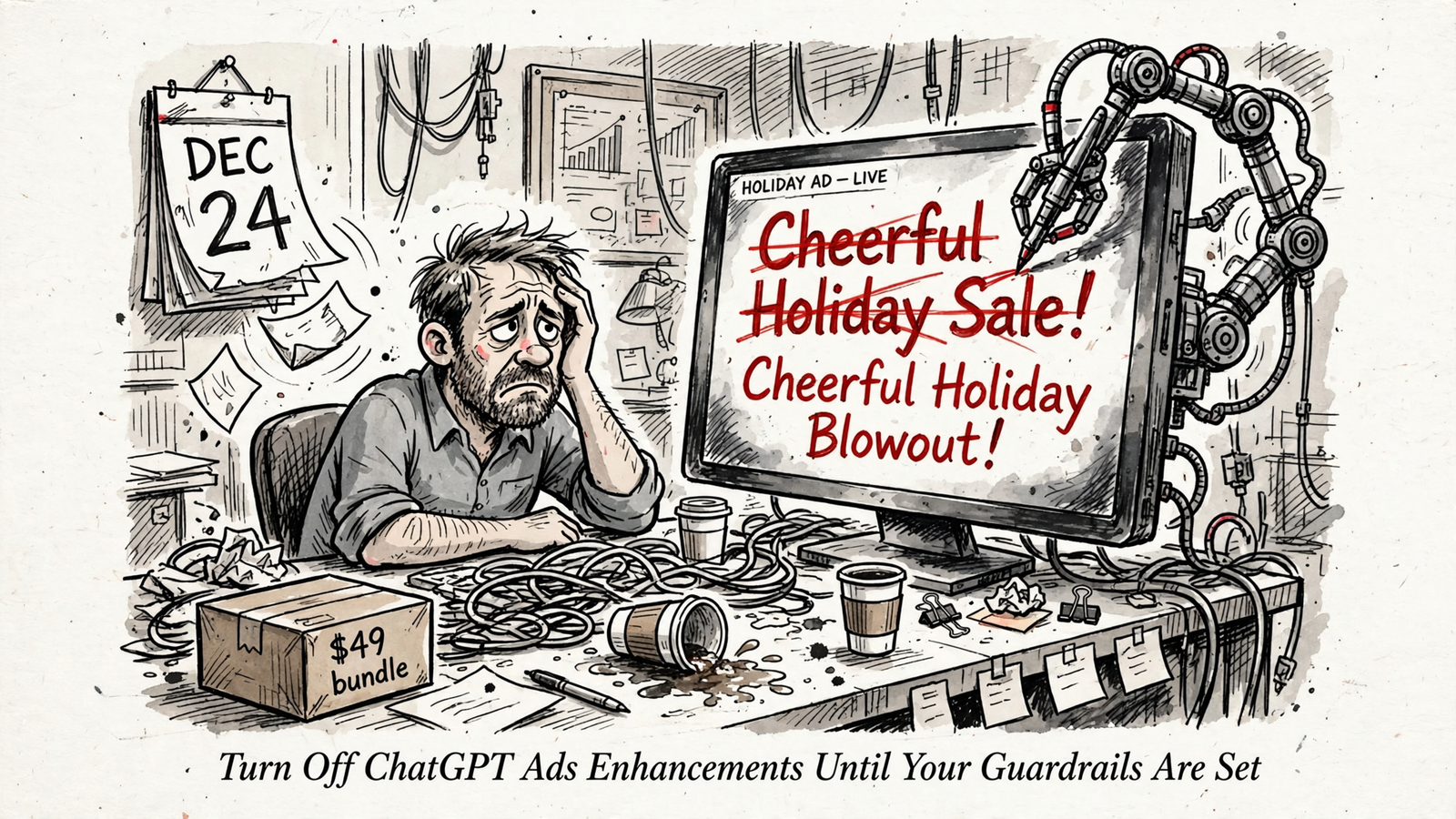
Leave the default on without rules and I do not get faster learning. I get a budget exposed to changed promises and wrong pages, without a per-version report to settle what ran. Turn it off, set the rules, then grant permission. Reverse that order and automation gets to work on the offer before anyone has agreed what must stay intact.


