

 LinkedIn

Two hours a week for 60 days. That is all the attention I would give a small-business owner’s ChatGPT ads test. Spend those hours on four jobs: state the offer facts, approve budget steps, tag which inquiries became customers, and kill what does not pay. Learning the platform is not one of them.
I have run accounts the slow way, by hand, at 1am. I used to tell clients to learn the basics so they could check my work. I was wrong. For an owner testing sponsored cards shown below the answer, learning bids and buttons eats the time needed for decisions only the owner can make. Give a done-for-you team the execution. Keep the truth, the money, and the final call.
1. Set the constraint: 2 hours a week, 60 days, one cap
Your allowance is 16 hours across eight weeks, followed by a decision on day 60. Setup, reports, questions, and lead tagging all count. If a task lives outside that allowance, it will quietly become your second job.
The money needs a boundary too. ChatGPT ads carry a $25-per-day minimum budget, about $750 a month, with starting bids around $3 to $5 max CPC and observed CPMs of $25 to $60. For a small shop, I would set aside $1,500 to $2,500 a month in media for this 60-day test, not the old $200,000 pilot number still floating around. That buys a chance at a readable signal, not certainty. Conversions can lag 24 to 48 hours, making day 30 the first useful read.
Cut the tutorials, daily logins, and experiments with bids. Owner-run accounts can drift toward 15 to 20 hours a month just to stay managed after the learning phase. That is not a two-hour plan. If a job does not need your knowledge of customers, your price list, or your approval, it is not yours.
2. Assign the four owner jobs; delegate the account
Your side of the desk has four items:
- State the offer facts the team cannot invent.
- Approve the initial spend cap and any later increase in writing.
- Tag which inquiries became paying customers.
- Decide on day 60 what scales, what holds, and what dies.
The team owns the account build, pixel and event wiring, one intent per ad group with 5–15 context hints, landing pages, daily bids and budgets, and retiring losers. You do not write targeting. The platform uses plain-language context hints rather than keywords, demographics, or search-term reports. Knowing how to click through that interface does not tell anyone which callers bought.
Own the account; delegate its setup. Have the team confirm the country, billing currency, and time zone with you before creation, since those settings lock and fixing them requires a new account and a different email. Keep administrative access under your business’s control and give the team the access it needs. Do not let an agency’s email become the only route into your account.
The done-for-you offer is familiar enough: listings promise build, launch, iteration, and pipeline reporting for $1,499–$1,500 a month flat plus media, compared with percentage-of-spend fees or larger retainers. The fee does not excuse vague ownership. Your time cost inside the ad account: zero. What that buys is room to do the work the account cannot do for you.
3. Week 1: spend 45 minutes on an offer brief
Sit down once and write the facts a media buyer cannot guess. I have watched small accounts burn a month because the targeting was fine and the offer was foggy. ChatGPT ads match conversations using context hints and the landing page. Vague input gives the team vague groups to build. Your 45 minutes buy a test with distinct intents instead of one unreadable average.
Write three blocks, then stop:
- Prices and math: Exact prices, minimum job size, your close rate on quotes, and what a customer is worth on the first job. Say a job brings in $900 and one in three quotes closes. Each quote then represents $300 in expected revenue before costs. That is not permission to pay $300 for every quote; it gives the team the numbers needed to agree on a sensible ceiling with you.
- Service area and hours: Towns you serve, towns you do not, and a response time you can actually keep.
- Bad fits: Renters for a roof-replacement offer, out-of-area callers, or price shoppers who will never book.
Hand over the page. Do not spend the rest of week one rewriting ads. The team now has what it needs to separate intents and match each one to a page.
4. Weeks 1–2: spend 45 minutes defining a real conversion
Allow 30 minutes to grant access and 15 to approve the definition of a win. The team does the wiring: the OpenAI Measurement Pixel through GTM, with Custom HTML and initialization on all pages; a conversion event, trigger, and tag for each tracked action; and UTMs on every ad URL.
Your decision is simpler. Name the event that means a genuine inquiry or sale: a booked call, a paid order, or a quote form that actually reaches your inbox. Not a page view. Not a button hover. Then confirm that you can match those inquiries to eventual customers in your lead sheet. If a pixel fires under the wrong event name, the account can report zero and later corrections do not backfill. Fifteen minutes of sign-off protects the read you are paying for.
Cut optimization toward clicks and raw form fills. Keep those numbers for diagnosis, not for deciding whether the test worked. This step buys a day-30 report you can interrogate instead of a meeting about whether tracking was installed.

5. Weeks 2–4: approve the spend limit, not the daily tweaks
Spend 10 minutes approving the first cap, then leave delivery alone. I would set a campaign-total limit of $3,000 to $5,000 for the test, roughly $50 to $80 a day on average, with a daily budget inside it. A campaign-total limit is a ceiling, not a promise of even pacing. A $3,000 total can disappear far sooner than its owner expected when ads match a lot of conversations.
Put the rule in Slack or email: no increase before day 30. At that point, allow one pre-agreed step up only if cost per booked job holds. Any increase needs your written yes. You approve the boundary; the team adjusts within it. Spend another 10 minutes around week four to approve that step or keep the original limit. Do not tell the team to raise a daily budget and then assume the campaign-total limit has risen with it.
The team keeps one intent per ad group, with its own hints and matching page. For a plumbing shop, that might mean burst-pipe calls, water-heater quotes, and drain cleaning. Same overall test, three separate reads. I once stuffed every intent into one Google ad group and spent a month arguing with my own report. Do not buy that lesson twice.
Cut daily logins, bid opinions, and creative opinions. The cap and the separate groups buy control without making you the operator.

6. Weeks 3–6: tag customers for 10 minutes each Friday
This is the weekly chore you cannot delegate. Open the lead sheet the team sends and mark which inquiries became paying customers and for how much. Customer or dud, plus job value. No essay. No platform login.
There is a reason to be this blunt. In one early comparison sending traffic to the same site, Google Ads visitors averaged 41 seconds of engagement and a 3.71% conversion rate; ChatGPT Ads visitors averaged 17 seconds and 0.21%. That does not decide what your shop will see. It does tell you not to confuse an interesting traffic source with paying work. Landing pages and follow-up matter; your tags show whether they produced customers.
The team’s UTMs connect each call or form to an intent group. You supply the answer that no pixel has: who paid. If the burst-pipe group sent four quotes and two became $900 jobs, compare its media spend with those jobs before calling it a keeper. If a research group sent nine chats and no work, put it on the day-60 kill list. Ten minutes of truth beats two hours of report-guessing.
7. Weeks 5–8: read three numbers in 20 minutes a week
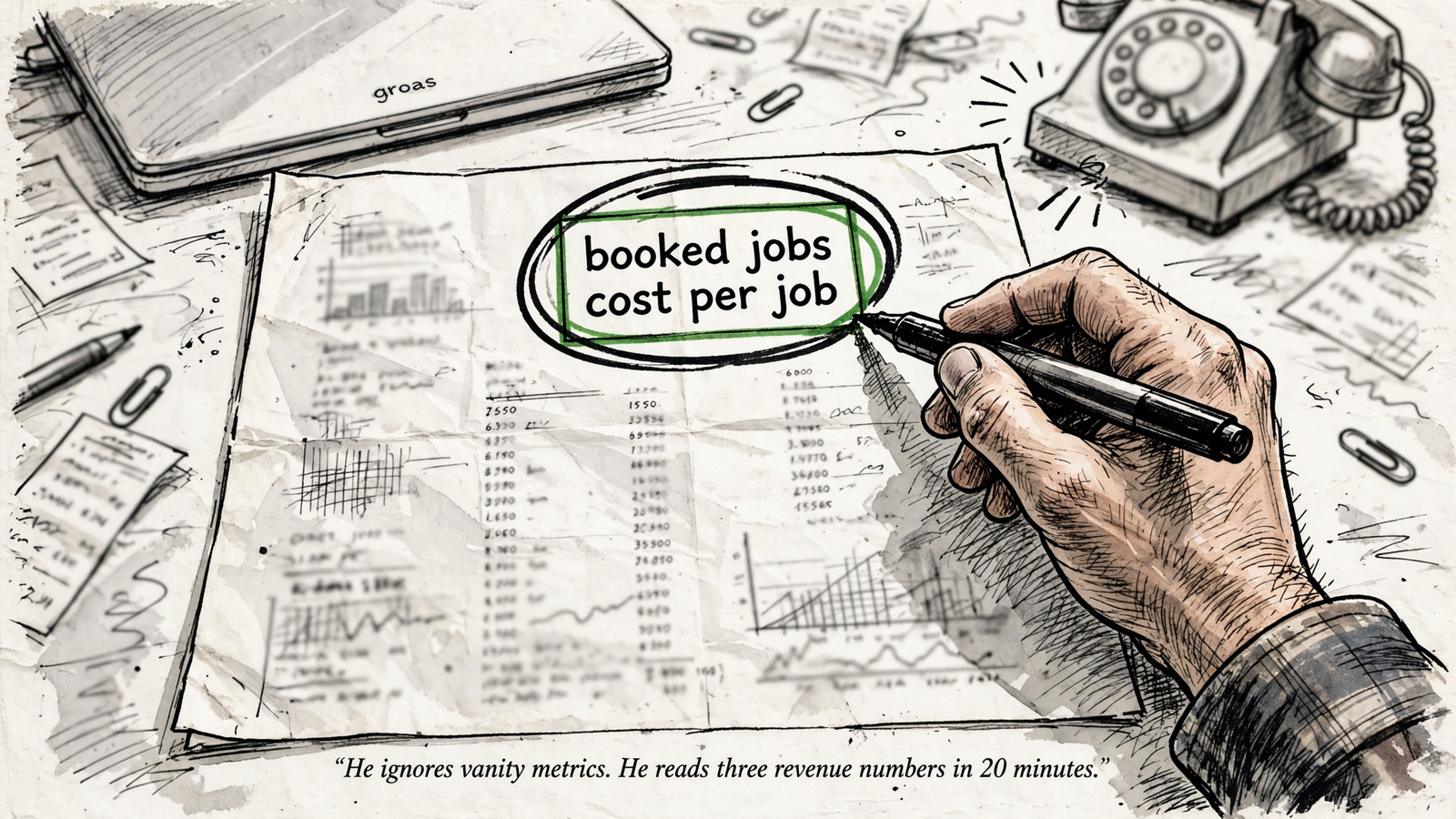
Set a timer. Once a week, read only:
- Cost per booked job by intent group: Media spent divided by customers you tagged.
- Booked jobs by group: Actual customers, not chats or form fills.
- Spend against the cap: Money used and days left in the test.
These answer the question at hand: which conversation sends people who pay you? Impressions, clicks, click-through rate, average CPC, and in-platform attributed conversions can help the team troubleshoot. They do not replace your customer tags. Sponsored cards appear below the answer for Free and Go users; a tap is still only a tap.
If cost per booked job holds within the economics you wrote down, the group earns more room. If it does not, no click rate rescues it. Twenty minutes buys a decision-ready report without turning your week into a reporting ritual.
8. Day 60: spend 60 minutes deciding what lives
Pull the full 60 days of tags and sort each intent group by cost per booked job. Make one of three calls, in writing:
- Scale a group that beats your agreed cost ceiling by a clear margin. If a booked job can cost $300 and one group produced six jobs for $1,200 in media, approve one step up. The team gives that group more room.
- Hold a group that sits within 20% of your ceiling but has too few tagged jobs for a confident call. Keep the same cap for 30 more days while the team retires the worst hints.
- Kill the test if no group comes close, or inquiries never become work despite clean tracking. Stop spend. Keep the pixel, tags, and customer list for follow-up.
Week-one delivery tells you the ads run. Day 30 shows the shape of the channel. Day 60 tells you whether it pays. That is why course-versus-consultant-versus-done-for-you comparisons tend to land on done-for-you for an owner with two hours a week. You bought a read, not a hobby. Cost today: 60 minutes. What it buys: an ending to the test.

9. Before you commit: cut the test if the fit is wrong
This is a gate, not a bonus assignment. Skip ChatGPT ads if your buyers mostly use paid ChatGPT plans: sponsored cards reach Free and Go users, so a buyer researching on Plus or Business may never see you. No context-hint rewrite fixes a reach gap. Skip it if you cannot tag customers on Fridays, cannot answer new inquiries within one business day, or cannot afford $1,500 to $2,500 a month in media plus management before a job books.
I have seen owners buy clicks they could not work, then blame the channel. The follow-up did not happen. Before hiring, check a pitch against the 12 jobs a done-for-you manager should own. If tracking, landing pages, or daily decisions land back on your desk, cut that pitch. Done-for-you should mean the execution is done for you.
When the constraint lifts, do not graduate to learning the platform. If the test scales, keep the same brief when prices change, the same Friday tags, and the same three-number report. Let the team add groups and pages while you approve the next budget step. For owners who want that division of labor without hiring, groas offers Search Ads across Google Ads, Bing Ads, and ChatGPT Ads for a $1,499 flat fee, with bids, hints, budgets, and landing pages worked continuously and actions logged with reasoning.
The account can grow. Your hours do not have to. Keep the four jobs that require you; delegate the rest. Paying to learn the platform was never the job. Paying for customers was.


