

 LinkedIn

Your parent company made the AI answer. Your product never made the shortlist.
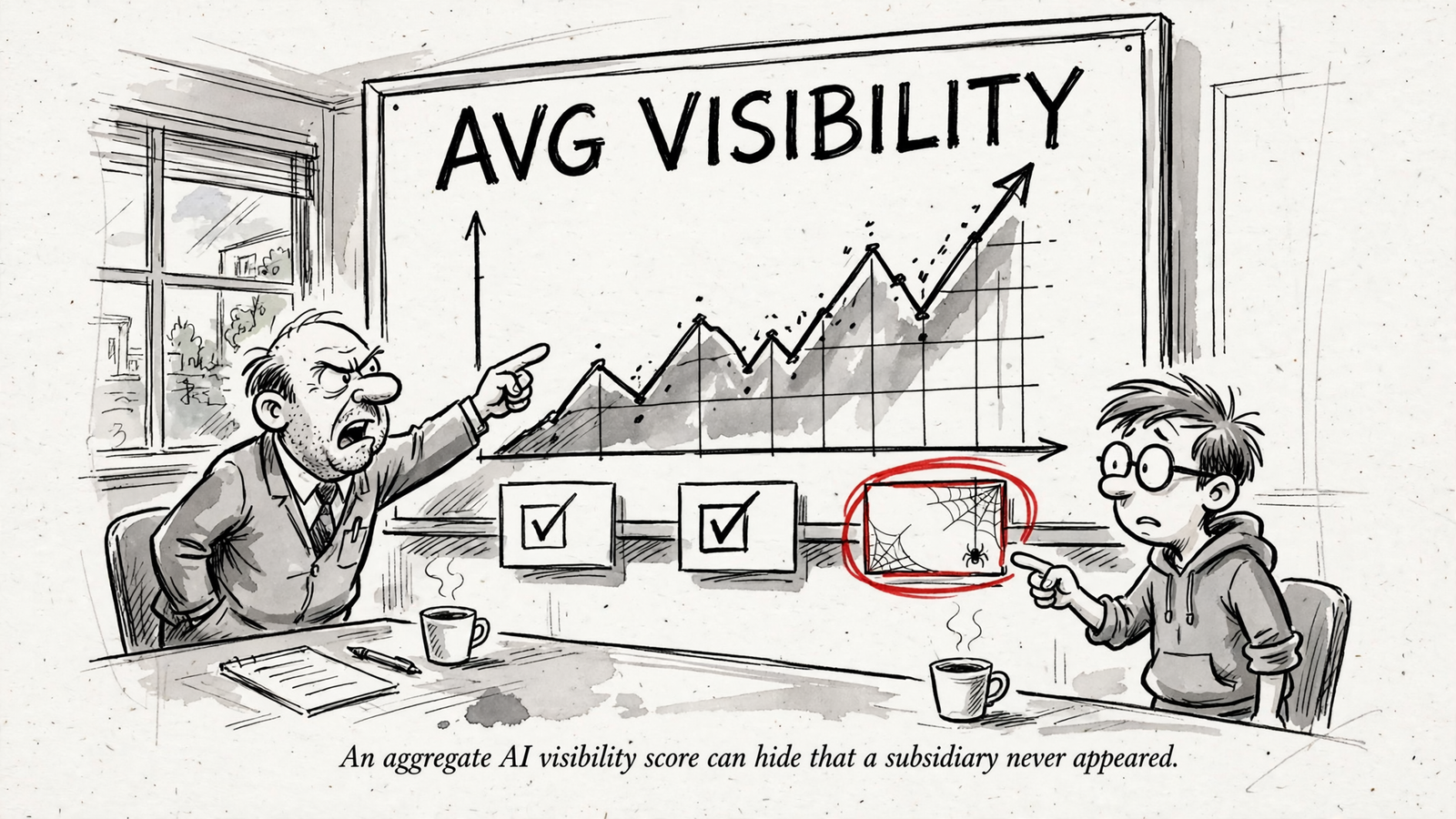
Say you run three trading names under one group. ChatGPT names the group among “reputable manufacturers,” but never names the product customers need or the local branch that books the job. Your monthly visibility chart still goes up. Convenient.
A parent mention is not product visibility. I do not want a report that treats them as interchangeable, and neither should anyone paying to generate business rather than decorate a dashboard. Before buying an aggregate SEO or GEO visibility score, I want the vocabulary to pull it apart.
That starts with identifying which business the answer actually means.
Entity
An entity is the specific business, product, or location an answer identifies, rather than every name connected to the group logo.
Schema.org models these distinctions with separate identity and ownership fields: alternateName for another label, sameAs for identity references, and parentOrganization and subOrganization for ownership. Acme Group, Acme Plumbing of Dallas, and Acme Water Heaters are not automatically interchangeable destinations for a buyer.
The reporting mistake is treating every related name as the same commercial destination. Suppose the parent gets 40 mentions and the Dallas branch gets zero. Calling that 40 wins for Dallas hides the exact problem the report should expose.
Ask which entity surfaced and which URL a buyer could use to act. The group logo is not an answer.
Brand alias
A brand alias is another label for the same entity, such as a shortened name, an old name, or a trading name used by that business.
Schema.org calls this alternateName. The distinction I care about is simple: two labels for one business are different from two businesses under one owner.
This matters during cleanup. An old name can still carry reviews, links, and customer memory. If customers keep searching for it after a rebrand, I do not want it counted as a separate subsidiary win. I do not want it deleted from the report, either.
Map aliases to their entity before calculating coverage. Otherwise, the same business can appear twice in the arithmetic while another disappears entirely. Ask for the alias map in writing.
Parent-subsidiary relationship
A parent-subsidiary relationship means one company owns another, not that recommending one automatically recommends the other.
Ownership has its own Schema.org fields. That relationship provides context; it does not make a holding company the right answer to every operating-company question. Someone asking for “emergency drain repair in Plano” needs the business that can book the job.
The same problem applies to software. Say a group owns three tools. Its flagship appears in “best CRM for agencies” answers, while the two smaller products get nothing. A rising group-level visibility line does not establish growth for those products.
Score each subsidiary against its own buyer questions. Roll the results up only after looking at them separately.
Canonical URL
A canonical URL is the preferred representative URL for duplicate or very similar pages, not an instruction about corporate identity.
Google explains how canonicalization selects a representative URL. A declared rel=canonical is a signal, not a guarantee that Google will choose that page.
The confusion starts when canonical tags become a proposed cure for brand ambiguity. Pointing regional brand pages at the corporate homepage does not explain which branch serves Dallas, which serves Denver, or which business a buyer should contact. It expresses a page preference where the actual problem is business identity.
Do not confuse duplicate-page cleanup with entity clarification. Distinct pages, offers, supporting evidence, and ownership relationships address a different job. If a proposal presents “canonical cleanup” as the entire GEO entity strategy, it is selling SEO plumbing for an AI identity problem.
Structured data
Structured data is machine-readable markup that describes what a page represents, such as a product, a local branch, or an organization.
It helps machines parse a claim. It does not force them to believe it or recommend the business making it. For Google AI Overviews and AI Mode, indexing and snippet eligibility matter, no special schema or llms.txt is required, and eligibility does not guarantee inclusion.
I like schema. I do not like selling it as a recommendation button. If reviews, directory listings, and press describe the parent while saying nothing about the Dallas branch, adding that branch to JSON-LD does not make the wider evidence gap disappear.
Buy markup for clarity, not guaranteed inclusion. Then ask what work will establish the operating company beyond its own website. “We added schema” is an action log entry, not a commercial result.
Mention
A mention means a name appears in the text of an answer.
That is the lowest bar in this glossary. A mention without a link is not a citation, and naming a brand is not recommending it. “Other large groups in this space include Acme” puts a name on the screen. It does not tell anyone to buy from Acme.
Here is how an aggregate report gets flattering. Say a business spends $20k a month across three brands and receives 90 mentions. If 70 are parent-company references in background paragraphs, the headline total conceals what happened to the operating brands. The remaining 20 still need inspection: they are not automatically endorsements, either.
Separate a passing reference from a buyer-facing recommendation. I want the answer text, not just a counter. A name appearing somewhere is a useful observation. It is not yet a win.
Citation
A citation is a linked source presented in support of part of an answer.
It identifies supporting material, not necessarily a recommended supplier. Citation tracking counts linked sources; the next question is what role that source played in the answer.
Suppose a subsidiary’s blog gets cited for a definition, while a competitor gets named as the supplier to call. The citation belongs in the report. So does the uncomfortable fact that the recommendation went elsewhere.
I would not dismiss the citation as worthless. I would refuse to label it a supplier recommendation. Those are different events, and blending them makes the report less useful precisely when a decision gets interesting.
Keep the cited URL and the recommended entity in separate columns. A citation tells me where the answer found support. It does not, by itself, tell me who got the commercial opportunity.
Recommendation
A recommendation is an answer presenting a business or product as a suitable option for the buyer’s question.
This is the distinction I want a report to make explicit: naming a brand is not recommending it.
Compare the two:
- Mention: “Acme Group is a large holding company.”
- Recommendation: “For same-day water heater replacement in Dallas, consider Acme Plumbing of Dallas.”
The second attaches an entity to a place and a job. That context is the point.
An answer can recommend the parent’s enterprise software while overlooking its SMB backup tool. If the parent appears in 22 of 50 tested prompts and the product appears in 3, an average hides the gap rather than explaining it.
Score recommendations per entity and use case. One strong brand should not be allowed to do the reporting for two invisible ones.
Prompt cohort
A prompt cohort is a defined set of buyer questions tested repeatedly so the results can be compared.
Not a handful of flattering questions selected after the answers come back. Ongoing AI-search work tracks prompts across engines, ships changes, and retests. The fixed set gives the comparison something to stand on.
For a multi-brand business, I split the questions before looking at the totals:
- Brand questions: “Who owns Acme Plumbing?” These test how the business and its relationships appear.
- Category questions: “Who can replace a water heater today in Plano?” These test whether the operating business enters the buyer’s consideration set.
Mixing them lets easy ownership answers inflate harder discovery results. The parent appearing in an answer about the parent is not evidence that the branch appears when someone needs a plumber.
Keep brand and category cohorts separate. Reputation questions and revenue-seeking questions do not do the same job.
Entity-level visibility
Entity-level visibility reports which specific business, product, or location appeared for each tested question, along with any relevant links.
GEO reporting uses measures such as citations, AI visibility, and share of voice. Whatever the chosen measure, combining entities too early can hide the one buyers never saw.
What the deck calls synergy, I call one chart hiding two missing subsidiaries. I want a breakdown like this, with the underlying questions and URLs attached:
| Entity | Appearances |
|---|---|
| Acme Group | 31 |
| Acme Plumbing Dallas | 4 |
| Acme Water Heaters | 2 |
Those counts are only the start. I still need to know whether each appearance was a mention, citation, or recommendation. But the split makes the next question obvious instead of burying it in a group average.
Require the entity breakdown before accepting the rollup. If a provider will not show it, I cannot tell whether the work serves the whole business or merely flatters its best-known name.
Attribution
Attribution connects discovery with subsequent business activity, such as a click, a call, a qualified meeting, or closed-won revenue.
It is not another word for appearance. Equating visibility with a lead or sale skips the step that matters commercially. I run paid search, so my questions stay blunt: what was the query, which entity appeared, and what did the buyer do next?
That does not mean every AI appearance comes with a measurable click path. A buyer may see a name without a link. A citation may lead to a help-center page rather than a booking page. Those are measurement limits to state, not blanks to fill with assumed revenue.
In Does ChatGPT Recommend Your Business? Seven Questions About Measuring AI Visibility, I separate mentions, citations, and recommendations. The same separation belongs here, alongside whatever subsequent behavior can actually be measured.
Report observed business activity per entity, and label what cannot be attributed. A visibility report can show an appearance without pretending it has proved a sale.

Multi-brand agency brief
A multi-brand agency brief defines the entities, buyer questions, and reporting requirements a provider must work against.
“Manage how my brand shows up across ChatGPT, Gemini, and Perplexity” leaves too much room for a tidy report about the wrong business. I want the distinctions above in writing before the work begins.
The brief can stay short:
- List entities and aliases separately. Include the parent, subsidiaries, products, trading names, and markets. Mark which names identify the same business and which represent separate destinations for buyers.
- Define two prompt cohorts. Keep brand questions separate from category-discovery questions. Agree on the exact questions, engines, and retesting schedule before comparing results.
- Specify the reporting fields. For each appearance, record the question, surfaced entity, appearance type, recommended name, cited URL, and actionable destination where one exists. Do not substitute an average across subsidiaries.
I also want the Google and AI reports to use the same entity names, aliases, and destination URLs. Otherwise, comparing them becomes a second job before anyone can identify which surface is failing which brand.
Then comes the work. I judge providers by whether they track the agreed cohorts, ship technical fixes, build relevant commercial pages, improve existing pages, and earn outside mentions that corroborate each entity. A dated action log beats a polished explanation of why nothing changed.
groas is built around that version of the job: paid search, SEO, and AI-search visibility work with strategic ownership, rather than a list of suggestions handed back to the client. That is the alternative I want to the reporting-heavy operating model: work done, not merely work recommended.
Require per-entity recommendations and clear revenue paths. If a provider cannot show that split, the brief has exposed a problem before the monthly chart gets a chance to hide it.
AI visibility score
An AI visibility score is a summary measure of appearances across a chosen set of questions, entities, and answer surfaces.
It is also the term I would retire when it means one blended number for a multi-brand business.
Take 31 parent mentions, 4 branch recommendations, and 2 product citations. Stir them together. Announce that visibility is up 18%. The arithmetic may produce a number, but the number no longer tells me which business the buyer could actually choose.
The cause is aggregation. The result is a chart that can climb while the subsidiary still gets overlooked.
Retire the blended score. Keep the entity-level table. Name which brand the AI recommended, for which question, with which link. That is the report I can use to decide what needs fixing. The rest can stay in the pitch deck.


