

 LinkedIn

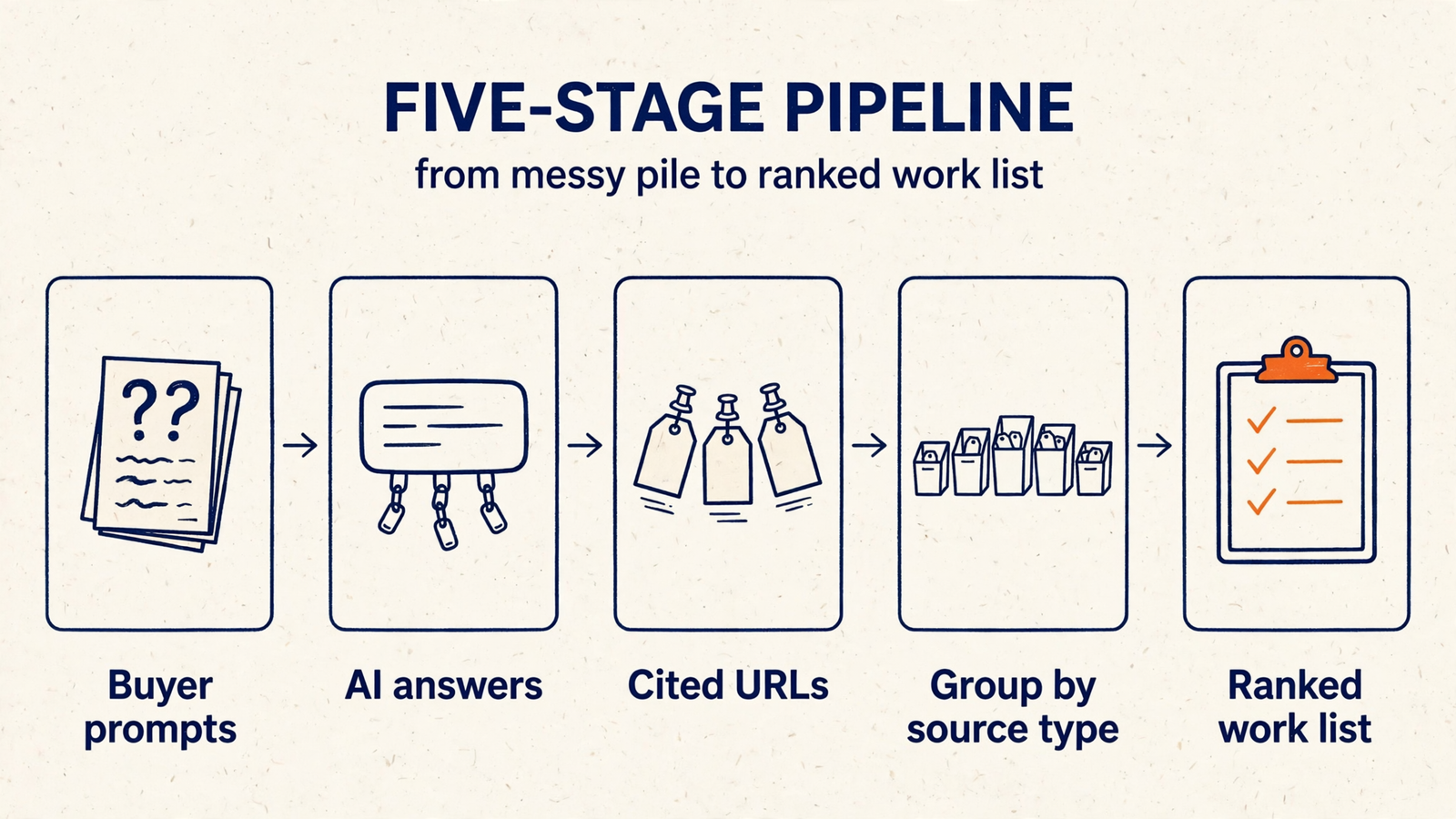
The sites AI assistants keep citing in your industry are a short, knowable list. I want that list to become a work queue, not another visibility score with a nice color palette.
By the end of this tutorial, you’ll have a one-page source map and a ranked content and outreach plan: which domains recur, which engines cite them, which pages to fix, and where to show up next.
The distinction is repetition. Hendricks logged 16,069 citations across 7,775 domains, but 67% of those domains appeared exactly once. Don’t chase the whole internet. Find the sources that keep answering your buyers’ questions.
Before starting: gather the account and buyer questions
Have these ready:
- A groas account: $19 flat a month for a whole team, with unlimited sites and accounts.
- Your own AI, through which you’ll query the data groas collects.
- 20 to 30 buyer prompts, written as people actually ask them: best X for Y, X vs Y, is X worth it.
For a free preview, Ahrefs’ AI Visibility Checker reports mentions, platform breakdowns, and top cited domains across several assistants without signup. Treat it as a preview, not the ongoing workflow. It does not keep watching.
The distinction matters because source mixes move. Citlyze tracked 200 buyer prompts and watched Reddit fall from 13.5% of Perplexity’s answers to 1.5% in six weeks. One export gives you a snapshot. This exercise needs a running log.
Step 1: build a fixed panel of buyer prompts
Write 20–30 prompts across four archetypes:
- Recommendation: best {category} for {segment}
- Comparison: {you} vs {competitor}
- Purchase check: is {product} worth it
- Problem-solving: how to {job to be done}
Use buyer language, not keyword-report labels. A category term is not a question, and a question from someone comparing products is not interchangeable with one from someone learning the basics.
That choice changes the measurement. In Analyze AI’s study of 460 B2B prompts, switching archetypes shifted measured mention rate by 8 to 17 percentage points. Comparison and alternatives prompts averaged around 35%; research and how-to prompts averaged 26%.
If the panel is mostly how-to questions, don’t read a lower mention rate as proof that the brand has disappeared. The panel may simply be asking assistants to explain rather than recommend.
Use this instruction to organize the starting set:
Group these buyer prompts into recommendation, comparison, purchase-check,
and problem-solving questions. Preserve the buyer's wording. Flag repeated
questions and show the final 20–30-prompt panel.
Expected result: one fixed panel covering the buying questions you want to measure.
Mistake to avoid: rewriting the panel every time the numbers disappoint. Freeze the starting set so later movement means something.
Step 2: collect cited URLs separately for each assistant
Run the panel on the engines your buyers use. For every answer, record:
- Prompt text.
- Engine.
- Date.
- Whether your brand was mentioned.
- Every URL cited in the answer text.
My counting rule is text-cited URLs only. Log mention-only appearances separately.
A mention is a brand name in prose. A citation points to a page with an owner and a format. That makes it a work item. A map has a next action; a score has a mood.
Keep engines separate. In Slate’s test of 1,000 B2B questions, four engines shared just 29 citations. A blended total hides which source matters where.
Also separate sources returned by an API from sources actually cited in the answer. Citlyze found that Perplexity’s API returned more sources than the answer text used. Counting the former put Reddit in 77% of answers; counting text-cited sources put it at 13.5%. Same broad subject, very different denominator.
Put the collection work through groas
Twenty prompts × four engines × four weekly runs is 320 answers to copy and tabulate. That is not the interesting part of this job.
Use groas to collect AI answers and their cited URLs continuously, alongside its competitor and Reddit research. Start your AI with:
Through groas, track our buyer prompt set across ChatGPT, Perplexity and
AI Overviews. For every answer record the prompt, engine, date, whether
our brand was mentioned, and every text-cited URL. Keep mention-only
appearances separate and report each engine separately.
Expected result: a running answer log you can query, rather than a screenshot folder.
Mistake to avoid: treating API results, signed-in answers, and logged-out results as interchangeable. Keep the collection method consistent. Don’t interpret a change in method as a change in visibility.
Step 3: group recurring domains by the action available
Sort cited domains into five buckets, then count appearances per domain, per prompt, per engine.
| Bucket | What it holds | Available work |
|---|---|---|
| Review and listing sites | Directories, review platforms, comparison marketplaces | Get listed, complete profiles, fix categories and reviews. |
| Reddit and forums | Threads where buyers ask each other | Read for buyer language and earn relevant mentions. Don’t treat threads as somewhere to dump a pitch. |
| Publishers | Trade press, news, comparison editorial | Offer data, expert quotes, or contributed insight where the publication keeps recurring. |
| Competitor pages | Rival comparisons and alternatives lists | Identify the comparison-page gaps on your own site. These are not pages you control. |
| Your own pages | Definitions, pricing, documentation, comparisons | Improve the pages you control end to end. |
Ask for the map:
Through groas, list the top 30 domains cited for our tracked prompts,
grouped into review and listing sites, forums, publishers, competitor
pages, and our own pages. For each domain, show citation appearances,
the prompts it appears on, and the breakdown by engine.
Use outside averages only as a sanity check. Hendricks found company-owned sites taking 64.5% of citations in healthcare and dental, but 27.0% in education. The spread is the finding. Your category’s counts decide the work.
Don’t restrict the map to famous domains, either. In Surfer’s analysis of 6.78 million AI Overview citations, the top 50 domains accounted for only 21% of citations. The niche comparison site nobody puts in a deck may matter more to your buyers than a globally prominent publisher.
Expected result: a ranked table for each bucket, with engine and prompt detail.
Mistake to avoid: counting unique domains instead of repeated appearances. Thirty domains cited once each are a different opportunity from three domains appearing across fifteen prompts each. Rank recurrence first, then inspect the questions behind it.
Step 4: turn the map into ten specific actions
Work the buckets in this order: own pages → review profiles → publishers. Use competitor pages to identify gaps and forum threads to understand the questions.
Start with your own pages because you control the edits, not because publishing another page guarantees a citation.
Check the formats already earning citations. Across Slate’s 1,000 questions, definition pages were the only format ranking in the top two for all three citing engines. Comparison pages came second. That gives you a starting point: inspect missing or thin definitions and comparisons before commissioning another broad article.
Where an assistant already cites one of your pages, check what it attributes to that page. The cited URL and the claim it supports are the unit of work, not a sitewide visibility score.
Ask your AI:
Using our groas citation map, identify which cited pages could reasonably
mention us and which of our own pages should be improved.

Give me the top 10 actions. Include the page, source bucket, engine,
prompts it appears on, frequency of appearance, and reason for the action.
Prioritize our own pages, then review profiles, then publisher opportunities.
Keep the forum bucket useful without turning it into an outreach fantasy. groas collects Reddit research and the quotes attached to threads. Read those questions for the language buyers use when they have a real problem and a budget in mind. Save that wording for the next panel update.
Expected result: ten named pages or outreach targets, each with a reason and a place in the queue.
Mistake to avoid: turning every cited domain into a pitch target. A rival’s comparison page is evidence of a gap. A buyer’s Reddit thread is research. Neither is a publisher waiting for your press release.
Step 5: check retrieval, then make logged edits
Before rewriting a page, check whether assistants fetch it. A citation starts with a fetch; copy cannot help if retrieval never reaches the page. Use the 30-day server-log protocol to inspect which pages ChatGPT and Perplexity actually read.
Then work in this order:
- Fix cited material that is wrong.
- Add missing material identified in the map.
- Pursue new citations.
Use this instruction before making changes:
For the prioritized pages, check the available retrieval evidence before
recommending rewrites. Separate retrieval problems from content problems.
Order the work: incorrect cited material first, missing material second,
new citation opportunities third. State the reason for each proposed edit.
I want the same discipline here that I expect from bid changes: put the reason in the log, not in someone’s head. groas logs the reason for each site or content change it makes, and any change can be undone in one step.
Expected result: a sequenced edit queue that distinguishes pages needing better content from pages assistants are not reaching.
Mistake to avoid: rewriting repeatedly before checking retrieval. Six weeks later, “the model decided” is not an explanation you can defend to a client.
Read these three limits before judging the plan
Keep citation coverage, available leverage, and engine differences visible while reviewing results.
- Some prompts produce almost no citations. ChatGPT cited a source in only 72 of Hendricks’ 480 answers, and 69 of those fell into just two question types. Track mentions where the answers offer no URLs. Don’t manufacture a citation problem from a non-citing answer format.
- Not every source is an outreach opportunity. You cannot pitch your way onto YouTube’s homepage. You can work toward appearing in videos and threads that assistants cite. Put that slower, less direct work in its own lane.
- An engine-specific plan is not a universal plan. The engines cite different sources. Prioritize the engine your buyers use, then inspect the others separately rather than expecting the same work to move every column.
Use these limits to classify the work, not to explain away every flat result.
Step 6: compare the map every 90 days
At 90 days, compare the same core panel with the previous quarter. Ask three questions, in order:
- Which domains entered or left the top 30?
- Did your own pages’ share of citations move?
- Which prompts still produce no citations to your pages?
Ask for the difference, not another fresh report:
Through groas, compare this quarter's top 30 cited domains with last
quarter's using the same core prompt panel. Which entered, which left,
and which of our pages gained or lost citations? Separate the results
by engine and show changes in each source bucket.
The point is to find changes that alter the queue. A publisher you planned to pitch may have stopped appearing. A niche comparison site may now recur across the questions that matter. Keep the work tied to the current map rather than finishing an outreach list simply because somebody made it.
Expected result: a side-by-side domain comparison plus page-level and bucket-level movement.
Mistake to avoid: panicking over one entrant at position 28. Watch repeated appearances and bucket movement before changing the plan.
Verify it worked, then refresh the questions
Run two checks against the log from Step 2:
- Page-level: which pages edited in Step 4 now appear as cited URLs in fresh answers? Give it six weeks minimum, and check retrieval before declaring a rewrite a failure. Publishing and being fetched are not the same event.
- Bucket-level: did your own pages’ share of citations move? Did any targeted listing site or publisher start appearing in the map?
If neither moves after two review cycles, look upstream before publishing more. Check whether assistants fetch the pages and whether the prompt set reflects how buyers ask. Publishing more pages at a fetch problem wastes a quarter.
The first thing to change once it works is the prompt set. Keep the core frozen so the trend stays honest. Each quarter, add three to five prompts taken directly from the Reddit research groas collects, using this quarter’s buyer language rather than last quarter’s assumptions. Keep those additions separate from the unchanged core when comparing results.
The short list was never the hard part. Keeping it current is.


