

 LinkedIn

A $500 ChatGPT ads test can spend every dollar and still tell you almost nothing. The low entry price limits what you can lose; it does not guarantee you will learn enough to make the next decision.
Here is the fact everything else follows from: a test buys evidence, not a guaranteed batch of customers. A small budget is useful only if that evidence can change what you do. If $500 buys 100 clicks and zero or one inquiry, you may have paid for a guess.
I will use that same $500 throughout, starting with what the money actually buys and ending with a case where a larger test might earn its keep.
Separate the management bill from the media budget
A test has three costs. Only one buys clicks:
- Management: setup, tracking checks, and the work of running the campaign.
- Media: the money paid to OpenAI for the advertising itself.
- Time: the wait between a click, an inquiry, and a sale.
Confuse the first two and a cheap test gets expensive before anyone visits your site. The management bill arrives whether the clicks turn into anything or not. Ignore the third and you can stop the test before its result exists.
The reported self-serve terms include no account minimum, but a $25 daily per-campaign floor in the US and suggested CPCs of $3 to $5. At $25 a day, $500 funds about 20 days of media. That tells me how long the budget can run at that pace. It tells me nothing yet about whether the result will be useful.
A spending limit is a sensible way to contain damage. It is not a measurement plan. Before choosing the daily budget, I want to know what decision the test is supposed to support.
Decide what counts before counting conversions
ChatGPT counts a conversion when its system records the action you told it to count. A qualified inquiry comes later: someone checks whether the need and budget are real and whether the inquiry deserves sales time. A customer comes later still.
Those are different events. Treating them as interchangeable makes a small test look more informative than it is.
In four same-advertiser comparisons, ChatGPT converted at 0.21% to 0.9% while Google converted at 3.71% to 6.64%. One B2B account in that dataset recorded 36 platform conversions but only two real inquiries. Whatever the conversion column captured, it was not the same thing sales counted as an inquiry.
A separate small-business field report described spending $500 in a little over an hour at about $3.50 CPC, with 140 clicks reported, only around 13% verifiable in site analytics, and zero leads or consultations. That account also reported a dashboard lag of about 24 hours and billing split into five charges.
I would not use either report to predict every advertiser’s result. I would use them to settle the measurement question before launch: judge the test on inquiries your team would actually work, not just the conversion column. Otherwise, you can buy a reassuring number without buying evidence of demand.
Work backward from inquiries to clicks
The first calculation is simple:
Media budget ÷ cost per click = visits you can buy.
At $500 and $3 CPC, that is about 167 clicks; at $5 CPC, it is 100. Management does not increase that number. Neither does stretching the same media budget across more days.
The next calculation introduces the number you know least on a new surface: the conversion rate.
If 1% of visits become inquiries, 100 visits produce one inquiry on average. That is an expectation, not an appointment in the calendar. Getting to 10 conversions at that rate takes around 1,000 clicks, or $3,000 to $5,000. Those conversions still need to mean something useful.
At a 3% conversion rate, $1,000 buys roughly six to 10 hypothetical conversions, depending on CPC. Then qualification separates the promising inquiries from the rest.
This is the mechanism behind the expensive guess: few visits multiplied by an uncertain conversion rate produce a result that can swing sharply on one inquiry. Start with the evidence you need, then calculate the traffic required to produce it. Starting with a comfortable price reverses the logic.
Zero inquiries is a result, but not always an answer
Suppose the $500 buys 130 visits and produces zero inquiries. Two explanations remain:
- The traffic does not want what you sell.
- The sample is too small to reveal a low conversion rate reliably.
The zero does not tell you which explanation is right. One inquiry would not settle it either. That single person would change the dashboard considerably without necessarily changing what you know about the channel.
I want three outcomes defined before launch: enough evidence to continue, enough evidence to stop, and inconclusive. The third is not a polite word for failure. It means the test has not earned either decision.
Write down what would count as a real “no.” Otherwise, every zero looks like failure and every single lead looks like proof.
Let the sales cycle finish before judging revenue
Now suppose the same $500 produces two inquiries in week two. You have moved beyond the click. You still do not have revenue.
For B2B, one sales-cycle benchmark puts the median at about 84 days, with smaller deals closing in weeks and larger deals taking three to six months. The sequence matters: the click happens in a chat, qualification happens on a call, and the signature may happen a quarter later.
That is why comparing fresh ChatGPT inquiries with mature Google results can mislead you. The Google numbers may include months of follow-up, closed deals, and dead leads already removed. The ChatGPT numbers contain two names you just met.
Judge qualified inquiries first, then revenue when the pipeline has had time to mature. Keep those judgments separate rather than asking an early metric to stand in for a later one.
If your sale takes 60 days to close, a 14-day spend test can show whether people inquire during that window. It cannot yet settle whether those people buy. Ending the media spend does not end the measurement period.
Make the provider price an inconclusive result
A provider willing to take $500 should explain what that budget can establish, not just how quickly the campaign can launch. I would ask for answers in this order:
- What counts as a useful inquiry? Agree on the action and the qualification standard before the first click.
- How will paid traffic be identified? Put tracking and UTMs in place before launch. Organic referrals already use
utm_source=chatgpt.com, so that source label alone does not separate paid from organic. - When will the reporting be readable? Reported delays include seven to eight hours for spend and 24 to 48 hours for attributed conversions. A day-two screenshot is not a final verdict.
- What makes us continue, stop, or admit we do not know? Name the decision before seeing the result.
- What does another round cost? Include the additional media, management, and time needed if the first sample is inconclusive.
The budget controls deserve the same attention. A daily budget can operate as a seven-day average and spend up to twice that amount in a day. A small daily number is not a promise of evenly paced spending.
I am less interested in a provider’s confidence than in the boundary of its promise. “We can start for $500” answers a purchasing question. “Here is what $500 can and cannot tell us” answers the business question.
No test should start until “inconclusive” has a definition and a price attached. That is the part a low entry price tends to leave out.
Where groas changes the cost—and where it cannot
The same arithmetic applies to my own side. groas charges a flat $1,499 a month for management, with platform spend on top. That fee covers Google, Bing, and ChatGPT management together; it is not charged three times. Each platform still needs its own media budget.
I have laid out how a $1,000 ChatGPT test becomes a $2,499 commitment once management is included. For our $500 example, the total is $1,999 for one month of management plus media. The media still buys roughly 100 to 167 visits.
That distinction matters when choosing between running the work yourself and paying $1,499 to have it managed. The fee pays for management. It does not turn a thin traffic sample into a thick one.
Price the whole commitment against the decision it can support. A well-run test can still be too small to answer the question you brought to it.
The economics change if you already pay groas to run Google and Bing. Adding ChatGPT creative and checks within that same $1,499 does not add a second retainer. That is the advantage of shared management: the new channel does not need a separate management bill.
It still needs media. And 100 visits still cannot settle a revenue question simply because the management cost is already covered.
I apply the same logic to an in-house hire versus a managed service: compare the total cost of producing useful evidence, not the fee in isolation. Include enough media to generate inquiries, the work of qualifying them, and the time needed to see what closes.
Practitioners put a practical SMB test budget at $3,000 to $5,000 a month. That is not a universal admission price. It reflects the traffic required to get beyond a handful of outcomes at the CPCs discussed here. A cheaper management arrangement helps the bill; it does not remove the need for evidence.
The cheapest sensible option may be to wait
Take a business selling a $4,000 service. It closes one in five qualified inquiries, and its site turns 2% of ad visits into inquiries.
Run our $500 forward at $3.80 CPC:
- The budget buys about 130 visits.
- A 2% inquiry rate suggests two or three inquiries on average.
- Those inquiries still need qualification before the one-in-five close rate applies.
- Even if they all qualify, the expected sales volume remains below one deal.
A zero-sale result would be unsurprising. One sale would also be plausible. The temptation is to call the first failure and the second proof. Neither verdict has much room beneath it.
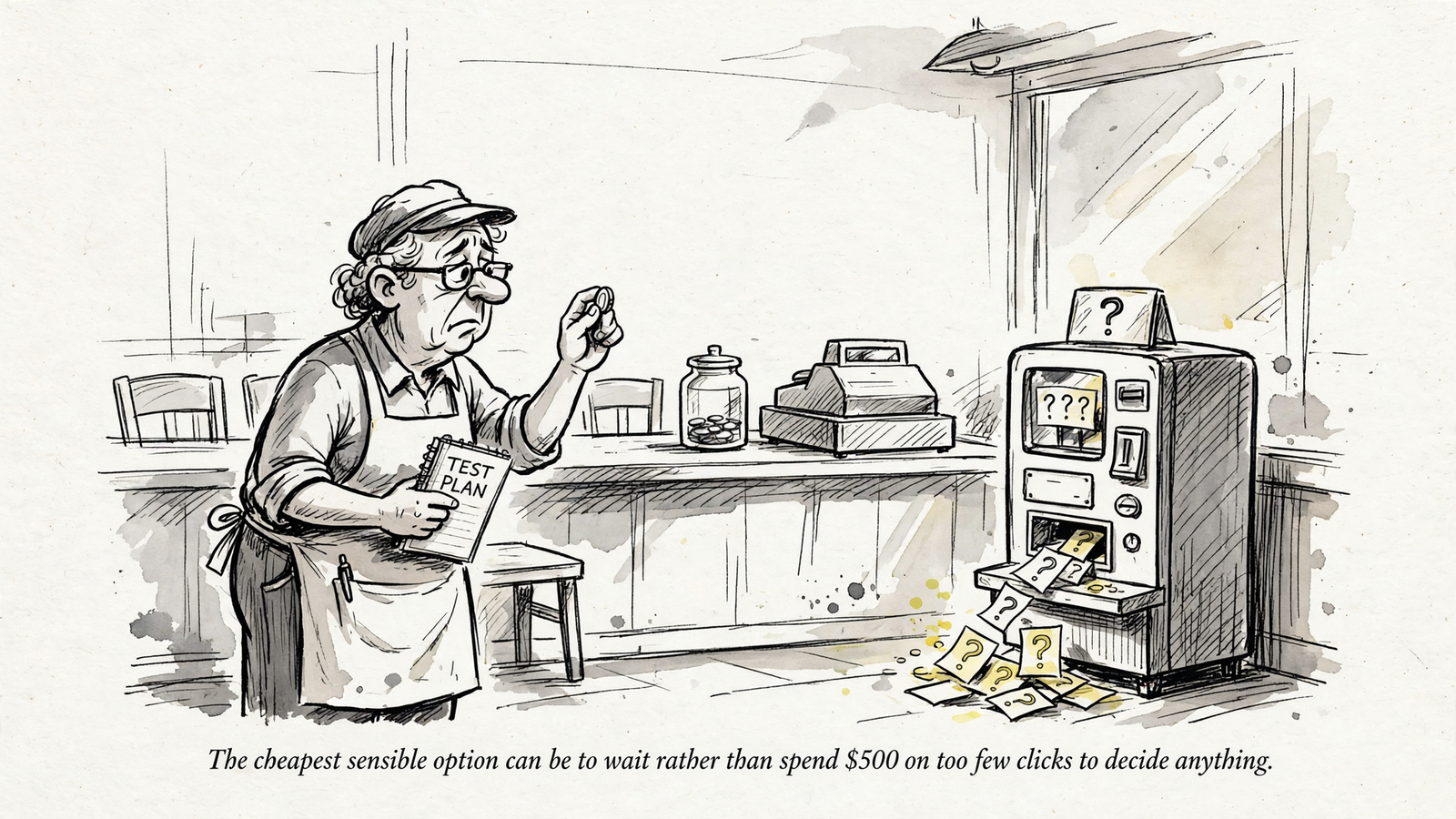
For that business, I would keep the $500, fix tracking, tighten the offer page, and return when the budget can fund enough visits to make the result useful. Waiting beats paying for a verdict the sample cannot support. That is not caution for its own sake. It is arithmetic.
Now change the case. Suppose you already run Google through groas and want to add ChatGPT next quarter. Your management fee does not change, your pixel and Conversions API already fire, and your site turns 3% of search visits into inquiries.
An additional $1,500 in ChatGPT media at $4 CPC buys about 375 visits. If that 3% inquiry rate carries over, you would expect roughly 11 inquiries. That is an assumption to test, not a result to put in the proposal.
Work through the next layer. How many of those inquiries qualify? Is their cost acceptable against the Google baseline? Have both groups had comparable time to develop? Revenue may still need months to mature, but qualified inquiries could support an earlier decision: continue, move the money back, or split it. If too few qualify, the answer remains inconclusive.
This case has a clearer path to a useful answer: no additional management retainer, working measurement, a baseline, and more visits. None guarantees success. Together, they make the test more capable of changing a decision.
If none of that describes your business, waiting is the better buy. No tracking, no baseline close rate, and only $500 for media means paying $1,999 all-in with groas for a sample that may produce one maybe. Keep the money, fix the offer page, and log where current inquiries actually come from before buying another source of uncertainty.
A cheap test is only cheap when it can tell you no. Until then, it is just an expensive guess with a receipt.


