

 LinkedIn

A campaign budget tells an ad platform how to spend. It does not tell finance what the business will spend.
Say I’m running $14,000 a month on Google and $6,000 on Microsoft for one client. On November 12, finance asks whether we’re on budget. I can add up the daily budgets in both accounts and send a number before anyone finishes their coffee. I used to do that. The number was easy to produce and answered the wrong question.
Finance approved a $20,000 ceiling. The campaign budgets are instructions I gave two separate delivery systems. To tell whether the business is on pace, I need ChatGPT to read what those systems have actually spent, separate what we’ve committed to from what we’re estimating, and show what might need to change. I’ll stick with that same $20,000 example until the finance note is ready to send.
What a $10 daily budget actually tells the platform
Google calls the setting an average daily budget. Average is the word that matters. A campaign can spend up to twice that amount on a high-traffic day. If the budget stays the same all month, Google limits monthly charges to 30.4 times the daily budget, with an overdelivery credit if charges exceed the limit. At $10 per day, that means a day can hit $20 and the monthly ceiling is $304. It doesn’t mean the bill will be $304.
Microsoft also treats the daily budget as a target, not a promise about each day’s spend. Delivery can come in above or below it, with single-day overspend usually less than 100% above the daily budget. Microsoft uses the number of calendar days in the month: a $10 daily budget gives it a monthly limit of $300 in a 30-day month or $310 in a 31-day month. If I change the budget mid-month, Microsoft recalculates the limit using month-to-date spend plus the new daily budget times the days remaining.
So even before I look at delivery, the same $10 setting doesn’t mean the same thing in both accounts. Each platform has its own billing math. Neither knows that finance approved $20,000 across both accounts. I use the platform limits to understand what my settings allow, not to forecast what the business will spend.
Start with actual cost and write down the cutoff
The first number I want from ChatGPT is reported cost through the last complete day, broken out by account and campaign. On November 12, that means Google spend through November 11 plus Microsoft spend through November 11. I want the cutoff alongside each total. If an account’s data is missing, I want it marked missing, not filled in with a zero that makes the month look cheaper. That’s the same discipline a good pacing sheet uses; changing the interface doesn’t change the job.
I check three things before I use the totals:
- Currency. Both accounts in this example report in USD. If they don’t share a currency, I keep the totals separate until I have a stated conversion rate for the finance summary.
- Time zone. Google Ads sets the account time zone at creation for reporting and billing. November 11 in a Pacific-time Google account and November 11 in an Eastern-time Microsoft account don’t end at the same instant. I label both cutoffs rather than pretend they do.
- Campaign status and launch dates. A paused campaign can still show a $200 daily budget. Its past spend belongs in the actuals, but I don’t count on it spending another $200 tomorrow unless the plan calls for it to resume.
I’d rather have ChatGPT read the accounts directly through groas MCP than go through the CSV export-and-paste routine. Either way, the first request is a read, not a change:
Using groas, read these Google and Microsoft accounts. Show reported spend through the last complete day by account and campaign. Keep currencies separate, note each cutoff and time zone, and flag missing data. Do not change anything.
The remaining allowance gives me a pace, not a prediction
Say the read comes back at $7,400 through November 11. I subtract that from the $20,000 allowance. That leaves $12,600 over 19 days, or about $663 per day across both platforms. That’s the remaining planning rate: what I can afford per day on average from here, not what I expect to spend. Dividing the original allowance by 30 doesn’t answer that question because some of the money is already gone.
Now I can build a run-rate forecast. I take the average daily spend through November 11 and project it over the remaining days. The assumption is that the rest of November behaves like the first 11 days. On this account, that puts the estimated finish a little above the ceiling. It’s a useful baseline precisely because I can see what it assumes. It’s not an instruction to keep doing the same thing.
Then I account for what’s already on the calendar. If the Black Friday push needs $3,000 from November 24 to 26, I reserve that money before spreading the rest. That leaves $9,600 over the other 16 days. The $3,000 is money I’ve set aside in the plan, not spend that has already happened or a guarantee that the campaigns will deliver it. If I use that plan to estimate a month-end finish, I still have to say what I expect the campaigns to spend.
So I keep three labels in the report: actual, reserved, and estimated. The first comes from the accounts. The second comes from the plan. The third depends on assumptions about delivery. I make ChatGPT write those assumptions next to the estimate, where finance can see them.
The combined total can look fine while the split goes wrong
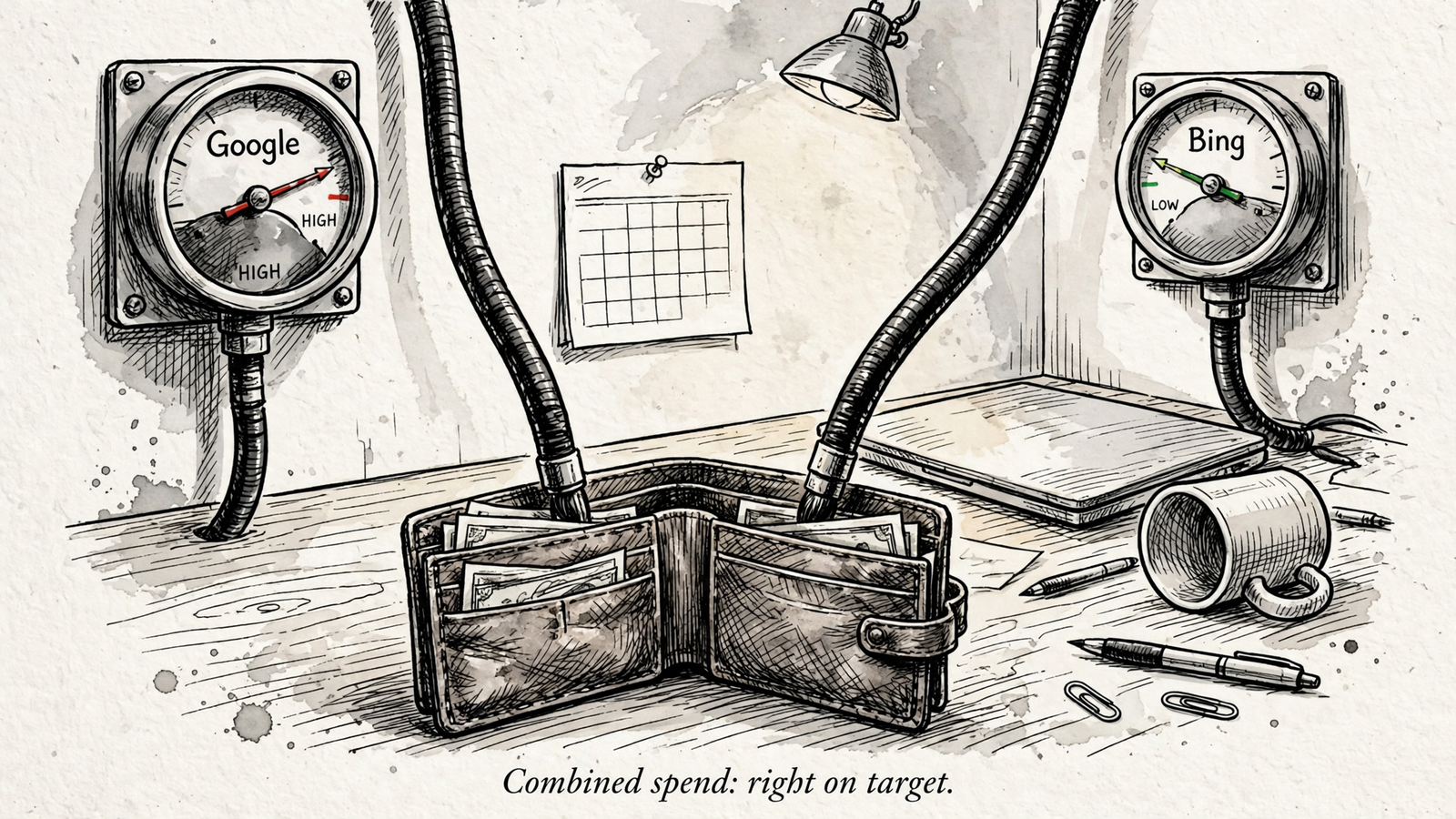
Through November 11, Google has spent $5,900 and Microsoft has spent $1,500. That’s $7,400 combined, close to the straight-line expectation of about $7,333. If I only show the total, the account looks more or less on track. But Google is spending ahead of its share and Microsoft is behind. In this example, two Microsoft Shopping campaigns haven’t made it out of learning after a feed disapproval. The good-looking total doesn’t tell me whether they’ll recover.
The combined pace tells me where I stand against the ceiling. The platform split tells me where to look. If Microsoft stays cold for three more days, I could propose moving some of its planned allocation to Google. I could also hold the money for the promo. Those are different decisions: one assumes I want more delivery on Google now; the other protects money I’ve already set aside for later.
I don’t ask ChatGPT to make that call by treating underspend as permission to spend elsewhere. The bids, budgets, learning periods, and account IDs are separate. Weak delivery in one auction doesn’t tell me what will happen in the other. I ask for each platform’s run rate, the combined position against $20,000, and the assumptions behind any proposed reallocation. That gives me something I can approve or reject without guessing what the model took for granted.
A proposal is not approval to change a budget
The forecast hasn’t changed a campaign. I keep it that way until I’ve seen the proposed settings and the reason for each one. I use a separate prompt:
Propose campaign-level budget changes consistent with the remaining allowance. Show the current and proposed settings, the affected account IDs, and the assumptions behind each change. Wait for approval.
Wait for approval is the line I care about. I want to see whether the proposal trims Google where it’s running hot, holds the reserve for the promo, or assumes the cold Microsoft campaigns will start spending again. “Bring the account back on pace” is not enough. I need to know which setting will move, in which account, and why that change fits the plan.
With groas, autopilot stays off until I switch it on under explicit rules. Changes are logged with their reasons, and I can undo a change in one step. What I can’t do is get back money the campaign already spent. Undo restores the setting, not the balance. That’s why undo is not a spending policy, and why I put approval before the change rather than relying on the log after it.
The five lines I’d send to finance
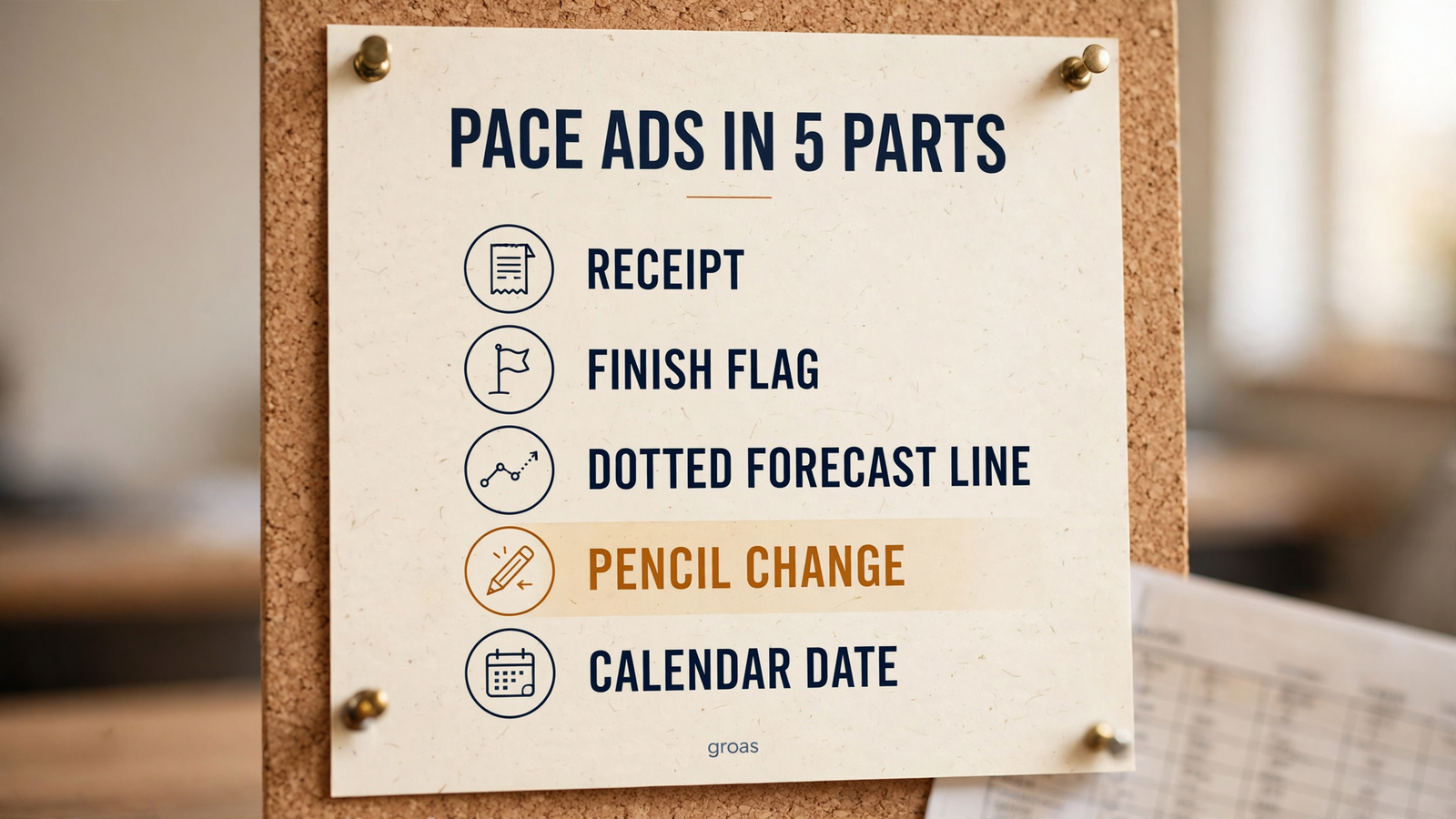
Finance doesn’t need campaign names to answer the budget question. It needs what’s spent, what’s estimated, and what I’m asking to change before money moves. For this account on November 12, I’d send:
- Actual spend: $7,400 through November 11 against the approved $20,000 ceiling. That’s $5,900 on Google and $1,500 on Microsoft, both in USD, with each account’s reporting cutoff noted.
- Estimated finish: Slightly above $20,000 if the average daily spend through November 11 continues. That’s the unchanged run-rate estimate, not the result of a budget change.
- Reserve and uncertainty: Hold $3,000 for November 24–26. How much the promo delivers, and whether Microsoft spend picks up after the feed fix, can change the finish.
- Proposal for approval: Lower one Google prospecting campaign from $280 to $220 per day. Hold Microsoft budgets flat until the feed fix clears. Attach the affected account IDs to the proposal.
- Next review: November 18, or sooner if daily spend moves more than 20% off the $663 planning rate.
That note leaves autopilot off. It tells finance where the account stands and puts a specific decision in front of the person who can make it. If a client wants ChatGPT to keep watch between reviews, I use the operating rules in the ChatGPT + groas autopilot guide to spell out what it may change, which budget and channel limits apply, and when it must stop for approval. I write down the ceiling before I switch anything on.
Same model, harder month: two currencies and a launch
Say December comes with a $30,000 allowance, a Google account in GBP, a Microsoft account in EUR, and a December 15 product launch with no spend history. December has 31 days, so Microsoft’s calendar-day calculation and Google’s 30.4 multiplier differ again. I note that in the finance report if it matters to a proposed setting. Neither number tells me what the launch will spend.
I start with actual cost through each account’s last complete day and keep the run rates in GBP and EUR. Then I convert for the finance decision, not for the campaign settings. On one line of the finance summary, I show the dollar equivalents at the stated rates and date. That lets me subtract spend from the $30,000 allowance without adding pounds and euros as if they were the same money. I set aside the launch reserve before spreading what’s left over the remaining days.
The December 15 launch has no history, so I don’t use the existing campaigns’ run rates as a prediction for it. I show the reserve as a decision we’ve made and the launch spend as an estimate, with the assumption written down. Then I check the combined forecast against the dollar ceiling and show any proposed changes by account ID, in the currency each account actually uses.
That last bit is what keeps a currency swing from looking like a campaign spent more in its own account. Finance gets one view of the ceiling. I get two sets of settings I can approve. Neither comes from adding up daily budgets.





