

 LinkedIn

No agency controls what ChatGPT says about your brand. Anyone selling that control is selling reporting with a better sales deck.
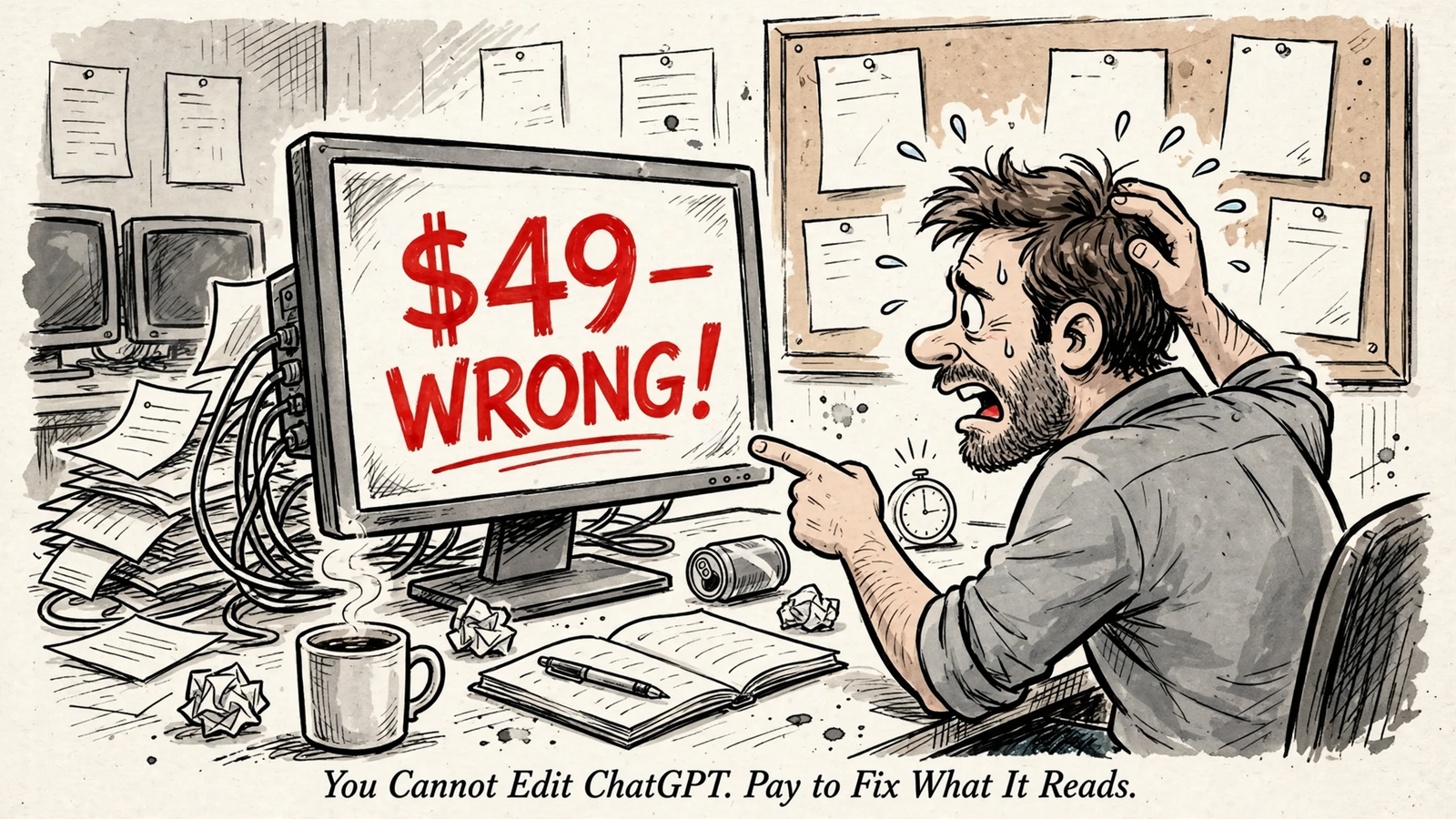
Say ChatGPT quotes your old $49 plan after you moved to $79 months ago. The temptation is to ask someone to fix the answer, as if it were a listing with an edit button. It is not. You cannot edit the answer. You can change the evidence available to it.
That distinction decides what you should buy next. Your website is editable. An independent answer engine is not. You can correct your pages, ask other publishers to correct theirs, and check whether crawlers can reach the facts. You cannot make ChatGPT, Gemini or Perplexity accept your preferred verdict.
Pay for influence over the evidence and there is work to hold someone accountable for. Pay for ownership of the algorithm and you bought a PDF.
The answer says $49. Your pricing page says $79. That gap is the job.
Say a buyer asks ChatGPT what your service costs for a team of ten. It answers confidently: $49 per user, updated this year.
Your pricing page says $79. Your old blog post still says $49. Two directories still say $49. One comparison article from 2023 says “starting at $49.” The wrong answer is the symptom. Those stale pages are where I start looking.
Commissioning five new blog posts is not a diagnosis. It adds more pages while leaving the sources the answer may already trust untouched. More publishing is not the same thing as better evidence. Sometimes the useful job is deleting an old PDF. Nobody puts that on the conference stage.
For correction work, I separate two problems:
- Live retrieval: the engine fetches pages and may show citations I can inspect.
- Training memory: the answer repeats information from a snapshot I cannot directly edit.
The distinction matters because a visible citation gives me somewhere to investigate. An uncited answer does not offer the same trail. Neither gives me an edit button for the model.
One pricing test found the maker’s page was retrievable but cited in only 6 of 10 answers. That is the useful distinction: retrievable is not cited. Missing is a different problem from available but unused.
My starting point is the exact wrong answer and the evidence behind it, not a content calendar.
A citation is not a recommendation
Your site is the place where you have edit rights. ChatGPT, Gemini and Perplexity form their own answers. An agency can work on the information those engines encounter; it cannot manage the verdict as if it were managing your ad account.
That leaves three outcomes worth keeping separate:
- A citation: your URL appears as a source.
- A mention: your brand name appears in the answer.
- A recommendation: the answer presents you as a supplier to hire for a buyer’s need.
Those are not interchangeable wins. A source can supply a useful fact without being the right product for the buyer. A brand can appear in an answer about why someone should choose something else.
The SearchIntel Decision Trace example makes the distinction concrete: the brand was cited, but a competitor received the recommendation because it described a tighter fit to the buyer’s question. Being read was not enough.
The work also differs by engine. One comparison found ChatGPT drew 57% of citations from brands’ own sites, while Perplexity drew about 70% from listicles. That is a reason to examine which sources each engine uses, not to assume one publishing tactic works everywhere.
I pay to make the facts more citable and the buyer fit clearer. I do not pay someone to rename a citation a sale. Before celebrating a visibility report, I want to know which of those three outcomes it actually measures.
Diagnose the information problem before buying more content
I start with the pages a business controls. If the pricing page says $79, an old blog post says $49, a help document says “contact us,” and a PDF from 2022 still circulates, the evidence contradicts itself before any model touches it.
Common failures include old prices, closed locations, discontinued products, mixed identities and thin-information guesses. They do not all need the same fix.
My diagnosis has three buckets:
- Missing: the fact is not clearly published. Put it on a clear, authoritative page.
- Inaccessible: the fact exists, but a crawler cannot reach it. Check access before rewriting the copy.
- Contradictory: several pages give different answers. Correct or retire the stale material before adding more.
Where citations are visible, I open every cited URL and note which claim it supports. In that pricing test, 4 of 10 answers cited only other sites, even though the maker’s page appeared in results. That tells me access alone does not settle source selection. It does not, by itself, tell me why the engine chose another page.
Then I check the technical door: robots.txt rules for OAI-SearchBot, firewall or CDN 403s, and whether key facts appear in the initial HTML. GPTBot and OAI-SearchBot serve different purposes; a training-crawler setting is not a substitute for checking search access. Allowing access still does not guarantee a citation.
Missing information needs evidence. Inaccessible information needs access. Contradictory information needs cleanup. A proposal that prescribes ten articles for all three has skipped the diagnosis.
Make the operator name the edits, in order
Once I know the failure, the work gets less glamorous and more useful. A serious operator starts with owned pages and works outward. That is the correction order practitioners describe, and it costs labor, not magic.
Here is the sequence I want in a proposal:
- Correct the canonical facts. Put current prices, plans, addresses and hours in plain HTML on a clear page with a visible updated date.
- Remove internal contradictions. Correct, redirect or delete retired pages and PDFs that still publish the old information.
- Check that the facts are fetchable. Review crawler rules, firewall blocks and the first HTML payload rather than assuming the rendered page tells the whole story.
- Correct external profiles. Bring Google Business Profile, directories and review sites into line with the current facts.
- Contact other publishers. Send editors of stale comparison articles the correction and a link to the authoritative page.
That last step is a request, not an instruction. An outside publisher has its own edit rights, just as an answer engine has its own source choices. I want the outreach logged, not dressed up as guaranteed control.
The facts need to agree across sources. They do not need to become an exercise in publishing the same sentence everywhere. The point is to stop presenting several incompatible versions of the business.
A thumbs-down inside ChatGPT can send feedback. There is no evidence that one rating rewrites the answer for everyone. I treat it like a suggestion box, not a work order.
And no part of this sequence lets an agency suppress a competitor by asking nicely. A rival can still win the recommendation while your site gets cited if its page answers the buyer’s question more precisely.
Correction is execution. Suppression is fantasy. Buy the former with a list of deliverables, not a promise about the latter.

Demand a correction log, not one flattering screenshot
Any proposal to “manage your presence” is a reporting proposal until it names the changes someone will ship. Before those changes begin, I want a baseline that another person could repeat.
The baseline record should include:
- The exact prompt wording.
- The engine and mode.
- The date.
- Two to three repeats in clean sessions.
- The answer text and every cited URL.
Then I want the same prompts tested after two to three weeks and again after six to eight weeks. Alongside the answers, I want the correction log: which page changed, what changed, and when it went live.
That record does not prove every later answer changed because of one edit. It does make the work inspectable. Without it, a vendor can show a bad answer from one prompt and a flattering answer from another, then call the gap a result.
One changed answer is not proof of a durable correction. Answers vary between runs, engines differ, and one corrected response does not mean the engine has changed its mind.
This is also why two visibility tools can disagree without either lying. Different prompts, engines, locations, run counts and definitions of visible measure different samples. A score without its sampling method is hard to interpret, however attractive the chart.
I measure what AI answers actually say by repeating buyer prompts, then report two lines separately: factual accuracy on price, location and product details; and relevant recommendations for buyer questions.
Accuracy means the facts are right. Recommendation means the answer sends buyers toward the business. I will not let a vendor use improvement in one to conceal failure in the other.
The alternative costs work, not access to a secret switch
The alternative to a presence management retainer is not doing nothing. It is paying for accountable execution: pages corrected, blocks removed, profiles updated and publisher corrections requested. Each item gets a date and a before and after.
That work has a cost. Someone has to find the old PDF, identify the conflicting help document, get access to the site, contact the directory and follow up with the editor. Some of it is technical. Some of it is tedious. None of it becomes strategy because the invoice uses that word.
If the proposal cannot name the edits it will ship in the next 30 days, it is not a correction service. It may be a useful measurement service. Then it should be sold and priced as measurement, not as ownership of ChatGPT, Gemini or Perplexity.
I also want the limits stated before the contract, not after a disappointing report. An operator can correct an owned page. It can request an external correction. It cannot promise that an engine will fetch either page on schedule, cite it, recommend the brand or remove a rival.
Those limits are not an excuse for inactivity. They make the deliverable more concrete: show what changed in the evidence, then show what happened in repeated answers. Do not collapse those two records into a single green arrow.
Where groas fits: find the evidence, then act on it
Where groas fits this rule is narrow on purpose. Your AI is the brain; groas is the hands and the data. It is infrastructure for doing the work, not a claim to own the answer.
Connect your accounts and website once, then plug groas into ChatGPT, Claude, Gemini or another agent over MCP. Your AI can find what answers cite across engines and change your pages in plain English. That connects the diagnosis to execution instead of stopping at a screenshot.
groas also collects evidence your AI cannot fetch alone, around the clock: competitor ads and funnels, Reddit quotes, how AI answers talk about you and whom they cite, plus SEO data from Semrush and Ahrefs.
Autopilot stays off until you switch it on. Every change is logged with its reason, and any change can be undone in one step. That is the kind of control worth buying: control over authorized work on your own assets, with a record of what happened.
It is not control over an independent answer engine. No guarantee of rankings, citations, recommendations or removal comes with it, from groas or anyone honest.
Hire an operator, not a witness
Before signing anything, I want three things on the table: the exact prompts being tracked, the source pages being corrected, and the dates those fixes go live. If the answer is a dashboard and a monthly call, that is a witness, not an operator.
Say the business spends $20k a month on search and AI answers still quote last year’s price. The witness bills to watch it happen. The operator deletes the old PDF, updates the pricing page, corrects the profile and emails three editors that week. Neither controls ChatGPT. Only one changes the evidence.
Ignore that difference and the same mistake keeps getting purchased. More pages published while the cited pages stay wrong. More scores tracked while the facts stay contradictory. More months where ChatGPT describes the business correctly on Tuesday and invents it on Friday, and nobody can show which sources were used or what anyone corrected.
You cannot edit ChatGPT. You can change what it reads. Pay for that work, logged and reversible, or keep paying for the feeling of control while the evidence rots.


