

 LinkedIn

You don’t need a GEO agency. For most small and mid-size businesses, adding a GEO retainer to an SEO retainer means paying two teams to work on the same pages.
The pitch is tidy: keep SEO for Google, then hire someone else for ChatGPT, Gemini and Perplexity. New acronym, new line item, new monthly call. But the pages, technical fixes and third-party mentions that make a business retrievable in AI search are largely the work that makes it visible in Google. The real change is the scoreboard, not the number of agencies you need.
The pitch: SEO for Google, GEO for ChatGPT
Search for agencies that can get your business recommended in ChatGPT and you will find a familiar division of labor. The usual roundups list AEO agencies selling audits, schema, prompt-gap analysis and proprietary tracking as a separate practice. SEO stays on one invoice. The new practice gets another.
I get why the pitch lands. AI answers look nothing like ten blue links. Your position tracker says you rank third, ChatGPT never names you, and someone has to explain the gap. A specialist arrives with a deck full of new line items.
What the deck calls prompt-gap analysis, I call finding buyer questions you never answered. What it calls entity optimisation, I call making your About page clear and your listings consistent. Those jobs matter. Giving them a second owner does not make them different jobs.
Ask what work the new retainer actually adds. If the answer is another plan for the same site, you are buying a handoff, not a capability.
Why the split fails: both teams need the same source material
Answer engines retrieve material and then generate an answer from it. Retrieval may draw on a search index or a live crawl; generation selects passages and may cite them. ChatGPT uses third-party providers and OAI-SearchBot, Perplexity has its own index and live retrieval, and Gemini and AI Overviews draw on Google’s index. If your page cannot be crawled or retrieved, elegant wording will not get it cited. That is an SEO problem with a new scoreboard.
Free tool: the AI Crawler Checker shows which AI crawlers your robots.txt lets in and what they receive when they arrive.
Google’s guidance for AI Overviews and AI Mode does not call for an llms.txt file, a special AI file or extra schema beyond the usual requirements for appearing in Search. Indexation and snippet eligibility still matter. I used to tell clients technical SEO was table stakes. I was wrong. It is the table.
The authority work looks familiar, too. An Ahrefs study of 75,000 brands found branded web mentions correlated 0.664 with AI Overview visibility, compared with 0.218 for raw backlink count. That is a correlation, not an instruction to buy mentions by the dozen. It is a reason to care whether other sites discuss your business, not just whether your own site declares itself excellent.
The on-page evidence points in the same direction. The KDD 2024 GEO paper often quoted in sales decks found adding quotations lifted visibility 41%, while adding statistics and sources lifted it 30 to 40%; keyword stuffing did little. A direct answer supported by evidence is useful to an answer engine. It was useful to a reader and to featured snippets before GEO had a sales deck. I built those pages in 2019. I build them now. The carpentry has not changed much.
One technical detail does deserve attention. OpenAI runs separate crawlers: OAI-SearchBot supports ChatGPT search answers, while GPTBot serves training. A blanket block on AI bots can shut out the search crawler when you meant to block the training crawler. Check the robots.txt rules before paying someone to explain why your pages are not retrievable. Crawler access is a technical check, not a second content strategy.
None of this means a Google ranking guarantees a ChatGPT mention. It plainly does not. It means the response to that gap should start with the pages, access and outside corroboration you already need, rather than an automatic second retainer.
The part that changed: questions, corroboration and measurement
I am not saying nothing changed. About a fifth of the job feels new, and that fifth matters. It changes which questions you answer, where you look for corroboration and how you tell whether the work paid off.
First, write for buyer questions, not just short keywords. Not best plumber Chicago. More like who do I call for a burst pipe at 2am in Logan Square and what will it cost? ChatGPT and Perplexity cite different pages for different buyer prompt types. A useful page answers the question directly, then gives the reader the price, scope or proof needed to act. My rule: if I cannot read the answer out loud in 20 seconds, the answer is buried.
Second, earn mentions beyond your own site. Reddit threads, comparison lists, local press and trade directories can give an engine something other than your About page to work with. Your blog quoting itself is not corroboration. That is authority-building work your SEO provider should recognise, even if the places worth attention shift.
Third, count named mentions across a fixed set of buyer prompts, not just rank positions. A Semrush test of 454 prompt-domain combinations found 61.7% ghost citations, where an engine used a page without naming the brand, and 38.3% named mentions. Being used as a source and being recommended by name are different outcomes.
Keep the prompts and settings consistent. Run 20 to 30 buyer prompts in ChatGPT, Gemini and Perplexity each week, and record who gets named. If the count moves, look for the page or outside mention that might explain it. Rankings can help diagnose the work. They are no longer the receipt.
Two retainers cost more than their combined fees
Start with the invoice. First Page Sage compiled 1,146 GEO/AEO quotes from 214 agencies and found a median retainer of $6,850 a month, 45% above the traditional SEO median of $4,740. Starter GEO tiers ran $1,800 to $4,200; growth tiers ran $4,500 to $11,000.
Say you spend $20k a month on ads and $5k on SEO. Add a GEO retainer and your organic overhead can roughly double, even when both providers want to rewrite the same service pages and pursue the same outside mentions. The question is not whether AI visibility deserves money. It does. The question is whether a second invoice buys work the first provider cannot do.
The commitment makes a bad split harder to unwind. Growth-tier GEO medians sat at $7,400 a month with a six-month minimum: $44,400 for about 6.5 deliverables a month. Now give two teams ownership of those deliverables. Two content calendars target the same buyer questions. Two teams edit the same pages. Two reports claim the win when one new answer page coincides with a ranking move and a ChatGPT mention.
I have watched that movie. It ends with a shared spreadsheet nobody updates and a monthly call where everyone agrees attribution is complicated. What the deck calls cross-functional coordination, I call paying people to discuss who owns the page.
If you pay twice, you do not necessarily get twice the work. You may get the same work argued over twice.
Buy one owner and a report you can interrogate
Buy one provider, one content plan and one visibility report covering Google and the AI engines. The work should connect: publish or improve an answer page, keep it accessible, earn relevant third-party mentions, then check whether your business gets named for the buyer questions that page addresses. One owner can be held to that sequence. Two owners can each claim the other one broke it.
That is why I point people to a unified SEO and AI search service covering Google, ChatGPT, Perplexity, Gemini and more for one flat $1,499 a month, rather than an SEO retainer plus a GEO retainer. Same pages, same fixes, same mentions, counted once. For the longer version, read why you don’t need a separate AI search agency.
Before signing anything, ask the provider five questions:
- Can you show me the same 30 buyer prompts in ChatGPT, Gemini and Perplexity this week and last week? If the answer is only a rankings report, they are measuring the wrong outcome.
- Which page did you publish or rewrite, and which prompt is it meant to answer? A mention count without visible work behind it is a story, not an explanation.
- What technical block did you clear? Ask about indexation, snippet eligibility and robots.txt access for OAI-SearchBot. Vague “optimisations” do not count.
- Which third-party mentions did you earn, and where can I see them? Your own blog quoting itself does not qualify.
- If I pause GEO, what stops getting done? If nobody can point to a distinct task, you never needed two retainers.
That last question kills most dual-retainer pitches faster than a 40-slide audit. The provider does not need a better acronym. You need a clear owner for the work and a way to see whether it changed anything.
Who should ignore this advice
This will not work for everyone, and here is who should skip it. If you are an enterprise brand with a dedicated digital PR team placing you in national press every week, keep that team. If you operate in a regulated category where claims need legal review before publication, keep that review layer. Neither case makes a duplicate GEO content calendar a good idea.
If your site has fewer than ten pages and no Search Console history, fix the basics before arguing about ChatGPT. Get indexed. Make your services clear. Get reviews. A prompt dashboard cannot rescue a site that has little for a search engine to retrieve. I used to tell small clients a separate specialist would move faster. I was wrong. Speed comes from one team that can publish without waiting for another team to approve the same page.
For everyone else selling a service in a defined market, including plumbers, garage door companies, SaaS tools and ecommerce stores with real catalogues, splitting SEO and GEO mostly buys meetings. The work that gets you cited is unglamorous and cumulative: answer pages with prices and proof, clean technical access, mentions where buyers already look. One owner for all of it beats two owners pointing at each other.
The invoice is the consequence
Rankings were always a proxy. They are a poor receipt for AI visibility. Your tracker can say you rank first while ChatGPT recommends a competitor by name; both can be true. So stop buying acronyms and start buying counts: how often your business is named across a fixed set of buyer prompts in ChatGPT, Gemini and Perplexity, week over week. Same prompts, same settings, named mentions only. Ghost citations do not pay the rent.
If a provider cannot connect that count to pages it published, technical blocks it cleared and mentions it earned, it has not shown you a distinct GEO practice. It may have renamed your SEO report.
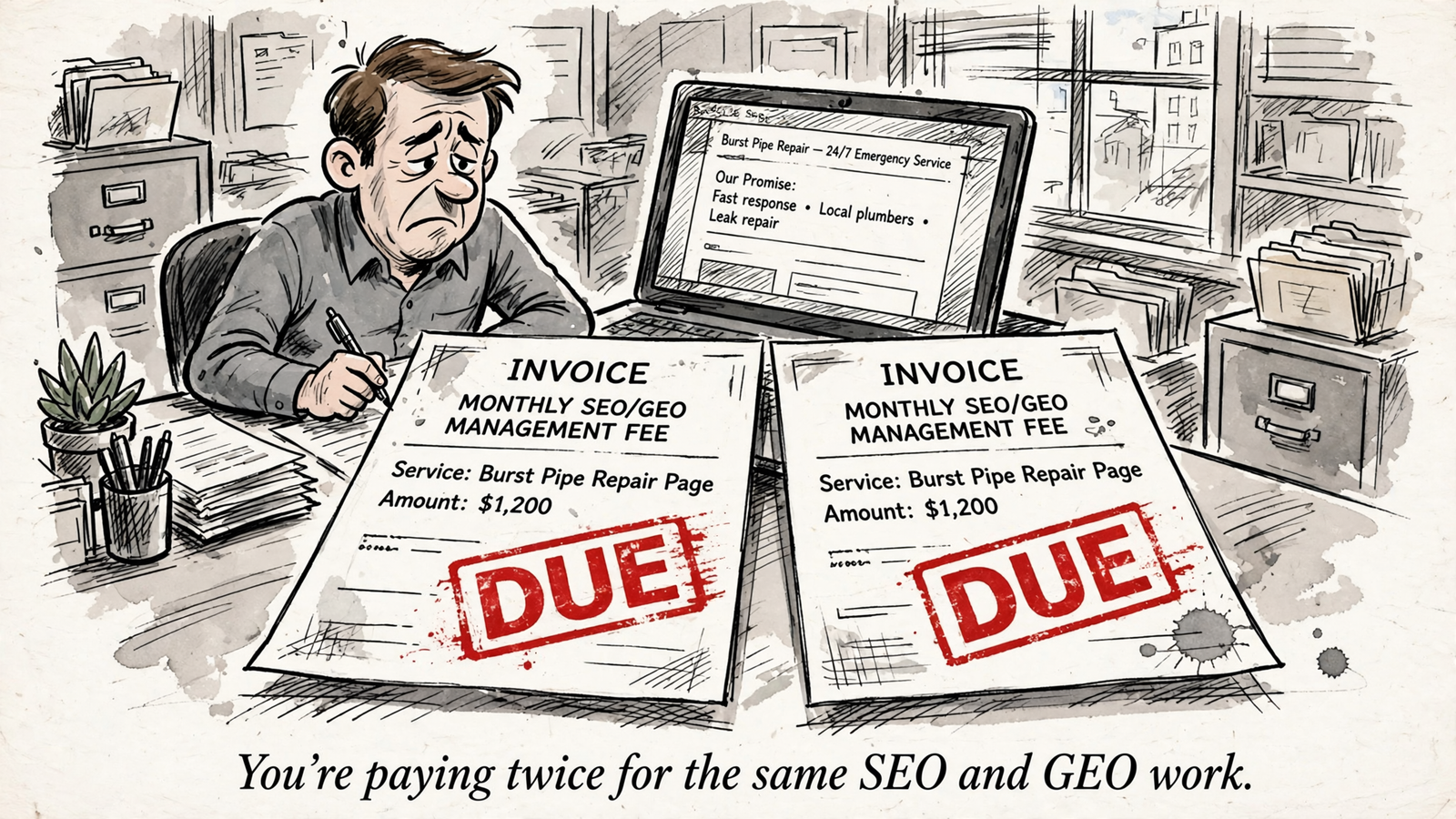
Keep the split and you may pay the SEO median, add the GEO median, and sit through two monthly calls where each team claims the same answer page as its win. A six-month growth-tier commitment can cost $44,400 before you learn that retrieval, indexation and corroboration were one job. Or hire one team to do that job and report the number you actually wanted to move. I know which invoice I would sign.
If you are staring at one of those proposals this week, run the cheap test first. Pick ten buyer questions you wish ChatGPT answered with your name. Run them in ChatGPT, Gemini and Perplexity, and write down who gets named. That list is your baseline. Any provider worth one retainer should be able to show progress against it in 30 days, with pages you can read and mentions you can click. If they answer with rankings instead, keep your money.


