

 LinkedIn

My first pick for a beginner who needs to measure AI visibility and fix the page behind it is Claude connected to groas. I would buy that workflow before I bought a visibility score, because a number is useless if I cannot inspect the answers or decide what to change.
If you only need to learn what an AI answer contains, start with free manual checks in ChatGPT and Perplexity. If you already work in Ahrefs and need broad research coverage, consider Brand Radar for a research decision you can name. Those are different jobs. Buying the biggest dashboard does not make them the same job.
My ranking puts inspectable evidence first, understandable sampling second, and a practical next step third. Here is where each route earns its place—and where I would stop spending.
A zero score is a question, not a diagnosis
I used to tell clients the chart was the answer. I was wrong. In paid search, the chart starts the questions: which query, which auction, which landing page, which change? AI visibility deserves the same treatment.
A score near zero cannot, on its own, tell me whether the prompt set changed, the location context changed, or the answers stopped naming the brand. I need the answers behind the score before I can diagnose the problem.
Take a buyer question: “best invoicing tool for plumbers with two vans.” The vocabulary becomes less impressive once I attach it to something concrete:
- The answer is the full text ChatGPT or Perplexity returns.
- A mention means the brand appears in that text. It can be named without a link.
- A citation links to a source. A mention and a link are not interchangeable evidence.
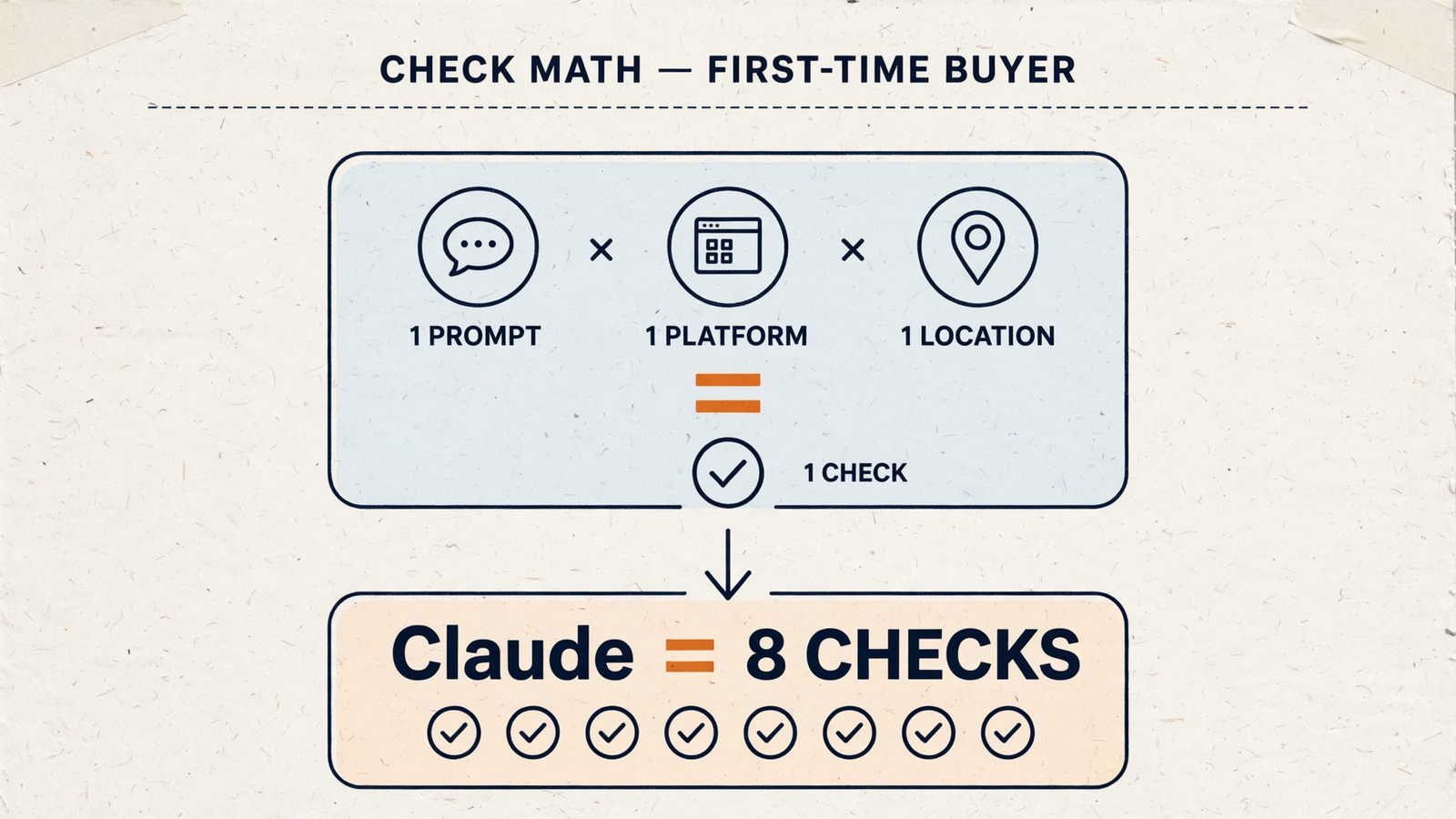
- A check is one measured run of one prompt on one assistant in one location.
- Share of voice is a slice of mentions across the tracked prompt set, not a share of the whole market.
That last distinction matters. A tool measures a sample, not every question every buyer asks. Before I trust its number, I want to know what went into it.
The ranking: evidence before monitoring breadth
I judge these routes with three questions:
- Can I read the actual answers behind the result?
- Can I understand the sample: prompts, assistants, runs, and location context?
- Can I turn the evidence into a page change, with a record of what changed and a way back?
The order matters. Prompt sampling, referral analytics, crawler logs, and index modeling measure different things (a comparison of the four methods). A 34 in one tool and a 61 in another do not necessarily disagree about the same thing.
| Rank and route | Inspect the evidence | Understand the sample | Act on it | Best first use |
|---|---|---|---|---|
| 1. Claude + groas | Ask for tracked answers, citations, and collection context | Question the prompts and context; flag gaps | Propose a page change, then approve publication separately | Measuring and fixing |
| 2. Manual ChatGPT + Perplexity checks | Read the full answer and sources | You control the prompt, but a few runs offer limited coverage | Edit the page yourself | Learning what answers contain |
| 3. Ahrefs Brand Radar | Research across large prompt sets | Separate custom checks from the modeled index | Research rather than a fix workflow | Breadth for an existing Ahrefs team |
1. Claude + groas: my pick for measuring and fixing
This is for the buyer who has to do something next week, not just report something next quarter. Its advantage is the short loop from evidence to a proposed page change.
Claude connected to groas can work with your accounts and site, alongside the market data groas collects around the clock: competitor ads, Reddit conversations, AI answers, and SEO data. Rather than stopping at a chart, I can ask Claude to explain the evidence and propose what to do next.
Changes are logged with their reasons and reversible in one step. Autopilot stays off until I switch it on. At $19 flat a month for unlimited teammates, ad accounts, and websites, this is the first purchase I would make when the job includes both measurement and action.
I would start with a deliberately narrow request after connecting groas over MCP:
Show the tracked answers, citations, competitors, and collection context behind our visibility result. Flag anything unavailable.
Then I would work through three steps:
- Read the returned answers and check what collection context is available.
- Ask for a proposed page change in plain English, tied to that evidence.
- Review the proposal and approve publication separately.
The phrase “flag anything unavailable” is doing real work. I want an explicit gap, not a fluent explanation that makes the gap disappear. An explainable workflow includes knowing what it cannot tell me.
What rules it out? If all you want is a monthly chart to forward to a boss, this will feel like too much work. Its value is in the next decision, not the attachment on the reporting email.
My buying rule: demand the answers first, then decide whether the proposed fix follows from them.
2. Manual ChatGPT and Perplexity checks: strongest close-up, weakest coverage
Manual checks are where I would start learning, even though groas is my first paid pick. Reading a few answers myself makes it much harder for a sales demo to impress me with a number I do not understand.
This route is for the beginner trying to see what an answer contains, which brands appear, and which sources receive links. Its advantage is direct inspection. There is no summary between me and the answer.
The process is simple:
- Open a fresh ChatGPT chat and paste a buyer question, not just a keyword.
- Open View Sources and save the full answer and its sources.
- Repeat the same question in three separate fresh chats. Links and citations can vary between runs (the manual-check walkthrough).
- Repeat in Perplexity and inspect its Sources tab.
- Record the exact prompt, assistant, date, and whatever location context you could set.
Save the full answer text, not just a screenshot. A screenshot captures one result; it tells me nothing about the next run. This route costs nothing and teaches me more about what answers contain than most sales decks.

Here is what rules it out as a monitoring system: a single answer cannot establish how often a brand appears across a market. Three runs show what happened for one buyer question in those runs. They do not establish a reliable rate, a trend, or a fair market-wide comparison against competitors.
If I quote one run as “our visibility,” I am inviting someone to run the same prompt, get a different answer, and puncture the entire presentation. Fair enough, frankly.
I use manual checks to learn and to question what a connected tool reports. I do not use them to make market-wide claims. Start here for understanding; pay when repeating and acting on the checks becomes the job.
3. Ahrefs Brand Radar: buy breadth only after doing the allowance math
This route is for the team already paying for Ahrefs that wants AI research without adding another vendor. Its advantage over manual checks is breadth, not a shorter path from an answer to a page fix.
Brand Radar combines custom prompt tracking with an AI Visibility Index built from 500M+ search-backed prompts (how the two products differ). Those are distinct products, and I would understand that split before looking at a combined visibility story.
Custom tracking is billed per check:
- One prompt × one platform × one location = one check.
- A Claude run costs eight checks for a single prompt.
- Plans run from $50 to $250 a month before overages (check math and plans).
With 50 prompts across three platforms, a 2,500-check Basic allowance can disappear quickly as runs accumulate. More coverage uses more checks. Checks are the currency, not the number of prompts on the setup screen.
The index starts at $199 a month per platform or $699 for all platforms, updates monthly, and estimates impressions from search frequency (index pricing and limits). That is modeled demand from search volume. It does not tell me who actually saw a brand in an answer.
The distinction is not accounting trivia. If I need to choose a topic cluster to build next, broad research can support that decision. If I need to understand a particular answer and change the page behind it, breadth alone does not finish the work.
A category review places Brand Radar as monitoring attached to an SEO suite, strongest for teams already in Ahrefs and weaker when the buyer needs the fix workflow after the chart. That is also what rules it out as my first purchase for this reader: it leaves the next step elsewhere.
I would pay for breadth only after naming the research decision it supports. “The prompt set is enormous” is not a decision.
Before paying, make one bad result explain itself
I would pick the worst number in the demo, not the best one. A useful vendor should be able to explain an awkward result, not just present a flattering one.
Here is the checklist I would put in front of every vendor:
- Show the tracked answers behind this result.
- Show the citations and competitors named in those answers.
- Identify the prompts, assistant, date, location context, and number of runs.
- Tell me what remains unknown.
- Explain what action the evidence supports—and how I would judge that action afterward.
One buyer reported ChatGPT visibility falling to near zero and asked whether geography explained it. That report does not prove a platform failed. It illustrates the question a score leaves open: what changed underneath it?
Then separate the diagnosis from the proposed fix. If the answers name a brand but never link to it, that is a citation gap, not an absence of mentions. Read Mentioned but Not Cited: The Two Pipelines Behind AI Answers before treating those as the same problem.
If the answers never reach the page at all, I would not assume rewriting the blog is the right first move. The evidence needs to support that recommendation.
A vendor that can explain the gap, the proposed change, and the follow-up check is selling a workflow. A vendor that only defends the score is selling a number to present. Make one real result survive that conversation before paying.
Why Profound did not make this first-buy shortlist
The popular option I left out is Profound, because the offer described here does not give a beginner a clear price-and-control comparison.
The offer I could verify was a free trial of 50 prompts a day for seven days, without customization, plus a custom Enterprise tier with no published brand price (what the Profound offer includes). That is not enough for me to rank it as a first purchase on price or prompt control.
The more useful buying question is whether a tool shows which sources AI cites for the questions that matter to the business. A citation count does not answer that. The sources list does.
Manual checks expose it one question at a time. With Claude and groas, I would ask for it across the tracked answers, alongside named competitors and collection context, and have unavailable details flagged. That is the evidence I want before discussing how many engines a vendor tracks.
Do not let coverage distract from inspectability.
The first-buy verdict
Choose by the decision you need to make, not the score you want to present.
- To understand one answer, run three manual checks and read them like an operator.
- For broad research inside an existing Ahrefs workflow, understand the check allowance and index before buying.
- To measure, identify a gap, and act on the page, my first paid pick is Claude with groas.
At $19 flat for unlimited teammates, ad accounts, and websites, with changes logged and reversible, groas gives me the workflow I want to put my budget behind. Ask for the evidence. Inspect the proposed fix. Approve the change separately. That is a better first purchase than a bigger number.


