

 LinkedIn

Hire the Meta agency that will make its own ROAS look worse. If it will not challenge the revenue in its sales pitch, I would not trust it with a scaling budget.
That means deducting refunds, separating returning customers, and showing exactly which clicks and views earned credit. Otherwise, you are not buying better management. You are buying a nicer report.
That habit is expensive. In a $110 million matched-advertiser sample, clicks got 6% cheaper year over year while cost per purchase rose 22% and platform-attributed return per dollar fell 26%. Cheaper traffic did not mean cheaper customers. An agency that refuses to reconcile that gap can keep selling you the click price while you pay the customer price.
The smaller number is not automatically the better number. But the agency willing to explain it is a better hiring prospect than the one hiding behind the larger one.
A prettier ROAS report does not mean a better business
Platform-attributed revenue is a measurement claim, not a bank deposit. Meta decides which purchases count based on its attribution setting. Changing that setting changes reported ROAS without changing real sales. With 7-day click plus 1-day view, a purchase can receive credit after someone merely saw the ad yesterday.
Free tool: the ROAS Calculator works out your return on ad spend, your break-even ROAS and the budget a revenue goal takes.
Same campaign, same spend, three different headlines. On $5,000 of spend, that attribution breakdown shows 1.71x on 1-day click, 2.30x on 7-day click, and 3.06x with both click-through and view-through credit. Nothing improved between the first number and the last. The counting got more generous.
This is where agency selection breaks. An owner asks which Meta ads management company improves ROAS, hears a bigger number, and assumes the business improved by the same amount. The pitch skips the mechanism. Did more customers buy, or did the report start claiming more of the customers who already did?
Add up the dashboards and the problem gets harder to ignore. When Meta, Google and Amazon claim overlapping orders, the summed reports can run 30–55% above store or ERP revenue. Two platforms can each claim the full value of the same $120 order. The reports show $240. The business still has one $120 order.
The agency did not create the extra money. The counting did. Before comparing providers, I want to know whether their numbers describe the same thing.
Three adjustments an agency should volunteer
An agency should not need a hostile cross-examination to produce these. Refunds, customer history, and attribution assumptions belong beside the headline—not in a footnote after the contract.
1. Deduct the revenue the store gives back
Meta records purchase value at order time and does not automatically reduce that historical value when an order is returned. The adjustment is straightforward:
Returns-adjusted ROAS = (attributed revenue − refunds on those orders) ÷ ad spend.
With 17% of holiday sales expected back and 19.3% of online sales for the year, an apparel store reporting 3.2x can be sitting near 2.6x after refunds clear. The orders looked productive when they arrived. Some stopped being revenue when they came back.
Show both numbers. An agency that refuses is asking me to judge its work on money the business did not keep.
2. Separate new buyers from returning customers
Blended CPA hides the cost of acquisition by mixing new buyers with existing customers. At $100,000 a month and a $28 CPA, the dashboard implies about 3,570 purchases. If 40% come from existing customers, the new-customer count is closer to 2,140 and the new-customer cost is about $47.
That is a different buying decision from “we acquire customers for $28.”
Optimizing toward standard purchases can favor the cheapest converters, including existing buyers. Repeat revenue can then flatter what the agency presents as prospecting performance. I want new and existing customers shown separately.
Returning customers are not worthless. They are simply not new customers. Separating them does not prove they would have bought without advertising; it stops retention revenue from wearing an acquisition badge.
3. Show which clicks and views earned credit
I want the attribution window in plain numbers, with click-through and view-through credit separated where the account allows it. “Meta attribution” is not a sufficiently precise answer.
The practical method in this attribution breakdown uses Compare attribution settings to inspect two differences:
- View-through share: the combined click-and-view result minus 7-day click.
- Longer click-window share: 7-day click minus 1-day click.
A high view-through share in high-frequency retargeting or existing-customer campaigns deserves scrutiny, not automatic celebration. A click-only number is not proof of causation either. It is a clearer description of what the report counts.
For the deeper counting fight, read Meta Says 4x ROAS, Shopify Says 1.8x: Which Number Changed?. It walks through how windows, view-through credit, and counting rules can explain the gap.
My hiring rule: anyone promising to improve ROAS without naming the window is promising to move a number before explaining what it measures.
How 4.0x becomes 1.44x without a single sale changing
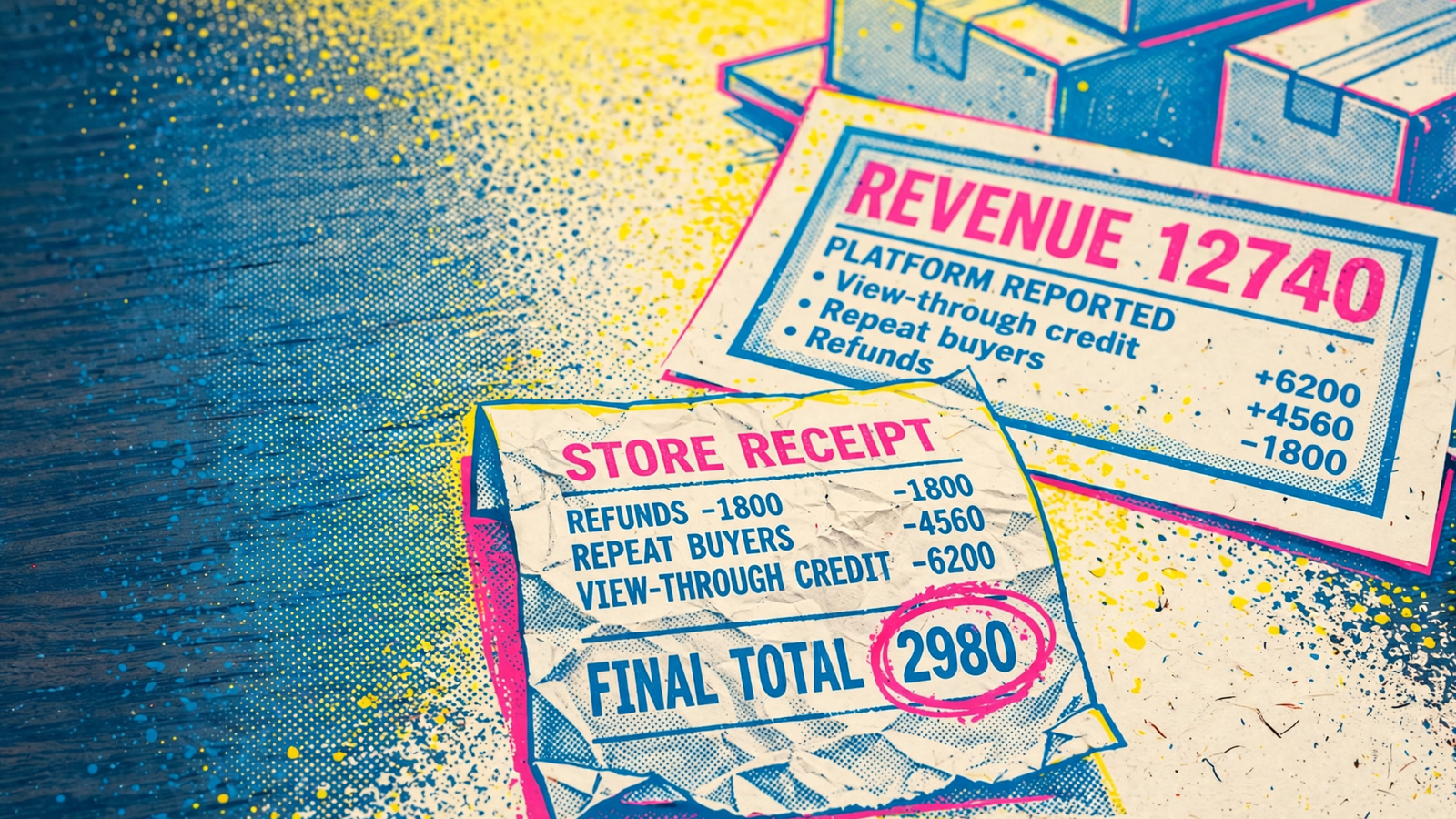
Here is a hypothetical reconciliation, not a client result. Say I spend $20,000 in a month and Meta reports $80,000 in attributed revenue: 4.0x on the dashboard.
I then match the attributed purchases to store orders and work through the deductions in sequence:
- Remove $11,200 in refunds and cancellations tied to those orders.
- From the remaining revenue, separate $28,000 from returning customers.
- From what remains after that, separate $12,000 credited only through views.
Those are non-overlapping deductions. The same refunded, returning-customer order does not get subtracted twice.
| Reconciliation line | Amount | What it represents |
|---|---|---|
| Meta-reported revenue | $80,000 | 4.0x headline ROAS |
| Less refunds and cancellations | −$11,200 | Revenue the store did not keep |
| Less remaining returning-customer revenue | −$28,000 | Kept revenue from existing buyers |
| Less remaining view-through-only revenue | −$12,000 | New-customer revenue credited without a click |
| Kept, new-customer, click-attributed revenue | $28,800 | 1.44x on $20,000 of spend |
The agency did not make performance worse by showing this. It stopped letting counting do the selling.
Nor has it proved that every dollar of the $28,800 happened because of the ads. Reconciliation cleans up the reporting definition; it does not replace an incrementality test. That distinction matters when the next conversation is about increasing spend.
It also matters in the monthly review. If the number drops from 4.0x to 1.44x because the definition changes, that is not a performance decline. The ruler changed, not the sales.
I want the correction logged once as a baseline reset, then every later period judged against the corrected definition. One page shows the reconciliation and its date. The next shows the trend on that definition only.
Otherwise, honesty becomes another reporting trick. Every future miss gets explained away as an attribution problem, and customer economics never have to improve. Fix the ruler. Then stop moving it.
The three questions I would ask before signing
The alternative to a pretty report has a cost: agreeing on definitions, matching orders, and accepting that some decisions need a test rather than a more flattering dashboard. I would rather pay that cost before scaling than discover it during a quarterly finance reconciliation.
The sales call should establish how the agency will be judged when the numbers stop flattering it. I would ask these questions in order.
1. Can you reconcile your purchase revenue to my store?
Show me the method and name the source of truth. For orders, refunds, and customer history, that means Shopify or the ERP—not Ads Manager.
I want the following in writing:
- How attributed purchases get matched to store orders.
- How refunds and cancellations get deducted, and how often.
- How new and existing customers get separated.
- Which attribution window the report uses.
- How unmatched purchases and overlapping credit get explained.
Make your purchase numbers agree before hiring a Meta ROAS agency, then make the candidate walk through that reconciliation line by line. A provider does not need to promise perfect attribution. It does need to explain the gaps without changing the subject to impressions.
2. How will you test what would have happened without the ads?
Attribution asks which interactions receive credit for an order. Incrementality asks what would have happened without the advertising. Another attribution dashboard cannot settle that second question.
I want to hear about a holdout: a group that does not receive the ads, compared with a group that does. This Conversion Lift example illustrates the distinction between observed conversions and lift. The point is not to borrow its result. It is to require a comparison that can challenge the platform’s claim.
A geographic version splits states or regions into ads-on and ads-off groups and compares sales. The agency should explain the control, duration, and success metric before the test begins—not choose the interpretation after seeing the result.
Any provider who answers an incrementality question with another attributed-ROAS screenshot is protecting the number that feeds the pitch.

3. Which decisions need a test, and which need execution?
Scaling budget 30%, opening a new audience, or abandoning a creative concept can warrant a controlled test. I want the candidate to explain when and why, with the success metric agreed before spend moves.
Changing a bid cap, excluding a placement, or fixing a feed error needs a logged action and a read on the agreed revenue measure. Not every adjustment needs to become a research project. Not every budget increase deserves a leap of faith.
If a candidate cannot distinguish the two, it can end up testing nothing and reporting everything. The method in Meta’s ROAS column grades its own homework makes the hiring standard explicit: challenge the claim with a holdout, keep the winner on a consistent definition, and pay for customer economics rather than confidence.
Hire the provider willing to contradict its own pitch
I am not asking anyone to hire pessimism. I am asking them to reject two different evasions.
The first is inflated credit: a 4.0x headline that includes refunded orders, mixes existing buyers into acquisition performance, and conceals how much credit comes from views. The second follows the cleanup: every future miss becomes an attribution story, so performance never has to improve.
A serious operator shows the smaller number, dates the baseline reset, and agrees to be judged on improving it. The target is new customers at a cost the margin can carry, not an increasingly elaborate explanation of why the dashboard deserves applause.
That is why the groas operating model matters to me: continuous execution against an agreed definition, with actions and reasoning logged, rather than a monthly PDF built to defend the fee. Execution should answer to the economics. The reporting should make that easier to inspect, not harder.

Lock the definition into the engagement before spend scales. I would ask for kept new-customer revenue per dollar, reconciled to store orders after a 30-day refund lag, with customer history used to separate new and existing buyers and the attribution window frozen for 90 days.
New creative, broader prospecting, higher budgets: judge them against that line. If the agency needs to change the window, it logs the change, dates the baseline reset, and explains why. No silent switch from 1-day click to 7-day click plus view when February looks soft.
That discipline makes the good months mean something. It also removes the easiest hiding place in the bad ones.
Choose the prettier report instead, and the consequence is predictable. In a hypothetical scaling decision, spend climbs from $20,000 to $50,000 because the headline looks strong, while the bank balance barely moves. More returning customers receive credit. More orders come back. Finance eventually reconciles the quarter, after the management fees have cleared.
The agency calls it an attribution headwind. It was a hiring decision.
Ask for the ugly number on the sales call, not after onboarding. If the pitch says 4x and the reconciliation says 1.4x, the second meeting starts at 1.4x—with a plan to improve kept new-customer revenue. Hire the provider willing to volunteer that reset. Ignore it, and the next scaling budget buys more of the reporting problem.


