

 LinkedIn

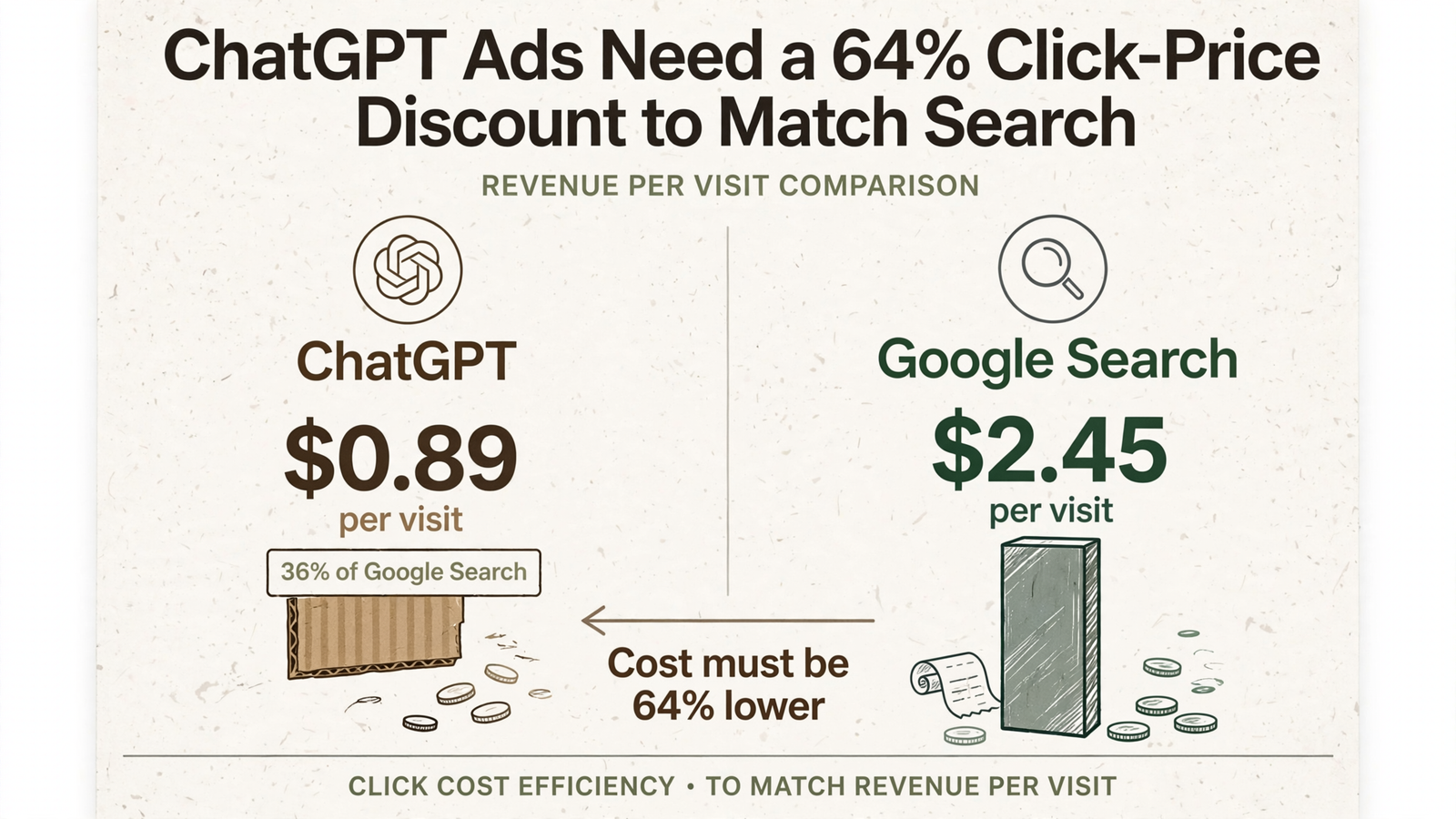
In one observational study, ChatGPT ad clicks needed to cost roughly 64% less than Google Search clicks to match their revenue per ad dollar. The reason is blunt: paid ChatGPT visits produced $0.89 in revenue per session versus $2.45 for paid Google Search in US traffic. That is about 36 cents of revenue for every dollar a Google Search visit produced, at equal margins and before management costs.
I would start there before touching the new Shopify app. Shopify became OpenAI’s first ecommerce partner for ChatGPT Ads on 16 September 2026, making campaigns easier to launch. Easier setup does not make a visit worth more. It makes it faster to buy visits before you know what they are worth.
The Kaiser and Schulze working paper is under review, and its paid comparison covers 102 advertiser sites with full sales tracking, not every store that could run an ad. I use its ratio as a hurdle to test, not a forecast to paste into a budget.
The Shopify app removes setup friction, not the price hurdle
The September launch delivered plumbing. The free Shopify app pushes products through Shopify Catalog and lets merchants manage them from Agentic Storefronts. US merchants got access first, with other ChatGPT Ads markets following from 23 September. The shopper still completes the purchase on your store. Your feed, landing page and checkout still have to do their jobs.
The Ads Manager plugin also builds a campaign from a website or brief, suggests copy and imagery, and offers opt-in headline rewrites and translation. HubSpot joined as the first CRM partner. OpenAI began testing Sponsored Agents, where a click opens a labeled brand-agent chat. These are useful ways to get a campaign live. None tells you what its traffic earns.
That distinction matters if an agency is selling the launch as a reason to raise spend. A shorter path from catalog to campaign is an operational improvement. It is not a change in revenue per visit. Price the visits before you celebrate the install.
What the paid-visit comparison actually measured
The paid analysis used 102 advertiser sites with full sales tracking. Those sites came from a broader sample of about 10 billion sessions across 1,898 sites from June 2025 to August 2026, as Search Engine Land summarized the methodology. The headline comparison is for US paid traffic.
| US paid traffic in the study | Revenue per session | Conversion rate |
|---|---|---|
| ChatGPT ads | $0.89 | 0.37% |
| Google Search ads | $2.45 | 1.17% |
Source: Search Engine Journal’s summary of the working paper. The revenue gap persisted within the same websites after accounting for device and week. Among 87 advertisers buying both in US traffic, 84 earned less per ChatGPT visit.
Conversion is part of the explanation for the revenue gap: fewer buyers per visit means less revenue per visit unless order values offset it. An earlier-stage conversation might help explain why someone clicks without buying immediately, but this observational comparison does not establish what each shopper intended. I would not turn a plausible story about intent into a measured result.
The average also hides a lopsided distribution. Seventy-three of the 102 advertisers recorded zero ChatGPT-ad sales across 18,726 visits, while one advertiser generated 66% of paid ChatGPT purchases. A few successful accounts can move a pooled average a long way. Your store could sit on either side of it; the study does not tell you which.
Finally, the paper is observational and under review. Its Google Analytics last-click view does not include prompts, impressions, subscription tiers or later purchases that return through another channel. Use $0.89 as a reference point to replace with your own measured value, not as your store’s expected revenue per session.
The 36% revenue ratio becomes a 64% click-price hurdle
Here is the arithmetic without the launch-deck fog. Divide the study’s $0.89 ChatGPT revenue per session by its $2.45 Google Search revenue per session. The result is 36.3%. If the two channels have the same margin and a billed click turns into a measured session at the same rate, a ChatGPT click can cost about 36.3% as much as a Google click and deliver the same revenue per ad dollar. Put the other way, it needs to cost about 63.7% less.
| Calculation from the study averages | Result | What it means |
|---|---|---|
| $0.89 ÷ $2.45 | 36.3% | ChatGPT revenue per visit as a share of Google Search revenue per visit |
| 100% − 36.3% | 63.7% | Required click-price discount under the stated assumptions |
Inputs: the working paper’s paid-visit figures, reported by Search Engine Journal. These are revenue comparisons, not profit comparisons. Different margins, click-to-session loss and management costs change the price you can afford.
I used to tell clients to begin this sort of comparison with conversion rate. I was wrong. Begin with revenue per visit because it includes both the likelihood of an order and its value. Then move from revenue to contribution before calling any CPC affordable.
The authors also put a dollar price on the gap. A median paid-search CPC of $0.72 across 16 US-heavy accounts scaled to about $0.26 per ChatGPT click for equal revenue per ad dollar. Resampling advertisers gave a $0.05 to $0.57 range. That spread is a warning against treating $0.26 as a universal bid, especially with purchases concentrated in so few accounts.
The available price examples do not close the gap. One disclosed account paid $1.72 per click over 15 days, more than six times that $0.26 parity price. OpenAI recommends starting CPC campaigns with a $3 to $5 maximum bid; a maximum bid is not the CPC you will necessarily pay. The US minimum is $25 per campaign per day, and spend can reach twice the daily budget on a given day.
Those figures come from different accounts and contexts. I would not splice them into a pretend market average. Their useful message is narrower: check the CPC you actually pay against the value your own traffic produces.
Replace study averages with your store’s contribution per session
Say your store spends $20k a month and an agency reports a blended 3.1x ROAS. That tells you little about whether ChatGPT Ads deserve another dollar. A strong channel can carry a weak one inside a blended result. Billed clicks sit in Ads Manager, sessions in analytics, and orders in Shopify; the counts rarely line up neatly.
I would reconcile the same date range in this order:
- Pull spend and billed clicks separately for ChatGPT Ads and Google Search.
- Pull measured sessions by channel so you can see how many billed clicks became tracked visits.
- Match orders, revenue, refunds and cancellations to comparable attribution windows.
- Calculate contribution after product cost, shipping, refunds and management fees, then compare it with spend.
The one-click install does not remove the underlying catalog work. Products still need to meet the OpenAI spec, arrive through SFTP with ongoing sync, stay grouped for bidding and reporting, and have purchase tracking in place, as the ecommerce setup described here makes clear. If the feed, source tagging or purchase tracking leaks, your revenue-per-session figure is unreliable before you do any clever math.
Next, give purchases time to arrive. The study’s tracked-visit view misses later purchases that return through another channel. Your store can miss them too. A shopper who clicks on Monday and buys through direct traffic on Friday can look like a failure in last-click reporting. Compare equivalent 7-day and 30-day click windows for both channels and let each cohort mature before judging it.
Then account for the people you pay to run the test. At the $25-per-campaign daily minimum, a 30-day campaign implies $750 in planned spend before support costs. One published support menu starts at £63.70 per hour without a long retainer for a test. That is an example of a cost to include, not a fee every advertiser pays.
Keep the labels straight. Revenue divided by sessions is revenue per session. Contribution divided by sessions is contribution per session. For a break-even click price, multiply contribution per measured session by measured sessions per billed click. Do not divide by that click-to-session rate: doing so would make lost sessions appear to increase the value of a click. Then leave room below break-even for the profit you require.
Make your agency show the channel-level answer
If your agency wants more ChatGPT budget because the Shopify app makes setup easy, ask it to earn that increase with your numbers. I would not approve it from a blended ROAS screenshot. The study’s 0.37% ChatGPT conversion rate versus 1.17% for paid Google Search gives you a good reason to inspect the channels separately, not permission to assume your store performs at either average.
The decision rule I use for whether to scale ChatGPT Ads spend is simple: show matured contribution by channel, or keep the budget where it already pays.
Ask for these four lines for ChatGPT Ads and Google Search, using the same date range and windows:
- Spend, billed clicks and measured sessions, so click-to-session loss is visible.
- Orders, revenue, refunds and cancellations in matured 7-day and 30-day cohorts, not same-session last click alone.
- Contribution after product cost, shipping, refunds and management fees, divided by sessions and compared with click cost.
- An explanation of attribution differences between the channels, in writing.
Most prompt-setup retainers stop before that reconciliation. That is the work I want judged, not the speed of a campaign build. groas Search Ads covers Google, Bing and ChatGPT Ads for a flat $1,499 a month with no cut of spend; it works bids, keywords and budgets around the clock and logs its actions. I would still demand the post-click numbers before increasing spend. I would also require the seven post-click fixes to ask a ChatGPT Ads agency for. An action log is useful; a channel-level contribution test makes the budget decision.
Decide with the CPC your store can afford
Here is how I would run the final check for a store spending, say, $20k a month. Pull a matured 30-day view for each channel. Divide contribution after product cost, shipping, refunds and fees by measured sessions. Multiply ChatGPT contribution per session by the share of billed clicks that became measured sessions. That gives you break-even CPC under those inputs.
For an illustration, suppose ChatGPT contribution is $0.60 per measured session and 85 of every 100 billed clicks become a measured session. The break-even CPC is $0.51: $0.60 × 0.85. If you want 30% of that amount left as a target margin, you can pay about $0.36. Those are illustrative store inputs, not a result from the study. The study’s $0.26 comparison likewise came from scaling a $0.72 Google CPC by the roughly 36% revenue-per-visit ratio; your own contribution, session rate and fees belong in your decision.
Now compare your hurdle with the CPC the auction actually charges. If your affordable price is $0.36 and your average ChatGPT CPC is $1.50, more budget buys that gap faster. The Shopify install, prompt-built campaign and suggested creative do not repair the arithmetic. ChatGPT may catch a shopper mid-conversation who buys later, through another channel, or not at all. Let a matured window capture what it can, and do not call an unmeasured later purchase a sale the campaign proved it made.
Scale the channel that clears its hurdle after margin and fees. Hold the other to a test budget until it proves matured contribution, not same-session ROAS. In the study, ChatGPT produced about 36 cents of revenue per visit for every dollar Google Search produced, implying roughly 64% cheaper clicks for revenue parity under equal conditions. Your store’s ratio may differ. Prove it before the next dollar goes to ChatGPT, to Google, or back in your pocket.


