

 LinkedIn

On a $3,000 to $10,000 monthly Meta budget, you can afford to read maybe two creative tests. Not run two. Read two, with enough spend behind each to tell you something useful about ROAS or cost per result.
This list is for owners spending in that range who keep seeing “ongoing creative testing” in a proposal or monthly report. I managed these budgets by hand for years, and I used to tell clients volume was the answer. I was wrong. Test selection is the whole job when most small-budget testing amounts to button-colour noise your spend can never make readable.
Say you spend $5,000 a month at a $40 cost per result. The textbook rule for a clean conversion read is variants × CPA × 50 conversions, minimum seven days. Three concepts would need $6,000 for the test alone. You do not have that. Under $10,000 a month, you have to judge early reads on hook rate, CTR and CPC, then confirm a winner later at conversion level. Fence off 10% to 20% of spend for testing so the core campaign keeps delivering.
1. Swap the first three seconds on your winning ad
This is the cheapest test here that can still move ROAS. Those first seconds determine whether someone keeps watching, and hook rate is three-second plays divided by impressions. One large sample of 88,329 sales-objective Meta videos averaged 25.44%, but I use my own account median as the bar and compare only within the same placement.
Keep the winning body and offer exactly as they are. Cut two new openings, giving you three hooks including the control, and run each to about 1,250 impressions before judging a five-point gap near 25%. First step: take the ad already spending and cut those two hooks this week. Change nothing else.
2. Run the same offer as one static and one short video
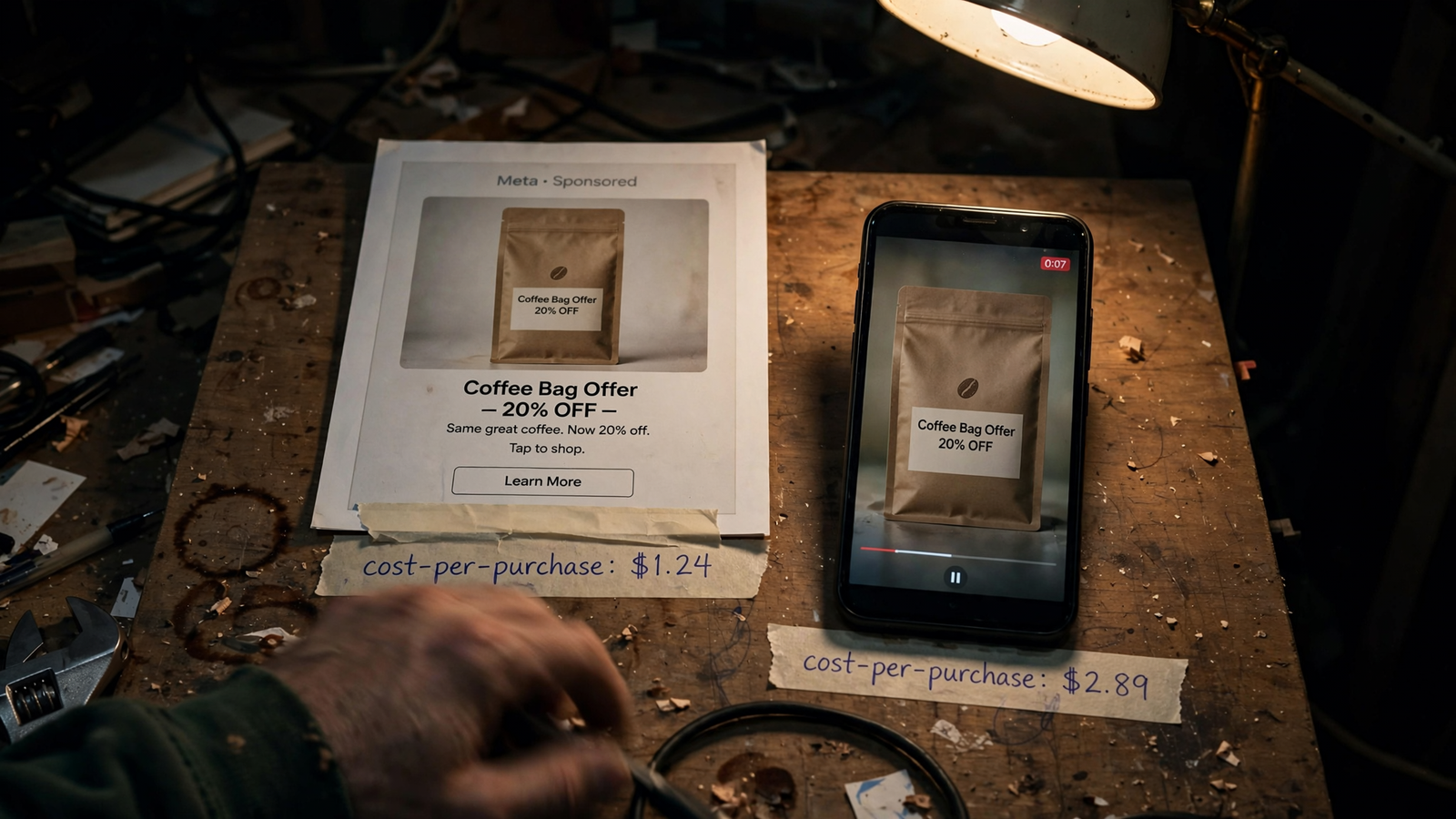
Same headline, same offer, two formats. I do this before paying for more production because statics are cheaper to make and, in the cited account sample, cheaper to serve. Across 17 US accounts and $14.9 million in spend, video took 68% of spend while statics took 32%, yet four in 10 top-spending ads were statics. Statics ran about 15% lower CPM and only 13% lower link CTR, with cost per purchase within 4% of video.
The mechanism is plain: a static gives you a cheaper read on the angle before you pay to shoot more video. First step: ship one square static and one 15-second vertical cut of the same promise, with the same budget. Let the result settle before commissioning the next cut.
3. Reframe the offer before you edit the ad
Discount versus guarantee versus bundle is a bigger question than another visual tweak. Meta’s A/B guidance says to test big questions: offer, destination and creative concept. The tool wants around 100 results per version, and a 25% CPA gap on 20 leads per side can still be chance.
Offer framing changes who says yes, not merely who clicks. A 10% discount speaks to bargain hunters; a 30-day guarantee addresses skeptics; a bundle can lift average order value. That does not mean you should split your modest budget three ways. First step: hold the visual constant and test two framings of identical value for at least seven days. Save the third for the next readable slot.
4. Test proof type before you test polish
Review screenshot, founder talking head or before-and-after: each answers a different version of why should I believe you? That matters more than who shot the footage. Keep the opening line and offer identical; change only the proof block in the middle.
Kill fast on leading signals; crown slow on conversions. The working thresholds are 2,000 to 4,000 impressions for a hook-rate read against your account median, 50 to 100 clicks if CTR or CPC runs 30% to 40% worse than control, and around 50 conversions for a CPA decision. First step: make three proof inserts for a winning script, but put only one challenger against the control at a time. Give each comparison a full seven days instead of starving all three.
5. Pit UGC-style against produced, once
This argument eats more management time than it deserves. Both can win, but not for the same purchase. Creative drives 70% to 80% of Meta performance as Advantage+ absorbs much of targeting. UGC cuts CPA by about 23% and can beat polished creative on CTR by up to 48%. Polished or hybrid creative still tends to win above $200 AOV, for brand-led buys and for seasonal launches where polish signals trust.
That matches what I saw managing small ecommerce: a phone-shot demo won on sub-$80 impulse buys, while produced creative won when a buyer needed to trust a $400 purchase. First step: run one UGC-style and one clean produced version of the same concept to the same broad audience. Read CTR early, cost per purchase later, and shelve the losing format until your AOV or category changes. Do not spend every month relitigating it.
6. Lead with the problem before the product
Same product, two openings. Version A names the pain in the customer’s words for five seconds, then introduces the product as the fix. Version B starts with the product: logo shot, feature list, the works. This isolates who you stop, not what you sell.
Problem-first often buys cheaper attention on cold traffic because it matches the scroll mindset. Product-first can win on retargeting, where the viewer already knows the category. First step: rewrite the first line of your control to say the symptom out loud. Keep everything after second six identical, then read hook rate before cost per qualified action.
7. Show the price in the ad instead of saving it for the landing page
This test asks whether you are paying for curiosity clicks. Showing price up front can cut click volume, but the people who click arrive pre-qualified. I use it for home services and anything with a call or quote on the other end. Hide the price and you may lift CTR and lower CPC, but the landing page and sales follow-up inherit the filtering job.
Judge qualification, not cheap clicks. Low-friction paths can win on volume while harder paths win on lead quality, so Ads Manager CPL cannot settle this. First step: run identical creative with and without the starting price in the primary text for a full week. Compare cost per booked job or qualified lead in your CRM.
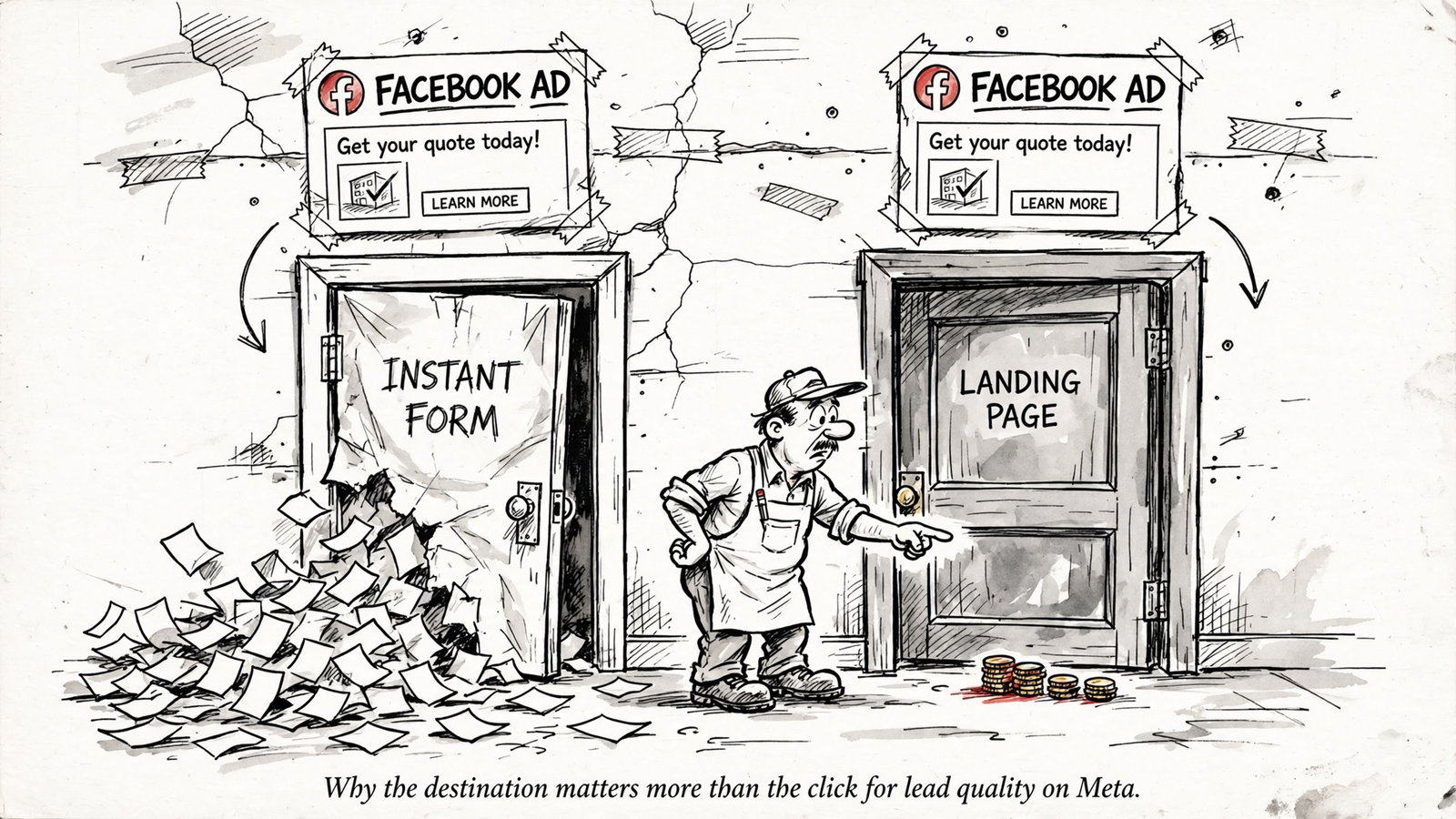
8. Send the same winning ad to a landing page and an instant form
Same creative, two destinations. The mechanism is friction versus intent. Instant forms tend to win on volume while landing pages win on qualification: across 3,000-plus campaigns, lead ads converted at 12.54% versus 10.47% for landing pages but cost $17.98 versus $13.26 per action. CRM data showed 11.7% higher click-to-lead for lead ads and a 5.7% higher qualified rate for landing pages.
The cheaper-looking lead is not necessarily the cheaper customer. First step: duplicate the control, change only the destination and run both for at least seven days. Judge cost per qualified lead from the CRM, never CPL alone in Ads Manager.
9. Replace a tired winner with the same concept in new clothes
Fatigue is not a feeling. Look for frequency above 3.0 alongside falling CTR and rising CPM. I have watched owners kill a good angle because its execution wore out, then chase a new angle they did not need. Winning Meta creative lives about three to six weeks, with refreshes needed every 10 to 14 days; a CPM lift near 29% alongside CTR decay is another tell.
Refresh the execution before abandoning the idea. Keep the hook and promise, but change the face, background and first frame. First step: when frequency crosses 3 and CPC climbs for seven straight days, ship version two of the winner before testing a new concept.
10. Test broad against one interest stack with creative held constant
This is the only audience test I still run at small budgets, and only once a quarter. It is not a new creative concept; it tells you whether your winning creative needs the audience constraint. Send the same ad to broad Advantage+ and one tight interest stack, with identical destinations and budgets in separate campaigns.
Targeting decides who Meta is allowed to show the ad to; creative does much of the work of stopping them. This test tells you whether the interest stack adds useful reach or just splits learning and raises CPA. First step: duplicate the control into broad, cap the stack test at 20% of spend, and read cost per qualified result after seven full days. CTR is not the verdict.
The 4 tests that only fill a report
If you see these on a proposal for $3,000 to $10,000 a month, you are paying someone to look busy. They produce charts without producing a useful decision.
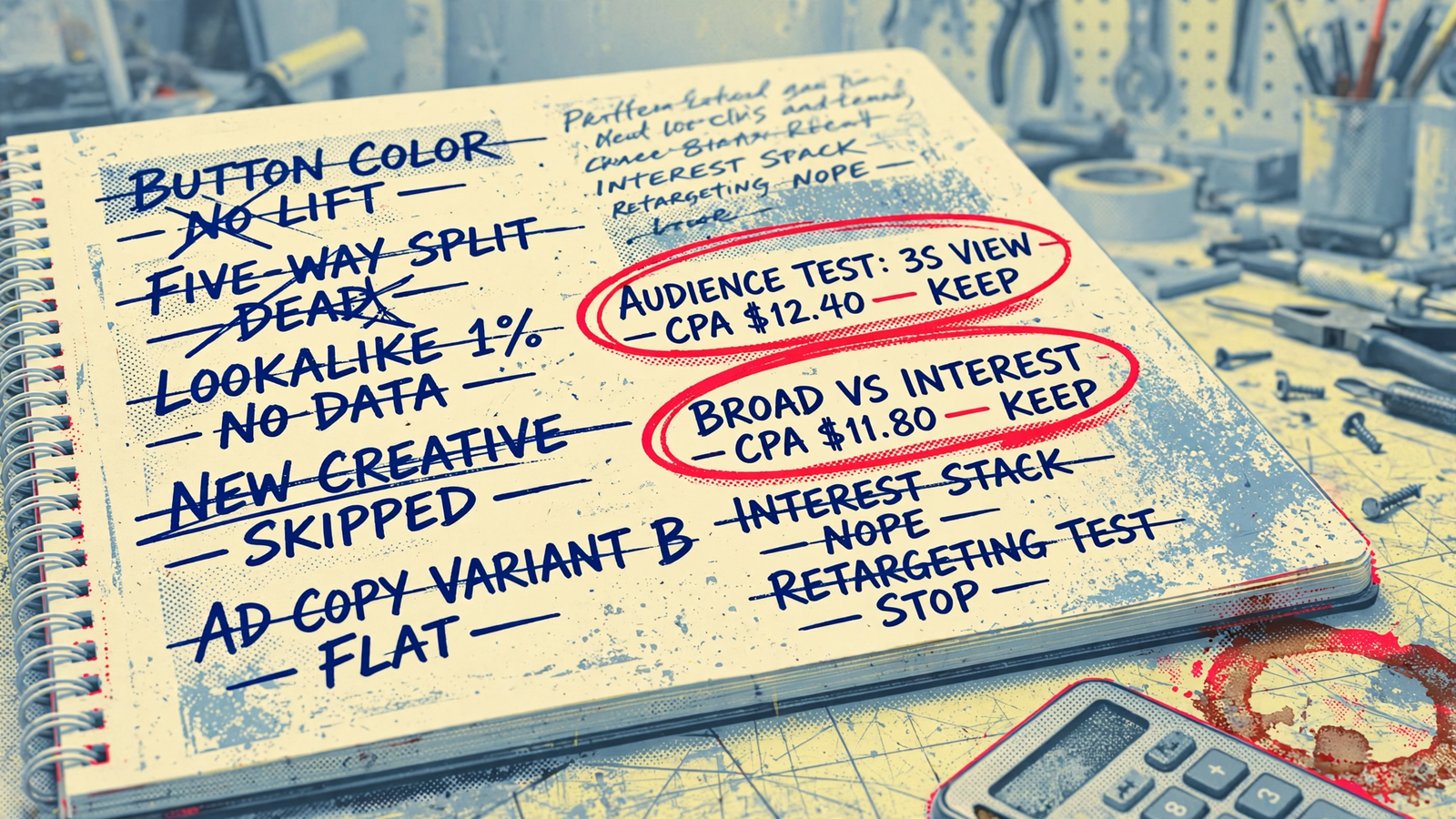
Report-filler 1: Colour and button tweaks
A blue-to-green button change or one swapped headline word is unlikely to move ROAS enough to read at 20 conversions a month. Meta’s testing guidance says to skip button colours and single-word headline changes in favour of bigger questions. I used to run these when a client demanded “testing velocity.” I was wrong. All it bought was a slide saying testing happened.
Refuse it when offer, proof or format remains untested. Your manager has a larger question available.
Report-filler 2: Five-way splits on a $50-a-day ad set
Five variants at $10 a day each buy you nothing you can read. At a $40 cost per result, that is about seven conversions per variant in a month. Even at 20 leads per version, a 25% CPA gap can be chance. The tool wants around 100 results per version before showing first results.
Instead, you get five starved ad sets and a report calling the one with three lucky conversions a winner. If your daily budget cannot fund two variants to 50 conversions, you do not have five tests. Your refusal line: one control, one challenger, enough budget behind both.
Report-filler 3: Placement-by-placement micro-tests
Reels versus Feed versus Stories as a creative test is delivery trivia dressed as strategy. Placements have different CPMs, viewing behaviour and denominators. Frequency can inflate the denominator and make hook rate sag, which is why I compare hooks within the same placement. Splitting $100 a day four ways tells you where Meta found cheap impressions that week, not which idea is better.
I let Advantage+ place the ad, then check placement breakdowns for exclusion or margin problems. Refusal line: test the idea with automatic placements first. Do not sell me four thin placement charts as four creative decisions.
Report-filler 4: A winner called after 48 hours
Nothing is won in 48 hours on a modest budget. The first day or two brings learning wobble. Set aside the first 24 to 48 hours before applying kill rules, then look for 1,000 to 2,000 impressions and at least seven days before a kill or scale call.
Meta’s chance score is a simulation, not significance. Jon Loomer ran three identical ad sets to more than $1,300 in spend, got 100, 86 and 80 results, and Meta still gave one a 59% chance of winning. On $3,000 to $10,000 a month, a 48-hour winner is a random number with a screenshot. Refusal line: seven full days or it did not happen.
Make the monthly report show a decision, not activity
A report worth paying for reads like a lab sheet, not a highlight reel. For each test, I want five lines:
- What the manager isolated, and what stayed constant.
- How much test spend it received.
- What the leading read showed at 1,000 to 2,000 impressions and 50 to 100 clicks.
- What the conversion read showed once it had real volume.
- What the manager did next.
“New hooks launched” with no spend, control or kill rule is activity, not testing. That is the standard I hold to in the eight weekly jobs your manager should be able to prove. It also separates a manager from a reporting subscription when you compare who should run Meta ads for a small business.
Start with test 1: the hook swap on your winner
If I took over your $5,000 account tomorrow, I would start with test 1. Two new openings against the ad already spending. Same body, same offer. Judge hook rate against your own median first and CPA later. It costs an editing afternoon, leaves the winning concept intact and answers the question that matters at small spend: can you buy attention cheaper?
Offer framing comes next because a better guarantee can beat three months of edit tweaks. That is why I like how groas runs Meta Ads at a flat $1,499 a month: new ads tested and winners scaled around the clock, with a named strategist who has to show the read and the decision, not just ship variants to fill a slide.


