

 LinkedIn

Informational organic sessions came in 44.3% below the study’s modeled baseline, versus 5.9% for transactional sessions. Before I buy another content quota, I want to know which side of that gap the proposed pages serve.
Those figures come from the same websites over the same window. They are not a forecast for your business, and they do not prove that informational content is finished. They support a more useful question: which buyer decisions does your site still fail to answer?
The mechanism is plausible. In Semrush’s sample of 200,000 AI Overviews, 80% of desktop Overviews appeared on informational keywords and under 3% on transactional ones. An answer above the results can satisfy a research question without sending anyone to the page underneath it. Publishing more versions of that answer does not, by itself, fix the problem.
Free tool: the AI Visibility Checker asks ChatGPT, Gemini, Claude, Perplexity and Grok the question your customers ask and shows whether they recommend you.
That is the distinction I want an SEO or generative-engine-optimization (GEO) proposal to address. Not how quickly a provider can fill a calendar. Which questions deserve a page, what that page adds, and how anyone will know whether it worked.
What the traffic study actually measured
The First Page Sage report, updated October 28, 2026, tracks 218 client websites across 12 industries. Its dataset covers just over 3.7 billion sessions from January 2023 through September 2026.
That is a large sample with a narrow address book. These are the agency’s own client sites, not a cross-section of the internet.
| Query intent | Reported organic-session change against the modeled baseline |
|---|---|
| Informational | -44.3% |
| Navigational | -19.7% |
| Commercial investigation | -14.5% |
| Transactional | -5.9% |
The baseline matters as much as the percentages. The panel was normalized for site growth, seasonality and spend. These figures describe performance against a modeled pre-2023 growth baseline, not necessarily an absolute decline in raw sessions.
The report also puts the zero-click rate at 92.0% for informational searches and 37.6% for transactional searches. It reports a 0.89 correlation between AI Overview coverage and organic loss across the industries studied. Together, those findings support examining exposure to AI answers. They do not establish that every missing session was taken by one.
A methodology review identifies gaps: per-industry site counts, country mix, raw data and confidence intervals are not supplied. That limits how confidently anyone can apply the headline to a particular business.
My takeaway is narrower than the sales-deck version: inspect the intent mix before prescribing more content. A vendor quoting the headline without the baseline is selling fear dressed as evidence.
What the numbers cannot tell you
They cannot forecast your website’s losses
One agency’s client mix cannot tell me what happens next to your site. Coverage of an earlier version of the report shows how widely the reported losses vary: 47.3% for media and publishing, 41.8% for education, and 38.2% for healthcare.
If you sell boiler repair in Leeds, an aggregate panel is not a local forecast. Before buying a recovery plan, I would compare your informational queries with AI Overviews against your informational queries without them. Practitioners discussing client reporting in this r/SEO thread describe that same split.
If losses cluster around queries with AI answers, the answer layer becomes a stronger explanation. If both groups fall, the investigation needs to go wider. Neither result, on its own, proves the cause.
Use the study to choose what to investigate, not to predict your next report.
They cannot tell you to retire every informational page
The methodology review also highlights a finding worth keeping beside the headline: sessions arriving through an AI Overview spent 23.0% longer on site, while visitor-to-lead conversion was 2.6%, versus 1.7% without one.
Fewer clicks, potentially more useful ones. That is not a promise that your cited pages will convert at the same rate. It is a reason to stop treating every lost research click as equally valuable.
The question becomes: which research questions can your site answer well enough to earn a useful citation and a worthwhile visit? Some informational pages may still deserve investment. Others may offer little beyond the answer already sitting above them.
Judge the question and the resulting visit, not just the intent label.
They cannot set a publishing frequency
Nothing in this dataset connects page count to outcomes. A proposal leading with “20 posts a month” is promising an input, not demonstrating a result.
I have watched that input get bought for years. It is easy to put on an invoice, harder to audit for usefulness, and convenient to pad when the strategy runs thin.
A quota can describe production capacity. It cannot explain why those pages belong on your site. Ask for the page rationale before negotiating the page count.
Google’s guidance makes originality a publishing requirement
Google’s October 1, 2026 update to its generative-AI-content guidance gives content buyers a more concrete acceptance test than publishing speed.
First, there is no blanket ban on AI writing. Google says generative AI “can be particularly useful when researching a topic, and to add structure to original content.” Human-only production is not, by itself, evidence of a ranking advantage.
The guidance instead warns against scaled content abuse: generating many pages “without adding value for users.” It also points to low-effort, low-originality content in the Search Quality Rater Guidelines. The line is not simply who typed the words. The page needs to earn its place.
Second, the updated guidance calls it “critical to manually factcheck and review all AI-generated content for accuracy” before publication. That covers article text, page titles and image descriptions. Fluent output is not an accuracy check.
Coverage of the change describes it as a documentation change, not a ranking-signal change. I would not turn it into a claim that a new ranking penalty arrived with the wording. I would put it into the publishing contract.
The proposal should answer:
- Who reviews factual claims before publication?
- Does that review include titles and image descriptions?
- What happens when a claim fails review?
- What original value does each page add beyond the existing answer?
“We write AI-optimized articles” does not answer any of those questions. As this GEO buyer’s guide argues, that can be a content shop with a new label.
Publishing velocity is not evidence of originality, accuracy or user value. Make those separate acceptance criteria.
Buy a page-level plan, not a larger calendar
The traffic split points toward buyer-question coverage. Citation data adds another reason to inspect the proposed pages rather than count them.
First Page Sage’s 2026 CTR dataset covers 1,184 domains, 3.67 billion impressions and 41.2 million clicks. It reports:
| Placement | Reported click-through result |
|---|---|
| First source cited in an AI answer | 5.2% CTR |
| Top organic result beneath an AI answer | 3.6% CTR |
| First three citations combined | 77.9% of AI-answer clicks |
These are reported placement averages, not a guarantee that securing a citation will produce that return on your site. They do show why a rankings-only deliverable misses part of the picture: in this dataset, the first citation draws a higher CTR than the organic result beneath the answer.
The page plan needs to explain both the buyer question and the page’s contribution. Pricing, comparisons and original data deserve scrutiny because they offer something more specific than another generic explanation. That does not mean every such page automatically belongs in the same intent bucket or earns a citation.
The practitioner discussion is useful texture here, not controlled evidence. Contributors describe moving away from how-to posts an Overview can answer briefly and toward material the answer layer has reason to reference.
Before signing, I want to see:
- A named prompt set built from real buyer questions, with the engines covered.
- A page-level map showing which existing pages answer those questions and which gaps need work.
- A reason to publish each proposed page: the decision it supports and the value it adds.
- A reporting plan that explains how a flat month will be assessed.
That matches the practical demands in this GEO checklist. An agency RFP question set adds useful artifacts: a semantic mapping framework, a content architecture example and a buyer-journey map.
A proposal that cannot connect a page to a buyer question is a volume plan wearing a strategy costume.
Name the technical work before anything ships
Pages dominate proposals because pages are easy to show. They are also easy to count without asking whether the underlying site works.
The provider needs to name and own the technical work alongside publishing:
- Fixing indexation and crawl errors.
- Keeping structured data consistent with what the page claims.
- Connecting relevant pages through internal links.
- Reviewing titles and image descriptions as well as body copy.
The last item follows directly from Google’s content guidance. Accuracy review cannot stop at the article’s final paragraph.
A provider that asks for technical access and examines pricing and comparison pages is at least investigating the purchase end of the journey. A provider that opens and closes with a blog calendar has not yet explained how the work supports a buying decision.
I want technical responsibilities in the scope, not waiting behind the next batch of articles.
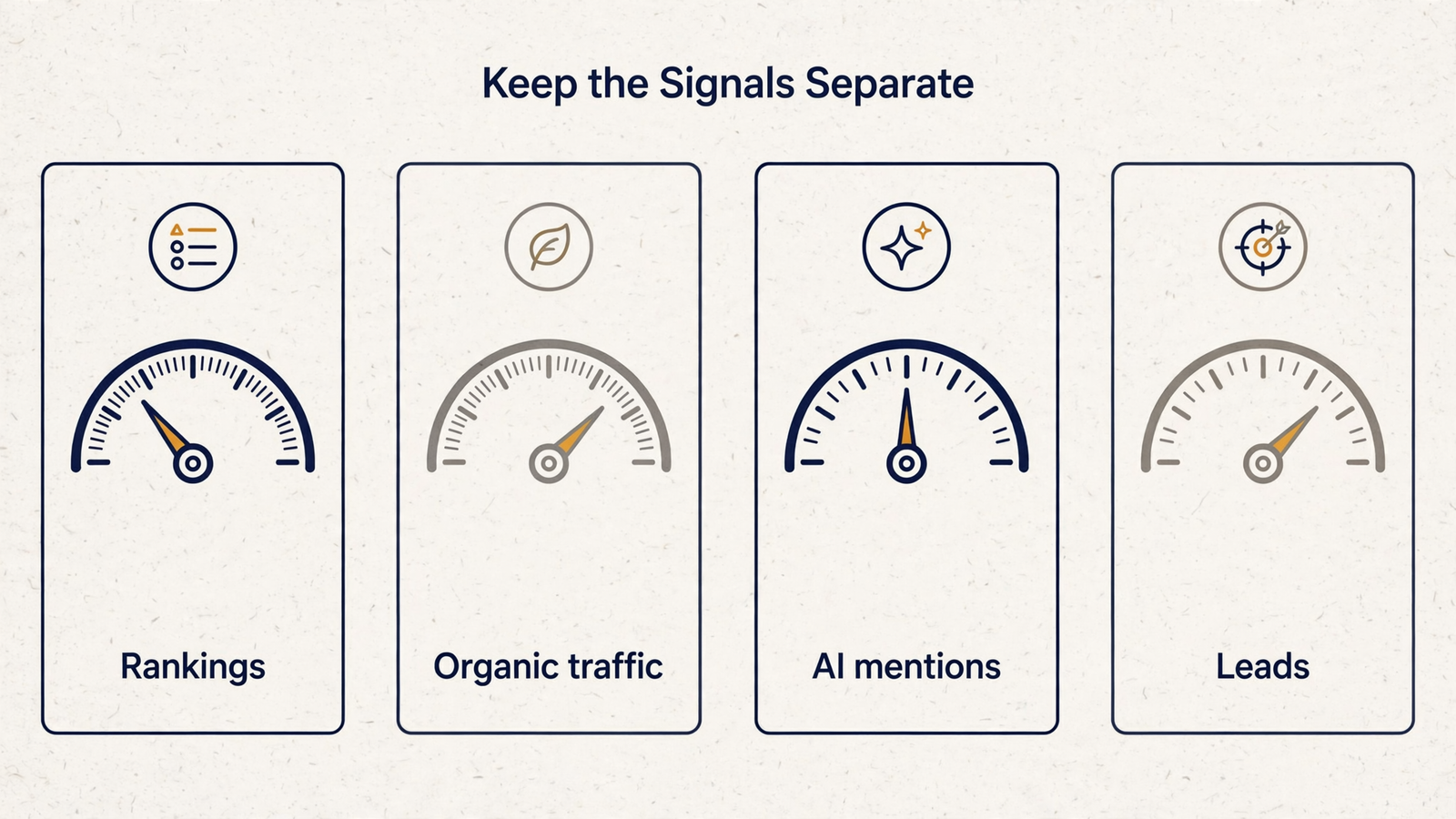
Keep rankings, traffic, AI visibility and leads separate
One blended visibility score is where bad months go to hide. I want separate reporting lines because each answers a different question.
| Reporting line | What I want to see |
|---|---|
| Rankings | Movement by query group |
| Organic sessions | Intent splits and comparisons between queries with and without AI answers |
| AI visibility | Which prompts mention or cite the business, and on which engines |
| Leads or pipeline | What happens downstream of the visits |
Raw totals cannot do all that work. Our own search-data writeup examines 4,033 impressions and one click at position three. The total was not the whole story.
For AI visibility, I want a provider that measures mentions against a named prompt set, month over month, with a baseline recorded before the engagement starts. Otherwise, a screenshot of a favorable answer is doing the job of a measurement system.
Ask every bidder how they explain a flat month. If they answer page-count questions faster than measurement questions, the easy math is running the engagement.
The decision: find the missing buyer answers before buying more pages
Put two proposals side by side. One opens with a publishing quota and a keyword-volume export. The other opens with buyer questions your site fails to answer, split by intent and marked where an AI answer already appears.
The quota version is easier to sell. The question list engages with the actual difference in the traffic data. It does not assume that every informational page is waste or every transactional page is safe. It asks where your next useful page belongs.
You are buying coverage of decisions, not an inventory of articles: what it costs, how it compares, who it is for, what breaks. Before I sign, I want the provider to show which of those questions remain unanswered and what the proposed work adds.
That is the filter I apply to groas. The deliverable is not a publishing quota. It is a named prompt set built from buyer questions, a page-level plan covering commercial and transactional needs, technical execution, and reporting that separates rankings, AI mentions and leads.
A named senior strategist sets the guardrails and owns the outcome. Actions are logged with reasoning. A flat monthly fee replaces percentage-of-spend billing. That is a more useful operating model than paying for volume without a clear account of what it serves.
To discuss that work for your account, book a consultation. Start with the missing buyer questions, not the size of the content package.
The reported 44.3%-versus-5.9% gap is not a reason to stop investing in organic. It is a reason to stop treating every page as the same investment. Ask which buyer decisions are uncovered. Then ask who will cover them. The rest is implementation.


