

 LinkedIn

Most agencies won’t tell you this: your preorder store can post a great Meta ROAS while piling up cancellations, supplier bills, and delivery promises it cannot keep. The purchase-event report celebrates money collected; your store still has to defend that money and ship the product. That gap is the hiring test. If a provider cannot explain retained orders, fulfillment timing, and cash constraints, they are managing campaigns. They are not accounting for the business those campaigns create.
1. “A purchase event means the revenue is safely earned”
People believe it because the setup feels airtight. Pixel plus Conversions API, purchases firing with value, Ads Manager showing clean numbers. It looks like a bank statement. It isn’t.
Meta counts the purchase event it receives; a later refund or cancellation does not remove it from Ads Manager. That revenue column records attributed orders placed, not necessarily orders kept. On an in-stock store, the difference matters. On a preorder store, it can dominate the decision about whether to keep spending.
Free tool: the ROAS Calculator works out your return on ad spend, your break-even ROAS and the budget a revenue goal takes.
Say Meta credits $100k on $25k spend. That reads as 4.0 ROAS. If $15k is later refunded or cancelled, refund-adjusted revenue falls to $85k and ROAS to 3.4, while Meta still shows 4.0. The cancellation happens in Shopify. The purchase credit stays in Meta. Nothing mysterious, just two systems answering different questions.
Ask every agency how it reconciles platform purchases with store records:
- Orders placed.
- Orders cancelled.
- Orders refunded.
- Orders fulfilled.
Those are not interchangeable labels for the same success. They show what happened after the ad platform counted its win.
If the answer is another screenshot of Ads Manager, the question remains unanswered. For the full reconciliation, read Your Meta ROAS Counts the Sale. Does It Count the Refund?.
2. “A good platform ROAS means we can afford to scale”
This one survives because the math looks complete. Cost per purchase is under target, ROAS clears break-even, so the agency asks for more budget and more creative to feed the winner. What the deck calls scale readiness, I call permission to buy obligations.
On a preorder store, each purchase is also a production commitment and a future shipment. Taking money upfront creates a liability; delays can trigger cancellations after cash is committed to suppliers, and poor communication invites more refunds. The ad account does not show how much of that cash is already spoken for.
Say you spend $20k/month at a reported 3.5 ROAS. That is $70k in attributed orders. If the factory payment falls due before shipping and 15% of those orders cancel during a six-week delay, you cannot treat the full $70k as money available for growth. Some goes to production. Some must go back to customers. The purchase column tells you neither amount.
Payment terms change the constraint, not the need to understand it. Pay-now brings upfront cash but leaves cancellation exposure during delays; deposits or pay-later defer cash, and later balance charges can fail or face chargebacks. A ship date needs supplier commitment plus buffer, not optimism in a campaign brief.
Before I approve a scale-up, I want three things beside the acquisition numbers:
- Retained revenue after expected cancellations.
- A ship date supported by supplier commitment and buffer.
- Cash remaining after supplier payments and refund exposure.
A rising ROAS can also reflect reporting visibility rather than more sales. Make the agency explain the movement, not just admire it: Meta ROAS Can Rise Without More Orders. Make Your Agency Explain Why.
No scale decision is complete until the cash and delivery plan survive it.
3. “Blended Shopify MER settles the attribution argument”
I like MER. Total store sales divided by total ad spend is refreshingly plain. It needs no channel attribution, but includes organic and repeat sales and cannot tell you which channel earned an order. Using Shopify sales also avoids counting the same sale across multiple platform reports, though returning customers, email, seasonality, and omitted spend still move the ratio.
That makes MER useful. It does not make it a verdict.
On a preorder store, a gross-sales MER tells you orders came in. It does not tell you Meta earned them, that the orders will stay, or that the money is available to spend. Quoting a 4.2 blended MER does not end that discussion. It starts it.
The sales definition matters first. Use net sales after discounts and refunds, excluding VAT; gross sales includes money never kept and flatters MER. Break-even MER is 1 divided by contribution margin share, so the threshold depends on your margins, not whichever benchmark looks reassuring in the report.
Say your MER is 3.8 on gross placed orders and your break-even is 2.5. You feel safe. Restate it on revenue after cancellations and refunds, and it is 3.1. Still above break-even, but with less room for the next delay or refund than the original number suggested. The cushion you were about to spend has shrunk.
And even a properly calculated MER cannot prove that Meta caused the sales. Email, returning customers, and seasonality have not politely left the room because you opened a spreadsheet.
Report MER on net kept revenue, then ask what moved it besides Meta. For the vocabulary behind that question, use Meta ROAS Isn’t Cash: The Glossary for Stores With Returns and Preorders.
4. “A delayed shipment is an operations problem, not an advertising problem”
I understand the appeal of this division. The warehouse ships late, the agency keeps buying clicks, and everyone knows which department gets the awkward email. On a preorder store, that boundary does not hold.
Meta runs post-ad surveys that ask about shipping delays, unexpected charges, quality, and refunds; customer feedback can affect auction competitiveness and advertising costs. A delivery problem can therefore become an acquisition problem: the shipment slips, the customer reports a poor experience, and that feedback can affect what it costs to reach the next customer.
That does not mean every rising CPM is a fulfillment diagnosis. It means an agency cannot sensibly investigate rising costs while ignoring a moving ship date. The ads may be identical. The experience they sell is not.
So I put delivery promises and inventory availability inside the campaign brief, not in a separate operations document nobody buying media reads. Every preorder offer needs:
- A confirmed ship date with buffer.
- A rule for updating the offer when that date moves.
- A pause trigger when backlog exceeds what the business can fulfill.
- An owner for the decision to slow or stop spend.
If a provider will not put the ship date beside the offer, it is not ready for preorders. Creative cannot repair a promise the business cannot keep.

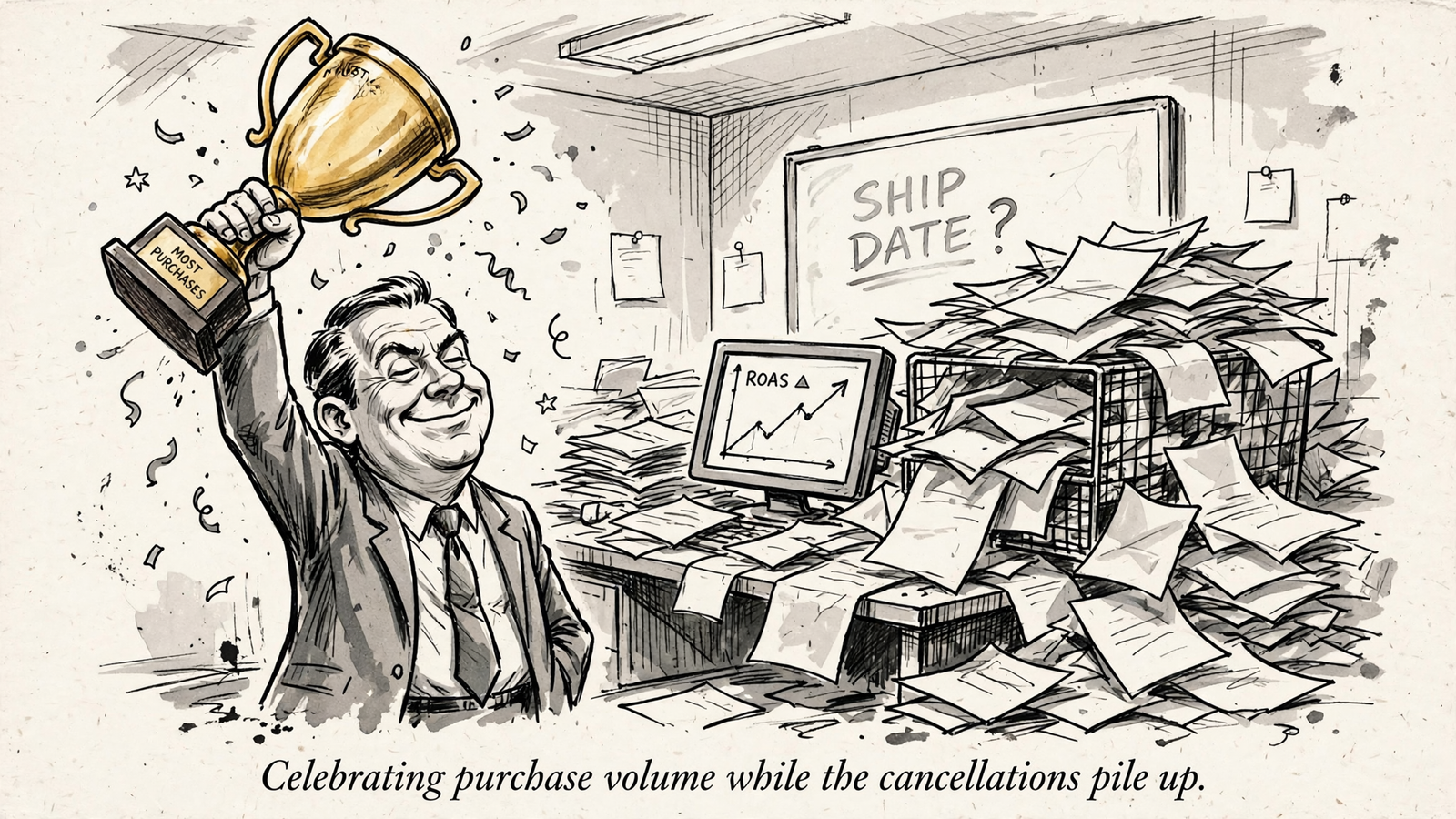
5. “More purchase volume is always a management win”
Agencies love this one because volume photographs well. More purchases, lower cost per purchase, a tidy screenshot for the monthly deck. Capacity is less photogenic.
For preorders, the backlog lives in factory slots and support tickets. Every extra order beyond what you can fulfill on time adds cancellation risk, refund exposure, and another customer who may report slow shipping. Purchase volume can rise while the quality of that volume deteriorates.
Refunds also deserve more attention than a single store-wide deduction. Their concentration across prospecting, promotions, and pay-later orders can change channel rankings once refunds are subtracted. The campaign that looks cheapest on purchase events may not look cheapest after cancellations. That is a hiring question, not an accounting footnote.
The correction is to cap spend around fulfillable demand, not celebrate booked orders in isolation. I want a weekly sellable quantity from operations and an explicit backlog threshold that changes the buying plan. A rule such as pausing at four or six weeks of production only means something if that threshold matches the delivery promise.
Then report settled revenue after refunds, cancellations, and unpaid orders, with refunds tracked by campaign. Otherwise, the agency gets credit for the order and the business gets left with the reversal.
Say the next batch can contain 800 units. Once Meta has sold 700, the job shifts toward protecting the ship date and slowing prospecting, not blindly chasing another purchase-volume record. The remaining capacity belongs in the budget conversation.
Volume beyond capacity is not performance. It is a liability with ad spend attached.
6. “Any ecommerce agency can handle a preorder business”
This is the one I find hardest to kill because it sounds reasonable in a pitch. Meta is Meta, Shopify is Shopify, purchase optimization is purchase optimization. What changes with a ship date?
The finish line.
An agency reporting purchase-event ROAS can show that it generated orders. A preorder store needs someone who also reads the store records beside Ads Manager and slows spending when the factory slips. In-stock fashion and supplement case studies do not, by themselves, demonstrate that operating discipline. The question is different: not just did we sell it? but can we deliver it, keep the order, and preserve the cash needed to do so?
If the provider cannot show how it connects those decisions, assume you will be the account where it learns. A familiar ad platform does not make the business model interchangeable.

The hiring filter: show me the orders we kept
When I assess a provider for a preorder store, I skip the opening ROAS screenshots and ask for the reconciliation. Useful agency questions already include how refunds and cancellations affect reporting, which outcome defines success, whether value separates new and existing customers, and whether Meta and Google claim the same sale.
For preorders, I make the questions harder to dodge:
- What counts as a win? Show placed orders versus kept orders by week, and state the date each number covers.
- Where do cancellations appear? Show them by campaign and ship batch, not as a footnote in Shopify.
- What stops spend? Name the next batch’s fulfillable quantity, the backlog trigger, and the person who owns the pause decision.
- What changes when delivery slips? Show how the offer, spend, and reporting respond. Track shipping feedback beside creative performance so delivery does not disappear from the diagnosis.
I am not asking the agency to run the factory. Supplier dates, production, and custody of preorder cash remain the store’s responsibility. I am asking the agency to stop treating those constraints as somebody else’s problem while it spends against them.
The part of the groas model I would insist on here is accountability: a named strategist, a record of what changed and why, and continuous campaign work rather than a monthly explanation of what already happened. But those management principles are not evidence that a provider can handle Meta preorders. The actual reconciliation and capacity rules still have to be demonstrated. A brand name does not get an exemption from the hiring test.
Campaign management buys purchases. Accountable ecommerce management protects kept orders. Put that distinction in the brief before anyone gets permission to scale.
That is why myth six refuses to die. It lets a good media buyer treat a hard operating business as a simple optimization problem. The first delay breaks that pretense: cancellations arrive, cash is already committed, and the ROAS that justified scaling still sits on the screen untouched. Hire the provider who starts from the orders you kept. Everyone else is selling you the screenshot while you carry the shipment.


