

 LinkedIn

Two of the three AEO agencies on your shortlist sent a screenshot of ChatGPT naming your brand. It is the most persuasive slide in either deck and the weakest evidence in it. One prompt they chose, one run, no date in the corner, and no way for you to repeat it. AI answers are rebuilt on every query, so the screenshot proves one output existed once. Buy reproducible visibility measurement and documented implementation, not a flattering answer. These six myths are where I would start pressing for evidence.
1. “A screenshot proves they can get us recommended”
People believe this because a generated answer feels like a live ranking: a search position you can rerun. It is not. The engine rebuilds the answer on every request. The agency may have picked the prompt that flattered you, and the slide may not show which competitors appeared alongside you. AEO Labs’ buyer’s guide calls screenshots, logos, or percentages without a starting point a red flag. Cubitrek flags screenshots of AI answers for the same reason: a photograph of one output is not a measurement.
I would send back a request, not a question. Give me the exact prompt text, engine and model, date and time, number of runs, share of runs where we appeared, our position in the answer, the competitors named alongside us, and the same prompt set run before work started. A baseline plus reruns turns a screenshot into a rate you can argue with. Without the starting point, you cannot tell whether the work changed anything. Without the reruns, you cannot tell whether the slide shows a pattern or a lucky answer. If the agency cannot hand over the prompt list, it chose the photos and will keep choosing them.
2. “A brand mention means our website was cited”
The pitch deck calls both visibility. The answer names your brand, so the agency counts a win and moves on. But a brand name in an answer is not necessarily a link to your site, let alone a recommendation to buy from you. Lifewood’s analysis of Gemini answers found that brand mentions and site citations overlap as little as 30% of the time. Its distinction matters: third-party coverage can help drive mentions, while your site’s structure can affect citations.
blimpp’s measurement methodology separates three outcomes agencies routinely collapse:
- A citation links a source as a reference. Its unit is the domain or URL, not the brand.
- A mention names the brand in the answer. A warning against buying from that brand still counts as a mention.
- A recommendation advises the brand for the prompt’s intent.
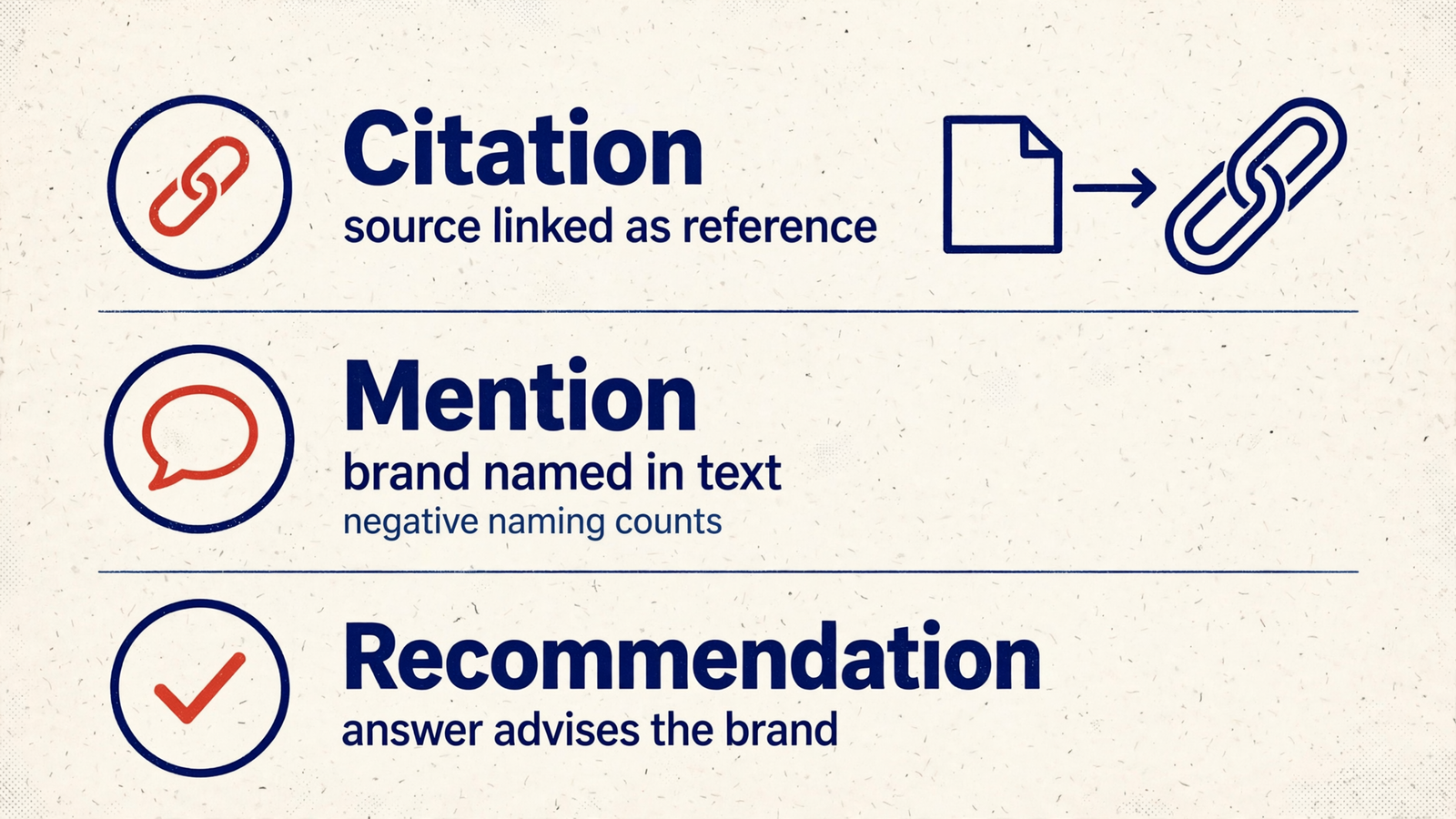
Those are different outcomes, and they call for different work. Mentions depend in part on third-party coverage and entity corroboration. Citations depend in part on whether engines can reach and use your pages. Recommendations depend on how your offer fares against alternatives in the answer. Referral visits are a fourth outcome again; analytics may not identify all of them as AI-referred. If you want the terms settled before the sales calls, I keep this glossary of mentioned, cited and clicked for exactly that moment.
Ask for the raw answer text behind every reported number, with separate counts by engine: how often you were named, how often a page on your domain was linked, and how often the answer recommended you over listed alternatives. Those counts give you something to investigate. A mention without a site citation points to a different problem than a citation in an answer that recommends a competitor. Ask separately what the agency can establish about referral traffic. A server log can show requests; without an identifiable referrer, it cannot prove which visits came from an AI answer. If the proposal rolls all four outcomes into one visibility percentage, ask which one it counts. The answer I usually get is “all of them,” which is how I know the number will not help me decide what to fix.
3. “Coverage across seven engines means seven proven results”
Seven engines in a capability grid reads like seven chances to win. It is closer to seven bets that need testing. VSSL’s hiring guide warns that an agency claiming to “track AI visibility” without naming the surface may be checking one engine and extrapolating. ChatGPT, Perplexity, Gemini, Claude, Google AI Overviews and Google AI Mode do not all retrieve and cite on the same terms. A page pattern that earns citations in Perplexity can land flat in Gemini. Proof on one surface is not proof on the rest.
What I want is a grid, not a score: a prompt set the buyer controls, run the same number of times on each engine each week, with mention and citation rates reported separately and raw answers attached. Cubitrek’s rule is the one I use on every shortlist: insist on engine-level numbers from prompts you control. A blended score hides where you are losing. It also hides whether an apparent gain comes from the engine where you were already showing up, while the one you asked the agency to improve stays flat.
Treat even a tidy score as a calculation, not an observable fact. Profound’s help docs distinguish Visibility Score, Mention Frequency and Citation Share, split branded from non-branded prompts, and note the absence of a native view of every response in the denominator. Ask what the headline number is divided by. If nobody can explain that, the grid is decorating the pitch, not informing the purchase.
4. “AI crawler visits prove buyers are seeing us”
This one usually arrives in a technical meeting: GPTBot fetched the site 400 times last month. It feels like visibility because the engine’s bot is paying attention. But a crawler hit means a bot requested a page. It does not mean an answer cited that page or a buyer saw it. MarketingCore’s server-log analysis makes that distinction bluntly. Its answer-citation data cannot be derived from crawl counts in your logs. Nor can logs reliably label visits as AI referrals when the request carries no identifying referrer.
Free tool: the AI Crawler Checker shows which AI crawlers your robots.txt lets in and what they receive when they arrive.
The bots are not interchangeable, either. Ranko’s 30-day field study across nine client sites describes GPTBot making broad, shallow sweeps, ClaudeBot making sparse re-verification passes, and PerplexityBot fetching pages in response to queries. In the tickets its team reviewed that quarter, half the reported losses of Perplexity citations traced back to PerplexityBot receiving a 403 from a Cloudflare rule the client did not know was on.
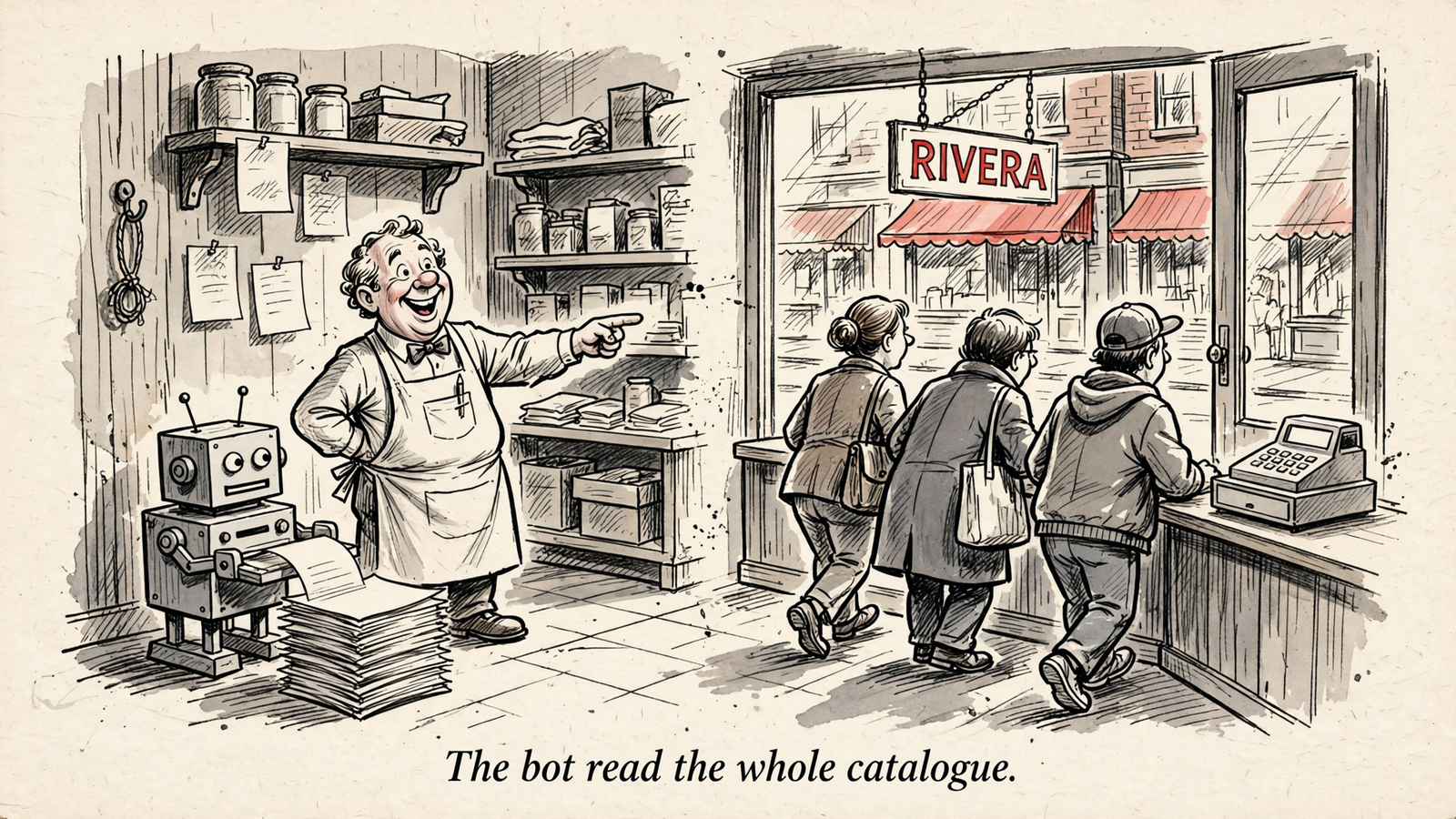
That is why I want an agency to report crawler access and answer citations separately. Access data can tell the technical team whether a bot was blocked. Answer data can tell the buyer whether pages appeared as sources. Neither report can stand in for the other. A crawl gap and a citation gap need different fixes. Bot hits alone cannot tell you which one you have.
5. “An audit means the implementation is included”
The word audit does quiet work in an AEO proposal. Buyers hear “they will find what is broken and fix it.” Often the deliverable is a document describing what is broken. King of AEO’s scoping guide names the comparison problem: one proposal includes implementation, another supplies recommendations, and both appear to promise the same outcome.
Between the audit and a live improvement sits the work nobody glamorizes: publishing pages, chasing a developer to remove a rogue noindex, getting a schema fix deployed. The access checklist in this piece covers the technical half alone. A delivered document is not a deployed change. If the agency needs your team to make every edit, that may be the arrangement you are buying. It should not be a surprise discovered when the first audit lands.
Ask for the trail, not the scope line: a sample brief, the named reviewer who checked its facts against the evidence plan, the QA pass, and the URL where it is live. nqz.ai’s deliverables framework frames the deliverable as a documented production pipeline, not a promised citation count. Then get ownership in writing: who approves factual accuracy, who approves release, and who owns unfinished items in month three?
The test is whether the agency ships the work it diagnoses. On my side of the table, that is why I stopped selling audits altogether. groas publishes pages and ships technical fixes as part of the work, logs actions and reasoning, charges a flat monthly fee, and assigns a named strategist who answers for it. The audit is where the work starts, not what you paid for.
6. “A guaranteed recommendation makes the purchase safer”
This is the myth I find hardest to kill because buyers want to believe it. A guarantee makes an uncertain purchase sound safe. The agency offering one gets to look confident while the other two explain the limit they cannot remove. Nakama’s hiring guide puts it plainly: an AEO agency cannot guarantee ChatGPT citations because answers vary between runs and users. AEO Labs goes further, calling a guaranteed ChatGPT position disqualifying. The third-party engine controls the answer. No provider holds the keys.
A serious provider commits to what it can control: the pages published, access problems fixed, relevant citations pursued, and corrections made when an attempt does not land. It commits to measurement, too: buyer-controlled prompts run on a fixed cadence, results separated by engine, raw answers attached, and a named human who explains what changed. A promise to do and document the work is stronger buying evidence than a promise to appear in an answer. You can inspect the former even when the answer changes on the next run.
I would put all three shortlisted agencies through the same request. Start with twenty buyer questions your prospects actually type into ChatGPT and Perplexity. Cubitrek’s cheapest first step is to run those prompts in logged-out sessions on ChatGPT, Perplexity, and Google with AI Overviews. Record whether you were named, whether your page was cited, and what got cited instead. Do that before a sales team touches the prompts. It gives you a baseline that costs nothing.
Then send each agency the same checklist:
- Run the buyer-controlled prompt set the same number of times per engine on a fixed cadence. Report mentions and citations separately, and attach raw answers.
- Show a sample trail from brief through review and QA to a published URL.
- Name who ships technical fixes, who owns outstanding items, and what the flat fee covers or excludes.
Nakama’s scoring framework offers twelve questions scored zero to two if you want a rubric; answers that promise outcomes without naming engines or prompts score weakly. This two-week test walks through the procedure in full. Use the same questions for each agency. Otherwise, you are comparing three sales pitches instead of three plans for the same problem.
Some agencies will be strong on implementation and thin on content. Others will have a tidy content workflow and no useful answer when you ask about PerplexityBot. That is the comparison you want. groas runs paid ads, SEO and AI search visibility under one flat fee per service, with actions logged and a named strategist accountable for the work. Its SEO & AI Search service covers Google plus ChatGPT, Perplexity, Gemini and more, with pages and technical fixes shipped rather than left in a PDF. No percentage of spend. No setup fee. Month to month.
None of that buys a guaranteed recommendation. It buys work you can inspect and measurements you can repeat. I would take that over the best-looking screenshot in the deck.


