

 LinkedIn
Put your brand name in a prompt and the resulting mention proves very little. This list is for owners who want to know whether ChatGPT and Perplexity put them in front of buyers, not just repeat a name someone already supplied. I use seven prompt types to separate discovery from flattery, then identify what each answer needs: category evidence, a comparison table, a pricing passage, compatibility details, outside proof or a switching guide. Another generic blog post is not the answer to all seven.
1. Ask for a category shortlist without naming your brand
Start with an unbranded shortlist: it tests whether you enter the buyer’s consideration set at all. Try either of these in fresh chats, using identical wording in ChatGPT and Perplexity:
- Best inventory software for a 20-person distributor
- Best PPC agency for home services
The engine has to find candidates without being handed your name. That makes this a discovery test rather than a reputation check. In one 30-prompt test, answers named only 1.5 tools on average, and 14 of 30 named none at all. There may not be much room on the shortlist.
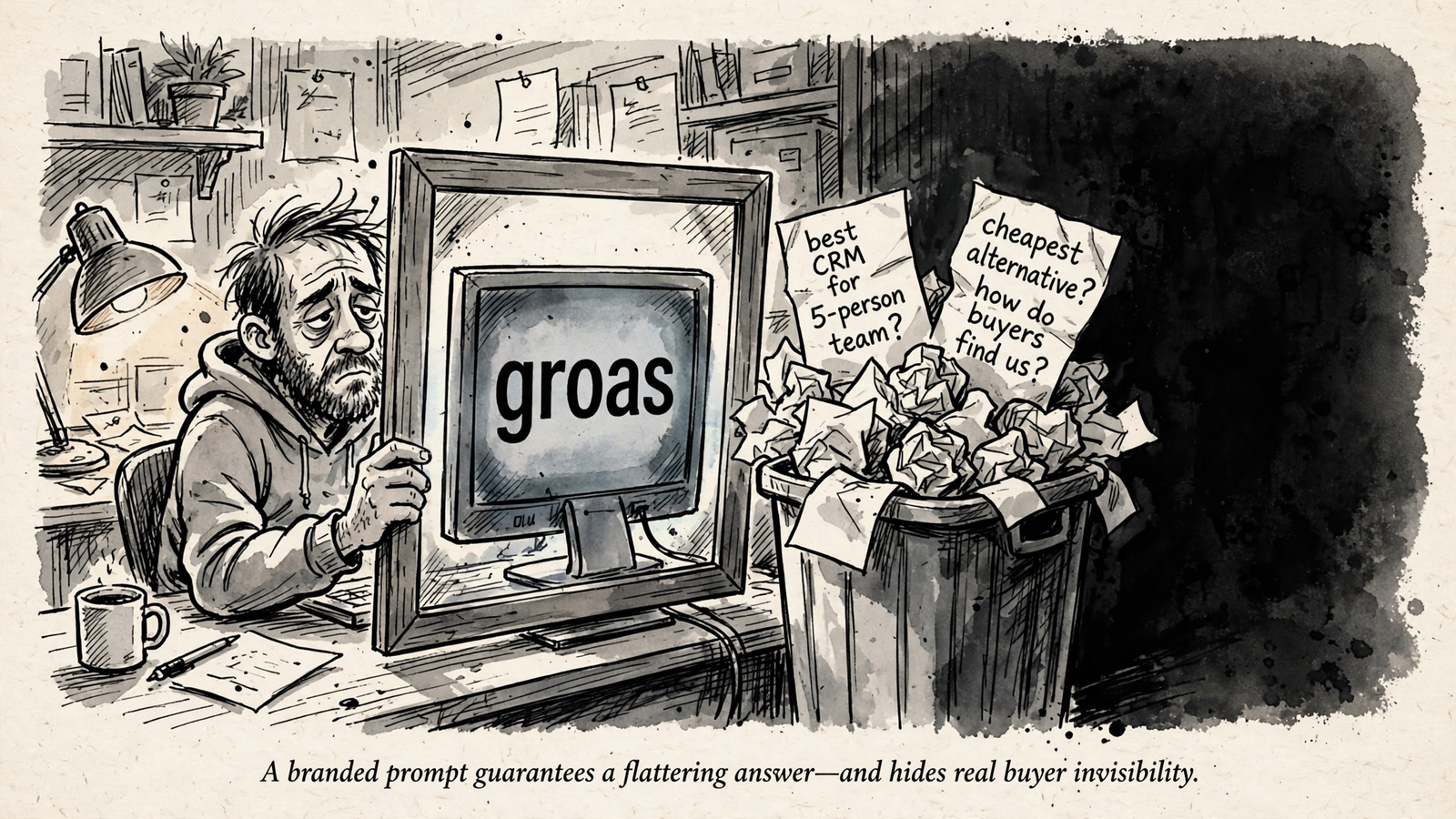
I have seen the same reporting trick with branded paid search for years. High impression share on your own name looks great in a deck. It tells you little about whether new buyers find you. One breakdown of AI visibility guarantees describes a near-100% mention rate by design when the prompt supplies the brand. In its set of 913 buyer-style agency prompts, 613 were never won once by the same agencies that answered fine when asked about themselves.
The source material to work on here is category evidence: pages that clearly establish what you offer and whom it fits, plus relevant third-party listings. A polished paragraph about your mission does not answer best PPC agency for home services.
First step: write five shortlist prompts from real sales calls. For each answer, distinguish mentioned, cited with a link, and recommended. Those are separate events, not three labels for success.
Use the same log throughout all seven tests:
- Engine, date and exact prompt wording
- URLs cited
- Whether your brand appears in the answer
- Whether it is recommended, merely listed or named with a warning
- Which alternatives appear when you do not
A screenshot captures one answer. A consistent log gives you something to compare.
2. Add one constraint the buyer cannot drop
Try:
- CRM for a five-person agency under $100 per month with QuickBooks integration
- Snow removal service in Naperville that handles commercial lots overnight
A constraint changes the candidate list because a broad category match no longer answers the whole question. The answer now needs evidence of budget, team size, geography or a must-have integration. That is why I put this test second: appearing for a category is useful; appearing for a buyer you can actually serve is more useful.
The source material is a self-contained passage that states the fit and its limits. The account of how Perplexity selects sources emphasizes passages that answer the exact question. A generic best-of page can leave the engine looking elsewhere for the number or condition the buyer specified.
I used to tell clients broad category pages would cover this. They do not cover every constraint just because the heading contains the right category.
First step: take your strongest shortlist prompt from entry 1 and add one non-negotiable requirement. Log which names and sources change. Then inspect the cited passage: does it state a limit, a number or a specific fit that your page leaves implicit?
If you disappear when the constraint appears, check the missing answer before commissioning another broad category article. The practical job is to make the relevant fact explicit, not bury it in more copy.
3. Compare two real options and inspect the evidence
Try: [Category leader] vs [second option] for [use case]. Use real names, including yours only if you belong in that comparison.
This is deliberately not an unbranded test. It examines one purchase-stage matchup, not whether buyers discover you unaided. Keep those results separate. A flattering comparison answer cannot repair a blank result in entry 1.
The useful source material is a table of checkable differences:
- Price points and minimums
- Limits and exclusions
- Supported integrations
- Who handles implementation
- Which use cases each option fits
Thin promotional pages rarely become the cited source. A page titled Why We Are Better can spend 1,000 words avoiding the exact difference a buyer needs. A table makes that difference easier to find, inspect and extract.
First step: publish the comparison your sales team keeps explaining, with attributable claims and dates. Then run the prompt and check whether either engine cites your table or someone else’s account of the same differences.
Do not stop at whether the answer names you. Inspect what supports its recommendation. If a third-party comparison supplies the deciding fact, that page belongs on your work list too.
Write what is measurably different, not another declaration of superiority. That gives the answer something concrete to use.
4. Ask what it costs, down to the number
Try:
- How much does inventory software for a 20-person distributor cost per month?
- What does a home services PPC agency charge as a minimum?
The mechanism is straightforward. A precise price question needs a precise price fact. Perplexity’s passage selection favors material that answers the question directly, including prices, steps, dates and sourced figures. Vague statements match every question a little and none well.
Compare affordable plans for every business with an illustrative passage such as $149 per month, onboarding $950 one time, updated March 2026. The second gives the answer usable numbers and a date. The first gives it an adjective. Nobody has ever built a budget out of affordable.
The source material here is a pricing page with enough context to make the number meaningful. A monthly fee without its minimum commitment, setup cost or exclusions can leave the buyer’s actual question unanswered.
First step: put your real numbers on one page, alongside exclusions, minimums and an effective date. Change that date when the content changes, not to make an old page look newly researched.
Then check which price the engines use and where it comes from. Your own current page and an old directory listing may tell different stories.
If your pricing lives only in a sales call, your site gives the engine no public price to cite. Fix the missing source before blaming the answer.
5. Test compatibility with what the buyer already owns
Try:
- Will [category] work with QuickBooks Online?
- Does [service type] work on a Shopify store with 5,000 SKUs?
This tests whether the relevant part of your content makes sense when separated from the rest of the page. An engine may use one passage, not your carefully staged journey from opening anecdote to final reveal.
The source material is an integration or compatibility answer that names the systems, requirements and limits. Each section needs to hold up when extracted alone: answer first under a question-phrased heading, repeat the subject by name and keep one idea together.
I used to write clever sections that only made sense after three paragraphs of setup. That is asking a retrieval system to appreciate the buildup. I would rather give it the answer.
Buyer phrasing matters here because retrieval is partly lexical. If the question names QuickBooks Online, a passage that says only it integrates with your existing tools leaves the important connection unstated.
First step: rewrite your top integration or fit question so its first sentence gives the direct answer, with the relevant names and numbers. Follow it with prerequisites and limits rather than hiding those elsewhere.
Replace “yes, in most cases” with the conditions that make the answer yes—or no. A compatibility claim is useful only if the buyer can tell whether it applies.
6. Ask for proof and inspect who vouches for you
Try:
- What proof is there that [category] actually lowers cost per lead?
- Is [tactic] worth it according to reviews?
This separates a company’s claims from the evidence around them. Your own page can explain the claim, but it is not independent corroboration. Models also draw on roundups, reviews, directories, reputable publications and community debate.
The source material to improve may therefore sit on somebody else’s site. For a smaller brand, getting listed accurately on the review and comparison pages already cited can move mentions faster than another homepage rewrite. I have watched owners spend a month polishing a claims page while a two-year-old directory listing helps shape the answer.
First step: collect the third-party URLs cited for your proof prompts. Check your facts there, and correct inaccurate listings before polishing the same claim on your own site again. That split between your own pages and third-party pages decides where the next hour of work goes.
Keep the measurement honest. A mention, citation and recommendation often do not co-occur. In one late-October test, 11 directory tools were mentioned, but four never had their own site cited. Another tool was cited once without being named at all. Counting links alone would miss part of that picture; counting names alone would miss another part.
This also changes what I want from a visibility service. No vendor decides what ChatGPT or Perplexity cites next Tuesday. The work worth paying for is concrete:
- Verifiable pages with specific answers
- Technical access so engines can fetch those pages
- Accurate information on the off-site page types these engines cite
- Reporting that separates mentions, citations and recommendations over time
That is the work I want from groas: continuous execution on sources and measurement, with a strategist who owns the result. Not a promise to control the answer.
Ask for evidence of source improvements, not another screenshot of your name. Pages shipped, listings corrected and rates tracked are work you can inspect.
7. Ask who replaces the incumbent when it fails
Try:
- Alternative to [market leader] for [use case]
- Switching from [big name] to something for small teams
A switching question needs more than a feature list. The buyer already has something. The answer has to address what changes, what moves and what might break.
The source material is a migration answer: requirements, data moved, implementation responsibilities, limits and who should not switch. A generic better alternative page skips the awkward details that make the decision real.
First step: write the switching answer buyers need, including the reasons your offer might not fit. Then inspect which pages the engines cite when they explain the move. If the answer relies on someone else’s migration guide, compare the questions that guide answers with the ones your page avoids.
Keep this result in its proper lane. I use three prompts as an honesty check on visibility guarantees:
- A prompt that includes your own name
- An unbranded category prompt
- A prompt that places you beside a rival or incumbent
The first checks how the engine talks about you. The second tests discovery. The third tests a specific matchup. The unbranded prompt is the discovery check; the other two cannot stand in for it.
If a vendor arrives holding we rank first in ChatGPT, remove the name and run the category question. If you disappear, that screenshot has not demonstrated reach.
Repeat the tests before claiming a change. I rerun identical wording in both engines a week apart because sources move. Across five engines, one study found that 79.6% of cited sites appeared on only one. Treat ChatGPT and Perplexity as separate observations, not interchangeable versions of the same result.
A fetched page is not necessarily a cited page, either. In one study, 64% of retrieved URLs were never cited. That is why these tests focus on usable passages and specific evidence, not just whether a page exists. If you want to repeat the process without building a folder of flattering screenshots, build a tracker that samples prompts per engine.
If I had one week and could run only one of these, I would start with entry 1: the unbranded category shortlist. It tells me whether the brand enters the consideration set before the buyer supplies its name. Zero mentions across both engines sends me back to category evidence and relevant listings. Mentions without citations send me to the passages and sources supporting the answer. Start where buyers start, not where the screenshot looks best.


