LinkedIn

$0.05 was the bid waiting in Microsoft Ads after a Google Search import. The account hadn’t been funded, so the number tells me what arrived, not what a click cost, and it’s not a number I could have verified from the original Google campaign.
The same report found a schedule shifted by about 10 hours, no imported conversion goal, and a monthly sync that could overwrite fixes made only in Microsoft. None of those findings came from a performance report. The authors found them by opening the destination account before the campaigns ran.
That’s where I want ChatGPT to start. Give it the original Google campaign and it can give me a polished story about bids, seasonality, or landing pages. It can’t tell me which bid Microsoft was set to use, when the ads were eligible to run, or which conversions Microsoft could count. And if the campaign has already spent money, settings alone can’t tell me what happened. For that, I need the destination account’s spend and conversion data, too.
What arrived in Microsoft before any money moved
I’m reconstructing MarketingStackHub’s two-campaign import, not presenting it as my own test. The authors imported Google Search campaigns into a new Microsoft Ads account before adding funds, then checked what arrived. That gives me a comparison between the source and destination settings. It gives me no CPA, no wasted-spend figure, and no recovery result.
| Check | Source setting or intended behavior | What the report found in Microsoft Ads | What the test can’t tell me |
|---|---|---|---|
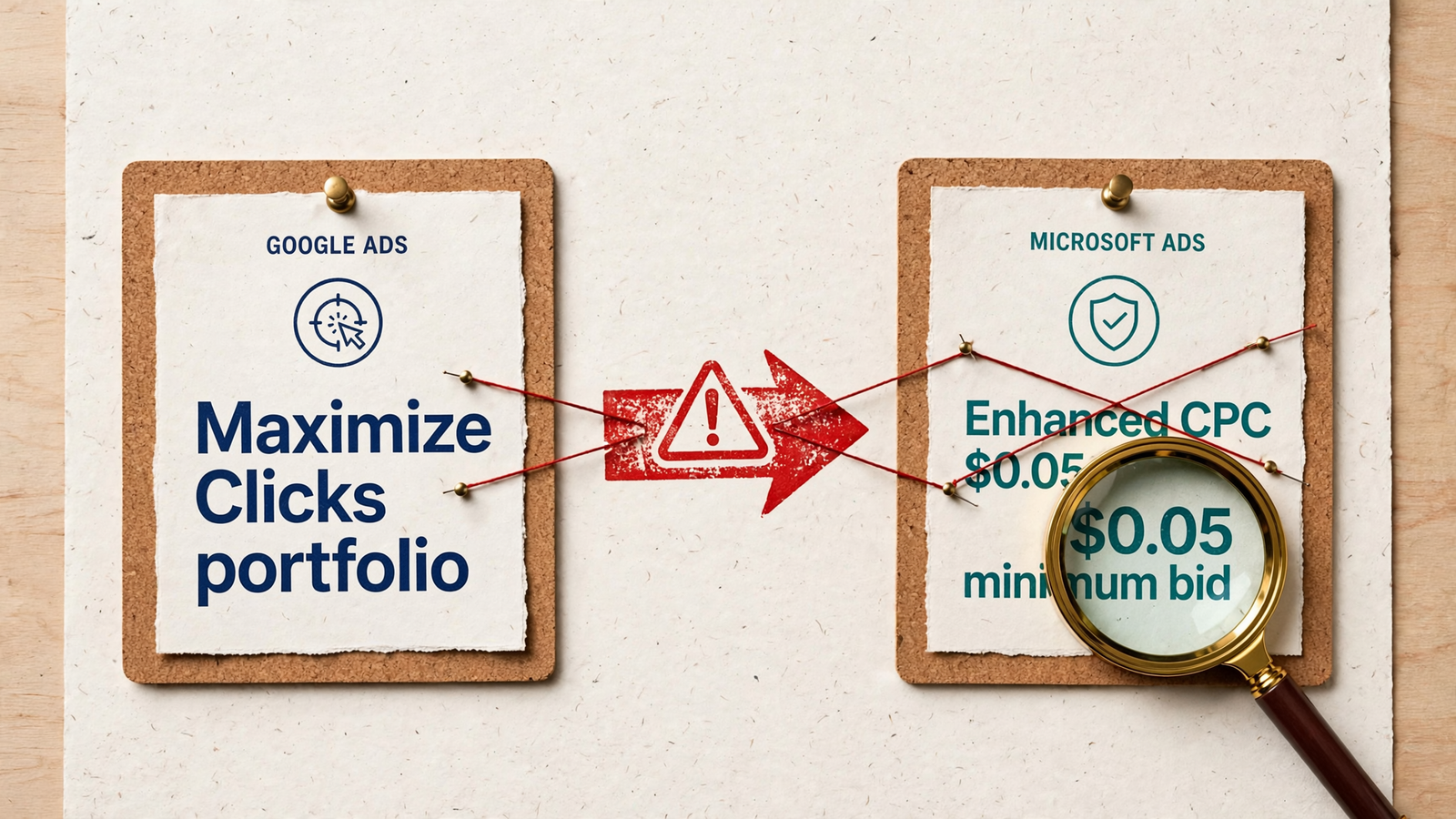
| Bidding | Maximize Clicks portfolio strategy | Enhanced CPC, with bids at the reported $0.05 US minimum | What clicks would have cost once the account was funded |
| Schedule | Ads eligible during the intended window | The original clock times in a different account time zone, shifting the window by roughly 10 hours | How traffic or conversions would have differed during the intended hours |
| Conversion tracking | Tracking existed in Google Ads | No conversion goal imported | Whether a live campaign would have generated leads that went unrecorded |
| Scheduled sync | Fixes made only in Microsoft would stay there | A monthly sync could overwrite destination-only changes | Whether it would overwrite a particular fix, or whether other accounts have the same sync settings |
The report also notes that the responsive search ads started pending review. I’m keeping that separate: pending isn’t rejected, and the report doesn’t say how long review took.
This is a record of an import, not a failure rate for Microsoft Ads. I wouldn’t use it to predict what will happen in another account. I’d use it to decide what to verify. The bidding and schedule checks tell me how the campaigns were set up to run. The goal check tells me what the account was set up to measure. The sync check tells me whether a setting I verify today might change again without another manual edit.
The $0.05 bid: read the value, not just the strategy label
The Google campaigns used a Maximize Clicks portfolio strategy. It had no exact match in this import, so Microsoft mapped it to Enhanced CPC and set bids at the reported $0.05 US minimum. A different strategy label tells me to check the bidding behavior. The reset bid tells me the auction input changed, too. Neither tells me what a click actually cost.
I used to tell clients an import preserved intent even when the labels changed. I was wrong. The HustleMarketers import guide makes the distinction in less dramatic terms: campaigns, keywords, ads, bids, and budgets can carry over, while automated rules, IP exclusions, and customer lists don’t. Imported describes what the tool did. It isn’t a sign-off on what arrived. For the bidding mechanics on the source side, see Google Ads bidding strategies in 2026.
With both accounts connected through groas, I’d ask ChatGPT to put the source and destination campaigns side by side. I want the strategy type, whether it’s portfolio or standard, the CPC values at campaign and ad group level where applicable, and any bid floor it can verify. If it can see a bid but can’t verify why that value was set, I want it to say so. Seeing the same value the report found wouldn’t be enough to establish that the same thing put it there.
Read the destination bid before recommending another one. An observed value is enough to flag a mismatch. It isn’t enough to explain the mismatch or tell me what to bid instead.
The schedule: same clock times, different hours
The schedule kept its clock times, but the source and destination accounts used different time zones, described as European and Pacific in the import report. That shifted the intended window by about 10 hours. The mechanism is boring, which is why it’s easy to miss: a schedule can look identical in both interfaces because the displayed hours match. Against the business’s clock, they don’t.
The import guide’s account time-zone notes explain why I wouldn’t assume a later import corrects it: the account time zone imports once and doesn’t update. Read a carried-over schedule against the wrong clock and the ads can be eligible when the business is closed, or ineligible while customers are searching. Those are possible consequences of the settings, not delivery outcomes this test measured.
I’d ask ChatGPT to show each account’s time zone and each campaign’s schedule as stored, then translate both schedules into the same time zone. I want the stored values beside the translation so I can check the conversion without losing sight of the actual settings. Compare both schedules on the same clock before changing either one. If they don’t line up, I have a setting to review. I don’t yet have an explanation for poor results.
The missing goal: a zero can be a measurement problem
MarketingStackHub found no imported conversion goal, even though tracking existed in Google Ads. The report describes tag-based destination-URL goals as eligible in a pilot, unlike Analytics goals, custom events, and Smart Goals. Even a goal that makes it across still needs a live UET tag to record anything, as the import guide’s tracking notes explain.
I separate the checks:
- Does the destination goal exist? I want the goal in Microsoft, not the name of the one in Google.
- Which goal does the campaign use? A list of account goals doesn’t tell me which one the campaign uses.
- Is the UET tag firing? I want whatever tracking status the account can show. If the available data can’t confirm that the tag is firing, I want it marked unverified, not inferred from the goal name.
The unfunded account can’t tell me whether a future lead would have gone uncounted. It does show why an AI diagnosis that starts with the conversions column is premature. In a funded account, a zero can mean no leads or no record of them. If I don’t know which problem I have, changing the bid might change how the campaign runs without telling me anything about the leads I’m trying to count. Verify the goal and tag before using destination conversions to explain CPA.
The monthly sync: check whether a fix will stick
The import report flags a monthly sync that could overwrite fixes made only in Microsoft. The HustleMarketers guide describes the mechanism: scheduled imports can update budget, bid strategy, and status unless those options are unchecked, and those import changes can’t be undone through change history. That’s not evidence that every sync overwrites every setting. It’s a reason to check which fields the next import is allowed to touch.
I’d use groas to have ChatGPT read what it can see in both accounts, including campaign settings and the action log. Then I’d ask it to list any sync settings it can verify and call out anything outside its access. If the Microsoft import-schedule dialog isn’t visible to it, that check stays with me.
The distinction matters even if the readback looks perfect. If I correct a bid strategy in Microsoft and the account shows the strategy I approved, that confirms the fix is in place now. It doesn’t tell me whether the next sync is allowed to replace it. Check what the scheduled import can overwrite before approving a destination-only fix. Otherwise, the repair is written in pencil.

What I give ChatGPT before asking it to recommend a change
A Google export is useful. Asking it to stand in for Microsoft is asking the wrong account the right question. The TofuAds review of AI ad management puts the access problem plainly: without a connection to the account, ChatGPT doesn’t have the live figures it needs. Kampaio’s review of 139 public discussions describes a similar gap: people trust it with copy, then run into problems with keywords and match types when it can’t see search terms, margins, or live spend. That review describes what people reported, not how often an import goes wrong.
For an imported campaign, I’d review the accounts in this order:
- Connect both accounts. I’d plug ChatGPT into groas over MCP so it can read Google and Microsoft live instead of treating a pasted source export as the destination record.
- Start read-only. I’d compare the bidding strategies and values, then the time zones and schedules. I’d check the Microsoft goal mapping and UET status and have ChatGPT separate confirmed sync settings from anything I need to verify manually. I want the discrepancies and the unknowns before I see a proposed fix.
- Match the recommendation to the evidence. If the account hasn’t run, I’d ask only for recommendations the settings justify. If it has run and I’m asking about performance, I’d have ChatGPT read Microsoft’s spend and conversion data after checking what the conversion column measures. Google’s numbers are useful for understanding the original campaign. They don’t fill a gap in Microsoft’s records.
- Approve named changes, then read them back. I approve a specific setting change, not a vague instruction to optimize the campaign. Then I check the resulting value in Microsoft and keep the action log. Changes made through groas are logged and reversible; that’s separate from what Microsoft’s own import can overwrite.
Read before approval. Read back after the change. The first check tells me whether the proposed change addresses a real mismatch. The second tells me whether the account now reflects what I approved. Neither substitutes for checking the sync.
The decision this test supports
The prefunding test shows no measured wasted spend, no CPA lift, and no recovery result. The reported bids never bought clicks. The shifted schedule never bought the wrong hours. The missing goal wasn’t tested against live traffic. I can call out a mismatch without pricing the damage. I can recommend correcting a setting without promising that doing so will fix performance.
If an import looks wrong, I’d connect both accounts through groas and ask for a read-only comparison before approving another change. If Microsoft has already spent money, I’d also ask for its spend and conversion data, with any tracking gaps named up front. If all I have is the source campaign, I stop at what it was meant to do. The Google campaign is the plan. The Microsoft account is where I check what arrived and, once it runs, what happened.