LinkedIn

Microsoft Advertising reports 10% more conversion value per click at a similar ROAS in its 18 November 2026 post, Building the Next Generation of Automated Bidding at Microsoft Advertising. I picked it for this teardown because it’s exactly the kind of number that gets forwarded with an implied instruction: switch the strategy and bank the gain. My verdict: it earns an inspection, not a switch. I’d have ChatGPT turn the announcement into an account-specific decision memo before anyone approves a change.
The 10% headline is a platform average, not an account forecast
Start with the sentence that does the work. Microsoft says its upgraded bidding models delivered, on average, 10% more conversion value per click at a similar ROAS for advertisers using Maximize Conversion Value and Target ROAS. The footnote points to Microsoft’s internal global data for Search and Audience Network in August 2026. It doesn’t give the sample size, the baseline, or a definition of ‘similar’ ROAS.
Those are the three things I’d want before putting that number in front of a client as a forecast. The blended figure doesn’t tell me what to expect in a £20k-a-month Search account, or in a local-services account where someone assigns a value to a phone call. It gives me a metric to inspect. It doesn’t give me a number to put in the budget.
The 8% and 18% figures are different claims
The neighbouring figures are easy to read as supporting evidence for the upgrade. The footnotes tell a different story:
- 8% greater conversion value refers to a switch from Target CPA to Target ROAS, measured from August to September 2026.
- 18% more conversions refers to a switch from eCPC to Maximize Conversions with a CPA target, measured from June to July 2026.
Those are strategy-switch results, not model-upgrade results. I’ve seen this slide pattern before: one number gets quoted in a meeting, and by the time it reaches the budget it’s absorbed the other two. Keep the three claims on separate lines when you give ChatGPT the post. ‘What’s the upgrade worth?’ is an invitation to turn them back into one.
The rollout clarification rules out a clean launch-date comparison
On 23 November, Microsoft Advertising liaison Navah Hopkins clarified the timing: there was no single go-live date, the rollout had been running since summer, and the figures were meant ‘to help you feel confident testing’. That’s the most useful line in the whole episode. 18 November is the publication date, not a before-and-after cutoff for your account.
The announcement doesn’t say which markets or accounts have the upgrade, how to check, or how to opt out. And while conversion-based bidding becomes available at five conversions at account level, that’s an eligibility threshold, not the volume Microsoft recommends before judging performance. I’d record rollout status as unknown unless I could verify it. I wouldn’t let ChatGPT explain a November swing by pointing at the date on the blog post.
‘Nearly twice as quickly’ doesn’t mean change targets twice as often
Microsoft’s post also says bids adjust ‘nearly twice as quickly’ after target changes. There’s no data note for that figure, no baseline, and no definition of what counts as adjusted. I’d treat it as a claim about the model, not as a timetable for editing an account.
Microsoft’s own guardrails are more useful:
- Verify that conversion tracking is healthy through UET or the Conversions API.
- Change targets in 15% increments and wait one full conversion cycle before reviewing.
- Aim for 30 conversions in 30 days at campaign or portfolio level before evaluating performance.
- Don’t assume a Maximum CPC cap is harmless just because it sits above average CPC. Microsoft advises against keeping it because it can override the CPA or ROAS target.
I’d follow the guardrails before acting on the speed claim. A faster adjustment is no help if the model is chasing a value you don’t trust.
Give ChatGPT the accounts before asking for a verdict
A bare ChatGPT window can summarise the post without ever seeing your accounts. That feels like diligence, which is what makes it dangerous. I used to paste screenshots. I was wrong to think a cropped snapshot was enough to tell me what had changed.
I’d connect groas to ChatGPT over MCP, then connect Microsoft Advertising and Google Ads once. That gives the same chat access to current strategies, targets, conversion goals, spend and reported conversion value across both platforms on matching dates. Google is a second set of account evidence here, not a control group for Microsoft’s rollout.
The official connectors stop short of that read-to-execution workflow. Google’s Ads MCP server can query through GAQL and run validate-only dry runs for assets or labels, but it can’t change budgets, bids or campaign status. Microsoft’s Advertising MCP setup requires a separate Entra ID OAuth app registration and Developer mode in ChatGPT, and the server is read-only for account analysis. I’d use groas for this job because I want the inspection and any later, approved change in the same workflow. That doesn’t mean doing both in the same prompt.
Make the first pass read-only. I’d start here:
Read both accounts without changing anything. Show current strategies, targets, conversion goals, spend and reported conversion value for Microsoft Advertising and Google Ads for the last 30 days and the prior 30 days. Use matching dates. Show the account currencies and flag any mismatch. Label every attribution difference you find before comparing results.
Then stop. If I ask for a recommendation in the same message, I’m inviting the model to compare whatever each platform happens to call a conversion. The first output should be a table I can challenge, not a verdict I have to unwind.
Check what the bidding model is actually being rewarded for
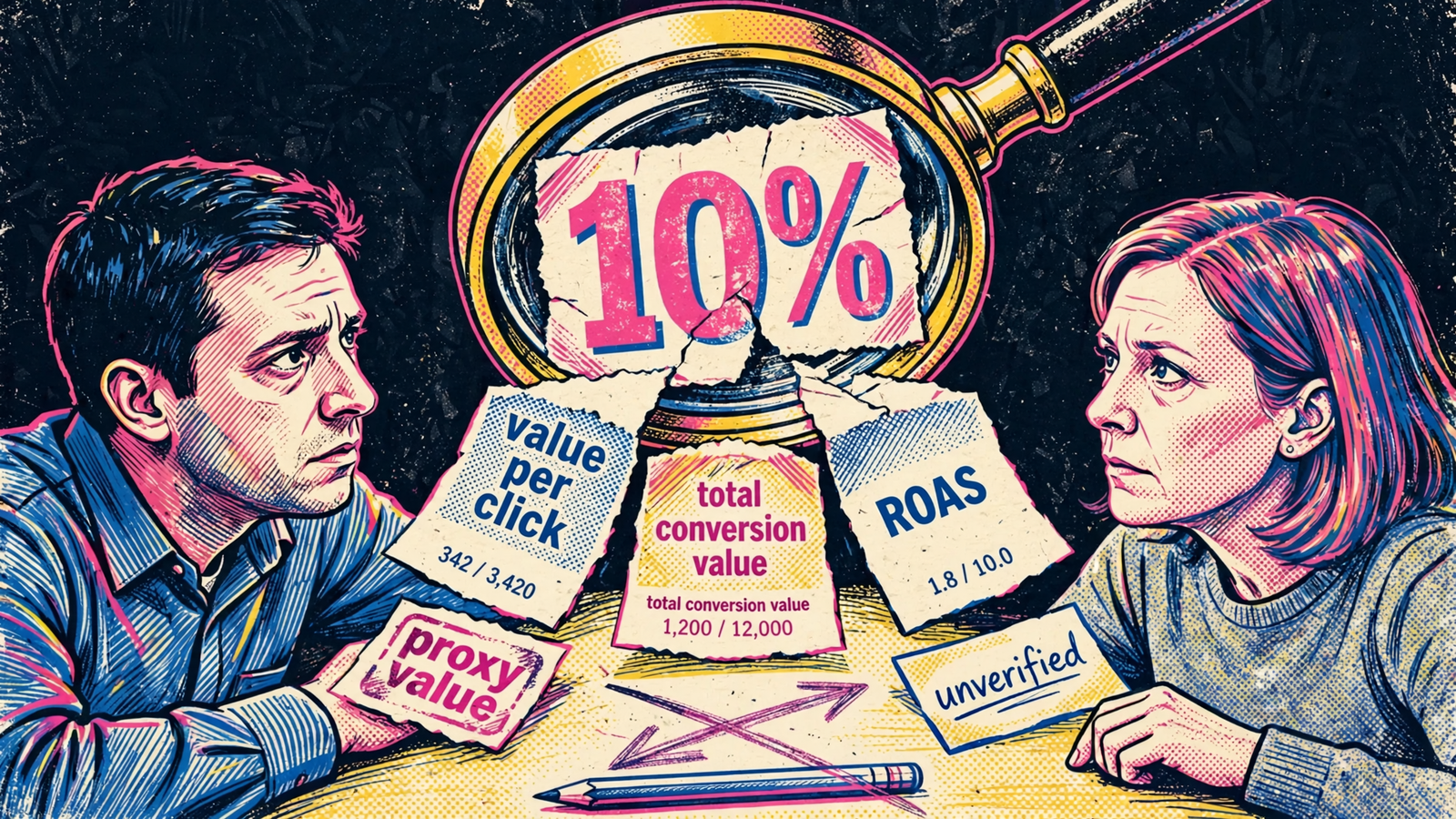
10% more conversion value per click isn’t 10% more revenue, profit or conversions. It’s recorded conversion value divided by clicks. The figure can rise because the values recorded against those clicks went up, or because the traffic mix shifted towards clicks that already generated more value. Cheaper clicks alone don’t raise value per click: spend isn’t in the denominator.
I’ve watched value per click improve after a secondary action was reclassified as primary. The bid strategy had a bigger number to chase. The business didn’t have a better outcome. That’s why I make ChatGPT show the arithmetic before it comments on the strategy:
Separate value per click, total conversion value and ROAS for each account. Show the inputs and calculation for each metric, name the conversion goal behind the value, and label it as recorded purchase revenue or an assigned proxy. Do not combine primary and secondary actions into one total. If you can’t confirm the value source, the attribution window, or whether the tag fires on a completed action, mark that goal ‘unverified’. Do not estimate.
The distinction between primary and secondary actions matters more than a tidy total. A real order value, a booked job, a qualified pipeline amount and a fixed number someone typed into a tag are not interchangeable. The coverage of Microsoft’s results highlights actual transaction values as the stronger basis for value bidding. If the account relies on a proxy, I want the memo to name it and explain what it represents, not quietly treat it as revenue.
Then I’d use the guardrails from the post to check whether the account is ready for a test at all:
List the target changes in both accounts over the last 60 days. For each, give the date, the size of the change and whether a full conversion cycle has passed. List every unresolved measurement issue by goal name. Flag campaigns below 30 conversions in 30 days and distinguish campaign volume from portfolio volume where relevant.
What I want back is a short, boring list: recent edits, thin volume, unverified values. If any of those prevents a fair read, that belongs at the top of the report. Lead with the changes and exceptions, not a thirty-row table that makes me find the broken tag myself.
Write the memo before anyone touches a target
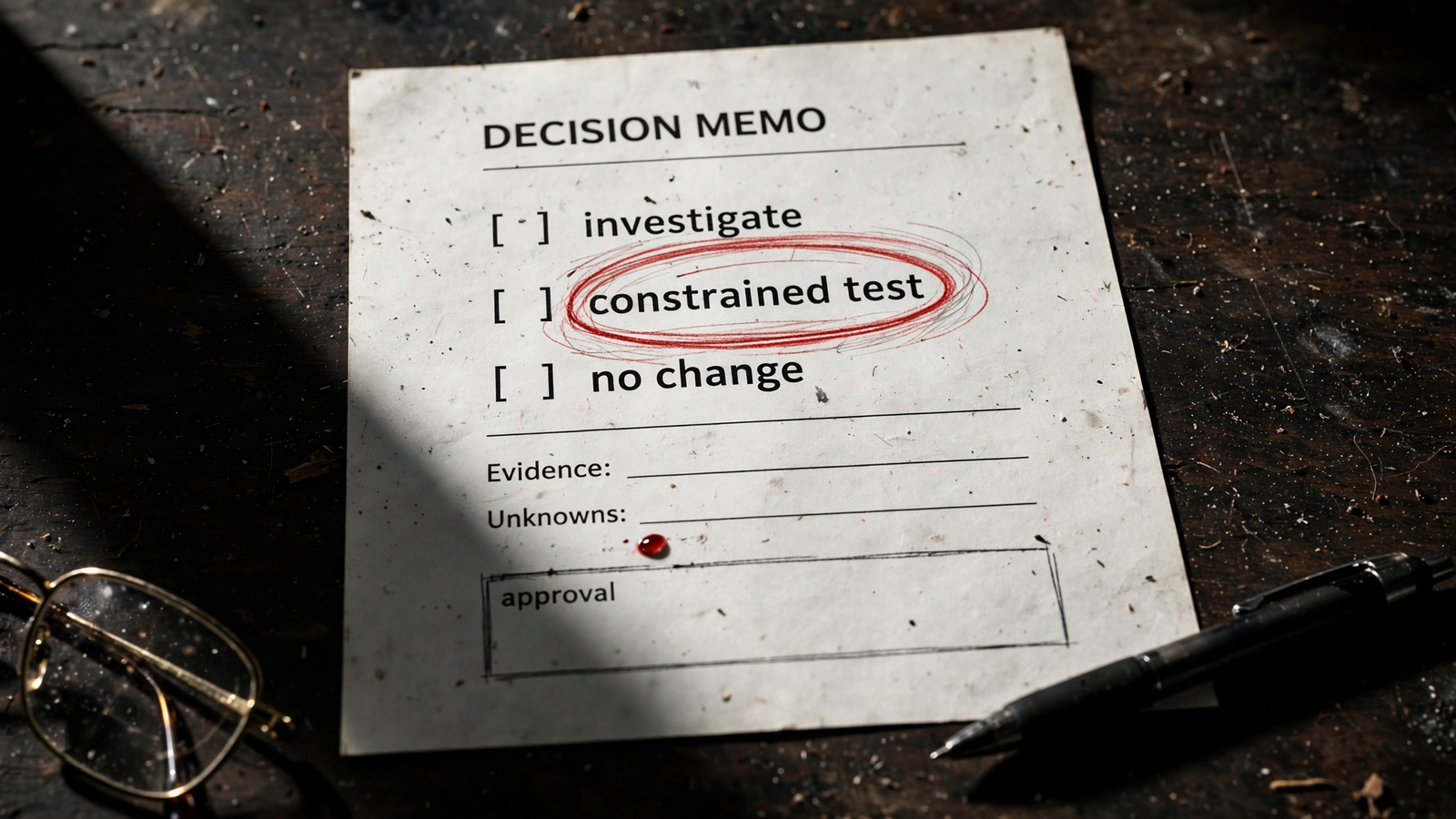
Once ChatGPT has shown the account data, the calculations and the gaps, I’ll ask it to commit. The memo has three possible recommendations: investigate, run a constrained test, or make no change. A vague yes is not a fourth option.
Recommend investigate, constrained test, or no change. Cite the account evidence you used, including dates, goals and values. List what you couldn’t verify. State what evidence would prove your recommendation wrong and what you’d need to see to change it. Do not make any changes.
Each answer needs to tell me what happens next:
- Investigate: Name the missing evidence and what finding it would settle.
- Constrained test: Name the campaign, strategy, target change, budget limit and the conversion volume needed before judging it. Keep any target change within Microsoft’s 15% guidance and state what would stop the test.
- No change: Say what rules out a switch now. If it’s a measurement problem, name the goal and what has to be fixed before the decision comes back up.
The line about what would prove the recommendation wrong is the one I’d fight to keep. Without it, I’m approving a preference. With it, I can tell the difference between a test that taught me something and a change that merely stayed live.
Execution comes after a human approves the memo, within the limits it sets. In groas, the autopilot stays off until someone switches it on; each change is logged with its reason and can be undone in one step. I’ve made the 11pm edit and come back to an interface that told me what I changed but not why I thought it was a good idea. The log preserves that reason. It doesn’t substitute for the evidence in the memo.
Verdict: keep the guardrails, not the forecast
I’d use ChatGPT for the part of account reporting that takes judgement: separate what changed from what might explain it, then say what the evidence warrants. Connected through groas, it can pull the two accounts into the same read-only pass and show where the comparison holds up and where it doesn’t. If I can challenge a date, a goal or a denominator in the memo, it’s doing useful work. If all I get is a better-written version of Microsoft’s post, it isn’t.
Microsoft’s 10% claim earns an inspection and possibly a constrained test. It doesn’t earn a strategy switch. For the account-level pass, I’d start with the prompts in Bing Ads investigations in ChatGPT. Before approving the memo, I’d also ask a second assistant the same question. When Claude and ChatGPT disagree about an account, I’d check the number they disagree on before picking the answer I like better.
What I’d keep from Microsoft’s announcement is the discipline underneath the headline: verify the signal, move the target in measured steps, and give the account enough conversions and a full cycle before judging the result. That belongs in the memo. The 10% belongs in the reason I opened the account.