LinkedIn

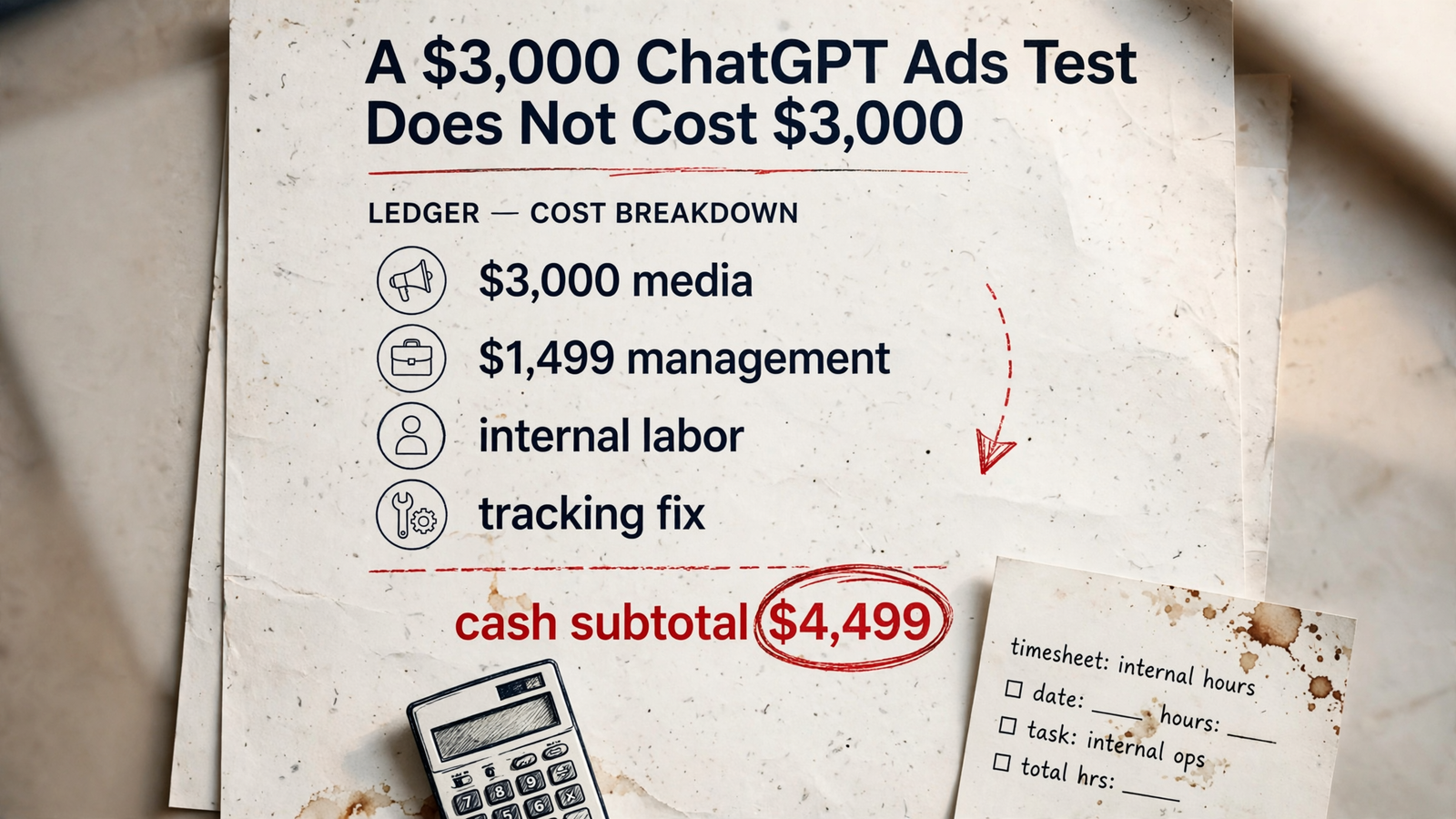
Put $3,000 into ChatGPT Ads media and, with a new groas engagement, your cash bill starts at $4,499 before you count your own time. Add the illustrative labor and tracking allowances below, and the first month costs roughly $5,300 to $6,900 fully loaded, with the verdict arriving later as leads mature.
That is the useful price of the experiment. Not the media budget. Not an arbitrary third of a three-channel retainer. I want two ledgers: what adding ChatGPT costs, and what acquiring business through it costs after management, qualification and measurement enter the picture.
This is an illustrative $3,000 media plan, not a platform minimum. ChatGPT Ads have no self-serve account minimum and a $25 daily campaign minimum in the US, with recent US tests starting around $3 to $5 CPC bids. Verify current account access before committing the budget.
The bill: listed costs, hidden work and one-off fixes
I keep these lines separate because a blended number hides which costs disappear when the test stops and which costs the business already carries.
| Cost line | What it pays for | Illustrative first-month cost | Timing | Source or basis |
|---|---|---|---|---|
| Listed: media | Clicks in the test | $3,000 | Recurring while live | Chosen test budget |
| Listed: groas management | Strategy, build, monitoring and reporting | $1,499 | Monthly | groas management |
| Hidden: internal labor | Qualification, approvals, follow-up and reporting | $800 to $1,800 | Recurring while the work continues | Illustrative allowance; replace with recorded hours × hourly cost |
| Conditional: tracking fixes | Client-side pixel, Conversions API or redirect work | $0 to $600 | Mostly one-off | Illustrative allowance; actual cost depends on development work |
| New-engagement cash subtotal | Media + management, before internal labor or extras | $4,499 | First month | $3,000 + $1,499 |
| Fully loaded test total | All four cost lines | $5,299 to $6,899 | First month | Sum of the illustrative allowances above |
Those labor and development ranges are planning assumptions, not quotes or market benchmarks. Replace them with your own costs before approving the test.
There is also a cost the table cannot price for you: waiting. A month of clicks does not necessarily produce a month-end answer about revenue. The ledger covers one month of media and management; it does not silently include another paid month while leads mature.
Line 1: charge the fee once, not three different ways
groas charges $1,499 a month for management. Media is separate. That distinction belongs above the fold, not halfway through a sales call.
A competing done-for-you offer lists $1,500 a month at an early-adopter rate, then $3,000 standard, with ad spend separate and a $1,000 minimum spend. Published category pricing puts small-account management at $1,000 to $3,000 a month flat. groas sits at the low end of that band and covers Google and Bing alongside ChatGPT. That makes the allocation question worth getting right.
There are two different buying decisions:
- New engagement bought for ChatGPT: the full $1,499 belongs in the test. Your media-plus-management bill is $4,499.
- Existing groas engagement adding ChatGPT: if the fee does not change, extra management costs $0. Your incremental media-plus-management bill is $3,000.
Do not charge ChatGPT one-third of the retainer just because it becomes the third channel. That is tidy spreadsheet work, not a useful account of what the decision costs.
The existing retainer still matters when reviewing the overall search program. It simply is not a new expense caused by adding ChatGPT. I use the incremental ledger to approve the addition and the standalone ledger to judge whether buying management solely for this channel makes sense.
Write down which decision you are making before dividing anything.
Line 2: pay for measurement once—and prove it works
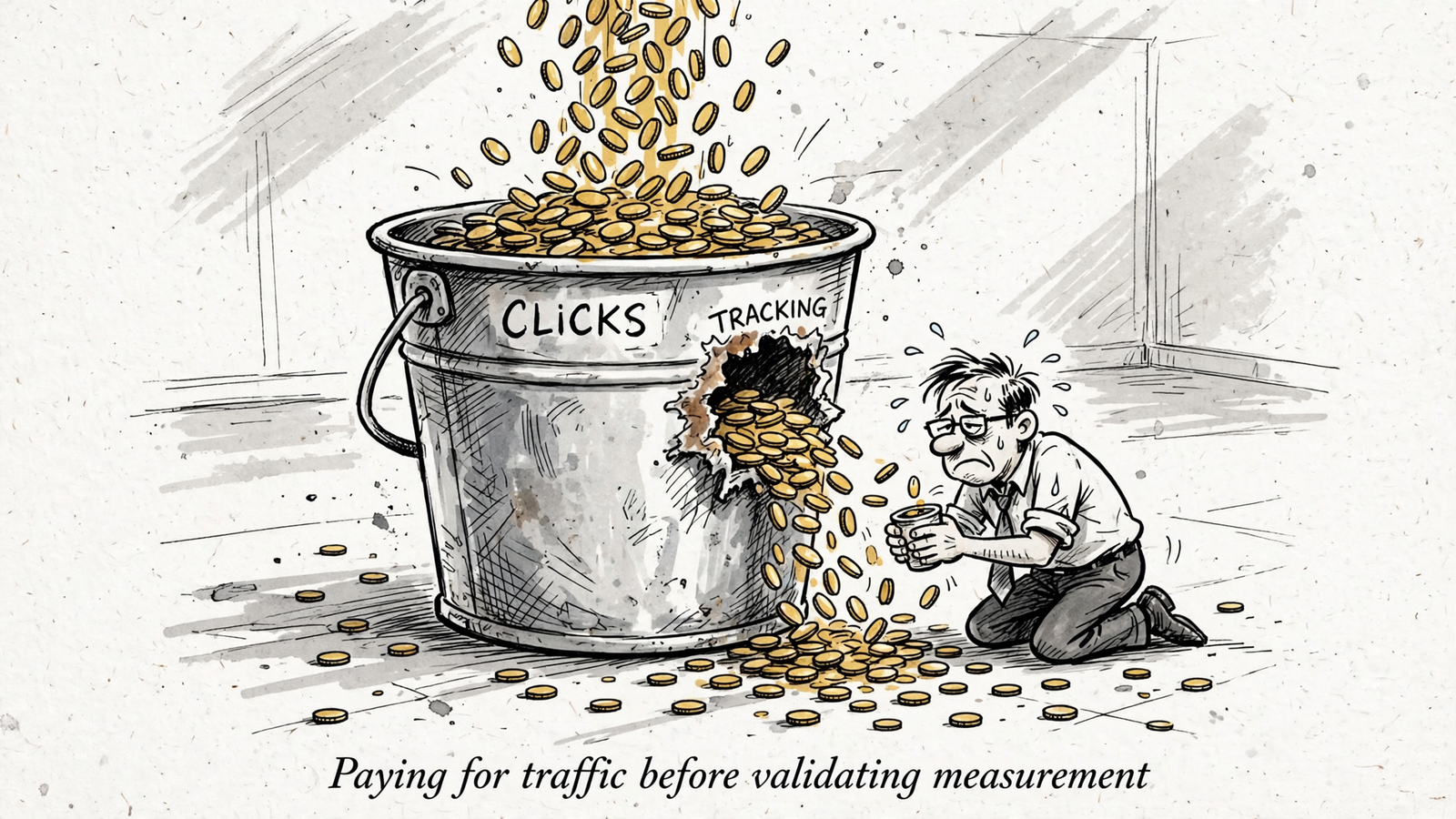
Before adding a tracking allowance, ask what management already includes. The expensive version of setup is paying the retainer, then paying a freelancer to do the same job.
Get ownership of these tasks in writing:
- Creating the conversion data source and mapping events.
- Implementing the Pixel and/or Conversions API.
- Deduplicating events when both send the same conversion.
- Preserving the click reference through redirects.
- Checking the landing page and downstream conversion path.
OpenAI’s conversion-measurement documentation describes Pixel and/or Conversions API implementation, matching event IDs for deduplication, and the oppref click reference. A redirect that strips the reference can leave you paying for traffic without a dependable account of what follows.
Price genuine extras, not duplicate setup. If your CRM needs a new integration or your site strips query parameters, client-side development belongs on this line. The table allows $0 to $600 as an illustration, not a promise about what your site will require.
If pixel placement, event mapping and landing-page checks are already covered, enter $0 for that work. If they are not, get the scope and price before launch. “Tracking included” is not specific enough to settle the invoice—or the CPA.
Line 3: the work that stays on your desk
Done-for-you management does not remove the business from the experiment. Someone still has to qualify leads, follow up, approve ads and pages, and explain the results internally.
At the cited $3 to $5 CPC range, $3,000 buys 600 to 1,000 clicks. For this ledger, suppose 750 clicks produce 30 raw leads at a 4% conversion rate. That is an assumption for the calculation, not a forecast.
Somebody must call those 30 people, mark the duds, move the good ones to sales and sit in the meeting where finance asks what ChatGPT Ads did. groas does not do that part of the business’s job.
I would price it in four buckets:
| Internal task | Illustrative input | Cost basis |
|---|---|---|
| Lead qualification | 4 hours | $45 an hour |
| Approvals and feedback | 3 hours | $120 an hour |
| CRM hygiene and reporting | 2 hours | $60 an hour |
| Sales follow-up | 1 hour per qualified meeting | Your actual hourly cost |
Use recorded hours, not a percentage of media spend. The first three lines do not finish the labor bill; follow-up depends on how many qualified meetings the test produces and who handles them.
The $800 to $1,800 allowance in the opening ledger is there to make that work visible. Replace it. If your actual number looks uncomfortable, that is useful: the media line was hiding work the business still has to fund.
Line 4: validation clicks belong inside the media budget
The cheapest insurance is checking the conversion path before reading efficiency into the dashboard.
I would use the first two days of traffic to validate the setup, not to declare an auction winner. Those clicks belong inside the $3,000 media budget. They are not a fifth cost line quietly added underneath it.
The checks are straightforward:
- Confirm that the intended conversion event fires.
- If Pixel and Conversions API both report it, confirm deduplication works.
- Check that
opprefsurvives the redirect path. - Follow the conversion into the system where the business qualifies it.
No validated conversion path, no verdict on CPA. A dashboard can display a precise number while the underlying measurement is broken. Precision is not the same thing as an answer.
An agency that runs the channel without owning these checks optimizes against numbers it cannot vouch for. That is why I want responsibility assigned before launch, not after the first report looks strange.
Line 5: waiting changes the verdict, not the first-month invoice
A B2B test can look expensive in week three because the sales process is slow, not because the channel has failed. Thirty raw leads are not 30 opportunities, and they certainly are not 30 customers.
Keep the cohorts separate. Leads from week one have had longer to qualify than leads from week four. Putting them in the same month-end revenue column does not give them equal time to produce an outcome.
I would set the review schedule before launch:
- At 30 days: report spend, raw leads and cash cost per lead. Check whether the data is trustworthy.
- At 45 to 60 days: review qualification and opportunity outcomes, allowing for the business’s sales cycle.
- As deals mature: calculate customer acquisition cost and compare it with contribution.
Those are review points, not promises that every business gets a conclusive answer on the same day. A small cohort may still be inconclusive.
Waiting does not automatically add another month of media. Continuing to buy traffic or retain paid management does add cost, and that belongs in the next ledger. Continued qualification work also needs recording. Do not pretend the first-month total pays for an open-ended experiment.
Keep hypothetical foregone profit from other channels in a note beside the comparison, not inside ChatGPT’s acquisition cost. Loading a what-if $2,000 of Google profit into ChatGPT CPA makes both channels harder to read.
Price the work of waiting; do not invent a waiting surcharge.
The final ledger: the same leads, three different costs
Now run the same illustrative 30 raw leads through the calculation. Assume one eventually becomes an opportunity. That is a scenario for testing the economics, not a benchmark.
| View | Included costs | Test cost | Cost per raw lead | Cost per opportunity |
|---|---|---|---|---|
| Media only | $3,000 media | $3,000 | $100 | $3,000 |
| New, standalone engagement | Media + $1,499 management + $1,200 labor + $300 tracking | $5,999 | About $200 | $5,999 |
| Existing client, incremental test | Media + $1,200 labor + the same $300 tracking | $4,500 | $150 | $4,500 |
The tracking cost stays in both loaded examples because the work is the same. If no extra tracking work is needed, remove it from both. Do not improve the incremental case by quietly dropping a cost that still exists.
I cover the same distinction in how many customers cover a $1,000 media test and the allocated-cost math for a managed test.
Each view answers a different question:
- Media-only qualified acquisition cost: can the traffic economics work before operating costs?
- Loaded qualified acquisition cost: can the business afford to generate and work these opportunities?
- Eventual customer acquisition cost: does the channel justify scaling after close rates and sales cycles play out?
Set the stop rule before launch. Media-only economics must leave room for management, labor and the close rate while still clearing break-even contribution.
For example, a roughly $6,000 opportunity cost with a 25% close rate implies a roughly $24,000 customer acquisition cost. A $40,000 deal at 60% margin produces $24,000 of contribution: that only breaks even against acquisition cost, with no room left for other costs. On an $8,000 deal, the same acquisition cost does not work.
No amount of bid tuning fixes that arithmetic.
What the fee buys—and what it does not
The $1,499 buys management, not clicks or guaranteed outcomes. Media stays separate. Lead qualification still belongs to the business. Neither disappears because the proposal says done for you.
The category’s contract details deserve the same scrutiny as its headline price. One competing seller states its lack of a ROAS guarantee plainly. Other buying risks include whose ad account holds the media and whether the agreement locks you in for 12 months. A long commitment gives the seller certainty. It does not make a young channel easier to evaluate.
For this ledger, groas makes the management cost straightforward: $1,499 a month, media separate, with month-to-month cancellation. A new buyer planning $3,000 in clicks starts at $4,499 in media and management, then adds actual internal work and any genuine tracking extras. An existing client adds the media and new work without inventing another management charge.
Anyone quoting one blended number without showing that distinction is hiding the decision inside the invoice.
Approve the addition on its incremental cost. Judge the channel’s economics on the loaded cost relevant to the buying decision. Then let the leads mature before pretending you know customer acquisition cost.
The cheapest mistake is burning $300 of validation clicks to discover a stripped redirect. The most expensive is calling the test a failure at day 30 because an immature cohort has not closed. Find the broken path cheaply. Do not buy a month of learning and throw it away before the answer arrives.