

 LinkedIn

A faster dashboard is not faster management. Your screen can refresh every 30 minutes while nothing in the account changes for 30 days, and you still get billed for management.
Take Optmyzr’s sale-season guide. It describes a Sale Day Command Center that pulls Google, Microsoft, Amazon, and Meta into one view, supports portfolios, and refreshes every 30 minutes so you can see pacing without switching accounts. Useful monitoring. Not someone writing a replacement ad, fixing your pixel, or moving budget off a loser.
I used to sell reporting as reassurance early in my career. I was wrong. Owners who have survived a bad agency retainer know why: seeing the problem is not the same service as owning the fix.
Your dashboard refreshed. What actually changed?
Optmyzr describes a monitoring tool. The trouble starts when an agency presents that visibility as evidence of management.
The guide lists six sale-day problems monitoring can surface:
- Spend pacing too fast or too slowly.
- Hour-by-hour surges or dips versus last year.
- Performance anomalies.
- Disapproved or out-of-stock products draining ROAS.
- Today’s winners versus a 30-day baseline.
- Sessions rising while sales stay flat.
Every item starts with an observation. None of them, by itself, produces new creative, fixes a feed, repairs checkout, or shifts budget with a steady hand. Sessions rising while sales stay flat gives someone a reason to investigate the site. It does not diagnose the fault, much less repair it.
That distinction is the whole purchase. Monitoring tells you something moved. Management decides whether that movement deserves a change, makes the change inside defined guardrails, and owns what happens afterward to qualified leads, sales, or acquisition cost.
When you pay for Facebook and Instagram management with creative testing and monthly reporting, you are buying the second job. A 30-minute refresh only speeds up the first one. Ask what happened after the alert.
A faster alarm does not justify faster edits
Watching Meta on a 30-minute feed during a sale feels like control. It can also become a very efficient way to talk yourself into breaking something that was working.
The weekly Meta optimization routine separates main budget and creative decisions, made on seven-day data, from a daily five-minute scan for emergencies: broken tracking, a rejected ad, or a spend spike. That separation matters. Significant edits can disrupt learning, while a daily CPA swing can tempt you to react before you have enough evidence.
A refresh interval is not a decision interval. Just because the dashboard has new numbers does not mean the account needs a new instruction.
I treat a fast dashboard as an alarm, not a steering wheel. It helps catch a disapproved ad at 9 a.m. on Black Friday. It helps spot pacing trouble. It helps you notice sessions climbing while sales stay flat, so someone investigates the site instead of automatically blaming the media buyer.
But the correct response to noisy 30-minute data is often to do nothing—and record why. That is not neglect. It is a decision with a reason and a review point.
A provider should be able to show that discipline. Otherwise, the dashboard becomes an excuse to spend your budget demonstrating how busy they are. Ask for the reason behind an edit, not just the timestamp.
Creative testing requires production, not a fatigue alert
Spotting a tired ad takes ten seconds. Replacing it takes a production system. That is what you are actually shopping for.
A testing service has three jobs a dashboard does not perform:
- Produce replacement creative, rather than merely flagging the old ad.
- Define the test before spend starts.
- Control the budget while the test runs.
The weekly routine includes incremental budget moves and a written record to review the following Monday. The record is the part I care about here: what changed, why it changed, and what the next review needs to establish. Without that, you have opinions with a refresh button.
Ask an agency how many new concepts it ships each month, who supplies raw video, and whether editing is included. Those three answers tell you more about delivery than another polished case study.
For calibration, a Motion benchmark covering 6,015 Meta accounts found that accounts spending under $10,000 a month averaged about 2.8 new ads a week. Accounts spending $10,000–$50,000 averaged 4.1; those spending $50,000–$200,000 averaged 6.6. Those counts included variations, and the measurement window included holiday testing.
Do not turn those averages into a quota for original concepts. The distinction between a new concept and another variation is exactly what the sales conversation needs to expose. If a provider promises testing but ships two resized headlines a month and calls it iteration, stop mistaking visibility for delivery.
There is another trap before production even starts: assuming the loss is in the ad.
I have watched owners approve rounds of new UGC because CTR slipped when tracking also needed attention. A pixel-only setup can miss conversions. Adding the Conversions API alongside the pixel, with shared event_id deduplication, addresses signal collection; the cited vendor benchmarks report 8–19% more attributed conversions.
Attributed is the word to watch. A reporting change is not automatically a sales change. That is why I want a Pixel and Conversions API audit before a service starts replacing ads based on reported performance alone.
You should own the ad account, pixel, and dataset. The agency works inside them. If it cannot separate a creative hypothesis from signal loss or a landing-page problem, the test will not tell you what you think it tells you. Check the signal before buying another batch of creative.
Demand four links in the accountability chain
If a provider cannot show you the chain, you did not buy management. You bought a login.
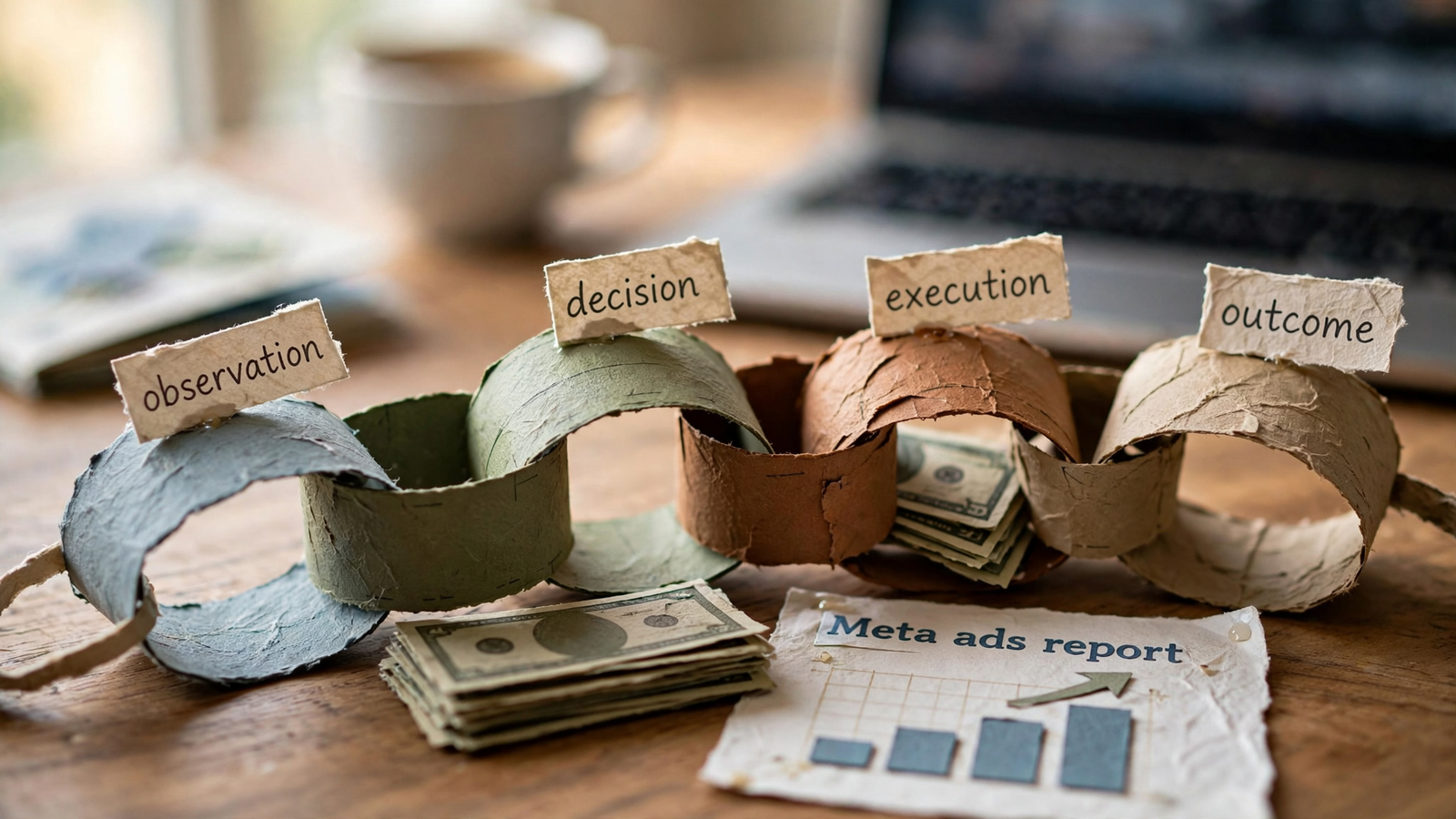
I ask for four links. Not four dashboard tabs. Four connected records that explain how an observation became a decision and what followed.
1. Observation: what moved, over which window?
“CTR dipped this morning” is not enough. An illustrative observation would be: CTR fell 34% over the last seven days versus the previous seven, while frequency rose from 2.1 to 3.4.
The point is not those particular numbers. It is the dates, baseline, and context. An observation needs a window before it deserves a response. Make the provider show the comparison it used.
2. Decision: act, investigate, or deliberately wait?
The reason belongs in writing. Waiting is valid when the data is thin. Investigating tracking is valid when the signal looks unreliable. Neither requires an immediate budget edit to look productive.
“No change” is a decision only when it comes with a reason and a review point. Otherwise, it is indistinguishable from nobody looking.
3. Execution: what changed, and who owned it?
The record should be concrete. For example: budget moved 20% from ad set B to ad set A. Creative C launched with a $40 daily test cap. A tracking fix shipped with event_id deduplication.
These are examples of entries, not instructions to copy into your account. What matters is that the change has an owner and defined guardrails. A recommendation sitting in a report is not execution. Ask what actually shipped.
4. Outcome: what happened to the business number?
After the change has had time to settle, the review should return to qualified leads, sales, or acquisition cost. Not stop at the metric that made the original alert look dramatic.
Close the loop on the outcome, not the activity. Without that fourth link, a provider can list plenty of work without showing whether it helped.
That missing chain is where retainers fall apart. I have sat through monthly calls where ROAS looked fine while orders did not move. I wrote about that trap in Meta ROAS Can Rise Without More Orders. Make Your Agency Explain Why.
The fix is boring: tie the observation to a decision, the decision to an owner, and the work to a downstream number. Boring is fine. Unaccountable is expensive.
The same boundary applies to automation. In “Set It and Forget It” PPC: What Genuinely Runs Unattended, I separate work that runs without a human from the things that still need one. An automated observation does not remove the need for ownership. Neither does an automated action.
Buy the action record, and accept what it costs
Stop shopping for refresh speed. Ask to see one real week of management: what was observed, what was decided, what shipped, who owned it, and what happened to cost per qualified lead or cost per acquisition.
If the sample shows three budget moves inside learning on 48 hours of data and zero creative shipped, you have your answer. Constant intervention is not management. Logged judgment is. Sometimes the best entry reads: “No change. Data too thin. Recheck Monday.”
That standard costs more effort than accepting a monthly PDF. Someone has to produce the creative. Someone has to control the test budget, investigate the signal, and follow the result through. You also have to tolerate a provider who explains why it is waiting instead of performing urgency for your benefit.
When an agency says creative testing and monthly reporting are included, do not accept “yes” as the scope. I want these answers before I buy:
- Ownership: Do I retain the ad account, pixel, and dataset?
- Production: How many new creative concepts ship each month? Who supplies raw video? Is editing included?
- Measurement: Does the work start with a Pixel and Conversions API audit?
- Accountability: Can I see the observation, decision, execution, and outcome for a real week?
- Business results: Is the service judged on enquiries, bookings, or sales—not reach or impressions alone?
Agency-owned accounts and reports that celebrate reach and likes are red flags. This checklist sounds basic because it is basic. A service that cannot answer it has no business charging you for accountable management.
I hold groas to the same standard. I write here; I still want the receipt. Its approach pairs continuous execution by specialized models with a named strategist setting direction and guardrails, plus action logs showing what changed and why.
That is the distinction I care about: execution with strategic ownership, not another layer of monitoring handed back to the client. The log is the evidence. I want to see the reasoning, the action, and the outcome—not accept “autonomous” as a substitute for accountability.
The same gap appears in organic search. I broke it down in AI Visibility Tools vs. Agencies vs. Done-for-You: Who Actually Ships the Fix? Seeing a missing citation is not earning one. Seeing pacing drift on a 30-minute feed is not fixing the budget, creative, or tracking underneath it.
Buy the chain from observation to decision to execution to outcome. The feed is useful only if somebody owns what follows.
Keep the dashboard. I keep fast views open during sales too, because catching a pacing problem at 10 a.m. beats catching it in Monday’s report. But a view is not a vendor. If nobody produced creative, controlled the test budget, fixed the signal, or logged why they waited, you paid for observation and called it management.
Ignore that distinction and the pattern repeats: another year of polished monthly PDFs, another tired ad left running, another tracking problem left unresolved, another call where reach looks healthy and bookings do not move.
Buy the chain instead. Observation with a window. Decision with a reason. Execution with an owner. Outcome in leads, sales, or acquisition cost. Anything less is a 30-minute refresh on a service that never started.


