

 LinkedIn

Your client’s website can supply the answer while a competitor gets the call. That is the distinction I want settled before an agency buys white-label AI search.
Say your agency looks after a garage door company in Denver. Someone asks ChatGPT who to call for a same-day spring replacement. The answer pulls a line from your client’s pricing page, links to it, then recommends Company A and Company B. Your client was cited. Your client was not recommended.
The reverse happens too: an answer can recommend a business while citing someone else’s website. A citation credits a source. A recommendation puts a business on the buyer’s shortlist. Those are separate outcomes, and buying one does not mean buying the other.
First, separate the source from the shortlist
I use three labels throughout this piece:
- Citation: the answer links your client’s page as a source.
- Brand mention: the answer names your client in the text.
- Recommendation: the answer presents your client as suitable for that buyer.
A mention is not automatically an endorsement. A citation does not require a mention. And a recommendation does not require a link to the recommended business.
In one large measurement set, 74.9% of appearances had a citation link, 38.3% had a brand mention, and only 13.2% had both. Citation-only appearances accounted for 61.7% of cases: what the researchers called ghost citations. The page was linked; the brand was never named.
For the Denver client, a clear explanation of spring types can supply useful information. Choosing a contractor is a different task. The buyer needs to know whether this company does same-day work in Denver, answers the phone, and has other sources backing its claims.
A single AI visibility score hides that distinction. Add footnotes and shortlist places together, and the report celebrates the Denver answer as a win even when the buyer calls someone else.
Report citations, mentions, and recommendations separately. Otherwise, you cannot tell which outcome the work produces.
Access comes before selection
For the Denver client’s page to be cited, it has to be reachable, readable, and retrievable. Start there, not with a new content calendar.
The crawlers are not interchangeable. PerplexityBot respects robots.txt, but its follow-up fetcher generally needs separate firewall rules; ChatGPT search inclusion runs through OAI-SearchBot, separate from its training crawler; and Google AI Overviews requires a page to be indexed and eligible for a snippet, with no separate AI crawler to allow.
Free tool: the AI Crawler Checker shows which AI crawlers your robots.txt lets in and what they receive when they arrive.
I used to tell clients that blocking AI crawlers in robots.txt was enough to keep content out of answers. I was wrong. Block the wrong bot and you can block training while leaving live answers untouched, or the reverse.
For our garage door company, the first question is therefore mundane: can the relevant fetcher read the service and pricing pages? A beautifully written spring-replacement page does nothing for retrieval if the firewall turns the fetcher away.
Check access for the engine you want to appear in. “AI crawlers allowed” is not a complete technical brief.
Being retrieved does not mean being used
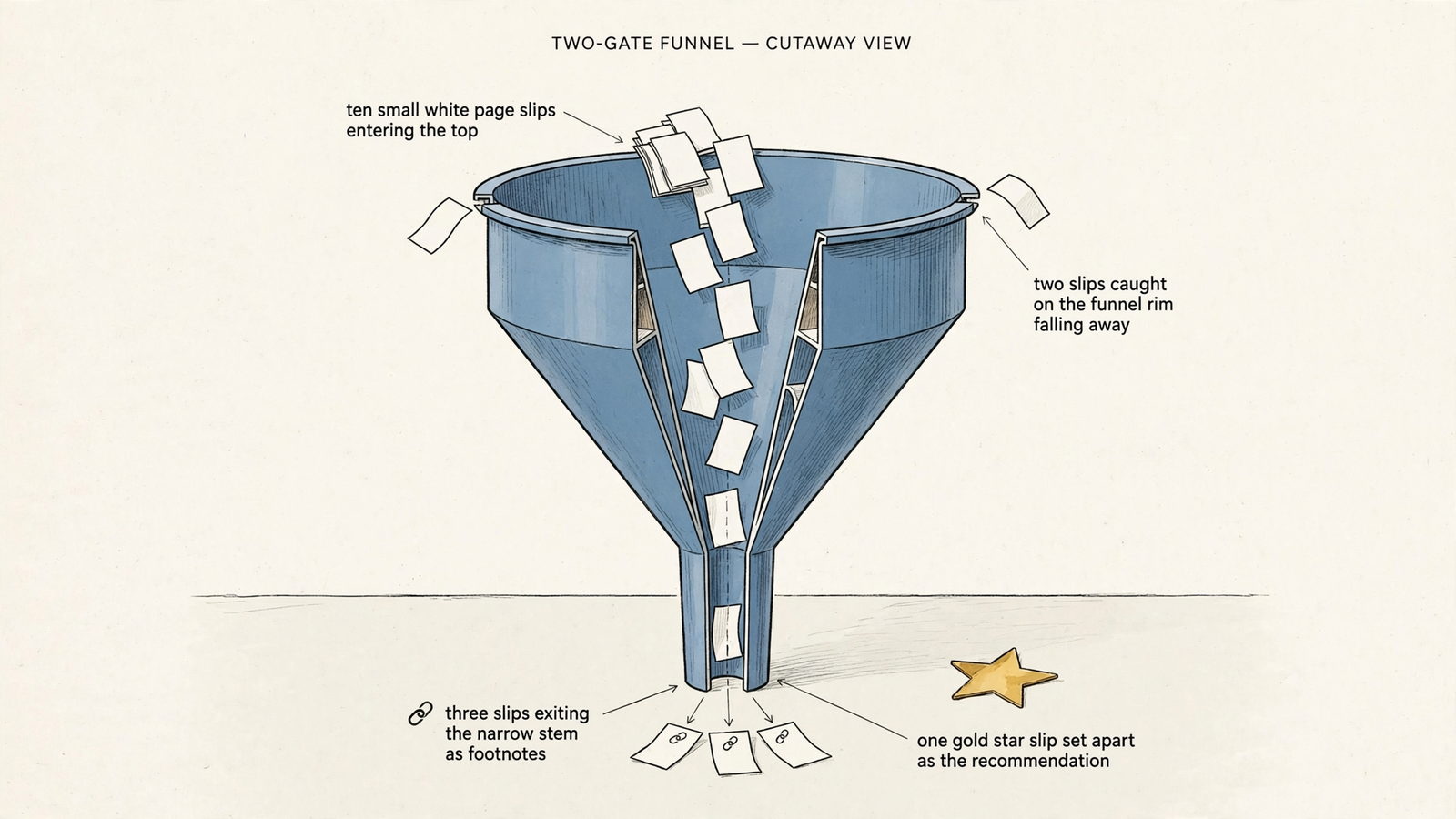
Once access works, there is another selection problem. Think of retrieval as a two-gate funnel: the engine pulls candidate pages that match the question, then uses only some of them. The analogy stops there. It describes page selection, not a guaranteed route from page to recommendation.
In one dataset, ChatGPT cited roughly 15% of the pages it retrieved, and 44.2% of its citations came from the first 30% of the cited text. Perplexity shows similar thinning: across 2,044 answers, it read a median of 10 pages per answer but gave a numbered citation to a median of 3. Its answers had a median length of 54 words and named 2 companies.
For the Denver client, ten garage door pages can be read for one question while three become footnotes and one or two businesses become names. Being read is not being used. Being used as a source is not being chosen as a supplier.
Google rankings do not settle this either. In one measurement set, 25% of the top ChatGPT-cited URLs had zero Google organic visibility. A Google ranking is neither required nor sufficient for the cut.
Nor do engines make the same selection. In the same research, ChatGPT linked sources in 87% of appearances but named the brand in only 20.7%, while Gemini named the brand in 83.7% but linked sources in only 21.4%. Google AI Overviews sat between them, citing often and naming often.
That is a measured pattern, not a permanent personality for each product. But it explains why the same Denver page can appear as a quiet footnote in one engine and a named option in another, without the page changing.
Keep engines separate in the report. Blending them hides the pattern that tells you what to investigate.
A useful explanation is not yet a useful recommendation
The next layer is the buyer’s question. A page explaining torsion springs helps answer “What is the problem?” A buyer asking “Who can fix it today?” needs different information.
For the Denver client, that means answering:
- Does the company offer same-day spring replacement in Denver?
- What does it cost?
- Which doors does it not service?
- Who else should the buyer consider?
That last question makes some agencies uncomfortable. But honest alternatives and limits help resolve a specific choice. “Best at everything” does not. This is the split I described before about cited pages that lose the supplier pick: useful for the definition, unusable for the decision.
The client’s own site is only part of that decision. In one set of 21,311 brand mentions, 85% came from third-party pages, not the brand domain. Brand search volume also correlated with mentions more strongly than backlinks did.
Tom Capper’s Audi example shows the reporting consequence: an AI answer recommended Audi while citing other websites. A domain-citation report would miss the recommendation entirely.
For the garage door client, the local review profile, Better Business Bureau listing, and Reddit discussion about who actually shows up on Sundays provide a different kind of evidence from another explanation of spring mechanics.
Treat decision-ready service pages and third-party corroboration as different jobs. A fifth informational post does not do both.
Buy inputs the partner can control
A good white-label partner controls inputs, not answers. For the Denver client, the work includes:
- Publishing service pages with plain facts: service area, hours, same-day policy, and price ranges.
- Removing technical barriers that stop fetchers reading those pages.
- Using structured data to state those facts in machine-readable form.
- Working on reviews and listings so other sites can corroborate the claims.
Comparative questions belong in that work. In the measurement set, comparative queries drew 2.4 times the mentions of informational queries. That is why decision-focused content looks like the pages I examined in the rival-naming piece: built to resolve a choice, not just define a term.
The agency still owns client facts, approvals, and positioning. No fulfillment partner can decide whether same-day really means same-day, whether the $189 spring job covers double-car doors, or whether the client answers after 5pm. Those details need confirmation, not persuasive copywriting.
Neither party controls the engine. In one comparison, when Perplexity and ChatGPT both cited sources for the same question on the same day, only 15.4% of Perplexity’s cited domains were also cited by ChatGPT. Same question, same day, different sources.
Buy fulfillment you can audit in the CMS and server logs, not a promise about next month’s answers.
Measure repeated buying questions, not a Tuesday screenshot
The person approving the purchase needs more than a visibility score. I want the report to show what was measured, how often the client appeared, and what the result has to do with inquiries.
Start with a fixed panel of realistic buying questions. One agency protocol uses mention, recommendation, and linked citation as independent labels, tests about 24 buying questions with three observations per question per week in fresh conversations, and logs prompt, timestamp, engine, location, and whether search was used.
For Denver, a panel of 20 to 30 prompts might include:
- Same-day garage door spring replacement Denver
- How much does torsion spring replacement cost in Denver?
- Best-reviewed garage door company near Capitol Hill
The questions represent different jobs: choosing someone now, understanding cost, and comparing providers. Keep the panel and collection context fixed so a changed result is not simply a changed test.
The reporting sequence is straightforward:
- Repeat the same buying questions in fresh conversations on each engine.
- Record the prompt, timestamp, location, engine, and whether search was used.
- Label citations, mentions, and recommendations independently.
- Report how often each occurs across repeated observations, including misses.
- Put those observations alongside inquiries and customer feedback, without claiming they prove more than they do.
Capper recommends the same underlying discipline: sample realistic questions with personas, budgets, and locations, hold the sample and collection context steady, and report visibility alongside revenue and post-purchase surveys.
Then disclose how jumpy the answers are. Across 1,636 answers to 39 buying questions over 14 days, ChatGPT repeated the identical list on only 2.9% of consecutive-day pairs, Perplexity on 20.3%, and AI Overviews on 5.8%. The average question surfaced more than 15 different names over the fortnight.
A single screenshot on a Tuesday cannot establish a pattern. Show movement over weeks, show failures, and never call your test panel’s share of appearances market share.
Attribution needs the same restraint. An AI recommendation can lead to a branded search or an offline call without a link to click. Ask new callers what they asked and where, then keep that feedback next to the citation log.
If a vendor will not show misses and day-to-day movement, you are buying a chart, not evidence of fulfillment.
Where groas fits—and where its control ends
groas does the implementation under your brand. It is not another dashboard that flags missing schema and leaves your junior to publish it.
The pages get written and shipped. Technical access gets fixed. Listings and the review footprint get worked on. The report separates citations, mentions, and recommendations by engine and prompt. If the requirement is pages live and fetchable without adding headcount, that is the job white label is supposed to cover.
It is also the distinction to use when comparing offers. One white-label GEO launch package lists $1,497 a month for an audit, schema, LLMs.txt, one content asset, and a white-label report, with higher tiers at $2,997 and $4,997. groas puts the emphasis on implementation rather than leaving the agency to turn findings into shipped work.
groas prices at $299 per client account per service, with a five-account-service minimum. Do the floor math before pitching it: five units comes to $1,495 a month before your markup. That is a minimum commitment, not a $299 total bill.
This will not fit everyone. Agencies with one client and no publishing access should skip it. And because no vendor controls the final answer, there are no guaranteed rankings, citations, recommendations, or leads. Anyone guaranteeing a shortlist place is selling something engines do not sell.
The purchase is implementation with accountable reporting, not ownership of the answer.
Run a new client through the same model
Now take an implant clinic in Austin. The business changes; the reasoning does not.
- Access: Can fetchers read the implant, pricing, and financing pages without firewall blocks? If not, fix that before treating content as the bottleneck.
- Usefulness: Do those pages explain what the clinic does, what it does not do, what it costs, and who it fits? Another definition of an implant answers a different question from “Which clinic should I choose?”
- Corroboration: Do review profiles and local directories confirm that the clinic does implants in Austin? The earlier finding that 85% of mentions came from third-party pages is a reason to examine off-site evidence, not just the clinic’s copy.
- Proof: Check the same 20 Austin buying prompts weekly. Count citations, mentions, and recommendations separately. Show the misses as well as the appearances.
If the clinic’s pricing page earns citations but the clinic never makes the shortlist, the work is not finished. If the clinic gets recommended while other websites receive the citations, a domain-only report misses the win. The distinction from Denver still holds.
Your agency owns the facts and approvals. groas owns the shipping. The engine owns the answer. Once that split is clear, the purchase stops sounding like magic and starts sounding like work you can defend.


