

 LinkedIn

Your agency took Meta ROAS from 2.8 to 4.1. I would vote no on the renewal anyway.
I have watched that slide earn an agency another six months. Spend a little lower, retargeting a little heavier, attribution set to include view-through conversions. Reported revenue per dollar climbs. New-customer revenue does not. A higher ratio can mean the account got better at claiming sales it did not create. That is why I never renew on ROAS alone, and why finance should not either.
Free tool: the ROAS Calculator works out your return on ad spend, your break-even ROAS and the budget a revenue goal takes.
ROAS Grades the Agency on Meta’s Scoreboard
Reported ROAS answers one narrow question: how much revenue Meta claimed for every dollar you gave it. Under Meta’s 7-day click + 1-day view attribution window, a purchase can count if someone clicked an ad in the last seven days or saw one in the last day without clicking. I used to report that number like it was revenue created by the ads. I was wrong. It tells you what the platform attributed, not what the ads caused.
A returning customer can see your Instagram ad while scrolling, ignore it, Google you the next morning, and check out. Meta can still claim the purchase. Google may claim it too. Neither claim tells you whether the customer would have bought without the ad. Add those platform totals together and you can end up with more claimed revenue than the store actually recorded. That is not a second customer hiding in the spreadsheet. It is two scoreboards taking credit for the same order.
The distinction matters most at renewal time. During a campaign, reported ROAS can help an operator spot a change worth investigating. At renewal, the question is different: did the agency add business worth paying it to pursue? If the case for another six months starts and ends with the ROAS column, you are letting the agency choose its own exam. Ask what changed in the store before you admire what changed in Ads Manager.
Three Ways to Raise the Ratio Without Adding Buyers
The easiest move is to chase people who already know you. Shift budget into retargeting past visitors, past add-to-carts, and 180-day engagers. The reported ratio can climb quickly because those people arrived with intent before the ad followed them around. I have made that move for a home services client back when I billed by the hour. Click-through looked great. Cost per purchase dropped. My report looked like skill. It was selection. Retargeting reports observed sales, not necessarily caused sales.
Next, cut prospecting. Broad and interest testing spend money reaching strangers, including plenty who will not buy. Pause that work, keep the warm pool, and the harder conversions disappear from the denominator. Say you were spending $20k a month at 2.9x, with $8k going to cold audiences. Kill the $8k and keep $12k on warm. Reported revenue falls from $58k to $48k, but reported ROAS climbs to 4.0x. The agency slide gets an arrow up. The business has less reported revenue and has stopped paying to find the next pool of customers. A higher ratio bought by abandoning new reach is contraction dressed as efficiency.
Then there is the quietest move: change the ruler. In one attribution-window comparison, the same $5,000 of spend at a $90 average order value reports 1.71x on 1-day click, 2.30x on 7-day click, and 3.06x on 7-day click plus 1-day view. The sales did not change between those calculations. The counting did. If an agency changes the window between renewal reports without putting the old and new settings side by side, its ROAS trend is not a clean comparison.
These are not three unrelated tricks. Retargeting selects easier buyers. Cutting prospecting removes harder ones. A broader attribution window claims more of the purchases that remain. Put them together and the report can improve while the work of adding customers gets thinner. Before I accept a rising ratio, I want the agency to show which audiences got the money, which window produced the number, and what happened to first orders. That is the mechanism behind the arrow.
The Best Defense of ROAS Still Is Not a Renewal Case
I am not saying ROAS is useless. It tells you something about how much reported revenue a dollar of spend brings back, and efficiency matters when margin is thin. If you net $30 on a $90 order after product, shipping, and refunds, you cannot keep paying $45 in ads to acquire that order. A 2.0x revenue-to-ad-spend ratio does not rescue the economics. You need an efficiency limit before you scale. Ignore it and you can buy sales that lose money.
But the highest ratio does not automatically deliver the most business. In one comparison of 16 campaigns, a $250-a-day setup at 5.27 ROAS drove $19,982 in reported revenue on 480 purchases. A $100-a-day setup at 7.00 ROAS drove $4,968 on 122 purchases. The higher-spend setup had the worse-looking ratio and far more reported revenue. That comparison does not, by itself, prove which setup produced more profit or incremental customers. It proves the narrower point a renewal deck often skips: picking the highest ROAS can mean picking the smaller result.
The first dollars can reach buyers who are easiest to convert. The next dollars may have to reach people who need more persuasion. That does not make every lower-ROAS expansion smart. It makes a ratio-only decision lazy. Set the economics the business can afford, then ask whether spending beyond the easy audience brings in customers who would not otherwise have bought. ROAS is a constraint on the decision, not the decision.

Make the Agency Prove What the Store Gained
First, reconcile the platforms with the till. Put Meta-attributed revenue, Google-attributed revenue, and net store sales after refunds and cancellations side by side for the same period. In one illustrative month, Shopify has $50k in net sales while Meta claims $38k and Google claims $22k: $60k claimed across platforms on $12k of spend. That is 120% of the store’s net sales. The totals are not interchangeable. Platforms can credit the same order, while a net-sales figure also reflects refunds. A platform-to-store gap is a reconciliation job, not a growth claim. If it widens past 30%, I want the agency to explain the change before it asks me to celebrate.
Second, separate new money from repeat money. Suppose a 4.0x blended ROAS report attributes 70% of its revenue to returning buyers. The remaining 30% represents revenue equal to about 1.2 times total ad spend. That is not new-customer ROAS; you would need to allocate spend to calculate that. It does tell you how little of the headline is attached to first orders. Ask for new-customer revenue using your store’s first-order flag, not just Meta’s definition of a new customer. Repeat purchases matter. They do not answer whether the agency added buyers to the customer file. Selling more to people already on your email list is not proof your acquisition program improved.
Third, demand a holdout, not a deck. A lift test holds back a control group from Meta ads, then compares its results with an exposed group. Incremental ROAS uses the revenue difference between treatment and scaled control, divided by spend. The distinction can be brutal in a useful way. In a synthetic example, $10k in spend reports 7.0x, or $70k claimed, but the comparison with a control group finds only $15k in lift. That is 1.5x incremental ROAS, not 7.0x. The platform counted purchases; the test asks how many purchases the ads added.
If the agency proposes a holdout to verify its claims, make it scope a test where there is enough volume to read it. Keep the offer and window consistent, use a clean geo or audience split, and agree that new-customer revenue is the scoreboard before results arrive. Otherwise the post-test argument becomes another meeting about which number deserves the largest font.

I used to tell clients a holdout was overkill for their size. I was wrong about when the question matters. A small account may not support a conclusive test, and a rough geo split will not turn noisy data into certainty. But an agency should still be willing to say what it can test, what it cannot, and what evidence it has instead. Without a credible comparison, a claimed sale remains a claimed sale. It is not proof the ad added a buyer.
The Renewal Memo: Contribution, Not Presentation
Here is the one-page memo I would put in front of finance instead of the ROAS chart. The agency has to earn its box:
- Continue: Net store revenue and new-customer revenue rose, and a readable holdout showed lift. The agency can explain what it spent to get there.
- Investigate: Blended ROAS rose, but new-customer share fell or the platform-to-store gap widened past 30%. Reconcile the numbers before calling it growth.
- Reduce: The ratio improved because spend shrank, prospecting stopped, or an attribution-window change did the work. Do not pay for another quarter of the same move.
Finance does not need a lecture on attribution. Finance needs to know which box the last quarter belongs in, and why. The memo forces the agency to connect its choices to the store rather than narrate a chart. It also makes a difficult result discussable: an agency can miss a ROAS target while doing useful acquisition work, or hit one while quietly giving up on it. Those are different performances. A single platform ratio makes them look like the same question.
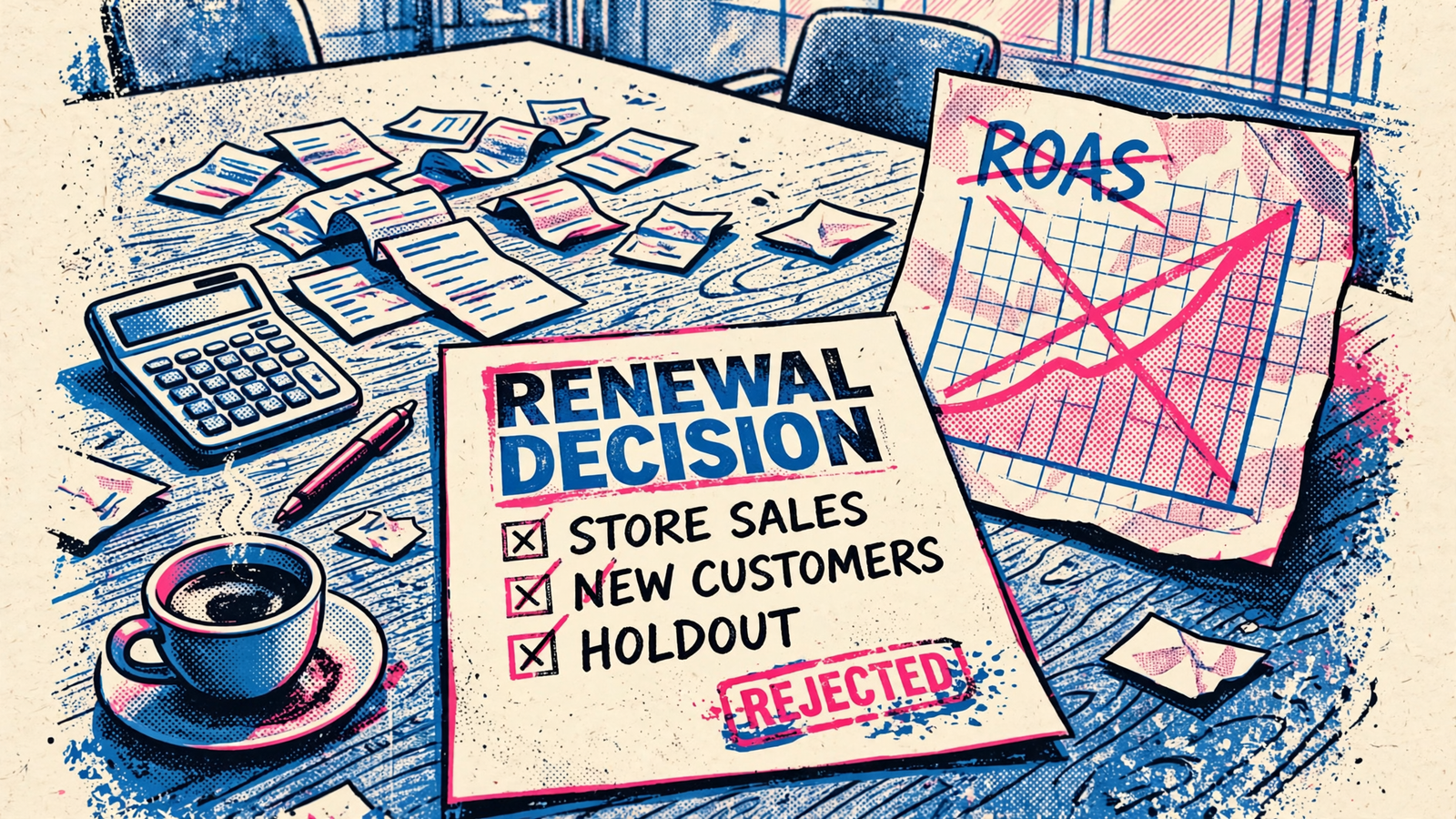
Most agencies I have fired would have passed their own report and failed that memo. The pattern behind rising ROAS and stalled new-customer growth is familiar: narrower audiences, heavier retargeting, friendlier counting. That is why I tell owners not to make improving ROAS the job description. Hire an operator to add buyers you would not otherwise have had. If the agency cannot connect its report to store orders, first-order flags, and a credible comparison, the prettier ratio is packaging.
The billing model can make that packaging harder to challenge. On a percentage-of-spend fee, the agency earns more as you spend more, then may defend the account with a ratio that looks better when it concentrates on easier buyers. Those incentives do not fit neatly together. I billed that way for years. It paid me to be busy once a month and persuasive in the deck. What the deck called optimization, I now call timing the report to the retargeting pool.
I work inside a different setup now. groas runs Meta Ads for a flat $1,499 a month regardless of spend, with no cut of spend or setup fee. Changes are logged with their reasoning, and a named strategist owns the outcome. A flat fee does not magically make every decision right. It does remove the percentage-of-spend incentive, while the action log gives you something more useful to inspect than a polished ROAS slide. Pay for added buyers, not for a prettier denominator.
Before you sign, make the renewal meeting answer three questions in plain numbers:
- Did net store sales rise after refunds and cancellations?
- Did first-order revenue rise, or did repeat buyers carry the result?
- Where a readable holdout was possible, did it show the ads added business?
If the agency answers those questions with the ROAS column, you have your answer. Renew on that column alone and you will get exactly what you reward. The account will tilt toward buyers who are easier to claim, prospecting will get thinner, and the ratio can keep looking better while the customer file gets older. When the warm pool stops carrying the report, the agency can ask for more testing budget. I have written that email.
Send one email before the renewal call: share the attribution window behind the reported ROAS, the new-versus-returning revenue split based on store first-order flags, and the plan for the next holdout. A good operator answers in numbers and dates. A weak one answers in slides about creative testing and seasonal headwinds. I keep that email short because the reply tells me everything. If they argue the ROAS column is enough, believe them. Then do not renew.


