LinkedIn

When a vendor shows me a rising AI visibility score, I ask what went up: Google rankings, AI citations, or website visits. If the score can’t tell me, it’s not a shortcut. It’s the confusion 2024 created, with a chart attached.
I spent years watching position, clicks, and conversions tell different stories in Google Ads. That’s why I don’t buy the split between old SEO and new SEO. The useful dividing line is a sequence of three launches that made rankings, AI citations, and website visits separate observations. Google put generated answers alongside search results without giving their clicks a separate line in the report. ChatGPT made a conversational answer worth tracking in its own right. Then Anthropic introduced a standard that made it easier to bring the evidence into one assistant without pretending it all measured the same thing.
That’s the distinction I want from a report. I bring Search Console performance, GA4 sessions, and observed AI answers together in Claude through groas. Then I ask three questions: Where do we rank? Where are we cited? Which visits can we actually attribute? One connection. Three answers.
May 14, 2024: Google rolls out AI Overviews without a separate click report
Google announced the U.S. rollout of AI Overviews, powered by a custom Gemini model for Search. The company said the rollout would reach hundreds of millions of users and projected more than a billion by year-end. It also said links in Overviews got more clicks than a traditional listing for the same query. That was the claim I’d have wanted to test. As Search Engine Land reported at launch, Google wouldn’t break out impressions and clicks for Overview links in Search Console or say what share of queries triggered an Overview.
Google changed the results page without separating the clicks in the report. Search Console can count an impression when a page appears within or alongside an Overview. Impressions can hold steady while clicks fall, and the totals won’t tell me what the Overview itself contributed. GA4 doesn’t settle it from the other end. As ProfileTree’s measurement breakdown explains, the referrer is still Google Search, and the session appears as google / organic without a parameter that identifies an Overview click.
Position still matters. It just doesn’t tell me whether the generated answer linked to my page or sent anybody to it. If clicks fall while position holds, I have something to investigate, not an explanation. Even if I see the page cited for that query, I still can’t tell from those totals whether anyone clicked the citation. That extra observation belongs in the report. It doesn’t close the case.
My first check in Claude, through groas, is simple:
Read our Search Console performance and observed AI Overview citations separately. Don’t infer citations from position.
If Claude can’t show me the citation, I mark it as unverified. I don’t fill the gap with a ranking.
October 31, 2024: ChatGPT search makes citations worth tracking on their own
OpenAI launched ChatGPT search for Plus and Team users first. It came with linked web sources, a Sources sidebar, and a fine-tuned GPT-4o search model that drew on third-party search providers and partner content. What I’m measuring here isn’t another ranked list of blue links. It’s a conversational answer with sources chosen for that answer.
A recommendation isn’t a position. A page can rank third on Google and never appear in a ChatGPT answer. A page outside the top 10 can show up repeatedly if it fits how the assistant answers the question. And repeatedly is doing work there. In one analysis of 193,507 answers from ChatGPT, AI Mode, and AI Overviews for non-branded buyer questions, only about a quarter of cited pages were cited again the following week. One screenshot shows what happened in one answer. Anyone selling me stability from that screenshot is guessing.
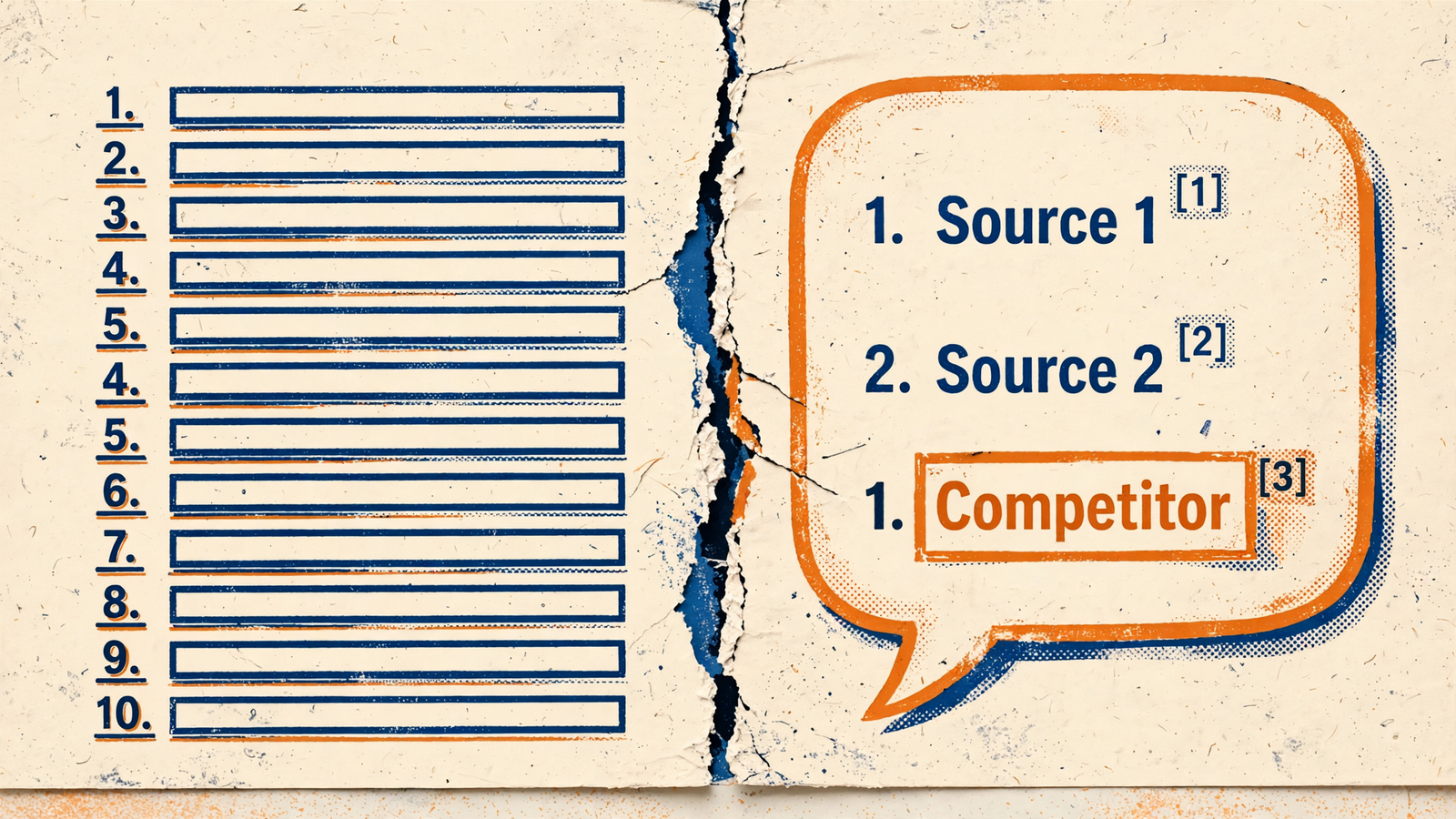
I used to make a version of this mistake in paid search: I’d read a click as if it were already a conversion. Here the first distinction is between a mention, where the answer names a brand without linking to it, and a citation, where it links to a specific URL. Neither is a visit. Supermetrics’ four-metric breakdown keeps AI impressions, citation share, AI referral sessions, and prompt-level presence rate separate. I want those labels because they tell me what somebody actually counted. If an answer names us but links to a competitor, I want to see both observations. Reporting that we appeared leaves out the part I need to investigate.
The prompt-tracking workflow practitioners describe gives me a way to check whether a citation shows up more than once:
- Write a fixed panel of 15 to 20 non-branded buyer questions before looking at the results.
- Run each question about three times per engine in fresh, logged-out sessions.
- Record the brands named, in order, and the URLs cited. Log timeouts separately. A question the engine didn’t answer isn’t an answer that left us out.
Then I ask Claude through groas: Which tracked buyer prompts cite competitors but not us? Show me the answer and the source URL. If all I get back is a chart and no way to inspect the citation, I don’t know whether I have a citation problem. I know I have a dashboard problem.
November 25, 2024: MCP connects the sources without combining the metrics
Anthropic introduced the Model Context Protocol as an open standard for secure, two-way connections between AI assistants and data sources. The problem was familiar: the model was in one place, the data was somewhere else, and each source needed a custom integration. TechCrunch’s coverage noted early adopters such as Block and Apollo, support from developer-tool companies, and a lack of benchmarks for Anthropic’s performance claims. OpenAI, meanwhile, was taking a more closed partner approach.
I don’t read the announcement as proof that the assistant got better at interpreting a report. MCP fixes access, not interpretation. That’s useful enough. An assistant can get to separate sources through a standard connection. It doesn’t follow that the sources now agree or that they should be averaged.

I think of MCP the way I think of a reporting API I used to build by hand: useful, boring, and only as honest as the data I feed it. When I plug groas into Claude over MCP, I can put Search Console performance, GA4 sessions, and observed AI answers side by side. That’s more useful to me than a chart that averages all three, because I can still go back to the row or the answer that supports the claim.
The Windmill Strategy measurement map draws three distinctions I want Claude to preserve:
- A citation is a link displayed in an answer, whether or not anyone clicks it.
- An identifiable AI referral is a visit from an assistant such as ChatGPT, Claude, or Gemini that GA4 can attribute when it has a usable referrer.
- A crawler request from a bot such as
OAI-SearchBotorGPTBotcreates no human session in GA4. I look for it in server or CDN logs, not in the traffic report.
The same discipline applies within a source. If an impression is already included in overall Search Console Web performance, I don’t add it to the total again just because I can see it in another view. I want one connection so I can read the evidence together, not so I can do arithmetic on things that don’t add up.
Today: I read three reports and approve one change
If I take over an account tomorrow, I’ll connect the website, Search Console, GA4, and AI visibility through groas. Then I’ll pick a page that matters and ask Claude to show its work:
For this page, show Google search performance, observed AI citations, and identifiable AI referral traffic. Label missing data and incompatible time windows.
Missing data belongs in the report, not inside the score. Search Console impressions don’t tell me how many sessions came from a third-party assistant. GA4 can show identifiable sessions from those assistants, but it can’t show how often an answer was displayed. And clicks from Google’s AI Overviews and AI Mode sit inside ordinary organic numbers. None of those views shows me both sides of the same journey.
I follow the distinction in Pepper’s GA4 analysis: AI impressions and identifiable assistant sessions go on separate lines, with the citation rate from prompt tracking alongside them. If the prompt panel shows a citation but GA4 shows no identifiable referral, I report exactly that. I don’t erase the citation, and I don’t claim it sent a visitor. The Claude setup walkthrough shows how to connect the sources without turning them into a composite score.
Once I have the three observations, I look for evidence that warrants one page update. Not ten. One. If the prompt panel keeps turning up a competitor, I read the answer and inspect the URL before deciding what, if anything, to change on our page. If I approve an update, I log what changed, why I changed it, the date, and the exact panel of buyer questions I’ll run again. If I change the questions after updating the page, I no longer have the same test.
For Google, I’d borrow the comparison from this practitioner thread: split Search Console queries by whether a rank tracker flags an AI Overview, compare click-through rates at the same position before and after, and use pages with no observed AI impressions as a comparison group. The thread reports one French site dropping from roughly 750 to 400 clicks a day and a site in a sensitive your money or your life category dropping from 80 to 25. Those drops are worth investigating. Their timing doesn’t tell me what caused them. For the difference between ranking and recommendation evidence, I’d use the side-by-side checks in Search Console versus groas in Claude rather than ask one report to answer both questions.
What I want from the next report
I used to tell clients that good SEO would eventually show up everywhere. I was wrong about the eventually part. A good page with clean markup and a clear answer block guarantees neither a citation nor a visit. Each surface keeps its own evidence, which is why I care more about what the connection lets me inspect than what a dashboard can put on one axis.
Here’s where I think the line points next: not to another visibility metric, but to a report I can use to make a decision and check it afterward. Did the ranking hold? Did the citation appear? Did an identifiable visit follow? I want each answer labeled with its own time window and its own gaps. If Claude sends back one number, I send it back. Show me the raw answer, the source URL, the query, the date, and the session source. If the evidence isn’t there, say so. The score is decoration.
That’s the work groas is built to support: keep the observations on separate lines, run the same prompt panel again, and log each change with its reason so it can be undone. I’d take that over a monthly PDF that averages the split away. Connect the sources once, read them separately, and make the next change earn its place in the log.