LinkedIn

By launch day, I want one new message I can judge against the old one. Asking Claude for 50 headlines is the fastest way to get everything but that.
I used to do versions of this by hand. I asked for more copy, changed the landing page, moved the budget, and called the activity testing. It wasn’t testing. It was rearranging the account and hoping the bill would explain itself later.
I use Claude with groas to read the account first, check what the product actually offers this season, and see what competitors are promising. Then I turn one defensible claim into responsive search ads and keep an unchanged reference where budget and the offer allow. The test starts with a sentence, not a pile of copy:
Replacing [current message] with [challenger] for [audience and scope] should improve [qualified outcome] because [reason], without harming [guardrail].
For B2B SaaS, I’d rather put a sales-qualified lead, an opportunity, or pipeline in that sentence than a click. Which one belongs there depends on what the account can actually track. The point is to name the outcome before the ads run, not pick the metric that looks best afterward.
1. What does the account say before I ask for copy?
Once groas is connected, I start with this prompt:
Using groas, read our connected Google Ads account and identify the buyer intents this campaign must serve.
That puts the work in the right order. I want Claude to look at what we’re buying, what’s converting, and what isn’t before it writes a word. A plain Claude chat without account access can give me fluent SaaS copy. It can’t tell me whether that copy addresses the searches I’m paying for. With groas connected to Claude, Claude can start with search terms, existing ads, and conversion actions instead of guessing from the category name.
At this point I want a brief, not a verdict. If Claude says a particular angle should generate more demo requests, I write that down as a hypothesis. I don’t put it in the launch plan as a promised result.
2. What has to be settled before I argue about headlines?
I write down three things while the brief is still short:
- The seasonal launch date.
- The budget ceiling.
- The name of the person who approves changes.
I’ve watched SaaS launches stall because “the team” was going to review the copy. A team can discuss it. A person has to approve it. I also put a review date next to the hypothesis, then check it against conversion lag before launch. If I can’t say who signs off, how much we can spend, or when we’ll look at the result, another round of headlines won’t help.
3. What can the ads honestly promise this season?
I worked with a SaaS startup that changed its offer every quarter. Product and pricing moved in Q2; the ads went on confidently describing Q1. What the deck called a seasonal refresh, I called fixing the source document before paying to amplify it.
I give Claude the current offer, not last season’s copy:
- Plan names and pricing conditions.
- Eligibility limits and the onboarding timeline.
- Claims I can substantiate, such as a named customer result or an integration that exists.
Then I ask it to compare those facts with the existing ads line by line. If an old headline promises a free trial and getting the trial now requires a sales call, I want that conflict flagged before launch. The offer document wins. The old headline doesn’t get a vote because it once converted.
Google’s Quality Score guidance covers expected click-through rate, ad relevance, and landing page experience. Its advice on consistency is the part I care about here: follow through on the offer and call to action from ad to page. The ad, the page, and the product should make the same promise.
4. Which searches and conversions belong in the test?
The first account read tells me what intents the campaign has to serve. Now I ask Claude to split the evidence into three buckets:
- Brand demand: People already looking for us. They’ll often convert on almost any sensible ad.
- Non-brand acquisition: People searching for a problem or category. Here, the message has to do real work.
- Downstream outcomes: What happened after the form fill. Did it become a sales-qualified lead or an opportunity?
I don’t let a strong branded result stand in for evidence that the challenger works on non-brand searches. And if the CRM outcomes aren’t coming back into Google Ads, I tell Claude that in the chat. If form fills are all I can see, I can judge form fills. I can’t call them pipeline. That’s how a SaaS team ends up celebrating a cheaper week of worse leads.
5. What are competitors promising, and what are they leaving unanswered?
I ask Claude to pull the ads, hooks, offers, and claims groas has collected. groas monitors competitor ads on Google and Meta around the clock, along with the landing pages and funnels behind them. That gives me more to work with than one screenshot from a friend’s browser.
I look for two things: promises that show up across rivals and objections nobody seems to answer. The first tells me what the category treats as table stakes. The second gives me something worth testing. What I don’t get is a P&L. A long-running competitor ad doesn’t prove the campaign is profitable. A last-shown date won’t tell me what the advertiser spent or what came back.
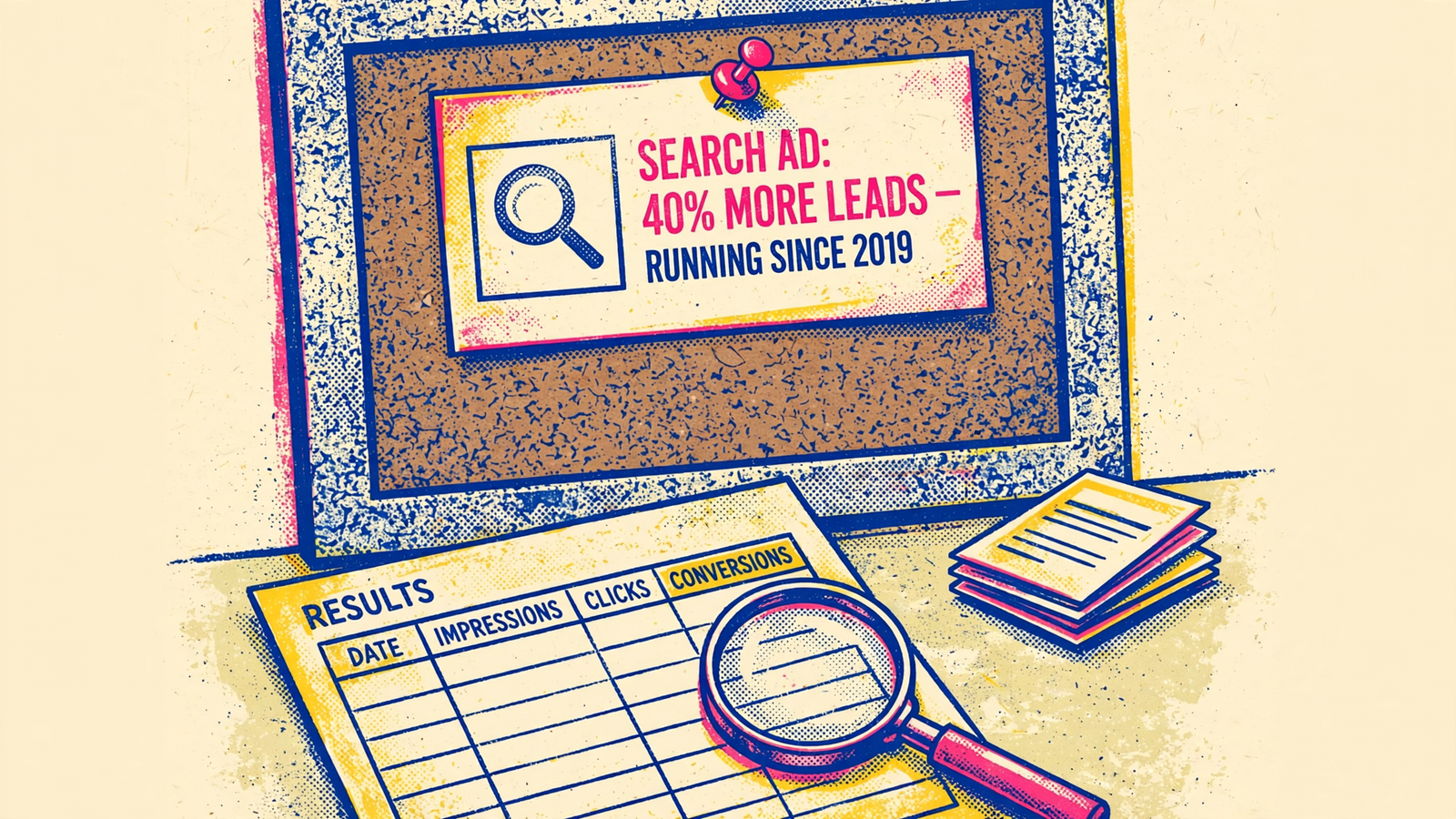
If three rivals lead with speed, I might test the cost of getting started, the pain of migrating, or proof that a specific workflow works. The choice depends on what my offer can honestly back up. “Copy the leader’s headline” doesn’t belong in the hypothesis. I don’t know whether I’d be copying their best decision or their most persistent mistake.
6. How do I turn one hypothesis into a complete search ad?
Only now do I ask for assets:
Draft distinct message hypotheses, then build assets for the selected hypothesis within current Google Ads limits.
I want different hypotheses before I choose, then one claim served by assets that do different jobs. Fifteen variations of one sentence aren’t fifteen ideas. Once I’ve chosen the challenger, I can use one headline to state the offer, another to give a reason to believe it, and another to tell the buyer what to do next.
A responsive search ad, or RSA, takes 3 to 15 headlines and 2 to 4 descriptions, which Google serves in combinations. I check the package against Google’s RSA documentation:
- Headlines: up to 30 characters each.
- Descriptions: up to 90 characters each.
- Destination: a final URL and up to two display path segments of 15 characters each.
Then I read the combinations, not just the list. The offer, proof, and call to action give me a way to organize the assets; they don’t guarantee that unpinned headlines will appear in that order. If a headline needs its neighbor to explain who qualifies, or two lines make the same promise in slightly different words, I revise the pool. I also map each ad group to the page it was written for. If the page can’t repeat the promise above the fold, the ad isn’t ready.
7. Does the promise survive the click?
I give Claude each ad group’s final URL and ask it to compare the ad claim, page headline, and next step. Does the page repeat the offer? Does the call to action land where it says it will? Does the form ask for something the ad never mentioned?
That’s a click-path audit, not a redesign brief. If the page needs work, I give that work its own owner, approval, and timeline. If the challenger can’t run honestly on the current page, I don’t bundle a rewrite into the launch and pretend I’m still testing copy alone.

A store owner on r/TechSEO reported losing ChatGPT-driven parts traffic after AI-assisted edits to their site. That wasn’t Google Ads traffic, and the report doesn’t prove the edits caused the loss. The part I take from it is about method: when several things change and no unchanged comparison is left standing, a drop tells me something happened. It doesn’t tell me which edit did it.
8. What stays put when the challenger goes live?
Before publishing through groas, I review the proposed changes and save the prior settings. Where budget allows, I keep a valid old RSA or ad group running unchanged. I change the message I wrote into the hypothesis, not the bid strategy, landing page, and audience in the same week. When creative, page, and bids all move together, I can tell a story about the result. I can’t separate the causes.
The old ad is a reference, not a randomized control. Google serves RSA combinations based on predicted performance, so I don’t assume the old and new versions get identical auctions. The comparison can inform a seasonal decision. It isn’t proof that the new message caused the difference.
I also do the retirement pass from Claude’s PMax checklist: retire last season before you fund the next. I check for expired offers, old asset groups, and last season’s budgets. I keep only what still belongs, and I keep it deliberately. An ad for an offer we no longer honor isn’t a reference I’m willing to run.
This is where groas earns its place over a plain Claude chat. Claude can draft on its own; through groas it can read the account, propose the changes, publish what I approve, and show me what changed and why. I can undo a change, too. The log makes review easier. It doesn’t make review optional.
9. What earns another week, and what makes me stop?
I set review dates around the outcomes I can observe. One B2B SaaS benchmark set puts the median sales cycle at 84 days. That isn’t a timer for every account. It is a good reason not to declare a winner after two weeks of cheap form fills.
I ask Claude to report three layers separately:
- Delivery: Did the ads serve and spend? This is where I apply the stop rule.
- Click response: Did the message earn the click? I give that question its own review date.
- Qualified conversion: Did the click turn into a sales-qualified lead or opportunity? I allow a longer window for that answer.
A read on delivery isn’t a read on demand. A read on clicks isn’t a read on lead quality. If offline tracking is thin, I fix it before judging creative on qualified outcomes. Raw form fills aren’t a pipeline measure, however tidy the report looks. If I approve a change mid-test, I inspect the logged reason and keep it with the decision record. No silent tweaks.
10. What do I save, and what do I do today?
I save the hypothesis, approved assets, destinations, limits, and decision rules in one place. Next season’s operator, who may be me with a worse memory, should be able to see what changed, what stayed put, and why I made the call.
I leave autopilot off for a bounded message test unless I deliberately enable it under the rules I’ve set. Having the option to make changes around the clock isn’t a reason to keep changing the thing I’m trying to judge.
The first thing I’d do today: connect groas to Claude and ask it to read the Google Ads account and name the buyer intents this campaign must serve. Leave the headline request for later.