

 LinkedIn

By December 31, 2027, a Claude PPC report worth paying for will refuse to call Bing cheaper than Google unless it can show that both numbers use comparable conversion actions, attribution rules and windows, and reporting periods. If it can’t show its work, I won’t pay for the verdict.
Say you’re spending $20k a month across both platforms. Claude pulls the accounts and gives you a tidy answer: Bing at $22 per lead, Google at $31. The client wants to move $5k to Bing. I used to make that move. Then finance counts actual sales and the tidy answer falls apart. Google credited a conversion under a 90-day window with data-driven attribution. Bing credited a different form submission under last click, in a different reporting week. The arithmetic was fine. I’d asked it to divide two numbers that didn’t mean the same thing.
The next useful advance in PPC reporting won’t be a faster combined summary. It’ll be an assistant that knows when not to rank the channels. I expect that refusal to show up in three places by the end of 2027: what the report puts beside each number, what it says when the evidence runs out, and what it’s allowed to do with the budget afterward.
Prediction 1: Claude will list what Google and Bing can’t fairly compare
My first test is simple: put the basis for comparison next to the number. I want to see the conversion action, attribution model and window, and reporting period beside each cost per lead. If those don’t line up, I want the report to tell me what doesn’t match instead of picking a winner. I shouldn’t have to dig through a footnote to find out that the two columns count different forms.
The platforms can give different things the same name. Compare the attribution defaults: Google Ads defaults to data-driven attribution for most conversion actions, while Microsoft Ads defaults to last click and offers data-driven attribution as an option per goal. Change the model and reported return on ad spend can move even when sales don’t. The lookback window changes what gets counted, too. If the platforms look back over different stretches of time, they can credit different conversions before I’ve learned a thing about which channel performs better.
There’s a reason I don’t settle the argument by adding up the dashboards. In one documented example, Google claimed 400 conversions, Meta claimed 250, and Microsoft claimed 60. Finance recorded 480 sales. Each platform could claim the same sale under its own rules. The sum tells me what the platforms claimed, not how many sales the business made.
Importing goals doesn’t settle it either. In the Google-to-Microsoft goal import pilot, eligible tag-based destination goals can carry over, but goals imported from Google Analytics don’t, and data-driven attribution comes over as last click. Microsoft also reports by click date where other tools may report by conversion date. Two columns labeled with the same week aren’t necessarily counting the same set of events.
What proves me wrong: By the end of 2027, buyers still find Google–Bing reports useful for deciding which channel is cheaper without being shown how the numbers were counted. Until then, my rule is to put unmatched figures in the unresolved section, not in the channel ranking.
Prediction 2: Buyers will ask Claude to say “insufficient evidence”
Matching definitions gets the comparison on the page. It doesn’t guarantee a verdict. If conversion counts are thin or last week’s clicks are still turning into leads, I want “insufficient evidence” as a report output, with the reason attached. I don’t want a winner followed by a paragraph explaining why I shouldn’t trust it.
Here’s what I check before I let either number carry an argument. The practitioner checklist is unglamorous, which is usually a good sign:
- The event and the count. Same conversion event, counting rule, value rule, currency, and treatment of refunds and duplicates.
- The clock. Same date range, time zone, and attribution window, with enough time for the conversions I’m comparing to come in.
- The tracking. Microsoft’s UET tag covers the actual form, call, and checkout paths that matter to the account.
Putting both accounts in one chat gets me both sets of numbers. It doesn’t fix any of those checks. One MCP connector that brings Google Ads, GA4, Meta, and Bing into a chat says outright that it doesn’t fix tracking. Missing click IDs, consent limits, and different attribution models can still leave the numbers at odds. I’d rather see the gap than have Claude fill it with a sentence that sounds plausible.
That cuts both ways. In one Q1 2026 dataset, comparable keywords cost $1.54 per click on Bing versus $2.96 on Google. That’s a click-price comparison, not a lead-quality verdict. Bing also skews desktop, where measurement gaps can show up differently. If the dashboard understates Bing’s return and I cut its budget on that basis, the neat cross-channel report has made me worse at my job. I used to call that inefficiency. I was wrong. It was ignorance with a chart on top.
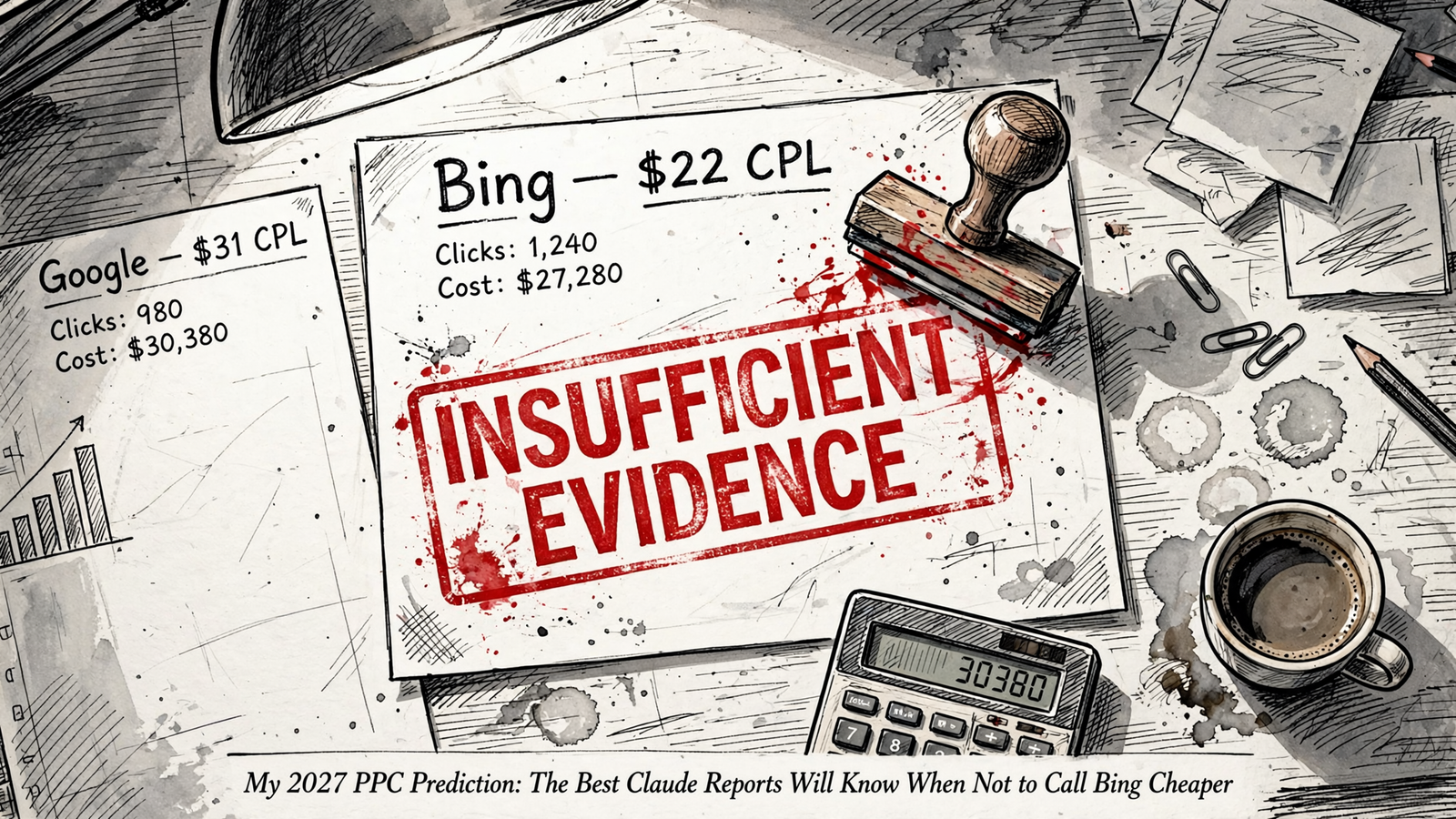
The prompt I use now gives Claude permission to stop: Compare Google and Bing, but label every unsupported comparison. Do not infer lead quality from platform conversions. That’s the same standard I want when an assistant reads the numbers behind an ad claim: show the evidence or don’t make the claim. If I get insufficient evidence, the next line should tell me whether to wait for lag, check a goal, or leave the comparison open because there aren’t enough conversions.
What proves me wrong: By the end of 2027, buyers still choose tools chiefly for polished summaries and don’t ask them to withhold a verdict when the counts are thin or the tracking is unresolved. My test at renewal is whether the report can tell me why it doesn’t know.
Prediction 3: Buyers will buy reporting and approve budget changes separately
The official connectors already show why reading an account and running it are different jobs. The Google Ads MCP’s seven tools cover three reads and four asset and label writes. They don’t change budgets, bids, or campaign status. The Microsoft Ads MCP pilot is read-only: it can retrieve campaigns, ad groups, ads, keywords, search queries, and metrics, but it can’t change budgets or pause campaigns. I can get a brief without granting the permission that would let the brief spend my money.
That’s how I want to buy it. Permission to read isn’t permission to move spend. With Claude plus groas, I can read both accounts in one chat and work through the comparability questions without turning that read into authority to reallocate budget. If I want automation, groas autopilot stays off until I switch it on. Every change is logged with its reason and can be undone in one step. The log tells me what happened; it doesn’t replace the decision about what I’m willing to let happen.
I keep the two permissions on different pieces of paper. One is for a recurring brief that compares what it can and names what it can’t. The other is for a proposed change: what moves, why, the account-level limits, and who approves it. I can read Bing without authorizing spend and still run one strategy across platforms while checking each one separately. One strategy doesn’t need to mean one blanket permission.
What proves me wrong: By the end of 2027, unattended cross-channel budget shifts are the normal expectation, with no separate approval step. Until then, if a brief makes a good case for moving $5k, I want a proposal I can sign, not a notification that the money has moved.
How I’ll score the predictions in December 2027
I’ll pull the documentation and a real report from my own setup. I’ll score the output and the permissions, not the demo. Then I’ll publish which vendors passed these three checks:
- Show the basis. Look beside each CPL figure for the account, period, currency, conversion action, and attribution rules. If the report calls Bing cheaper without showing why the figures are comparable, it fails the first check.
- Withhold the verdict. Pull a thin month, say 11 Bing conversions against 140 on Google. If the evidence doesn’t support a winner, the report should say so. If lag or a goal mismatch is part of the problem, it should name it, not hide it under a confident recommendation.
- Keep the approval separate. Check whether the same chat that wrote the brief can move $5k without a second approval, an account-level limit, or a change log with an undo option. That tells me what the setup allows. Whether buyers expect that freedom by default is the test of the prediction.
A prediction I can’t score this plainly is a slogan. I have no interest in writing those.
What I’d buy before next season
I understand the temptation to buy speed. I run Google and Bing ads for clients, and reporting takes forever. But speed is what got me into trouble. Buy the report that’s hardest to misread. The spec I’d sign has two documents:
- A recurring Google–Bing brief. Same accounts, periods, currency, and conversion actions, with attribution windows beside each figure. Anything that can’t be matched goes under Unresolved questions, not in a footnote. If closed-won revenue lives in the CRM and never reaches the ad platforms, I want the brief to say so. A connector doesn’t create missing sales data or repair attribution by itself.
- A separate change proposal. Spell out the proposed shift, why it’s justified, the caps for each account, and who approved it and when. Record what happened after the move. Don’t give the assistant budget authority just because it wrote a tidy paragraph about CPL.
I’d connect Claude to both accounts through groas, run the same brief every Monday, and keep budget authority in a separate document the client signs. The standing order: Compare Google and Bing on identical events and windows only. Label every unsupported comparison. Do not infer lead quality from platform conversions. Propose no spend change without limits and approval. That’s the Google–Bing answer I want to bring to a finance review: what we can defend, what we can’t, and what we’re proposing to do about it.
I’d make one exception on cadence. If Bing is a $1,500-a-month test beside $30k on Google, I wouldn’t run the full comparison every Monday. I’d do it monthly and use the weekly check to make sure UET fires on the money pages and both sides handle refunds and duplicates the same way. Below about 30 conversions per channel per period, my rule of thumb is to keep the budget steady rather than crown a winner. Clearing that bar doesn’t make mismatched goals comparable.
And yes, ChatGPT can read PPC campaigns too. I’d connect it to both accounts and give it the same standing orders, not assume the connection itself is the analysis. The assistant that follows those orders is useful. The one that skips them to give me a faster summary can cost more than the reporting hours it saves. Buy the report that refuses. Approve the move separately.





