LinkedIn

By December 2028, evidence from outside the ad account will matter more than tool count when buyers shortlist a marketing MCP. I’d take the connection that puts my last 30 days of spend beside a rival’s current ad, the landing page behind it, the words customers use to describe the problem, and the sources AI answers cite. The longer tool menu can stay in the sales deck.
Ranking pages make it easy to shop by menu length. One roundup of 15 marketing MCP servers ranks them by 28-day Search Console impressions. Fine for finding names. It doesn’t tell me which connection I’d trust with a budget decision. Connecting all 15 doesn’t answer that either. It gives me 15 authorizations to manage, 15 sets of updates and failure modes, and more places to look when I need to check what happened.
I’m making three bets about what buyers will ask for instead. The first is about what the connection can do. The second is about what it can see. The third is about whether I can tell why it wants to do something. Each has a way to prove me wrong.
Prediction 1: Approved writes become standard, not a selling point
A reporting-only connection can tell me that CPA rose 18% last week. That’s useful if I asked for a report. If I asked Claude to fix the cause, the same connection stops at the handoff: I still have to make the change somewhere else. That’s why I expect account reads and approved writes to come together in the same connection. Not because every action belongs there, but because the actions I repeat are the ones I least want to shuttle between tools.
Google’s own connector shows the distinction. It launched as open source in October 2025. The November 2026 update added four write tools for assets and labels, with a propose-and-confirm step. Campaign creation, budgets, and bids still sit with other tools or with the operator. So supports writes tells me less than it appears to. If I’m evaluating a connection to manage budgets, an approved label change may be useful. It doesn’t get the budget changed. I laid out the fuller argument in By November 2027, Marketing MCPs Will Need More Than Write Access.
- What I expect by 2028: Most shortlisted connections offer both account reads and approved writes. Comparison pages start naming the actions, the approval steps, and what still takes manual work instead of putting an automation badge on all of it.
- What proves me wrong: Reporting-only servers still win most evaluations, or execution stays rare outside a handful of large platforms. Either way, writes haven’t become the baseline.
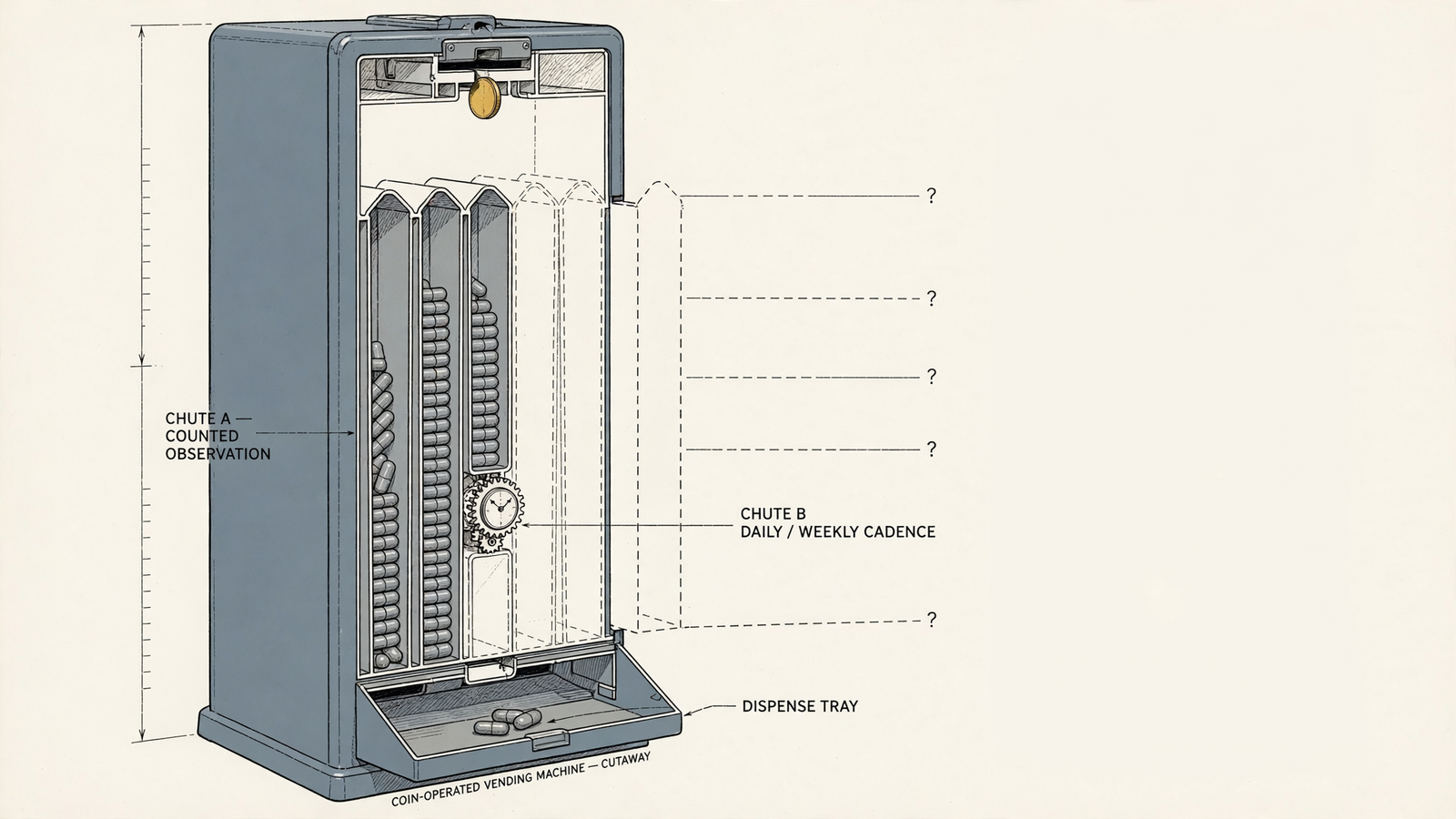
My first procurement question is: “What can you read, what can you change, and what still requires manual work?” I want three separate answers. If a vendor can only show me the first two, I still don’t know how much of the job is mine. And even if the connector can make the exact change I need, I haven’t learned whether it knows enough to recommend it.
Prediction 2: Fresh evidence from outside the account makes the shortlist
I used to give the account too much credit for explaining what was happening outside it. Take a home-services account where CPA climbs for six weeks on a job the business keeps losing to the same rival. The account can show me the climb. It can’t show me that the rival rebuilt its landing page around next-day slots and started bidding on the underserved suburb. Even if I find that page, I haven’t proved what caused the CPA increase. I have a better lead than I had staring at the account report.
That limit is baked into what the API covers. Klipio’s comparison of Meta’s Marketing API and Ad Library API spells out the difference: the Marketing API covers accounts I can access. The Ad Library API covers political and social issue ads, with wider coverage in the EU under the DSA. I can see commercial ads on the public Ad Library website, but I wouldn’t assume the API gives me the same view. A longer list of account tools doesn’t solve that problem.
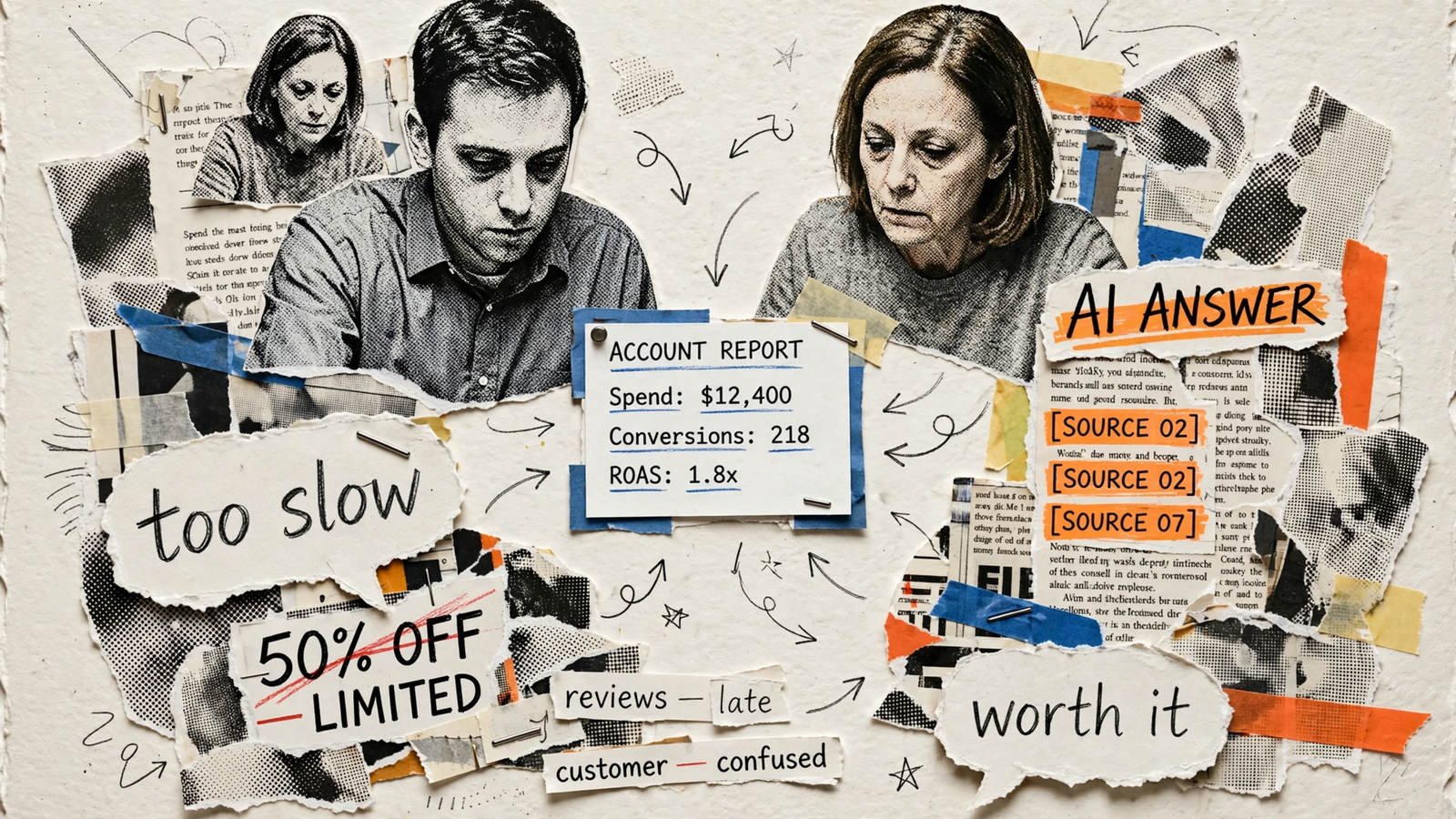
I expect buyers to ask for continuously collected evidence from outside the account, with enough detail to tell what they’re looking at and when it was collected. Three kinds belong on the shortlist:
- Competitor ads and the pages behind them. The ad shows the pitch. The landing page and funnel show what a customer sees after clicking. I want both before I decide whether the rival’s move deserves a response.
- Customer language from places like Reddit. I want to compare the words customers use for the problem with the words I’m already paying to put in front of them.
- AI search answers and citations. I want to see what the answers say about the business and which sources they cite, not just whether the brand name turns up.
Reddit is a good example of why I care about the source and the date. In Soar’s analysis of a May 2026 Parse export, which covered 100 domains and 358,000 citation observations, Reddit ranked second with 55,505 observations. The same analysis points to a Semrush study in which ChatGPT’s Reddit citation share swung sharply over 13 weeks. I’d use that as a reason to check what an answer cites now, not as a reason to assume that one ranking holds across engines or over time.
- What I expect by 2028: Comparison pages and buying checklists spell out which sources are covered, how often they’re refreshed, and where the evidence came from. Tool count won’t settle the shortlist.
- What proves me wrong: Buyers keep picking by tool count even when the outside evidence is missing, stale, or impossible to trace. Putting competitor intelligence on a feature list doesn’t count as a pass.
My second procurement question is: “How do my account results compare with the relevant competitor ads and landing pages, and what did you actually see?” I’d ask Claude through groas and have it separate observation from inference. If I can’t see what it found and when, I don’t want its guess dressed up as a finding.
Prediction 3: The evidence attached to a change beats a polished answer
Claude and ChatGPT can both write a persuasive recommendation. That’s the problem. It’s easy to mistake a smooth explanation for a supported one in a demo where nothing goes wrong. It gets harder the first time a client asks why I moved $500 to that campaign. I need to show what I knew before I moved it, what I was still guessing at, and what I actually approved. The nice paragraph can come last.
The OWASP MCP Security Cheat Sheet recommends explicit confirmation for destructive, financial, or data-sharing operations, full tool parameters rather than a summary, and logs that include parameters, user context, and timestamps. A budget change is a financial operation. I take two buying requirements from that: I need to see what I’m approving before the change and be able to inspect what happened afterward. The log tells me what ran. The evidence attached to the proposal tells me why I thought it should run. I want both.
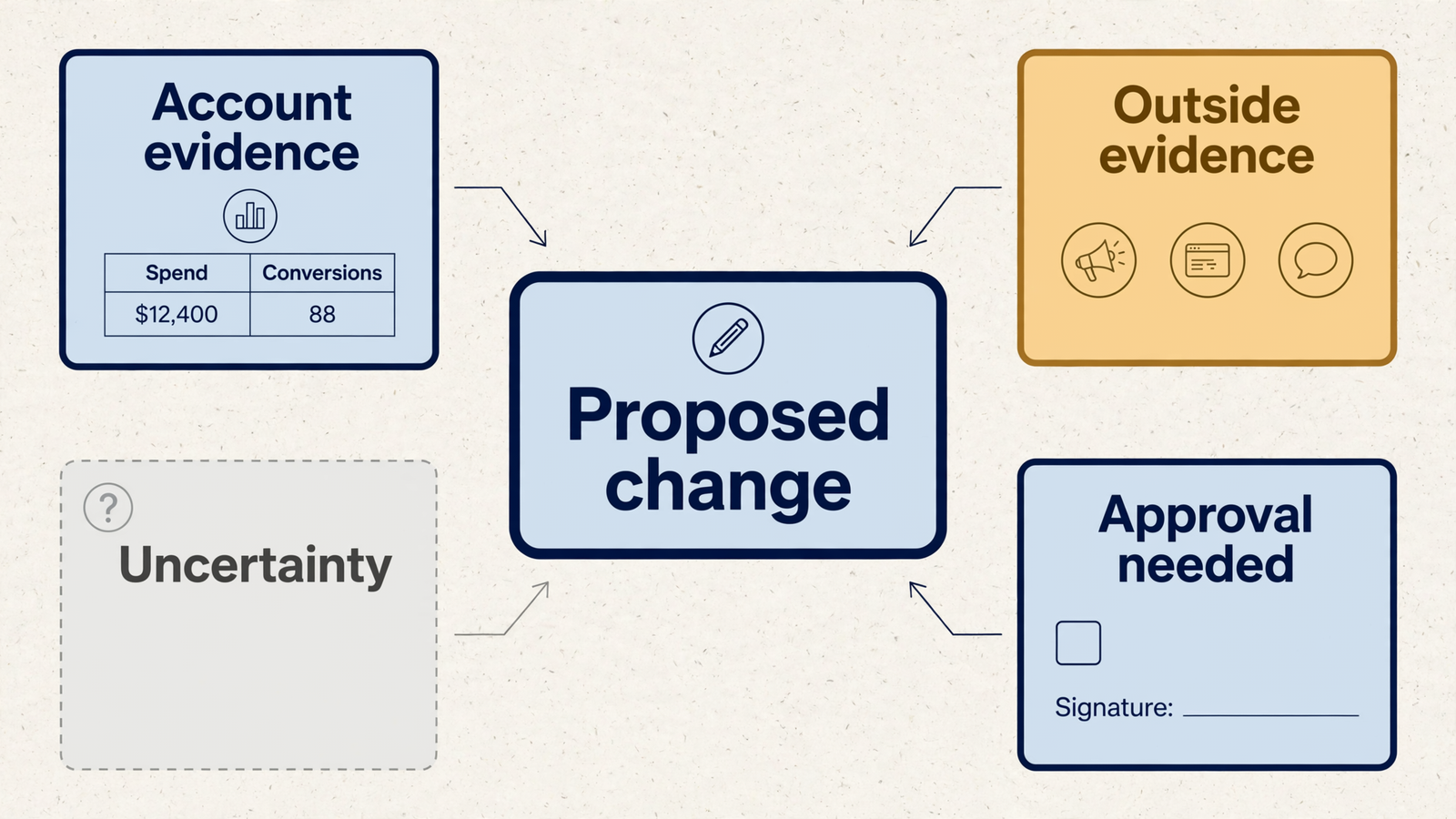
My third procurement question is: “For this proposed change, what’s the account evidence, what’s the outside evidence, what’s uncertain, and what approval do you need?” I’d ask it about one change, not an account-wide strategy. If I’m looking at a budget move, I want to see the account result that prompted it, what the outside evidence adds, and what neither can establish. Then I want to see the full change I’m being asked to approve. A convincing explanation isn’t a substitute for any of those things.
- What I expect by 2028: Buyers ask for source-linked reasoning and inspectable change histories during evaluations. They expect to see the reason for each change and to be able to undo it in one step.
- What proves me wrong: Unsupported recommendations still win just as often as sourced ones. If buyers keep choosing the nicer paragraph without asking to see the evidence or the log, I’ve overestimated how much they value either.
If a vendor can’t walk me through one change from evidence to approval to log, I’m not giving it a hundred to make.
What I’d connect this week
I’d start with three decisions I make every month, not the feature list. Say I’m spending $20k a month across Google and Meta. I’d write down where I might move budget, which rival’s move might warrant a response, and which landing page change I might approve. Next to each decision, I’d write down what I need to see before I make it. That’s the test I’d take into a demo.
- Check the work I can hand off. I’d ask what the connection can read, what it can change with approval, and what it leaves me to do by hand.
- Check the evidence I can’t get from the account. I’d ask for a relevant rival ad and its landing page alongside my own results. I’d check when the material was collected and whether the answer separates what it found from what it inferred.
- Check one proposed change. I’d ask for the evidence, uncertainty, and approval step. Before giving it write access, I’d check that I can see the full parameters, audit the change history, and undo a change in one step.
On Claude’s Free plan, which allows one custom connector, the choice is especially clear. I’d use that slot for the connection that can read the account, make approved changes, and bring in outside evidence. Otherwise, I’m swapping connectors and losing the history I wanted in one place.
I’d leave autopilot off until I can put its scope in writing: which accounts, which changes, what spend limit, and what needs approval. I want every change logged with its reason. That’s how I answer the question that ends a vague setup: Why did we move $500, and what did we see before we moved it? If I can’t answer it from the evidence and the log, the connector doesn’t get write permission yet.
groas is where I’d run that trial, not proof that the forecast has come true. Through groas, Claude or ChatGPT can read connected ad accounts and sites, make changes I approve, and draw on the data groas collects around the clock: rival ads on Google and Meta, their landing pages and funnels, customer language from Reddit, AI search answers and citations, and SEO data from Semrush and Ahrefs. I’d check the pricing, then run the same three questions on a decision I already have to make. For the wider bet, including the rules that carry across assistants, I wrote By 2028, Marketing MCPs Will Sell Context, Not Connections.
In December 2028, I’ll grade the forecast on what buyers actually ask for, not on what vendors manage to ship. I used to tell clients that match type structure would last. When broad match and smart bidding took over, I told them I’d got that wrong. Same rule here: if two of the three predictions miss, I got the timing wrong or misread what buyers pay for. A forecast doesn’t get to pass because the sales pages picked up the vocabulary.
One exception: if I were running one small account with stable spend and no serious rivals, I’d skip most of this. If the monthly work is budget pacing and search term cleanup, a simpler connector and an hour of my time cover it. But if rivals change offers without warning and customers describe the problem in words I’ve never bid on, I want fresh evidence from both sides of the account. Make the vendor prove it on one change before trusting it with a hundred. The tool count won’t tell me whether it can.