

 LinkedIn

By November 2027, I predict the ChatGPT ad tools worth paying for will compete on recovery, not tool count. The demo that wins won’t be the one with 1,000 tools; it’ll be the one that can tell me whether the budget change I sent at 9:03 actually happened when the confirmation still hasn’t arrived at 9:04.
Here’s the scenario I keep coming back to. I ask ChatGPT to raise one campaign’s daily budget by a set amount and leave the other campaign alone. The connector sends the change. The connection drops before I get a confirmation. If I send the same instruction again and the first change went through, I’ve just raised the budget twice. If the first change never landed, repeating it does what I wanted in the first place. Same prompt. Very different bill.
No confirmation doesn’t mean no change. A timeout tells me the client stopped waiting, not that the server stopped working. The request might have failed, might still be running, or might have finished while the response was on its way back. I can usually repeat a read. A write needs a status check before I repeat it. The recovery pattern I want to see is simple to describe: reconnect, keep the unresolved operation on record, look it up by a stable ID, and retry only if the server can recognize the duplicate.
I spent years watching human operators make this mistake in Google Ads. A script timed out, somebody reran it, and a bid change went through twice or a negative keyword list got applied again. The script wasn’t the interesting part. Nobody knew what the first run had done. That’s the lens I’d use to judge the next crop of ChatGPT ad tools, and it gives me three predictions I can lose in public.
Prediction 1: Routine reconnect prompts will cost vendors renewals
By November 2027, I expect scheduled reconnection during normal use to count against a ChatGPT ad connector. I don’t mean a password change, revoked access, or a security check that should require fresh approval. I mean a connection that silently expires and leaves me clicking Reconnect, with no clear answer about the request I was in the middle of sending.
The mechanism matters more than the annoyance. Refreshing a token can restore the connection. It doesn’t tell me whether an in-flight request reached the server. If the connector treats the restored session as a clean slate, I’m back to guessing whether to repeat the last instruction. The button works. The workflow doesn’t.
In one OpenAI community thread about MCP token refresh, users reported that after about 11 minutes idle, ChatGPT refreshed the token and retried successfully. After about two hours idle, it skipped the token endpoint, tried to reconnect, got a 400 or 405, and looped or failed. Multiple posters reported the pattern, and OpenAI Support said in September 2026 that it couldn’t confirm the issue was resolved. That’s a specific report about one setup, not a diagnosis of every connector. It’s also not a complaint about how many tools the connector lists.
The vendor-side signal is in Ryze’s changelog. An August 31 entry says replies recover when they stop midway and live connections no longer drop during token refresh. An October 13 entry describes refreshing and retrying expired sessions. The October 20, 2026 entry, Lasting MCP connections and correct parallel responses, says MCP connections no longer expire after 30 or 90 days. A November 8 entry adds an email and banner when an integration disconnects. That’s vendor-reported work, not independent proof that the fixes hold everywhere. What interests me is how often the same class of problem comes back in the release notes.
What would prove me wrong: By November 2027, the leading connectors still treat routine reconnect prompts as normal, and buyers keep renewing without treating expiry as a reason to switch. Until then, I’d ask for the documented expiry policy and an explanation of how I can tell whether a request was delivered, is still pending, or never went out. If the answer is “just reconnect,” I’d keep it out of unattended work.
Prediction 2: Parallel requests will need separate, inspectable outcomes
By November 2027, I expect a separate outcome for each request to be a baseline requirement. In one chat, I ask for yesterday’s Google Ads performance and a proposed budget shift. In another, in the same minute, I ask for a Meta account check and a draft recommendation to pause the worst ad set. Same assistant, same connector, overlapping calls. If the answers come back crossed or attributed to the wrong account, I don’t have parallel execution. I have a slot machine.
The two tasks are independent, so they can run at the same time. But the connector needs to match each response to a unique call ID, not to a tool name or the order in which responses arrive. And I need to see more than two neatly labeled chat bubbles. Each request needs its own record: which account it targeted, what was proposed or validated, whether it ran, and whether it succeeded, failed, or ended with its outcome unknown. Otherwise, an answer that looks like success can wind up attached to the wrong job, or a timeout can get mistaken for a failure.
The October 20 Ryze entry says that when an assistant sends several requests at once, each request now gets its own response. That’s a concrete fix to point to. It doesn’t tell me whether I can inspect each request’s execution record, which is the standard I’m predicting. In a demo, I’d ask the vendor to show the Google read and the Meta draft side by side, with the account, task, and outcome visible for each. A clean result in the chat is nice. I want to know what I’ll be able to check when one result isn’t clean.
What would prove me wrong: By November 2027, responses still get merged or crossed, and buyers don’t insist on separately inspectable outcomes. Until a connector can show me which result belongs to which request, I’d run one write, confirm it, then run the next. Slower, yes. Easier to explain on Monday morning.

Prediction 3: “Did it happen?” will beat “Can it do it?”
This is the prediction I’d keep if I had to drop the other two. By November 2027, the decisive question in a ChatGPT ad-tool demo will be “Did it happen?” And I’ll want the answer from evidence I can inspect outside the chat. “Can it do it?” is a feature claim. “Did it happen?” is an audit.
The difference is what the assistant has to work with when something goes wrong. A September 2026 study of 150 MCP servers found that agents recovered from expired credentials 45% of the time when the error message told them to run a terminal command, versus 84% when it named the login tool. For rate limits, recovery went from 6% with a bare instruction to wait before retrying to 88% when the message named the call to repeat. Those aren’t ad-account recovery rates. They show why a concrete next step matters more than an error message that amounts to “try again later.”
For a budget write, the next step I want named is inspect, not repeat. Show me the live account state, the operation record, and what I should check next. If the record and the account disagree, say so. If the outcome remains unknown, say that too. The assistant doesn’t have to resolve every interruption on its own. It does have to stop short of calling an unverified change a success or sending it again on hope.
What would prove me wrong: By November 2027, tool counts, platform coverage, and approval steps still dominate buying decisions, with no standard way to verify a write whose confirmation went missing. That’s a real possibility if I judge by what gets compared today. PaidSync markets 630+ tools across 14 platforms, and the connector comparisons I’ve read focus on reads, edits, approvals, and price. Those categories tell me what’s on the menu. They don’t tell me what happened to my budget.
The scorecard I’d use in November 2027
I’d pull the documentation and release notes for the leading connectors and look for three things I can point to in writing:
- An expiry policy: What happens when authorization expires during normal use, and what happens to work already in flight?
- Separate request outcomes: Can I check the account, task, and result for each overlapping call?
- Evidence after a lost confirmation: What can I inspect before deciding whether to repeat a write?
Missing documentation isn’t proof that a feature doesn’t exist. It does mean I can’t use that documentation to audit the behavior or tell an assistant what to do next. I’d use the eight checks before paying for a marketing MCP as a starting point, then ask to see the parts the docs don’t answer. “We handle that” is not something I can inspect at 9:04 in the morning.
What I’d connect now: One campaign, one approved change
If a connector worked once and then left me with a reconnect loop, crossed responses, or a write I couldn’t verify, I wouldn’t give it a bigger job. I’d start with one campaign and one approved change. I’d use groas for that test, and I’d hold it to the same standard as any other connector.
- Connect groas to ChatGPT over MCP, connect the ad account for the test, and leave autopilot off.
- Ask ChatGPT to read one campaign and report its current budget, status, and recent spend.
- Ask for one proposed change in writing. Tell ChatGPT not to make it until I approve that specific change. Approve it once.
- Ask ChatGPT to inspect the live account and the groas change log. I want to see what changed, when it changed, and the logged reason. If the account and the log disagree, stop. Don’t send the write again while the outcome is uncertain.
A clean run shows me where to look for evidence. It doesn’t prove how the connector handles every dropped connection, and I wouldn’t read it as a promise of automatic retries or protection from duplicate writes. What puts groas ahead for this job is that I can check the live state against a change log that records the reason, and I can undo a logged change in one step. A chat transcript that says “done” gives me neither.
groas Unlimited is $19 a month, flat, for a whole team: unlimited teammates, ad accounts, and websites, with every feature and all the data. Agencies pay the same for every client. Autopilot stays off until I switch it on. If I want to grant more authority later, Ask, Approve, Autopilot spells out the control levels. If I’d rather hand over the work, Done For You starts at $5,000 a month and is run by groas’s senior team.
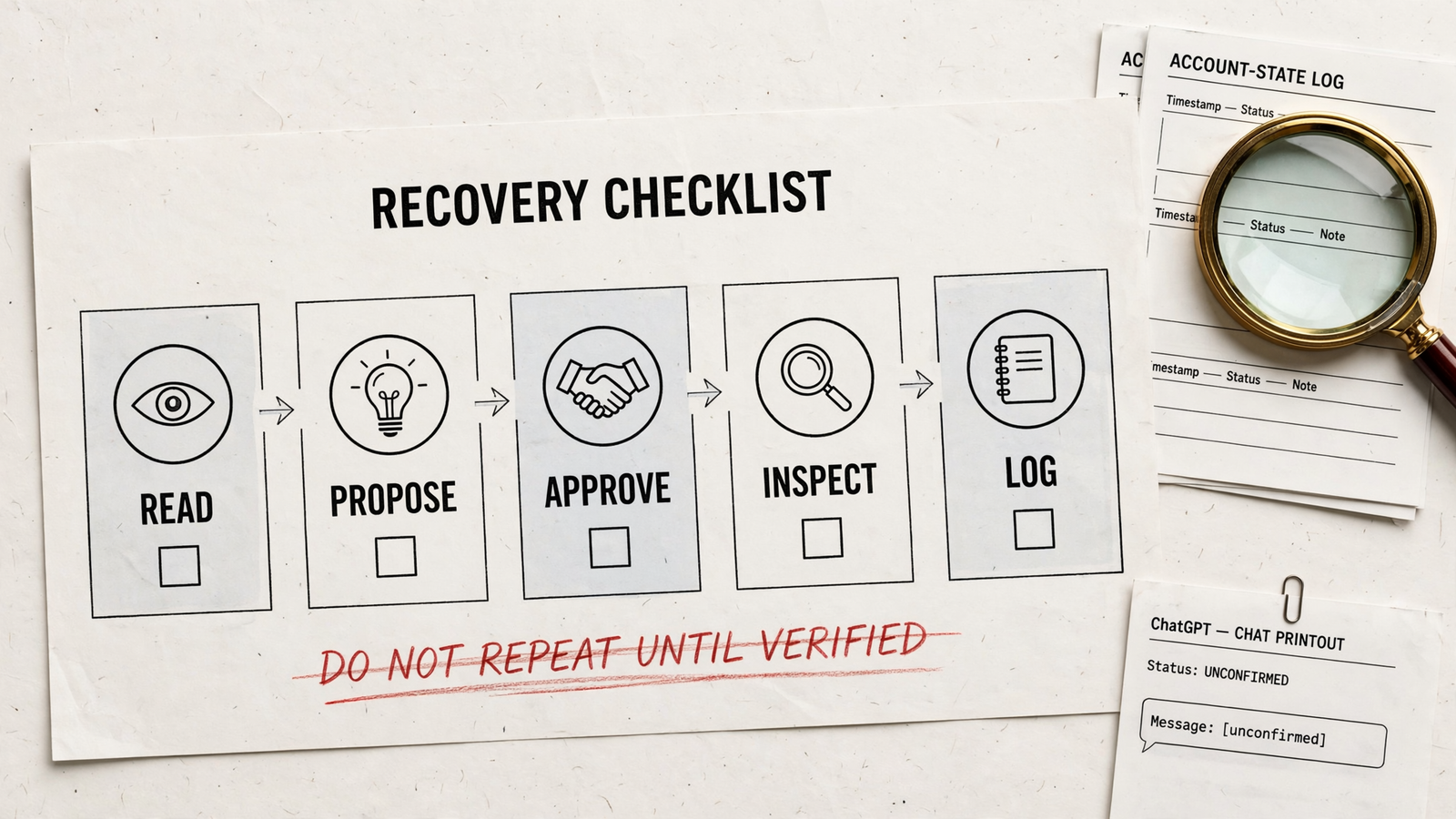
My buying rule is the same whether I’m looking at 150 tools or 1,000. If I can’t investigate an uncertain change, I keep the connector out of autopilot and scheduled runs. That doesn’t mean taking it out of the stack. It means not giving it permission to repeat a write while I sleep.
By November 2027, I expect the demos that win to be the ones that survive the interrupted request. Ask for the connection policy. Ask for the separate request outcomes. Ask to see the log after a change that didn’t confirm. The provider who can show me all three gets the account. The provider who answers with tool count doesn’t. Run the bounded workflow this week, and don’t widen it until “Did it happen?” has an answer you can point to.





