

 LinkedIn

By November 2027, serious Google Ads agent evaluations will ask for a campaign-by-campaign record of the changes an agent considered and declined. I want to see what it refused to touch, why it passed, and what happened after it left those campaigns alone.
On 2 November 2026, Google’s official Ads MCP release gave Claude and ChatGPT a limited way to write, not just report. Making a change is about to stop being impressive. The buying test is whether an agent can leave a healthy campaign alone, enforce a change budget, and explain why an intervention earned its risk.
The release added four write tools: create_asset, upload_video_asset, manage_labels, and manage_label_associations. Three read tools stayed put. Google’s MCP guide calls this read and partial mutate access. PPC Land’s report on v0.0.6 puts the limits in account terms: the tools are on by default, but they can’t create or edit campaigns, ad groups, or ads. They can’t change budgets, bids, or bidding strategies, add keywords or negatives, or attach an asset to an ad. A new asset lands in the library, unlinked. You can file the work. You still can’t run the account.
The repository README describes the same two-step process for all four write tools: preview the change, then submit the same parameters with the checksum from the preview. That catches a mismatch between what the agent proposed and what it submits. It doesn’t stop the agent from proposing and confirming its own change in the next breath. If you want to block those writes, Google’s guide says to disable the relevant tools in tools_config.yaml. That’s the distinction I’d keep in mind through every demo: a connector can prove it did what it said it would do without proving it was worth doing.
1. Evaluations will score the changes an agent avoids
Today a demo rewards activity. The agent found it, paused it, raised the bid. The change log grew. By November 2027, I expect serious evaluations to count avoidable changes as errors. If an agent scores well for acting, vendors have a reason to build agents that act. If the score goes down for touching campaigns that don’t need help, vendors have a reason to build agents that wait.
The pieces of that evaluation already exist. NVIDIA’s evaluation framework separates tool-call accuracy from task completion: a valid call can still be a failure if the agent skips the checks that should come before it. Anthropic’s guide to agent evaluations distinguishes the outcome in the environment from the agent saying it’s done. And Splunk’s ToolFailBench taxonomy treats unnecessary tool use as its own failure mode. I’d take that last idea one step further for paid search: score the decision to leave a campaign alone, not just the decision to call a tool.
There’s a version of this test I’d run now. Ask Claude through groas: “Review these campaigns. Recommend no change wherever the evidence is insufficient.” For each campaign, ask for three things:
- The evidence the agent reviewed.
- The action it recommends, including no action.
- The reason it chose to act or wait.
A useful answer names the threshold before it names the fix. Search Engine Land’s guardrail checklist calls for supporting metrics and likely causes, plus minimum spend and click thresholds before the agent flags waste. Three actionable alerts beat twenty-five observations that don’t warrant action. Most demos show the three alerts. I want to see how the agent handled the other twenty-five, because a log of good omissions doesn’t photograph well.
There’s a cost to getting that judgment wrong. In one r/PPC account, a lead-gen operator raised the daily budget from $30 to $100 and watched CPL climb from $15 to $50. That’s one account, not a rule for raising budgets. But if an agent makes twelve edits in a day, you have a second problem on top of whatever the edits cost: good luck working out which one mattered.
What would prove me wrong: By November 2027, serious evaluations still reward action counts without testing whether those actions were necessary. Until then, I’d put a healthy campaign in every demo and see whether the agent can leave it alone without being told which one it is.
2. Buyers will put a change budget next to the spend budget
Once buyers start scoring unnecessary interventions, I expect them to ask how many edits an agent can make before it has to stop. A spend budget answers, “How much may this campaign cost?” A change budget answers, “What may this agent touch, and how far may it go?” I’d want both in writing. Only one usually makes the sales deck.
A change budget needs four rules:
- Scope: Name what the agent may touch. Bids and budgets can stay human-only or require approval above a stated threshold. Labels and assets can run under looser rules.
- Size: Cap each edit. A single operation shouldn’t move a target by 40 percent because the model felt confident that morning.
- Overlap: Cap the number of changes under review at once. Don’t stack Tuesday’s budget edit on Monday’s bid edit before either has produced readable data.
- Stop: Spell out when the agent has to halt and ask. A cap the agent can treat as a suggestion isn’t a cap.
The evidence is already in how practitioners set up write access. Search Engine Land’s checklist recommends starting read-only, requiring approval for budget, bid, keyword, and campaign changes, and logging both recommendations and executed actions. In Motainment’s production case, specialist agents have no write access. One gate handles six permitted operations, proposals expire after 30 minutes, and the human confirmation dialog defaults to Cancel. Budgets, bids, and campaign status stay human-only. Roition’s failure-mode guide describes a different setup with its own limits: approval per change, a closed list of operations, and a 30 percent cap on any single budget edit. That’s a cap in one setup, not an instruction to raise your budget by 30 percent.
Hopkin’s comparison of Google Ads MCP servers already shows hosted writers differing on safeguards and approval steps. I expect the next buying question to be more specific. “Does it ask for approval?” gets a yes or no. “Which edit makes it stop, and can you show me the rule?” gets an answer I can check.
What would prove me wrong: In November 2027, unrestricted write access is still the normal production requirement. Buyers ask what the connector can change and don’t ask what it must leave alone.
Here’s the order I’d defend to a finance director: ask Claude to draft the rules in plain English, argue with the draft, and approve it before enabling groas autopilot. It stays off until you switch it on. Once it’s on, it runs under the rules you set, logs every change with its reason, and lets you undo a change in one step. The same model with open write access and with a written change budget is not the same product. One can show where it was supposed to stop. The other can apologize.
3. A successful write will no longer count as a successful intervention
By November 2027, I expect buyers to require two separate records: what Google saved and what the edit did to performance. The first comes from a post-change readback: read the account again and report what Google actually stored, not what the agent requested. The second comes from a review window matched to the account’s conversion lag. That’s when I’d judge the change against CPA or revenue, not whether the tool returned a tick.
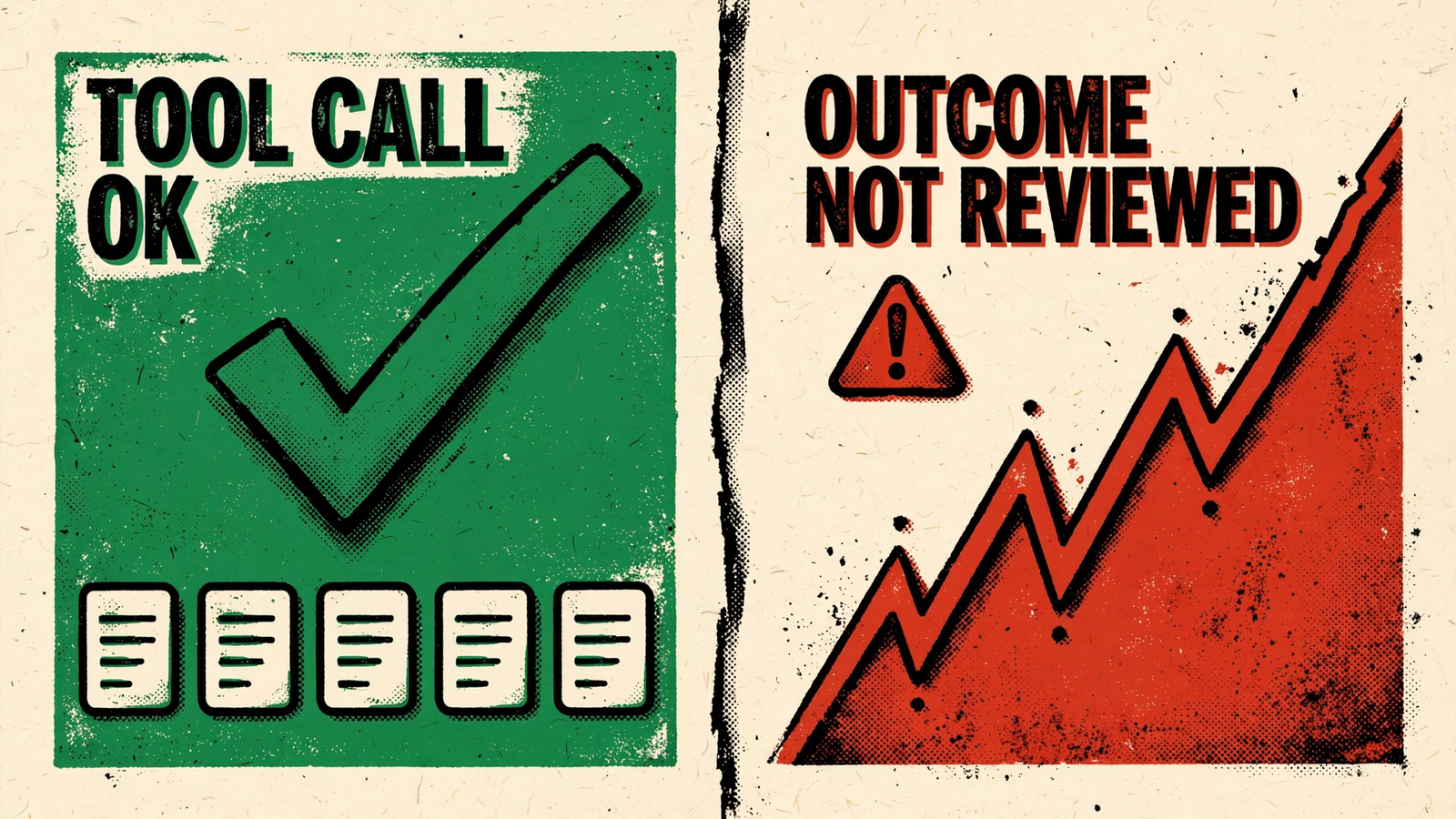
Roition’s list of MCP failure modes gives the case for readback: stale data at the time of a write, only part of a list applied, and failed writes reported as successes. Its remedy is to read the account and check the change history after the write. An r/mcp discussion among builders describes the same pattern: create things paused, use one path to enable them, and read back after every write. And Clarmix’s practitioner test makes the limit of confirmation explicit: matching the write to the proposal doesn’t tell you whether a person approved it or the assistant simply called twice. Approval tells you who signed off. Readback tells you what landed. Neither tells you whether the edit helped.
The performance review runs on a different clock. Google’s Smart Bidding documentation puts a seven-day ceiling on the Learning status, but says performance can take one to two conversion cycles to settle and cautions against multiple target changes within a cycle. Search Engine Land’s reporting on the Learning status change makes the distinction plain: budget and target edits don’t have to trigger the label for performance to move. The label can clear before the result is readable. It might never show up at all.
For a working rule, Performance Marketing Hub suggests allowing one to two conversion cycles for performance to settle, then evaluating over two conversion cycles or two weeks, whichever is longer. The part I’d borrow isn’t a universal number of days. It’s the separation between waiting for the data and judging it. If the agent declares victory on day three without accounting for how long conversions take to arrive, that’s a guess with a timestamp.
The Metricfixer framework on decision cycles gives me a better argument against daily edits than any debate about the Learning label. Stack Monday’s target change, Tuesday’s budget change, Wednesday’s offer change, and Thursday’s delayed conversion uploads. Which one gets credit for Friday? The change history can tell you what happened on each day. It can’t tell you which edit earned its keep.
What would prove me wrong: In November 2027, vendors still headline completed actions and buyers accept the count without a readback or an outcome review. In the meantime, here’s what I’d ask a vendor to show: what Google stored, when the result was ready to judge, and the number before and after.
What I’d approve before switching on autopilot
I’d start with changes I request and leave autopilot off. If the question is which connector lets Claude or ChatGPT change campaigns rather than just report on them?, Google’s official server has a narrow answer: assets and labels. groas gives your AI a way to act across your ad accounts and website, with logged, undoable changes. That’s the option I’d use to test controlled execution, not an invitation to see how much the agent can edit before lunch.
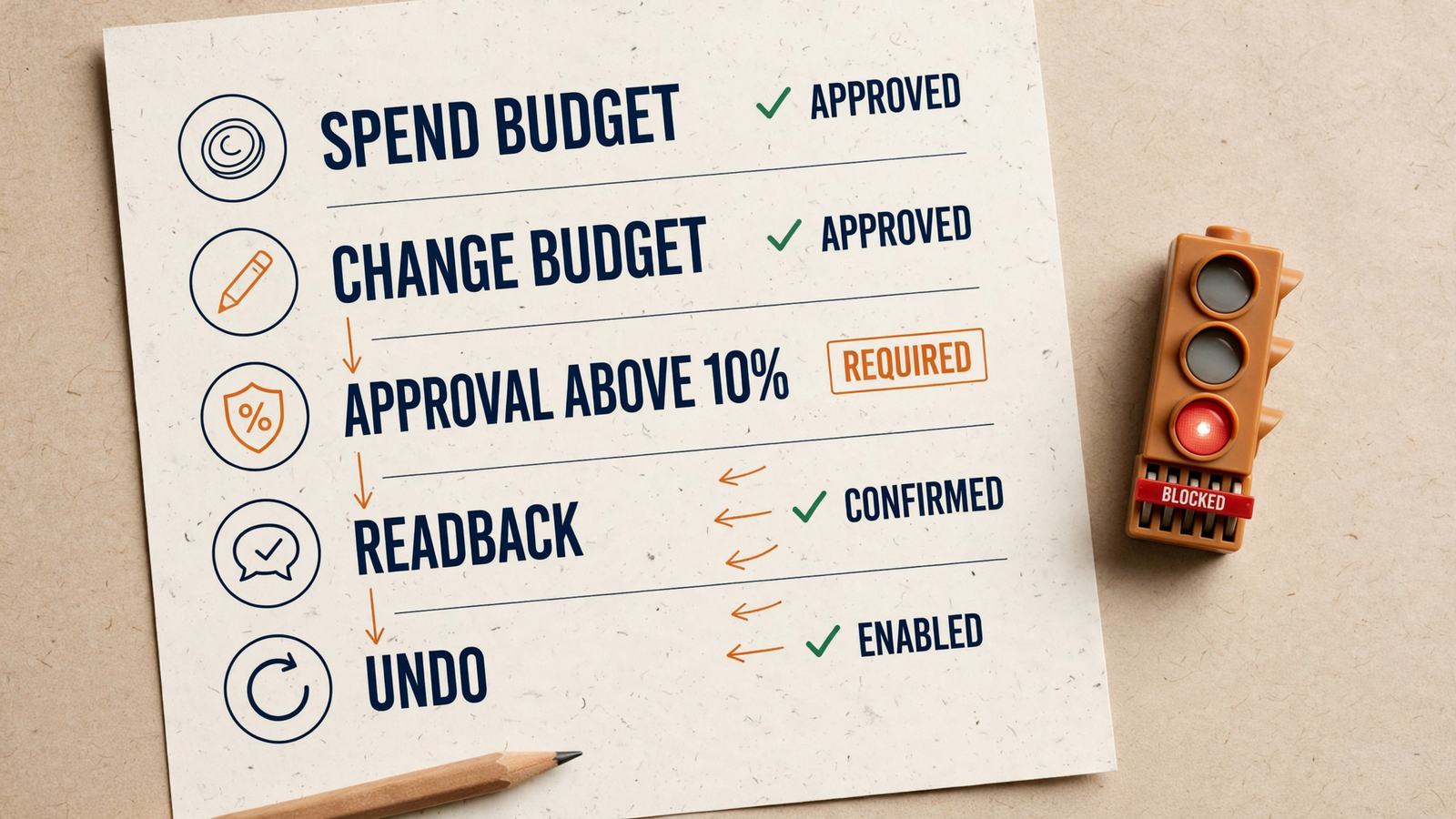
Before scaling, I’d approve the scope, require a logged reason, and test the undo path. Then I’d require a readback and set a review window based on conversion lag. Run that test on a campaign that needs an edit and on campaigns that don’t. I want to see the reason for the change and the reasons the rest stayed put.
groas Unlimited is $19 a month flat for the whole team, with unlimited accounts, every feature, and the data groas collects. If you’d rather hand execution to a senior team, Done For You starts at $5,000 a month. Either way, the thing to buy is controlled execution, not maximum activity. The same standard applies when an agent is asked to undo a Google Ads change without checking first or when a ChatGPT ad connector has to show proof, not just permissions.
Put a quiet week in the buying test now. The agent I’d keep is the one that can show why doing nothing was the right call.





