LinkedIn

One connection does not create one conversion
Your store reports 120 purchases and 480 quote requests. If Claude calls that 600 conversions and uses the total to tell you where to move your ad budget, the arithmetic is right and the recommendation has no business being made.
Say the store sells a $180 order. The quote form is for the same product line, but it serves customers who need a sales call before they buy. You connect Google Ads, Meta, and your analytics to Claude through groas and ask which channel gives you the cheapest conversion. I’d ask that too. I just wouldn’t start there.
A purchase is a paid order. A quote request is someone asking to talk. Divide spend by 600 and you get a tidy cost per conversion without learning how many enquiries qualified, what they were worth, or whether some of the people who filled out the form are already in your purchase count.
One connection unifies access, not measurement. An ad platform counts the event it was set up to count, within a particular window and under its own attribution rules. Google’s explanation of its conversion columns shows how much can sit behind one label: the main Conversions column covers primary actions, can include modeled conversions, and generally reports by the time of the ad interaction rather than the time of the conversion. One chat can put those figures side by side. It can’t make the definitions match.
Start with what each account actually counts
I want Claude to show its work before I ask for a ranking. Start with the connected reports: the accounts, the conversion actions, the periods, and the currencies. Then separate what the reports say from what the business can confirm. That distinction matters more than how complete the dashboard looks.
Ask Claude for an inventory, not a recommendation
Inventory our connected channels, conversion actions, reporting periods, and currencies. Do not change anything.
For each reported action, I want the inventory to answer three questions:
- What happened? Did the platform count a purchase, a quote request, a phone call, or something else?
- What earned credit? What window did it use, and can an ad view earn credit, or does the person have to click?
- How was it reported? What period, date basis, time zone, and currency does the figure use?
I’ve seen a Google Ads column quietly mix newsletter sign-ups with purchases. If you take the heading at face value, Claude can give you a perfectly accurate ranking of that column. It still hasn’t told you which campaign sold more.
In the store example, a platform-reported outcome is a purchase or quote request the platform credits to an ad under its own rules. A verified business outcome is what the store, CRM, or sales team can confirm: an order was paid or an enquiry became a qualified opportunity. One tells me what the platform claimed. The other tells me what happened in the business. Neither, on its own, tells me whether the person who requested a quote later placed one of those orders.
If the connected sources don’t show the attribution window, CRM status, or a way to match an enquiry to an order, I want Claude to say so. A missing definition is a finding, not a blank to fill in.
The same order can appear in two reports
Once I know what each platform counts, I can ask whether the counts overlap. This is a separate problem from mixing purchases and enquiries. Even if I pull nothing but purchases, I can still count the same order twice.
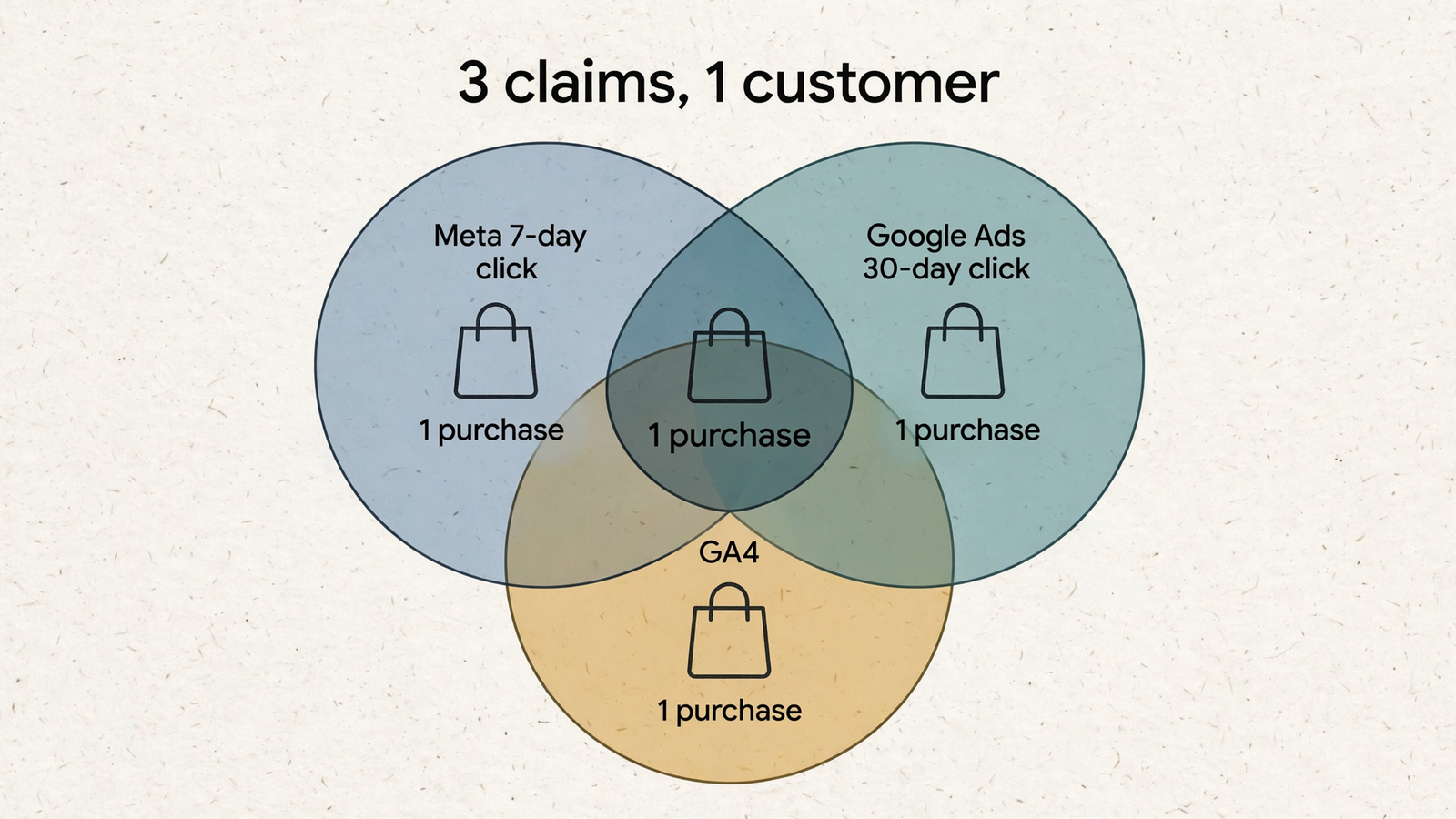
Say a customer clicks a Meta ad on Monday, clicks a Google ad on Wednesday, and buys on Friday. If the purchase falls within both platforms’ click windows, both can report it under their own rules. The store still shipped one order.
Ask Claude to map the overlap
Show which totals can overlap and which comparisons the available data cannot support.
I’m not asking Claude to reconstruct a customer journey from aggregate reports. I’m asking it to show where the reports might give credit for the same purchase. Which include views? Which count only clicks? Which use different windows? If I can’t answer those questions, “Meta beat Google last week” is a stronger claim than the reports support.
A worked cross-channel reporting example makes the problem concrete: Meta reports 140 purchases, Google reports 85, and the store records 112 orders. The platform sum is 225, but that isn’t a count of unique orders. Subtracting the store total doesn’t tell me how many orders both platforms claimed, either. Dates, definitions, and attribution windows can all contribute to the gap.
Back at our store, keeping the 480 enquiries out of the purchase total solves one problem. It does nothing to establish whether Google and Meta both claimed some of the 120 reported purchases. When the reports can overlap, keep the claims separate from the store’s order count.
A cheap enquiry is not a cheap order
Now suppose I’ve dealt with overlap. I still can’t rank purchase CPA and enquiry CPA as if both campaigns bought the same thing. One bought a paid order. The other bought a chance for the sales team to turn a conversation into one.
At a 40% margin, the $180 order leaves $72 before ad spend. For a quote request, suppose the sales team qualifies one in five and closes one in three of those qualified enquiries. I need those steps to estimate what a form fill is worth. The ad account can tell me what I paid for the form fill. It can’t supply the economics that come after it.
I used to tell clients that a cheaper conversion was a better conversion. I was wrong. If I tell Google that a phone call, a booked appointment, and a purchase all count toward the same goal, I shouldn’t be surprised when bidding favors the action it can get more cheaply. It’s following the instruction. The instruction is the problem.
If the connected reports don’t include margins, close rates, or CRM status, those questions come back to me. I need to know what share of enquiries qualifies and what a qualified opportunity is worth. I also need to decide whether I’m treating a returning customer’s order the same as a first order. Compare the same business outcome before comparing what it costs.
Ask Claude to build groups it can defend
Group campaigns by comparable business outcome. Keep unmatched goals separate and explain every exclusion.
Start with purchases against purchases and enquiries against enquiries. Keep phone calls separate if you can’t match them to either definition. Even within a group, check that the reports cover the same period on the same date basis. A lead created on November 3 after an October 28 click can appear in October in Google Ads and in November in the CRM. Aligning dates and windows matters because a shared month label doesn’t guarantee the reports include the same events.
I’ll take two or three comparisons I can defend over one chart with every campaign on it. And if two numbers still reflect different attribution rules, grouping them under “purchases” doesn’t fix that. I want that difference on the page, not hidden in the average.
A change in the report is a question, not a diagnosis
With the groups defined, I can ask what changed. This is where an AI audit can go from useful to confidently wrong in one paragraph. Claude can flag a drop in conversion rate, a rise in CPC, or a campaign that stopped spending on Tuesday. That doesn’t tell it whether a promotion ran, the sales team followed up slowly, or someone swapped the landing page.
I’ve had versions of this argument on client calls. The write-up is polished. The explanation has nothing to do with what happened. In ZATO’s account of a stakeholder-run Claudit, the audit flagged a CPC as too high. The team was paying it on purpose because those clicks converted at three times the rate. The number was real. The diagnosis was wrong.
For our store, say the cost per enquiry falls. I want Claude to separate the observation from the explanations. A change in the offer could affect what those cheaper enquiries are worth. A change in the conversion action could mean I’m comparing different events before and after. The report alone doesn’t establish that either happened.
Ask what changed, what might explain it, and what would distinguish the explanations. If the open question is lead quality, I want Claude to ask for CRM status, not write a paragraph about why Meta deserves more money.
Put limits on the recommendation before you put money behind it
Ask Claude for the next investigation or a bounded change
Within each comparable group, propose the next investigation or bounded budget change. State the evidence, missing context, and approval required.
The order matters. If I still don’t know whether the cheaper enquiries qualify, the next step is an investigation. If I have a defensible comparison within the purchase group, I can ask what a limited budget change would look like.
“Move 20% to Meta” tells me how much to move. It doesn’t tell me how long to run the test, what would make me stop, or what I’ll compare afterward. I’d rather see a proposal I can approve or reject as written:
- Cap and duration: Shift up to $500 a week from purchase campaign A to purchase campaign B for two weeks.
- Stop condition: Stop if purchase CPA in the comparable group rises above the threshold I approve.
- Review: Report the result against the baseline on the same purchase definition and reporting basis.
That’s where groas gives Claude a way to act on the account. In this workflow, Claude proposes the change within my rules and I approve it before it goes through. The change is logged with its reason and can be undone in one step. Autopilot stays off until I switch it on. I care about that because “Why did the budget move on Thursday?” should have a better answer than “The chat seemed pretty sure.”
When I inspect the result, I go back to the group and the baseline I used to approve the test. Did purchase CPA improve on the same definition, or did the report count orders under a different window? If the result doesn’t beat the baseline on the aligned measure, undo the change and record why. The approval and the review should use the same definition of success.
Run the model on a new offer: paid consultations
The store now adds a third offer: a booked appointment for a paid consultation. The owner asks whether appointments are now the cheapest conversion. I don’t need a new framework. I need to know what the new action counts.
First, I ask Claude to inventory the booking action and its attribution window. Does the report show that an appointment was booked, or that a consultation took place? Until I know which event it counts, I can’t even say what the appointment CPA buys.
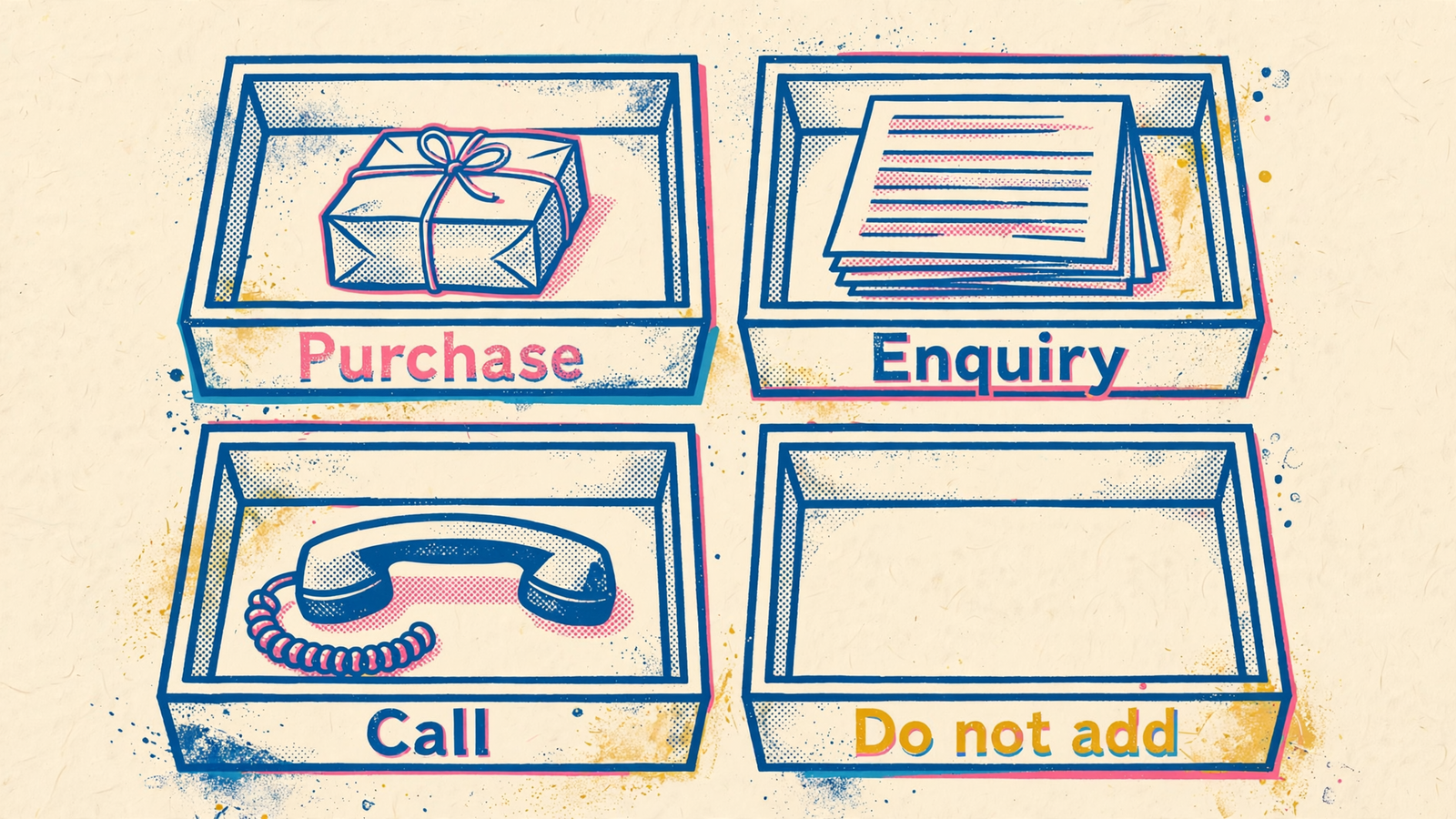
Next, I keep the appointment in its own group. An enquiry isn’t a booking; a booking isn’t a store order. If I want to compare the economics, I supply the consultation margin and show-up rate. If those are missing, Claude can tell me what I need to find out. It can’t get there by dividing spend by bookings and putting the result next to purchase CPA.
Only then would I ask for a bounded test inside the appointment group, with a cap, a stop condition, and a baseline that uses the same definition. The connection didn’t change. The outcome did. Claude can help me work out what a booking costs and what I need to know before funding more of them. It still doesn’t get to add the booking to a parcel and call the result a strategy.