

 LinkedIn

The worst thing I can do with a Google Ads audit before next season is fix everything in it. I want Claude to defend what it leaves alone against the coming offer, the conversion evidence, and the spending limit before I let it touch a live account.
I spent years clearing warning lists and treating a clean report as proof an account was ready to spend. It wasn’t. A warning tells me something about the account as it stands. A fix makes a claim about what will happen if I change it. A higher grade doesn’t prove that claim.
Start with what the grader can see. WordStream’s free grader grades ten metrics across four areas: wasted spend, Quality Score, impression share, and account activity. A clean report tells me about the checks the tool ran, not what its coverage leaves out. Google’s own Optimization Score moves when I apply a recommendation and when I dismiss one. I can reach 100% by dismissing recommendations. That’s a score for answering the suggestion box. It doesn’t tell me whether I can afford a higher CPA or which leads turn into paying customers.
The calendar makes the problem obvious. One r/PPC poster’s seasonal business returns 5–7x ROAS from October through March and 3–4x from April through September. A grader looking at the lull can flag a real drop. That still doesn’t make April the right basis for an October budget change. Act on it anyway and I can spend the opening weeks of the busy season undoing a fix for a problem that was just April.
Give Claude the offer before the account ID
I used to send the account ID first and the context later. That left the model to guess what the business wanted and rank its findings accordingly. Expand reach. Raise budgets. Fine tactics, if either is the job. A KPI dashboard and “we want to grow” don’t tell Claude what it’s allowed to trade away for another conversion.
The brief sets the boundaries. Before I ask for findings, I give Claude:
- The offer, the dates it runs, and the products or services it covers.
- The outcome I’m paying for: booked jobs, SQLs, or closed-won deals. Pick one.
- The margin constraints and the spending ceiling I won’t cross.
A practitioner who ran Claude on an $8,000-a-month account describes what happens when margins, seasonality, and the leads that actually close are missing: the recommendations sound plausible, but there’s no way to validate them. That’s not a copy problem. The model doesn’t have the information it needs to make the call.
My opening prompt is three clauses: Read this connected account through groas. Do not make changes. Evaluate findings against this brief. I want Claude to use live account numbers, keep the audit to inspection, and judge the findings against the coming season rather than a grader’s checklist.
For every finding, I ask for the account ID, the date range, and the metric behind the claim. A PPC practitioner who tested Claude and Codex on synthetic negative-keyword cases found the tools good at spotting things he’d missed and quick to crown winners on short-horizon ROAS, even with detailed business context. His protocol required the query, IDs, dates, evidence, proposed action, and a reason to withhold it. I want that last item on every finding. And if Claude can’t tell me when a number was measured, it’s an opinion wearing a decimal point.
Make the warning prove that acting beats waiting
I don’t sort findings by severity. I sort them by what I’d need to know before acting. Clique’s test for recommendations asks what a change does in plain English, whether it costs more or shows ads to more people, and what number would prove it worked by when. Here’s what I want Claude to answer before I approve anything:
- Evidence: What did the account actually show, and over which dates?
- Mechanism: What would the proposed change do, and why would that help this offer?
- Downside: What could it cost, or who else would see the ads?
- Disproof: What result would tell me the change didn’t work, and when could I read it?
If I approve the change first and go hunting for the metric second, I’m not auditing. I’m writing a defense of a decision I already made.
Measurement comes first. A checkout tag that counts a purchase twice can make a search term look cheaper than it is. A purchase credited to the wrong campaign can send the budget discussion in the wrong direction. I put those findings ahead of match types, bid targets, budgets, and copy. Mavix’s audit spreadsheet puts tracking first and stops the review when a critical tracking check fails. That’s the right order. No amount of bidding judgment recovers from a broken denominator.
Some findings don’t have an answer in the account. Whether a keyword’s CPA is acceptable depends on the margin behind the product. Whether April is weak depends on what April is supposed to do. Whether a high-cost search term failed depends on whether its conversions were tracked in the first place. Claude should write insufficient evidence, then name what’s missing. Sometimes I can supply it. Sometimes I have to wait. A bid strategy can spend about a week learning, an experiment can sit undecided for four to six weeks, and a small account may not have the volume to settle it at all. If I can’t read the result before the decision is due, I don’t pretend the test has already happened.
Give every warning one verdict: Fix, Defer, or Reject
Fix is a verdict, not permission. It means I have a verified problem that conflicts with the offer or breaks an approved boundary. A disapproved ad for a product I’m about to push belongs here. So does a keyword spending money on queries I know are outside the offer. Neither gets changed until I approve the precise edit.
Defer means the idea might hold up, but I’m missing evidence or haven’t waited long enough to read it. That’s where a match-type change that needs a full conversion cycle goes. It’s also where I put a budget shift based on two weeks of lull data. I give it a recheck date rather than letting “later” do the work.
Reject means the recommendation runs against the brief I’ve already approved. If wider reach doesn’t work at the margin I have, broad match expansion isn’t waiting for one more report. It’s out. I reopen it only if the constraint behind the decision changes.
| Verdict | Test | Example | Next move |
|---|---|---|---|
| Fix | Verified problem that threatens the offer or breaks a hard limit | Checkout tag counts purchases twice | Queue the correction for approval before launch |
| Defer | Plausible, but the evidence isn’t in | Broad-match query mix flagged on 14 days of lull data | Recheck after a full conversion cycle |
| Reject | Conflicts with the approved brief | Broader reach the offer’s margin can’t support | Log the conflict and leave it alone |
Before I sign off on those verdicts, I check what can change without my approval. Google’s auto-apply settings can adjust CPA and ROAS targets, add broad match keywords, expand to search partners, and switch bid strategies. The Ads API’s recommendation subscriptions can also apply recommendations such as lowering a ROAS target or raising a CPA target. I want to know which decisions I’ve already handed over. Rejecting a recommendation in the audit doesn’t help if the account is set to apply it anyway.
Approve the edit, not the summary
Once I have a Fix queue, I want to see exactly what Claude proposes to change: the keywords, ads, budgets, or settings, with IDs attached. Not “improve bidding.” I want “change the target CPA on campaign 4829173 from $45 to $52.” That’s what an approval line looks like, not a recommendation to raise that target. I read the preview the way I used to read a diff at 1 a.m.: line by line, with the option to reject one edit without throwing out the batch.
Every approved edit needs a reason in the log. That’s where groas earns its keep over a chat window with an Ads connection. It logs each change with its reasoning and lets me undo it in one step. Three weeks into October, “budget moved from Search to Shopping” tells me what happened. It doesn’t tell me why I signed off or whether the reason still holds. I’d rather have that answer in the log than reconstruct it for whoever signs the invoices.
I keep autopilot off after the audit. The review produces a short queue I approve by hand, not permission for the account to keep changing. If I later want groas to run parts of the account around the clock under rules I set, I make that decision separately. I start with what I chose not to change, not with the momentum of a clean report.
Write down what stays untouched
The page I want most from a pre-season audit is the one nobody writes: the non-change log. Every deferred or rejected finding gets a reason and a condition for reopening it. The difference matters six weeks later, when somebody asks why the warning is still orange. I want an answer that doesn’t depend on anyone remembering the meeting.
- Deferred: broad-match query mix on campaign X. The warning comes from lull data. Set a recheck date and read 30-day CPA against the target before deciding whether to act.
- Rejected: broad match expansion. The margin doesn’t support wider reach under the current offer. Reopen only if the brief changes that constraint.

The habit I had to unlearn was fixing the report instead of the account. The score climbs, the deck gets a green tick, and the reason performance is off sits exactly where it was. A practitioner who audits accounts spending $10,000 a month and up points to muddled conversion data and messy account structure as recurring problems. Those are worth investigating. Clearing warnings layered on top of them is theater.
The action log covers what changed. I have to write the other half: what stayed put and what would make me reconsider. I want both alongside a plain statement of what the audit couldn’t establish. The companion piece on dissecting a grader’s claims with Claude covers how to make each warning show its evidence and name what would disprove it. This is what I do with the answers.
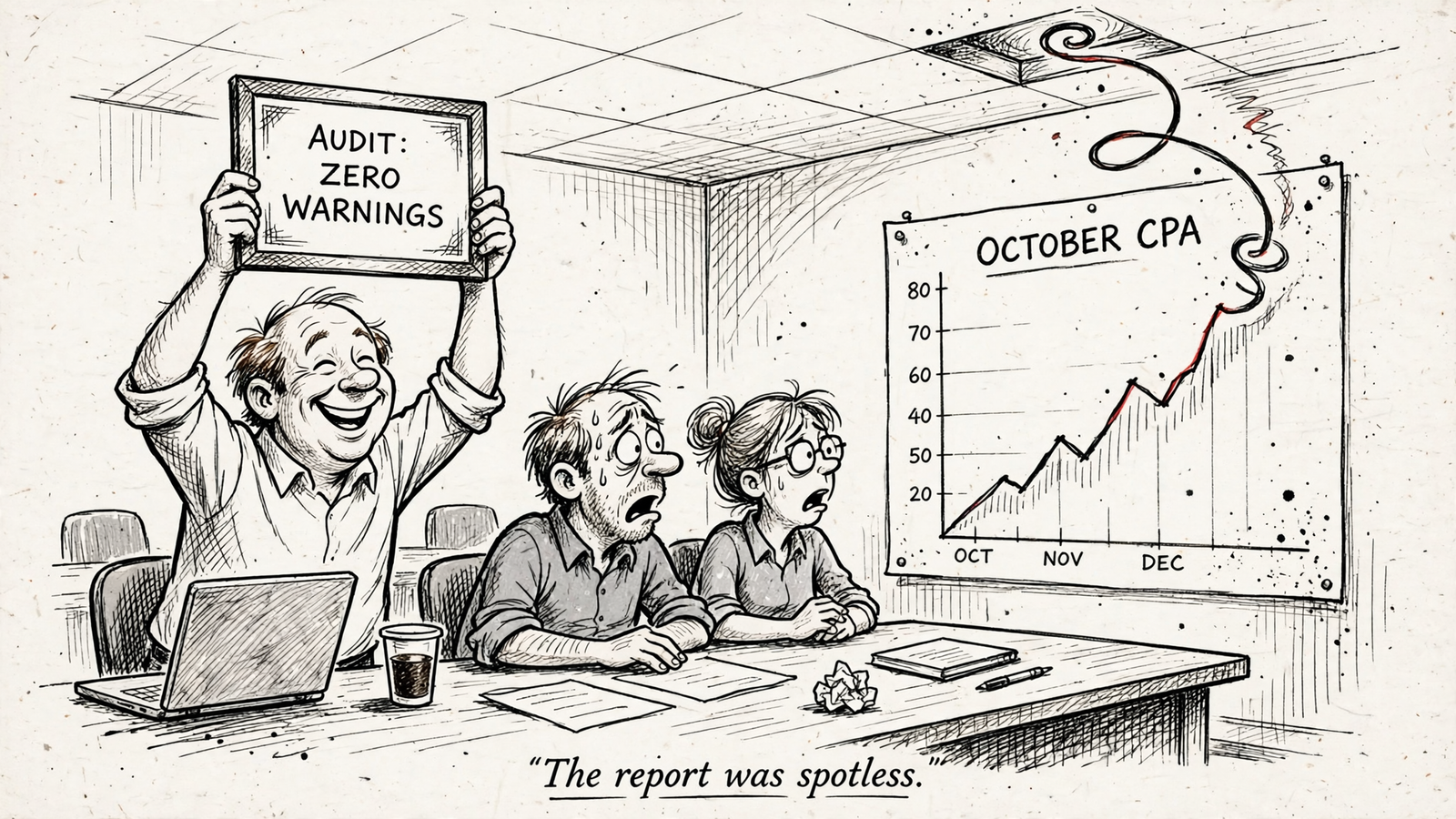
Leaving warnings orange through launch week feels irresponsible. Clearing all of them feels better right up until October, when the account has to absorb changes I couldn’t justify in April. Then I’m doing the correction in the weeks that pay for the year. If the deliverable has no page for what I chose to leave alone, it isn’t an audit. It’s a to-do list with a score on top.





