

 LinkedIn
This three-row Google Search Console export shows search demand, not proof that ChatGPT recommended a brand. I chose it because it is exactly the kind of evidence a first-time buyer might bring to an AI visibility dashboard demo: familiar metrics wrapped around AI-sounding queries.
The whole document fits in a table:
| Query | Impressions | Clicks | Average position |
|---|---|---|---|
| “ai overview tool” | 227 | 0 | 18.3 |
| A visibility-package question | 210 | 3 | 7.3 |
| “ai visibility dashboard” | 71 | 1 | 14.6 |
Read quickly, those rows look like evidence of an AI search presence. Read properly, they show a page surfacing in Google Search for AI-related words. The subject of a query does not tell me where the result appeared or what an assistant said. That vocabulary overlap is the trap.
One assistant can hold SEO data and AI-answer evidence at once. It should not add them together, average them, or let one stand in for the other. I’ll take this export apart in the order a reader encounters it, then identify the evidence it cannot supply.
Before the rows: keep the metric definitions attached
Before interpreting anything, I give the assistant one procedural instruction: preserve the source, date range, and metric definitions alongside the rows. Exports travel. Their context usually does not.
An assistant that starts interpreting before it knows whether “impressions” covers 28 days or 16 months can produce very confident nonsense. The numbers have not changed. The story has.
These are the four columns I need to keep straight:
- Query: the search term associated with the page appearing in results.
- Impressions: recorded appearances of a link to the site in Google Search, under Google’s counting rules.
- Clicks: clicks from the search result to the site.
- Average position: the topmost position occupied by a link to the site, averaged across impressions. Google describes position as “a relative ranking of where a link was seen,” not a quality score.
Two limitations matter before I reach row one. These are aggregates of past exposures, not reproducible rankings. Searching the same query later may not reproduce the result because results vary by time, place, device, and history.
The export is also a visible slice of demand, not a complete inventory. Google omits anonymized queries from the query table while including their data in chart totals. Missing rows can matter when judging the wider topic.
My rule: keep the provenance attached before asking the assistant for an interpretation. A clean table without its context is just easier to misread.
Row one: 227 impressions do not establish AI Overview presence
The first row reads like a win if I want it to: “ai overview tool,” 227 impressions, zero clicks, average position 18.3. The word overview starts doing unpaid marketing work before I have even reached the numbers.
The verdict is narrower: this row records Google Search exposure for an AI-related query. It does not identify an AI citation.
Start with position. An average of 18.3 summarizes the topmost link’s position across the recorded impressions. It is not a fixed slot I can visit, and it does not tell me exactly what each searcher saw. Zero clicks tells me that none of those recorded impressions produced a click to the site. It does not tell me why.
That distinction matters because the tempting explanation arrives fully dressed: people searched for an AI Overview tool, saw the brand in an AI Overview, and did not need to click. The row supports the first part only as a query description. It supplies no answer text to support the rest.
Here is the split I would ask Claude to preserve:
| What the row records | What the row does not establish |
|---|---|
| The query “ai overview tool” | Whether an AI Overview appeared |
| 227 impressions | Whether an AI answer named the brand |
| Zero clicks | Why nobody clicked |
| Average position 18.3 | Whether an assistant cited or recommended the brand |
Even “227 people searched” would go beyond the row. Impressions are not a count of distinct people. The distinction is small on the page and important in the sales pitch.
The useful finding survives without embellishment: the page surfaced for a phrase related to AI Overview tools. That is a demand signal worth examining. I would keep it in the SEO evidence table and refuse to relabel it as AI-answer presence.
Row two: 210 impressions and three clicks show demand, not share of voice
The second row is a visibility-package question: wording that asks for one thing covering SEO and AI visibility. It records 210 impressions, three clicks, and average position 7.3.
This is the row I would spend the most time on because it contains a commercially useful observation. People search for a combined package. The query reveals interest in the offer; the metrics do not reveal the brand’s share of AI answers. No arithmetic on these columns will produce that missing measure.
Position 7.3 puts the average topmost result roughly around seventh. Three clicks from 210 impressions is about 1.4%. A quick diagnosis might be bad title tag. That is a proposal, not a finding.
There are other explanations. Practitioners describe cases where strong average position accompanies weak click-through because searchers read an AI Overview and stop. That possibility is worth investigating. It is not something this row proves.
At least three explanations fit the same numbers:
- The searcher read an AI answer and left.
- The searcher preferred another result.
- The searcher refined the query instead of clicking.
The irony is useful: the query asks about AI visibility, and an AI answer might help explain the click shortfall, but the export cannot settle that question. I do not get to promote a plausible mechanism into an observed event because it makes the article tidier.
What survives is a practical content observation. The export contains a query about a combined SEO and AI visibility package. A page addressing that need is therefore a possible content opportunity.
Those are two different statements:
- Observed: the query appeared in the export with 210 impressions and three clicks.
- Inferred: a visibility-package page might be worth building or improving.
I would ask the assistant to label them that way. Observations point back to the row. Proposals explain the judgment connecting the row to an action. “We should make this page” can be a sensible recommendation without pretending it arrived inside the CSV.
Keep the commercial signal. Do not turn it into share of voice.
Row three: the category name is not evidence that the category works
The final row names the product category itself: “ai visibility dashboard.” It has 71 impressions, one click, and average position 14.6.
This is the easiest row to overclaim because the phrase sounds like the outcome being measured. It is not. A search for “AI visibility dashboard” measures neither dashboard effectiveness nor the brand’s presence in ChatGPT.
Position 14.6 summarizes the topmost link’s average position across those impressions. One click is one recorded visit from the search results. It deserves to stay in the table, not become a story about a buyer’s intentions.
The row is also small enough that I would resist building a confident content strategy around it alone. The wider category may include anonymized queries missing from this export. That does not make the 71 impressions wrong; it makes the table incomplete as a picture of category demand.
Nor would I try to validate it by typing the phrase into Google during a demo. A live search is a different observation, not a replay of the export. As Google’s Performance report documentation explains, I may not see the site at all when I repeat a query.
A vendor pointing at a live result has shown me that result at that moment. The historical row and the demonstration still do not tell me what ChatGPT said.
The category name is the trap, so I want the distinction written plainly in the assistant’s instructions:
Do not turn related vocabulary into a citation claim. Ranking for AI visibility terms is not evidence of appearing in AI answers.
That rule does not make the query useless. It keeps the useful part intact. The row shows the page surfacing for a relevant search phrase. It can help identify a topic worth investigating. It cannot establish that an assistant mentioned, cited, or recommended the brand.
I would keep the one click as a number. It has enough work to do without a fictional buyer journey attached.
Where the export ends: ask for actual answer records
The three rows have now given me everything they can. More interpretation will not turn them into answer text. The missing evidence requires a different record, not a more imaginative reading of the same table.
For every AI-visibility finding, I would ask a connected assistant for:
- The tracked prompt.
- The assistant that answered.
- The observation date.
- The answer text and any URLs it cited.
Plugged into Claude through groas, that request runs against captured AI answers and market data collected around the clock, rather than the model’s memory of what ChatGPT might once have said. That is the useful connection: the assistant gets data it cannot conjure from a CSV, and the CSV stays what it is.
I would then separate three terms that dashboards too often squeeze into one:
| Signal | What I am checking |
|---|---|
| Mention | Does the brand name appear in the answer text? |
| Citation | Does the answer link a URL as support? |
| Recommendation | Does the answer tell the reader what to buy? |
One answer can name a company, cite its product documentation, and recommend a competitor in the same breath. Those are three valid observations answering three different questions. Tools that score them differently can report different numbers for the same answer.
The distinction is not pedantry. A brand mention answers “was I named?” A recommendation answers a much more commercially interesting question. Counting them as interchangeable makes the dashboard simpler by making the evidence worse.
I have covered the two pipelines behind AI answers elsewhere. For this teardown, the requirement is simpler: show the answer record and label what happened in it. Do not ask the buyer to infer a recommendation from a citation, or either one from a Google impression.
The verdict: one connection, two evidence tables
Here is the instruction I would paste into Claude after connecting groas:
Show SEO demand beside AI-answer evidence. Link related topics, but do not equate impressions with citations or infer causation.
The first sentence asks for the layout I actually need:
- Demand table: queries, impressions, clicks, and average position from Search Console, with the source and date range attached.
- Answer table: prompt, assistant, observation date, answer text, and cited URLs.
The second sentence stops those tables collapsing into one score merely because both contain the letters AI.
Then I would give the assistant one task:
Propose one page improvement grounded in both sources, and show which source supports each part.
Not a content calendar. Not a strategy deck. One page, one change, with the demand row that justifies the topic and the answer records that justify the angle.
I would review it before publishing and apply the same test I would use on a freelancer’s pitch: does the evidence actually connect, or has the model found two adjacent facts and drawn a line between them?
That is where one assistant becomes useful without turning two evidence classes into one metric. It can bring the records together, expose the reasoning, and propose an action. It should leave me able to inspect every step.
With groas, the assistant can measure what happens after a change and publish under rules I set. It cannot guarantee a recommendation or a citation. A vendor promising either is selling the slide-deck version of these three rows.
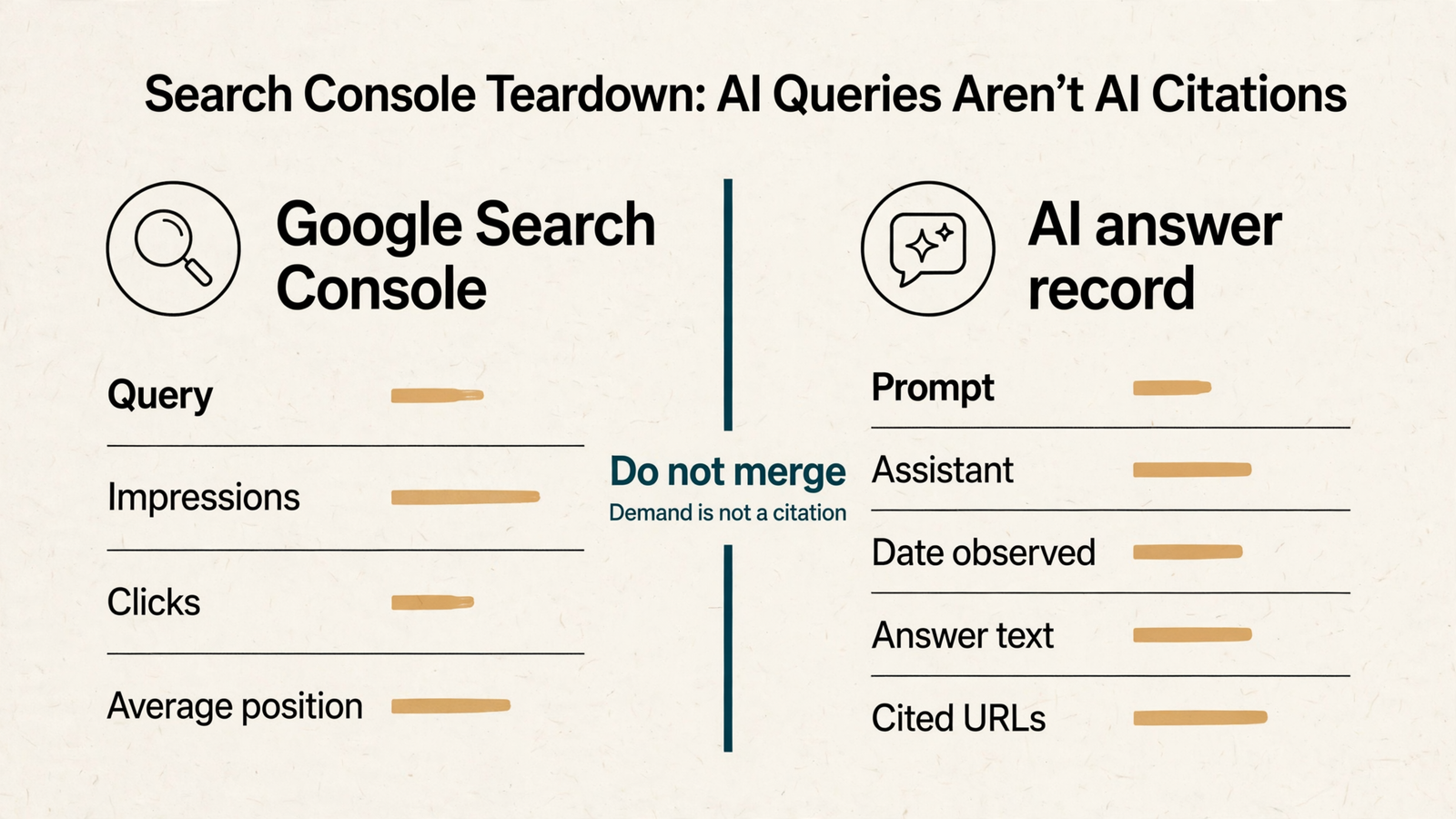
What would I keep from this artefact? All three rows, filed under demand, with their date range and metric definitions attached. The 227 impressions stay. The three clicks stay. The single click on “ai visibility dashboard” stays a number, not a story.
What gets cut is every conclusion the export invites but cannot support: that 227 impressions establish AI Overview presence, that position 7.3 measures share of voice, or that one click proves a buyer wanted this brand’s product. The artefact is honest. The overreading is not.
I have spent enough time in advertising accounts to distrust vocabulary doing the work of evidence. This is the same problem in a cleaner font. The word “AI” in a query is not an AI citation.
If a vendor shows me one blended visibility score, I ask for the two evidence tables underneath it: Search Console rows and answer records with prompt, assistant, date, and cited URLs. If the tool cannot show how those records support the score, I am not buying a clearer view of performance. I am paying for a slide.


